


🔐 Secure Payment Guaranteed
Safe checkout with trusted global payment methods.
🌟 Why Choose Infinity Market Research?
At Infinity Market Research, we dont just deliver data — we deliver clarity, confidence, and competitive edge.
In a world driven by insights, we help businesses unlock the infinite potential of informed decisions.
Here why global brands, startups, and decision-makers choose us:
Industry-Centric Expertise
With deep domain knowledge across sectors — from healthcare and technology to manufacturing and consumer goods — our team delivers insights that matter.
Custom Research, Not Cookie-Cutter Reports
Every business is unique, and so are its challenges. Thats why we tailor our research to your specific goals, offering solutions that are actionable, relevant, and reliable.
Data You Can Trust
Our research methodology is rigorous, transparent, and validated at every step. We believe in delivering not just numbers, but numbers that drive real impact.
Client-Centric Approach
Your success is our priority. From first contact to final delivery, our team is responsive, collaborative, and committed to your goals — because you re more than a client; you re a partner.
Recent Reports
Diaphragm Pressure Sensor Market
Wideband Sensor Market

Global 5G Mobile Baseband Chip Market Size, Share and Analysis Report 2026-2032
Apr 2026
Semiconductor and Electronics
Pages: 92
ILR4904
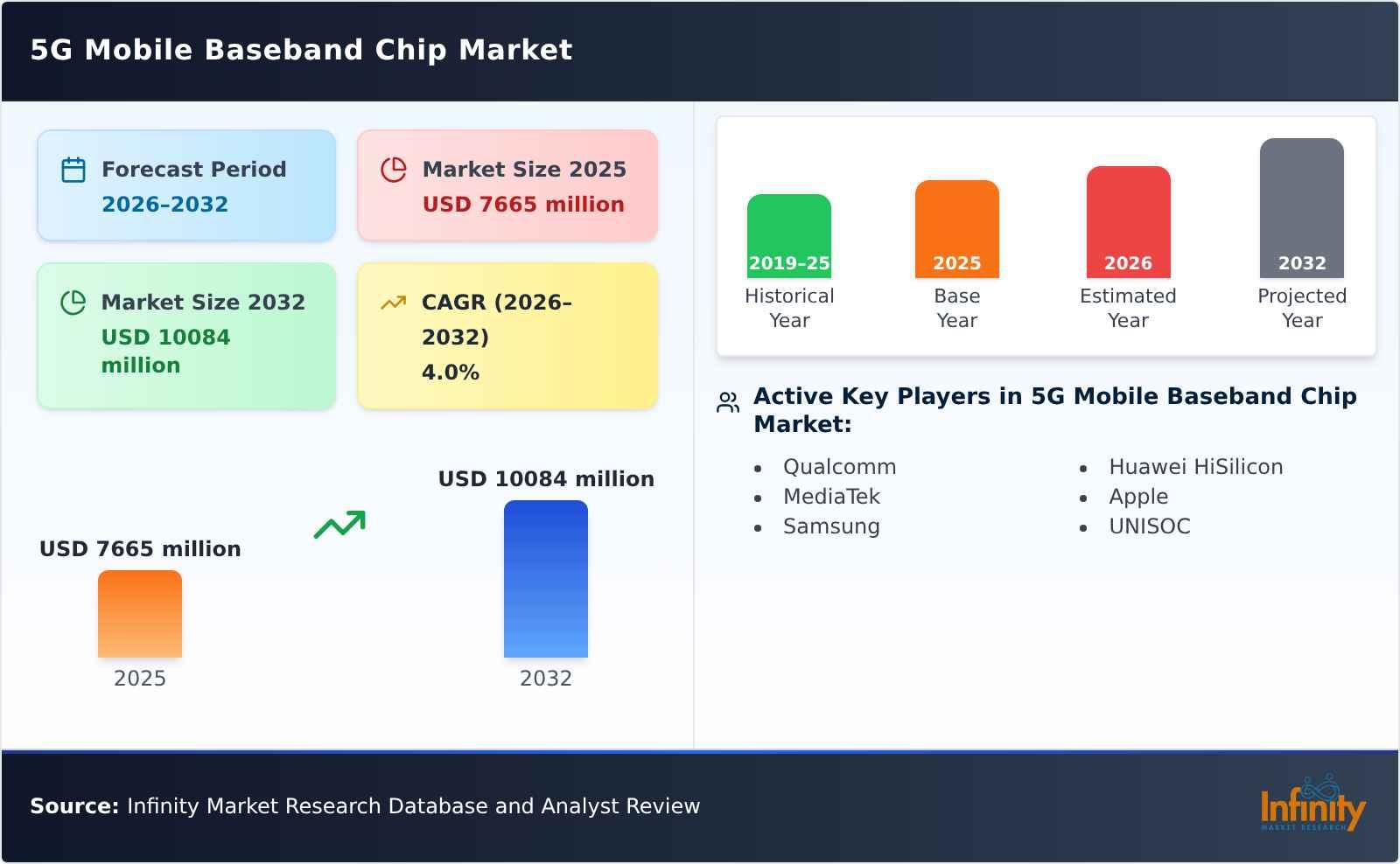
The global 5G Mobile Baseband Chip market size is predicted to grow from US$ 7665 million in 2025 to US$ 10084 million in 2032; it is expected to grow at a CAGR of 4.0% from 2026 to 2032.
Explore this report in detail? Download a free sample copy
Download Free Sample Report
A 5G Mobile Baseband Chip is the core semiconductor device in a smartphone responsible for enabling 5G cellular communication. It typically integrates digital baseband processing for the 5G NR air interface, cellular protocol stack processing, and control functions that coordinate with the RF transceiver, addressing the challenge of achieving stable, high-speed connectivity across cells, frequency bands, and radio access technologies in mobile scenarios. Through this capability, smartphones can complete essential communication procedures such as network access, authentication, resource scheduling, handover, and the carriage of voice and data services, while maintaining connection continuity and usable performance under complex wireless conditions including weak signal coverage, network congestion, and high-mobility environments. The product has evolved historically from predominantly standalone basebands in the 2G/3G era, focused on voice and low-rate data services, to the 4G era emphasizing mobile broadband throughput and more mature multi-band and multi-mode support, and further into the 5G era with the introduction of wider bandwidths, more complex carrier aggregation, massive MIMO, lower latency, and stronger uplink performance. In terms of product architecture, this evolution has led to the parallel development of standalone basebands and integrated basebands embedded within SoCs: the former facilitates rapid iteration of communication generations and high-end differentiation, while the latter has become the mainstream approach by optimizing power consumption, cost, and form factor through system-level integration. The upstream supply chain spans both raw materials and electronic manufacturing: on the materials side it includes high-purity silicon, lithography and process chemicals (such as photoresists, specialty gases, and wet chemicals), interconnect metals and dielectric materials, as well as packaging inputs such as substrates, resins, solder materials, and thermal dissipation materials; on the component and manufacturing services side it includes chip design and IP (baseband algorithms, DSP and protocol-stack-related IP), advanced wafer fabrication, assembly and test services, and key companion components and modules that work in conjunction with the baseband, including RF transceivers and RF front-end components (filters, power amplifiers, switches/tuners, and antenna matching networks), as well as power management, clocking devices, and memory, collectively supporting stable operation and mass production of 5G smartphones across multiple frequency bands and operator networks worldwide.
In 2025, global production capacity for smartphone 5G baseband chips reached 1.0 billion units, with shipments totaling 724 million units. The average selling price was USD 10.82 per unit, and corporate gross margins ranged between 50% and 70%.
The market today is broadly defined by relatively high concentration, intensified system-level competition, and a growing need for supply-chain orchestration. Leading vendors maintain defensible positions through deep IP portfolios, rapid R&D cadence, carrier certification know-how, and long-running relationships with handset OEMs. Competitive differentiation has shifted from headline specifications to end-device experience and engineering execution?stability in weak and congested networks, uplink consistency, latency and jitter control, handover and recovery behavior, and the shape of power and thermal performance across real usage patterns. Because spectrum is fragmented and radio configurations vary widely by region and operator, modem-centric solutions increasingly require joint optimization with RF front-end parts, antenna design, board layout, system software, and operator parameters. This expands validation scope, lengthens integration cycles, and raises the bar for platform-scale tooling and repeatable mass-production readiness. On the OEM side, multi-sourcing strategies and vertical integration efforts are progressing in parallel: brands want both supply and pricing leverage and differentiated user experience, but achieving either typically increases organizational and engineering complexity.
Future development will center on smarter connectivity policy, tighter system coordination, and broader convergence of connectivity features. Rather than focusing solely on peak throughput, evolution will emphasize availability and consistency of experience?more granular decision-making across bands and modes, adaptive trade-offs among throughput, latency, and energy under changing coverage and load, and deeper use of AI/ML for link management, congestion behavior, weak-signal scheduling, and application-aware QoS. Product architectures will continue to favor deeper integration for power, thermal, and footprint optimization, while certain premium or specialized scenarios may still benefit from more modular approaches that enable faster iteration or flexible radio configurations. At the ecosystem level, cellular connectivity is expected to integrate more tightly with positioning, satellite fallback, cross-device continuity, and coordination with vehicles and wearables, encouraging unified management across cellular and short-range radios and more software-defined capabilities. In parallel, validation frameworks and test automation will become more standardized to reduce the marginal cost of multi-region, multi-operator adaptation and to accelerate stable mass deployment.
Drivers and constraints are tightly intertwined. Momentum comes from persistent user expectations for more reliable coverage, longer battery life, and lower latency, along with application-side demand growth for strong uplink and real-time responsiveness. Ongoing operator network evolution and spectrum changes continually open new optimization opportunities, pulling both devices and silicon into faster iteration cycles. At the same time, OEMs? pursuit of reduced dependency, stronger bargaining power, and differentiated platforms encourages multi-vendor strategies and in-house development, increasing investment in engineering and tooling. Countervailing forces remain substantial: IP and licensing structures raise barriers to entry and introduce economic uncertainty; regulatory compliance and carrier acceptance testing across regions are resource-intensive and can extend schedules; and the rising complexity of RF front ends and antenna systems means silicon capability alone does not guarantee real-world experience?component variability, process drift, or thermal constraints can materially affect outcomes. Added geopolitical and advanced-manufacturing volatility further complicates access to leading processes, capacity, and critical materials, forcing repeated trade-offs among performance, cost, supply assurance, and compliance. Over time, the winners tend to be those who can industrialize repeatable end-to-end execution across IP, ecosystem, manufacturing, validation, and mass production?not just those with standout silicon in isolation.
Infinity Market Research newest research report, the ?5G Mobile Baseband Chip Industry Forecast? looks at past sales and reviews total world 5G Mobile Baseband Chip sales in 2025, providing a comprehensive analysis by region and market sector of projected 5G Mobile Baseband Chip sales for 2026 through 2032. With 5G Mobile Baseband Chip sales broken down by region, market sector and sub-sector, this report provides a detailed analysis in US$ millions of the world 5G Mobile Baseband Chip industry.
This Insight Report provides a comprehensive analysis of the global 5G Mobile Baseband Chip landscape and highlights key trends related to product segmentation, company formation, revenue, and market share, latest development, and M&A activity. This report also analyzes the strategies of leading global companies with a focus on 5G Mobile Baseband Chip portfolios and capabilities, market entry strategies, market positions, and geographic footprints, to better understand these firms? unique position in an accelerating global 5G Mobile Baseband Chip market.
This Insight Report evaluates the key market trends, drivers, and affecting factors shaping the global outlook for 5G Mobile Baseband Chip and breaks down the forecast by Type, by Application, geography, and market size to highlight emerging pockets of opportunity. With a transparent methodology based on hundreds of bottom-up qualitative and quantitative market inputs, this study forecast offers a highly nuanced view of the current state and future trajectory in the global 5G Mobile Baseband Chip.
This report presents a comprehensive overview, market shares, and growth opportunities of 5G Mobile Baseband Chip market by product type, application, key manufacturers and key regions and countries.
Segmentation by Type:
5G NR Sub-6 Modem
5G NR mmWave Modem
Segmentation by Modem Architecture:
Discrete Modem
SoC-Integrated Modem
Segmentation by Performance:
Entry-Level
Mainstream
Flagship-Level
Segmentation by Application:
IOS System Mobile Phone
Android Mobile Phone
HarmonyOS Mobile Phone
Others
This report also splits the market by region:
Americas
United States
Canada
Mexico
Brazil
APAC
China
Japan
Korea
Southeast Asia
India
Australia
Europe
Germany
France
UK
Italy
Russia
Middle East & Africa
Egypt
South Africa
Israel
Turkey
GCC Countries
The below companies that are profiled have been selected based on inputs gathered from primary experts and analysing the companys coverage, product portfolio, its market penetration.
Qualcomm
MediaTek
Samsung
Huawei HiSilicon
Apple
UNISOC
Key Questions Addressed in this Report
What is the 10-year outlook for the global 5G Mobile Baseband Chip market?
What factors are driving 5G Mobile Baseband Chip market growth, globally and by region?
Which technologies are poised for the fastest growth by market and region?
How do 5G Mobile Baseband Chip market opportunities vary by end market size?
How does 5G Mobile Baseband Chip break out by Type, by Application?
5G Mobile Baseband Chip Market Scope
| Report Attribute | Details |
|---|---|
| Market Size (Start Year) | USD XX Million |
| Market Size (End Year) | USD XX Million |
| Compound Annual Growth Rate (CAGR) | USD XX Million |
| Forecast Period | USD XX Million |
| Base Year | USD XX Million |
| Historical Data | USD XX Million |
| Key Players | USD XX Million |
REPORT COVERAGE
Revenue forecast, Company Analysis, Industry landscape, Growth factors, and Trends
SEGMENT COVERED
By component, deployment, organization size, application, and industry.
REGIONAL SCOPE
North America, Europe, Asia Pacific, Middle East & Africa, South & Central America
COUNTRY SCOPE
Includes key countries across all major regions.
📘 Frequently Asked Questions
1. What is the market size of Global 5G Mobile Baseband Chip Market?
Answer: The global 5G Mobile Baseband Chip market size is predicted to grow from US$ 7665 million in 2025 to US$ 10084 million in 2032; it is expected to grow at a CAGR of 4.0% from 2026 to 2032.
2. Which regions are analyzed in the Global 5G Mobile Baseband Chip Market report?
Answer: The Global 5G Mobile Baseband Chip Market report covers major regions such as Europe, Middle East & Africa. Each region is analyzed for trends, opportunities, and market dynamics.
3. What methodology is used for forecasting of Global 5G Mobile Baseband Chip Market?
Answer: The Global 5G Mobile Baseband Chip Market report uses a mix of primary research, secondary data, and expert analysis to build its forecasts. Models include both qualitative and quantitative approaches.
4. Are emerging markets analyzed separately in the Global 5G Mobile Baseband Chip Market?
Answer: Yes, the Global 5G Mobile Baseband Chip Market report highlights high-growth emerging regions with dedicated insights. These include untapped opportunities, risks, and potential for expansion.
5. Does the report include competitive benchmarking of Global 5G Mobile Baseband Chip Market?
Answer: Yes, Global 5G Mobile Baseband Chip Market report compares major players based on revenue, product portfolio, innovation, and regional presence. This helps assess competitive positioning.
6. Can I access country-level data within the Global 5G Mobile Baseband Chip Market report?
Answer: Yes, Global 5G Mobile Baseband Chip Market report includes detailed data by country, especially for key markets. This allows for localized insights and decision-making.
7. Can I get customized insights or data from the Global 5G Mobile Baseband Chip Market report?
Answer: Yes, we offer customization options to align with your specific business needs. You can request tailored sections or regional breakdowns.

🔐 Secure Payment Guaranteed
Safe checkout with trusted global payment methods.
🌟 Why Choose Infinity Market Research?
At Infinity Market Research, we dont just deliver data — we deliver clarity, confidence, and competitive edge.
In a world driven by insights, we help businesses unlock the infinite potential of informed decisions.
Here why global brands, startups, and decision-makers choose us:
Industry-Centric Expertise
With deep domain knowledge across sectors — from healthcare and technology to manufacturing and consumer goods — our team delivers insights that matter.
Custom Research, Not Cookie-Cutter Reports
Every business is unique, and so are its challenges. Thats why we tailor our research to your specific goals, offering solutions that are actionable, relevant, and reliable.
Data You Can Trust
Our research methodology is rigorous, transparent, and validated at every step. We believe in delivering not just numbers, but numbers that drive real impact.
Client-Centric Approach
Your success is our priority. From first contact to final delivery, our team is responsive, collaborative, and committed to your goals — because you re more than a client; you re a partner.