


Global 6 Axis Force Sensors Market Trends, Growth and Opportunities 2026-32
Jan 2026
Semiconductor and Electronics
Pages: 213
ILR2156
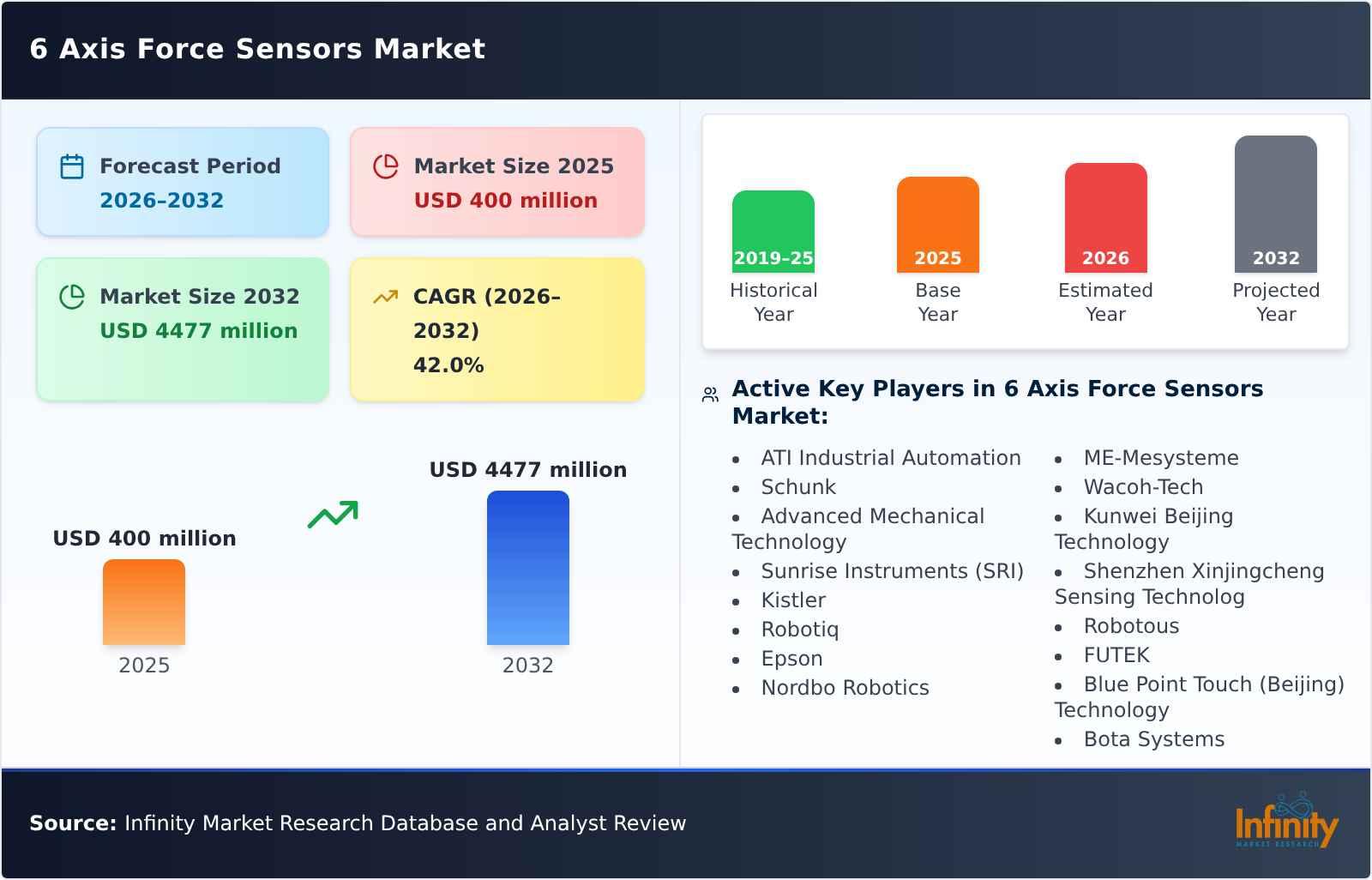
The global 6 Axis Force Sensors market size is predicted to grow from US$ 400 million in 2025 to US$ 4477 million in 2032; it is expected to grow at a CAGR of 42.0% from 2026 to 2032.
Explore this report in detail? Download a free sample copy
Download Free Sample Report
6 Axis Force Sensor is a special force sensor that can simultaneously measure three forces (FX, FY, FZ) and three moments (MX, MY, MZ) in a neutral coordinate system. It is widely used in robot control, mechanical experiments, scientific research and other fields, and is also one of the commonly used sensors in industrial robots.
The 6 Axis Force Sensors originated from the aerospace industry and is used to measure the aerodynamic characteristics of aircraft, including lift, drag, lateral force, pitch moment, yaw moment and roll moment. Since the orthogonal three-directional forces and three-directional moments need to be measured simultaneously, the 6 Axis Force Sensors came into being. With the publics knowledge of the comprehensive mechanical measurement advantages of the 6 Axis Force Sensors and the rapid development of technology, the application field of the 6 Axis Force Sensors has gradually expanded to detection, prevention, control, teaching, measurement, protection and other scenarios.
Since Musk proposed the concept of humanoid robots in 2021, the 6 Axis Force Sensors market has ushered in rapid development. According to the latest research data, the global sales of 6 Axis Force Sensorss will be nearly 60,000 sets in 2024, of which Chinas sales will be about 17,000 sets, a year-on-year increase of more than 40%. It is estimated that by 2030, the global market sales will reach 820,000 sets, and Chinas sales will reach 300,000 sets, with a compound annual sales growth rate of 60% from 2025 to 2030. At present, the global 6 Axis Force Sensors industry market is dominated by ATI Industrial Automation, Schunk, Advanced Mechanical Technology, etc., occupying the global core market. Chinese manufacturers such as Yuli Instruments, Kunwei Technology, and Xinjingcheng have also ushered in explosive growth. In 2024, the worlds top five manufacturers will account for more than 60% of the market.
According to different measurement principles, they can be divided into photoelectric, strain, capacitive, piezoelectric and other types. Among all force sensors, strain force sensors are the most widely used, and their usage accounts for more than 80% of the total force sensors. At present, companies that use strain force sensors include ATI Industrial Automation, Schunk, ME-Mesysteme, Sintokogio and almost all players in China.
At present, 6 Axis Force Sensorss are widely used in collision tests, wheel hubs, seats and other parts tests in the automotive industry, as well as in many scientific and technological fields such as aerospace vehicles, biomechanics, medical fields, scientific research experiments, robots and industrial automation. Among downstream applications, the application scale of industrial automation (including traditional robots) accounts for the largest proportion, but the application scale of humanoid robots grows fastest. According to the latest data , the global compound annual growth rate of humanoid robots from 2025 to 2030 will reach 104%. In the long run, the mass production of humanoid robots will be a major source of growth for the 6 Axis Force Sensors market. The application scenarios of 6 Axis Force Sensorss in traditional robots include force control, force feedback, quality inspection, and dynamic control; the application scenarios in humanoid robots include force control, swing stability control, and safety control. 6 Axis Force Sensorss can improve the refinement and flexibility of humanoid robot hand operations and the stability of foot walking. They are mainly installed at the end parts of wrists and ankles, and have become the standard of high-performance humanoid robots.
Dimensional force sensors are the highest-dimensional force sensors. With their advantages of high precision, high sensitivity, high bandwidth, and high reliability, they can provide the most comprehensive force information and improve sensing accuracy. They play a vital role in many high-tech fields. With the continuous advancement of technology and the continuous expansion of downstream application fields, the 6 Axis Force Sensors market will usher in broad development prospects.
Infinity Market Research newest research report, the 6 Axis Force Sensors Industry Forecast looks at past sales and reviews total world 6 Axis Force Sensors sales in 2025, providing a comprehensive analysis by region and market sector of projected 6 Axis Force Sensors sales for 2026 through 2032. With 6 Axis Force Sensors sales broken down by region, market sector and sub-sector, this report provides a detailed analysis in US$ millions of the world 6 Axis Force Sensors industry.
This Insight Report provides a comprehensive analysis of the global 6 Axis Force Sensors landscape and highlights key trends related to product segmentation, company formation, revenue, and market share, latest development, and M&A activity. This report also analyzes the strategies of leading global companies with a focus on 6 Axis Force Sensors portfolios and capabilities, market entry strategies, market positions, and geographic footprints, to better understand these firms unique position in an accelerating global 6 Axis Force Sensors market.
This Insight Report evaluates the key market trends, drivers, and affecting factors shaping the global outlook for 6 Axis Force Sensors and breaks down the forecast by Type, by Application, geography, and market size to highlight emerging pockets of opportunity. With a transparent methodology based on hundreds of bottom-up qualitative and quantitative market inputs, this study forecast offers a highly nuanced view of the current state and future trajectory in the global 6 Axis Force Sensors.
This report presents a comprehensive overview, market shares, and growth opportunities of 6 Axis Force Sensors market by product type, application, key manufacturers and key regions and countries.
Segmentation by Type:
Strain Gauge Type
Piezoelectric/Capacitive Type
Others
Segmentation by Application:
Industrial Robots
Medical Robots
Automotive Field
Humanoid Robots
Others
This report also splits the market by region:
Americas
United States
Canada
Mexico
Brazil
APAC
China
Japan
Korea
Southeast Asia
India
Australia
Europe
Germany
France
UK
Italy
Russia
Middle East & Africa
Egypt
South Africa
Israel
Turkey
GCC Countries
The below companies that are profiled have been selected based on inputs gathered from primary experts and analysing the companys coverage, product portfolio, its market penetration.
ATI Industrial Automation
Schunk
Advanced Mechanical Technology
Sunrise Instruments (SRI)
Kistler
Robotiq
Epson
Nordbo Robotics
ME-Mesysteme
Wacoh-Tech
Kunwei Beijing Technology
Shenzhen Xinjingcheng Sensing Technolog
Robotous
FUTEK
Blue Point Touch (Beijing) Technology
Bota Systems
FANUC
Changzhou Right Measurement and control system
Hypersen Technologies
Sintokogio
Anhui Zhongke Mi Point Sensor
Nanjing Bio-inspired Intelligent Technology
Aidin Robotics
OnRobot
Guangzhou Haozhi Industrial
Anhui Bioforcen Intelligent Technology
Chongqing Luban Robotics Technology Research Institute
Shenzhen Jiaan Intelligent Technology
Torque Sensor Technology (Shenzhen)
Beijing Zhengkai Instrument
Keli Sensing Technolgy(Ningbo)
Zhonghang Electronic Measuring Instruments
Shenzhen Ampron Technology
Key Questions Addressed in this Report
What is the 10-year outlook for the global 6 Axis Force Sensors market?
What factors are driving 6 Axis Force Sensors market growth, globally and by region?
Which technologies are poised for the fastest growth by market and region?
How do 6 Axis Force Sensors market opportunities vary by end market size?
How does 6 Axis Force Sensors break out by Type, by Application?
6 Axis Force Sensors Market Scope
| Report Attribute | Details |
|---|---|
| Market Size (Start Year) | USD XX Million |
| Market Size (End Year) | USD XX Million |
| Compound Annual Growth Rate (CAGR) | USD XX Million |
| Forecast Period | USD XX Million |
| Base Year | USD XX Million |
| Historical Data | USD XX Million |
| Key Players | USD XX Million |
REPORT COVERAGE
Revenue forecast, Company Analysis, Industry landscape, Growth factors, and Trends
SEGMENT COVERED
By component, deployment, organization size, application, and industry.
REGIONAL SCOPE
North America, Europe, Asia Pacific, Middle East & Africa, South & Central America
COUNTRY SCOPE
Includes key countries across all major regions.
Frequently Asked Questions
1. What is the market size of Global 6 Axis Force Sensors Market?
Answer: The global 6 Axis Force Sensors market size is predicted to grow from US$ 400 million in 2025 to US$ 4477 million in 2032; it is expected to grow at a CAGR of 42.0% from 2026 to 2032.
2. Which regions are analyzed in the Global 6 Axis Force Sensors Market report?
Answer: The Global 6 Axis Force Sensors Market report covers major regions such as Europe, Middle East & Africa. Each region is analyzed for trends, opportunities, and market dynamics.
3. What methodology is used for forecasting of Global 6 Axis Force Sensors Market?
Answer: The Global 6 Axis Force Sensors Market report uses a mix of primary research, secondary data, and expert analysis.
4. Are emerging markets analyzed separately in the Global 6 Axis Force Sensors Market?
Answer: Yes, the Global 6 Axis Force Sensors Market report highlights high-growth emerging regions with dedicated insights.
5. Does the report include competitive benchmarking of Global 6 Axis Force Sensors Market?
Answer: Yes, Global 6 Axis Force Sensors Market report compares major players based on revenue, product portfolio, and innovation.
6. Can I access country-level data within the Global 6 Axis Force Sensors Market report?
Answer: Yes, Global 6 Axis Force Sensors Market report includes detailed data by country for major regions.
7. Can I get customized insights or data from the Global 6 Axis Force Sensors Market report?
Answer: Yes, we offer customization options to align with your specific business needs. You can request tailored sections or regional breakdowns.