


Global AI Chips Market Size, Share and Analysis Report 2026-2032
Feb 2026
Semiconductor and Electronics
Pages: 171
ILR4471
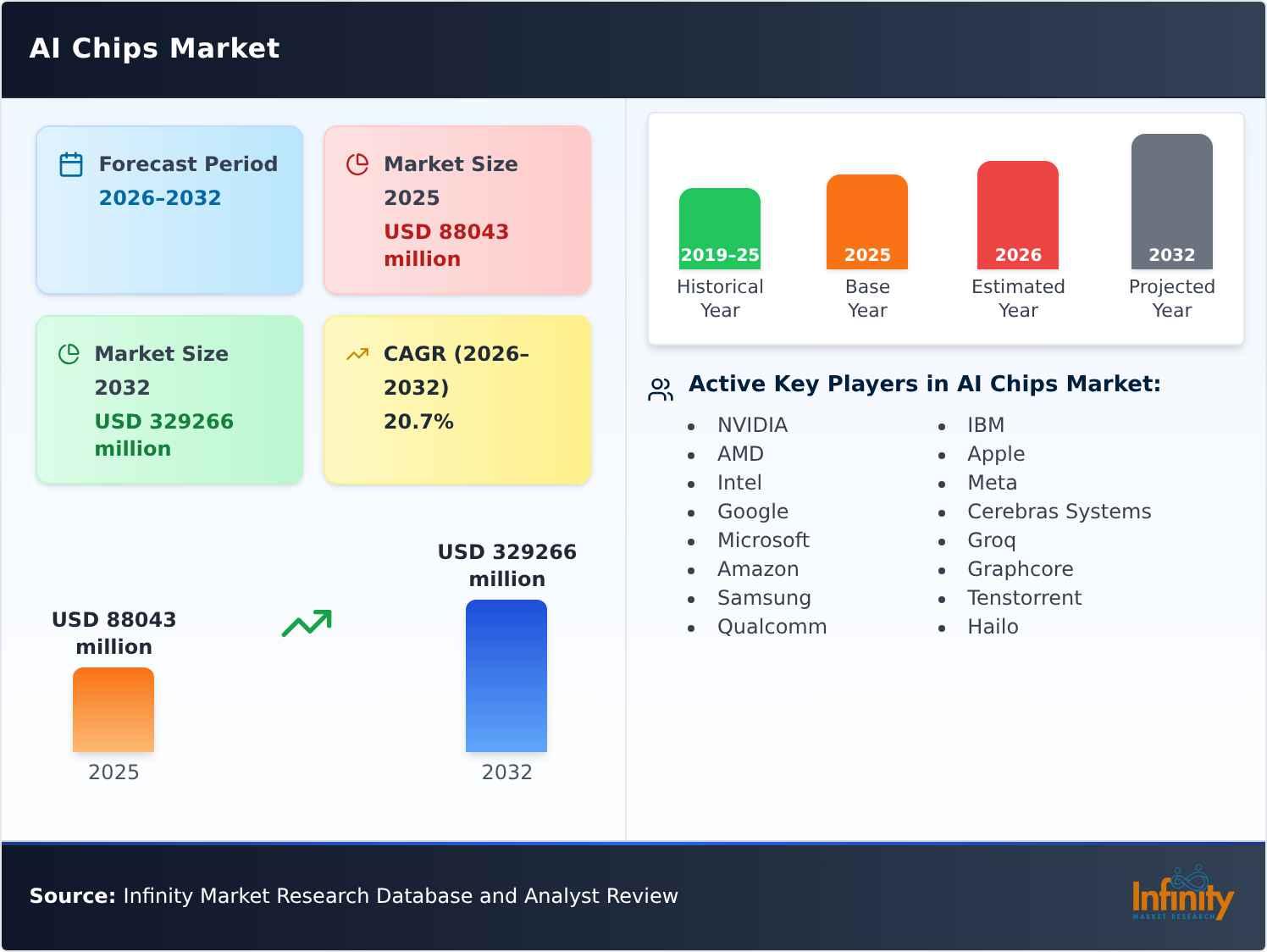
The global AI Chips market size is predicted to grow from US$ 88043 million in 2025 to US$ 329266 million in 2032; it is expected to grow at a CAGR of 20.7% from 2026 to 2032.
Explore this report in detail? Download a free sample copy
Download Free Sample Report
In 2025, global AI Chips capacity 8,000 k Pcs, sales reached approximately 7,500 k Pcs, with an average market price of around 12,000 USD/Pcs, industrial gross margin 54%.
AI chips have shifted from ?a single accelerator? to a system product: in the cloud, GPUs or in-house ASICs are packaged with high-speed interconnects, rack-scale power delivery and liquid cooling to industrialize training and inference as repeatable ?AI factories?; on-device, AI chips are embedded into SoCs/CPUs where privacy, power and user experience define differentiation. The market?s center of gravity spans three tracks: NVIDIA-style GPU + full-stack systems, AMD/Intel pushing datacenter accelerators and open software, and hyperscalers (Google/AWS/Microsoft/Meta) scaling in-house ASICs to secure supply and economics; at the edge, Apple and Qualcomm turn NPUs into platform gates.
AI-chip KPIs are moving from peak compute to system efficiency across compute ? memory ? interconnect ? power density. HBM capacity/bandwidth is now decisive (e.g., MI300X discloses 192GB HBM3 and 5.3TB/s; Gaudi 3 up to 128GB HBM and 3.7TB/s; TPU v5p publishes per-chip HBM specs). Low precision (FP8/FP4) and new kernels are the incremental lever for inference and reasoning workloads, while rack-scale fabrics improve realized throughput (NVL72 emphasizes a unified 72-GPU domain and 130TB/s-class fabric; Blackwell Ultra discloses NVLink 5 bandwidth and max topology). Power density and cooling are ?chip-level constraints,? with DGX-class systems publishing system power and HBM3e bandwidth; in automotive/robotics, determinism and safety isolation become part of what an AI chip is, exemplified by disclosed Thor compute and power envelopes.
Across the supply chain, AI chips are increasingly a systems game: upstream, leading-edge nodes plus advanced packaging (2.5D/CoWoS-class) and HBM supply set the ramp speed; midstream, competition extends from silicon into boards, servers, racks, networking and the software stack (compilers/inference runtimes/collectives) that determines time-to-deploy and stickiness; downstream, hyperscalers, internet platforms, automakers and device OEMs harden requirements into specs. A telling recent move is how rack-scale delivery becomes part of ?AI chip capability?: AMD has completed its acquisition of ZT Systems, explicitly combining CPU+GPU+networking with rack-scale systems expertise to match how hyperscalers buy and deploy.
Growth is spilling out along three lines. (1) Datacenter AI chips are shifting from ?single-GPU racing? to ?AI-factory racing,? with hyperscalers publishing rack/cluster-scale availability (OCI discloses liquid-cooled GB200 NVL72 for very large clusters; SK Group and NVIDIA announce an AI factory exceeding 50,000 GPUs, anchored by manufacturing, digital twins and agents). (2) Geopolitics and compliance have become part of product roadmaps: the U.S. AI diffusion framework and its subsequent rescission?along with continuing guidance on advanced computing ICs?push finer-grained supply, SKU and shipment strategies. (3) On-device AI chips are becoming eligibility gates: Windows writes a 40+ TOPS NPU threshold into Copilot+ PC requirements; Apple discloses M4?s 38 TOPS Neural Engine and ties on-device GenAI to system experience; in vehicles, centralized compute platforms like Thor point to cockpit + AD fusion and higher safety-grade compute as the next leg. Over the next 12?24 months, the most bankable trend is not just ?bigger models,? but ?more inference, stronger systems, deeper verticalization?: FP4/FP8 inference and communication efficiency become the power-efficiency battlefield; HBM and advanced packaging remain critical supply constraints; sovereign/industry AI factories will expand procurement from chips to racks, power, liquid cooling and ops software; robotics and industrial edge broaden AI-chip demand from vision into multimodal real-time control.
Infinity Market Research newest research report, the ?AI Chips Industry Forecast? looks at past sales and reviews total world AI Chips sales in 2025, providing a comprehensive analysis by region and market sector of projected AI Chips sales for 2026 through 2032. With AI Chips sales broken down by region, market sector and sub-sector, this report provides a detailed analysis in US$ millions of the world AI Chips industry.
This Insight Report provides a comprehensive analysis of the global AI Chips landscape and highlights key trends related to product segmentation, company formation, revenue, and market share, latest development, and M&A activity. This report also analyzes the strategies of leading global companies with a focus on AI Chips portfolios and capabilities, market entry strategies, market positions, and geographic footprints, to better understand these firms? unique position in an accelerating global AI Chips market.
This Insight Report evaluates the key market trends, drivers, and affecting factors shaping the global outlook for AI Chips and breaks down the forecast by Technical Architecture, by Application, geography, and market size to highlight emerging pockets of opportunity. With a transparent methodology based on hundreds of bottom-up qualitative and quantitative market inputs, this study forecast offers a highly nuanced view of the current state and future trajectory in the global AI Chips.
This report presents a comprehensive overview, market shares, and growth opportunities of AI Chips market by product type, application, key manufacturers and key regions and countries.
Segmentation by Technical Architecture:
GPU
FPGA
ASIC
Others
Segmentation by Function:
Training Chip
Inference Chip
Segmentation by Industry:
Data Center
Automobile
Robot
Consumer Electronics
Medical
Others
Segmentation by Application:
Cloud Server
Edge and Terminal (Mobile Device)
This report also splits the market by region:
Americas
United States
Canada
Mexico
Brazil
APAC
China
Japan
Korea
Southeast Asia
India
Australia
Europe
Germany
France
UK
Italy
Russia
Middle East & Africa
Egypt
South Africa
Israel
Turkey
GCC Countries
The below companies that are profiled have been selected based on inputs gathered from primary experts and analysing the companys coverage, product portfolio, its market penetration.
NVIDIA
AMD
Intel
Google
Microsoft
Amazon
Samsung
Qualcomm
IBM
Apple
Meta
Cerebras Systems
Groq
Graphcore
Tenstorrent
Hailo
SambaNova
Huawei
Cambricon
Horizon Robotics
Biren
Iluvatar CoreX
Moore Threads
MetaX
Enflame
Hygon Information Technology
Changsha Jingjia Microelectronics
Kunlunxin
T-Head (Alibaba)
Hexaflake
Key Questions Addressed in this Report
What is the 10-year outlook for the global AI Chips market?
What factors are driving AI Chips market growth, globally and by region?
Which technologies are poised for the fastest growth by market and region?
How do AI Chips market opportunities vary by end market size?
How does AI Chips break out by Technical Architecture, by Application?
AI Chips Market Scope
| Report Attribute | Details |
|---|---|
| Market Size (Start Year) | USD XX Million |
| Market Size (End Year) | USD XX Million |
| Compound Annual Growth Rate (CAGR) | USD XX Million |
| Forecast Period | USD XX Million |
| Base Year | USD XX Million |
| Historical Data | USD XX Million |
| Key Players | USD XX Million |
REPORT COVERAGE
Revenue forecast, Company Analysis, Industry landscape, Growth factors, and Trends
SEGMENT COVERED
By component, deployment, organization size, application, and industry.
REGIONAL SCOPE
North America, Europe, Asia Pacific, Middle East & Africa, South & Central America
COUNTRY SCOPE
Includes key countries across all major regions.
📘 Frequently Asked Questions
1. What is the market size of Global AI Chips Market?
Answer: The global AI Chips market size is predicted to grow from US$ 88043 million in 2025 to US$ 329266 million in 2032; it is expected to grow at a CAGR of 20.7% from 2026 to 2032.
2. Which regions are analyzed in the Global AI Chips Market report?
Answer: The Global AI Chips Market report covers major regions such as Europe, Middle East & Africa. Each region is analyzed for trends, opportunities, and market dynamics.
3. What methodology is used for forecasting of Global AI Chips Market?
Answer: The Global AI Chips Market report uses a mix of primary research, secondary data, and expert analysis.
4. Are emerging markets analyzed separately in the Global AI Chips Market?
Answer: Yes, the Global AI Chips Market report highlights high-growth emerging regions with dedicated insights.
5. Does the report include competitive benchmarking of Global AI Chips Market?
Answer: Yes, Global AI Chips Market report compares major players based on revenue, product portfolio, and innovation.
6. Can I access country-level data within the Global AI Chips Market report?
Answer: Yes, Global AI Chips Market report includes detailed data by country for major regions.
7. Can I get customized insights or data from the Global AI Chips Market report?
Answer: Yes, we offer customization options to align with your specific business needs. You can request tailored sections or regional breakdowns.