


Global Aircraft Engine Leasing Market Size, Share and Analysis Report 2026-2032
Feb 2026
Information and Communication Technology
Pages: 99
ILR4243
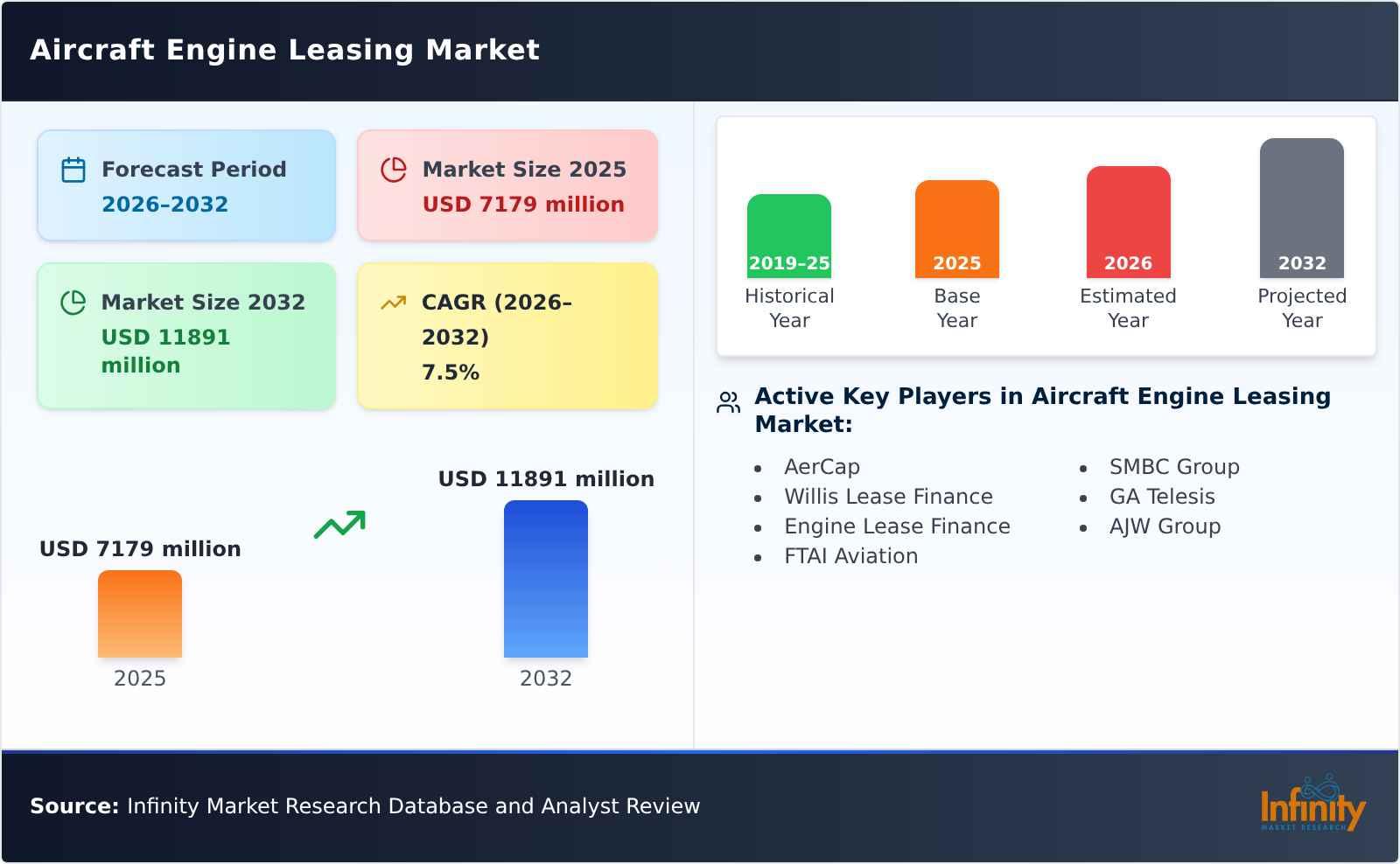
The global Aircraft Engine Leasing market size is predicted to grow from US$ 7179 million in 2025 to US$ 11891 million in 2032; it is expected to grow at a CAGR of 7.5% from 2026 to 2032.
Explore this report in detail? Download a free sample copy
Download Free Sample Report
Aircraft engine leasing refers to a practice in which airlines or other aircraft operators obtain the right to use aircraft engines through leasing rather than purchasing them outright, in order to meet operational needs such as regular operation, spare coverage, or support during maintenance. The engines are typically owned by specialized engine lessors or aviation asset management companies. Lease portfolios may include both brand-new engines and used engines that have been overhauled and refurbished.
From a business model perspective, aircraft engine leasing is generally divided into short-term leasing and long-term leasing. Short-term leasing is most commonly used for ?spare engines,? ensuring uninterrupted flight operations when an operator?s own engines are undergoing major maintenance (MRO) or suffer unexpected failures. Long-term leasing is closer to an asset-substitution solution: airlines can use leased engines over an extended period to reduce upfront capital expenditure. Lease agreements usually specify strict terms regarding operating hours, cycles, maintenance responsibilities, and the required return condition.
From a cost and financial management standpoint, engine leasing can significantly ease an airline?s funding burden. Aircraft engines are expensive, require substantial maintenance spending, and face rapid technological iteration. Leasing converts large capital expenditures into predictable operating expenses, improves asset turnover efficiency, and enhances budget stability. At the same time, leasing helps airlines respond flexibly to uncertainties arising from capacity changes, new aircraft introductions, or route-network adjustments.
From an industry chain perspective, aircraft engine leasing is a typical business that integrates aviation finance with aviation engineering, involving multiple stakeholders such as engine OEMs, maintenance organizations (MROs), insurers, and financial institutions. With the continued growth of global air transport and the expansion of aircraft fleets, engine leasing has become an important tool for airlines to safeguard operational reliability, improve operational flexibility, and optimize their financial structure.
Aircraft engine leasing is an aviation asset service model in which airlines or other aircraft operators obtain the right to use engines through leasing rather than purchasing them outright, primarily to support operational continuity, spare coverage, and maintenance replacement needs. Engines are typically owned by specialized engine leasing companies or aviation asset management firms. Lease portfolios may include both brand-new engines and used engines that have been overhauled and refurbished. Lease agreements are governed by constraints such as operating hours, cycles, maintenance responsibilities, airworthiness compliance, and return conditions, making the business fundamentally an asset-pricing and risk-management activity built on controllable engineering status.
From a product-structure perspective, aircraft engine leasing can be classified along five commonly used dimensions: by lease term (short-term vs. long-term); by purpose (spare-engine leasing, maintenance-replacement leasing, and capacity-support leasing); by aircraft platform (narrowbody vs. widebody engine leasing); by asset attribute (new-engine leasing vs. refurbished used-engine leasing); and by pricing mechanism (fixed rent, pay-by-the-hour (PBH), lease structures linked to maintenance reserves, short-term exchange packages, and bundled ?lease + MRO? solutions). In practice, these dimensions often overlap, and the industry typically defines product boundaries using a combination of ?use case + pricing mechanism? to better match an airline?s operating rhythm and cost objectives.
In terms of application structure, airlines are the primary demand drivers. Short-term leases are more oriented toward spare-engine pools and AOG coverage, providing rapid replacement when engines are queued for shop visits, when unexpected groundings occur, or during peak capacity periods. Long-term leasing is closer to an asset-substitution solution, helping airlines reduce upfront capital expenditures and improve cost predictability. Low-cost carriers and fast-growing airlines often place greater emphasis on the cash-flow flexibility enabled by leasing, while major network carriers focus more on operational reliability and fleet-planning assurance. Meanwhile, collaboration between MRO providers and lessors is strengthening through integrated ?shop visit + spare engine? offerings, which improve bay utilization and turnaround efficiency, reduce aircraft-on-ground losses, and enhance the controllability of maintenance planning.
From a cost-structure and profitability standpoint, value creation in engine leasing comes from a system-level optimization of ?cost of capital?utilization/turnover efficiency?maintenance strategy?residual value management.? Funding costs define the base pricing envelope; maintenance strategy and return conditions shape the engine?s rentable time and availability status; turnover efficiency determines revenue output per unit of asset base; and residual value management spans the full lifecycle and is closely linked to trading in used engines and used serviceable materials (USM). Profitability is materially influenced by engine generation, supply?demand tightness, shop-visit lead times and MRO capacity constraints, and contract design, with players that have stronger engineering management and global redeployment capabilities generally achieving higher-quality earnings for a given asset base.
Across the value chain, upstream participants include engine OEMs and critical component suppliers; midstream players include engine lessors, aviation asset managers, financial institutions, and insurers; and downstream participants include airlines and MRO providers. The competitive landscape is characterized by both concentration and specialization: integrated aviation leasing platforms leverage capital strength and customer reach to build large-scale engine pools; independent engine lessors differentiate through fast delivery, flexible contract products, and refined engine-platform management; and vertically integrated players with MRO capabilities or USM ecosystems enhance turnover and residual value control through ?leasing + maintenance + reuse? closed loops. Looking ahead, the industry is expected to continue evolving toward greater service orientation and refinement?PBH and bundled offerings will expand, digital health monitoring and life-remaining management will strengthen engineering-based pricing, more mature used-engine and USM markets will improve circular utilization, and fleet growth in emerging aviation markets will accelerate localized deployment of engine pools and maintenance resources.
LPI (LP Information) newest research report, the ?Aircraft Engine Leasing Industry Forecast? looks at past sales and reviews total world Aircraft Engine Leasing sales in 2025, providing a comprehensive analysis by region and market sector of projected Aircraft Engine Leasing sales for 2026 through 2032. With Aircraft Engine Leasing sales broken down by region, market sector and sub-sector, this report provides a detailed analysis in US$ millions of the world Aircraft Engine Leasing industry.
This Insight Report provides a comprehensive analysis of the global Aircraft Engine Leasing landscape and highlights key trends related to product segmentation, company formation, revenue, and market share, latest development, and M&A activity. This report also analyses the strategies of leading global companies with a focus on Aircraft Engine Leasing portfolios and capabilities, market entry strategies, market positions, and geographic footprints, to better understand these firms? unique position in an accelerating global Aircraft Engine Leasing market.
This Insight Report evaluates the key market trends, drivers, and affecting factors shaping the global outlook for Aircraft Engine Leasing and breaks down the forecast by Type, by Application, geography, and market size to highlight emerging pockets of opportunity. With a transparent methodology based on hundreds of bottom-up qualitative and quantitative market inputs, this study forecast offers a highly nuanced view of the current state and future trajectory in the global Aircraft Engine Leasing.
This report presents a comprehensive overview, market shares, and growth opportunities of Aircraft Engine Leasing market by product type, application, key players and key regions and countries.
Segmentation by Type:
Turbofan
Turboprop
Turbojet
Others
Segmentation by Compatible Models:
Narrow-Body
Wide-Body
Regional Jets
Others
Segmentation by Rental Model:
Dry Lease
Wet Lease
Segmentation by Application:
Airlines
Secondary Lessors
MRO Providers
Others
This report also splits the market by region:
Americas
United States
Canada
Mexico
Brazil
APAC
China
Japan
Korea
Southeast Asia
India
Australia
Europe
Germany
France
UK
Italy
Russia
Middle East & Africa
Egypt
South Africa
Israel
Turkey
GCC Countries
The below companies that are profiled have been selected based on inputs gathered from primary experts and analyzing the companys coverage, product portfolio, its market penetration.
AerCap
Willis Lease Finance
Engine Lease Finance
FTAI Aviation
SMBC Group
GA Telesis
AJW Group
Aircraft Engine Leasing Market Scope
| Report Attribute | Details |
|---|---|
| Market Size (Start Year) | USD XX Million |
| Market Size (End Year) | USD XX Million |
| Compound Annual Growth Rate (CAGR) | USD XX Million |
| Forecast Period | USD XX Million |
| Base Year | USD XX Million |
| Historical Data | USD XX Million |
| Key Players | USD XX Million |
REPORT COVERAGE
Revenue forecast, Company Analysis, Industry landscape, Growth factors, and Trends
SEGMENT COVERED
By component, deployment, organization size, application, and industry.
REGIONAL SCOPE
North America, Europe, Asia Pacific, Middle East & Africa, South & Central America
COUNTRY SCOPE
Includes key countries across all major regions.
Frequently Asked Questions
1. What is the market size of Global Aircraft Engine Leasing Market?
Answer: The global Aircraft Engine Leasing market size is predicted to grow from US$ 7179 million in 2025 to US$ 11891 million in 2032; it is expected to grow at a CAGR of 7.5% from 2026 to 2032.
2. Which regions are analyzed in the Global Aircraft Engine Leasing Market report?
Answer: The Global Aircraft Engine Leasing Market report covers major regions such as Europe, Middle East & Africa. Each region is analyzed for trends, opportunities, and market dynamics.
3. What methodology is used for forecasting of Global Aircraft Engine Leasing Market?
Answer: The Global Aircraft Engine Leasing Market report uses a mix of primary research, secondary data, and expert analysis.
4. Are emerging markets analyzed separately in the Global Aircraft Engine Leasing Market?
Answer: Yes, the Global Aircraft Engine Leasing Market report highlights high-growth emerging regions with dedicated insights.
5. Does the report include competitive benchmarking of Global Aircraft Engine Leasing Market?
Answer: Yes, Global Aircraft Engine Leasing Market report compares major players based on revenue, product portfolio, and innovation.
6. Can I access country-level data within the Global Aircraft Engine Leasing Market report?
Answer: Yes, Global Aircraft Engine Leasing Market report includes detailed data by country for major regions.
7. Can I get customized insights or data from the Global Aircraft Engine Leasing Market report?
Answer: Yes, we offer customization options to align with your specific business needs. You can request tailored sections or regional breakdowns.