


Global Automatic Human Posture Recognition Market Growth (Status and Outlook) 2026-2032
Jan 2026
Information and Communication Technology
Pages: 132
ILR1713
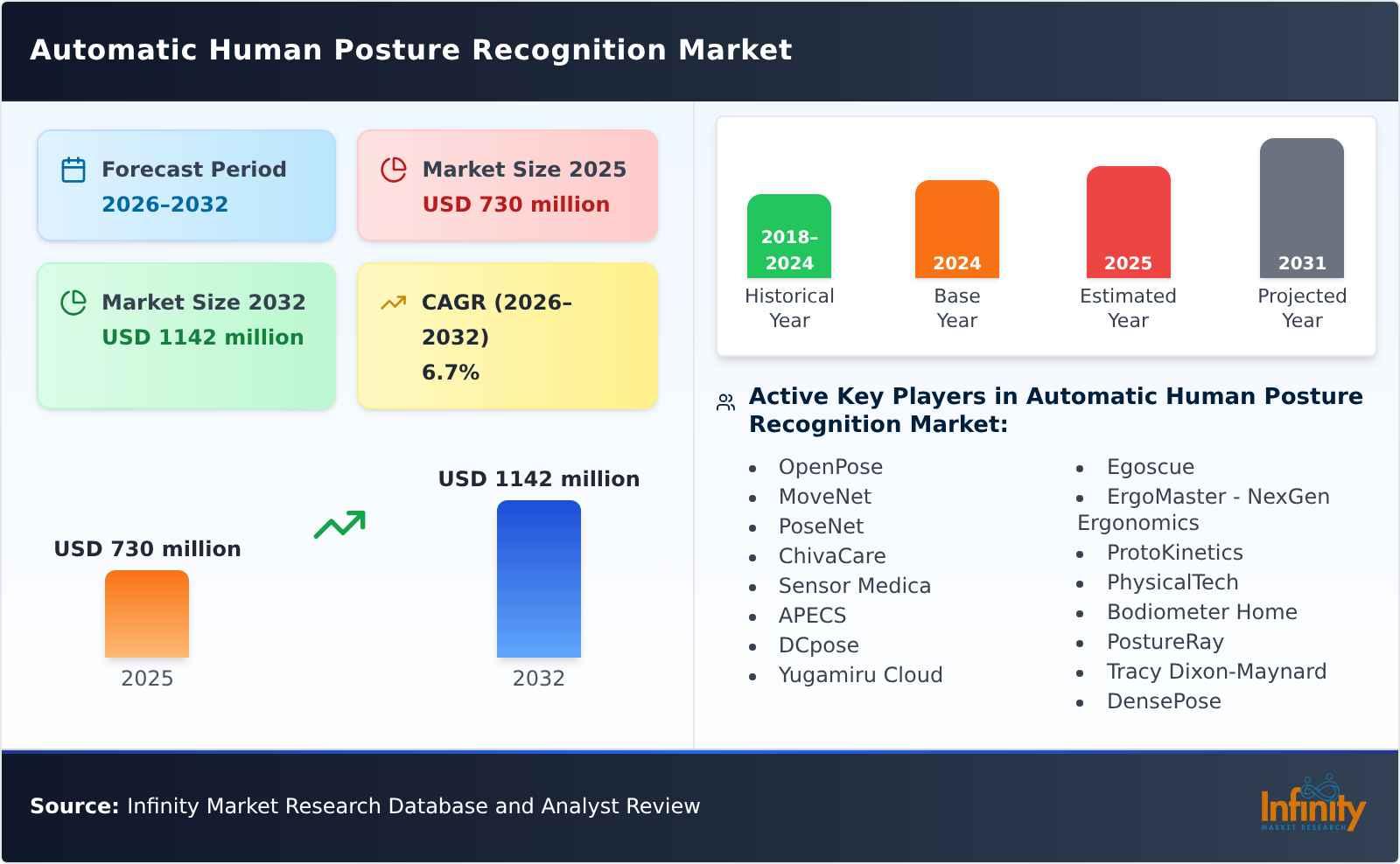
The global Automatic Human Posture Recognition market size is predicted to grow from US$ 730 million in 2025 to US$ 1142 million in 2032; it is expected to grow at a CAGR of 6.7% from 2026 to 2032.
Explore this report in detail? Download a free sample copy
Download Free Sample Report
Automatic human pose recognition refers to the core technology that uses computer vision and deep learning algorithms to automatically detect and analyze the positions of key human joints (such as head, shoulders, elbows, wrists, hips, knees, and ankles) from images or videos captured by cameras, constructing a human skeleton model to determine the current posture or movement pattern of a person, such as standing, sitting, walking, bending over, raising hands, or falling. The system typically includes several steps: human detection, keypoint localization, skeleton modeling, and pose classification. It can run on ordinary cameras or even mobile phone cameras and is widely used in motion and rehabilitation training action evaluation, intelligent fitness/dance scoring, human-computer interaction, abnormal posture (such as falls and climbing over railings) recognition in security scenarios, and intelligent monitoring of dangerous postures and violations by workers in industrial settings.
From the demand side, automatic human pose recognition has quietly become a fundamental capability, although most end-users are unaware of this term. On one hand, there are To C scenarios: home fitness apps, smart TVs/motion-sensing games, online rehabilitation training, and AI motion scoring in mini-programs are all using pose recognition to replace expensive motion capture equipment, allowing a mobile phone or camera to perform functions such as posture assessment, yoga/dance movement correction, and monitoring of adolescent hunchback; on the other hand, there are To B/To G scenarios: nursing homes and home care use it for fall/prolonged bed rest monitoring, factories, warehouses, and construction sites use it to identify violations such as bending over to carry objects, climbing to high places, and entering dangerous areas, and subways/shopping malls/scenic spots are beginning to experiment with pose + behavior recognition to detect abnormal gatherings, fights, and fence jumping. As the advantages of non-intrusive, non-wearable, and low-cost are recognized, this technology is expanding from single-point pilot projects to become a video surveillance upgrade package and a standard capability for smart terminals.
From the supply and competitive landscape perspective, automatic human pose recognition has entered a stage where general algorithms are reaching their limits, and scenarios and closed loops determine value: the underlying 2D/3D pose models have basically been leveled by large companies and open-source frameworks, and simply selling SDKs or model interfaces has high prices and high substitutability; the real bargaining power lies with players who integrate pose recognition with a complete business closed loopfor example, providing action scoring + training prescriptions + risk warnings in the rehabilitation/sports field, directly linking to alarms, assessments, and team management in industrial safety, and integrating with nursing systems, bedside alarms, and family apps in elderly care. Looking further ahead, as edge computing capabilities are deployed to cameras, NVRs, and other devices, whoever can develop sufficiently lightweight models that perform stably under complex lighting, occlusion, and multi-person scenarios, and who can leverage long-term data to build an industry action library and risk control models, will have the opportunity to upgrade from being an algorithm provider to a service provider for safety, health, and efficiency improvement in a specific vertical scenario, securing recurring subscription and project-based revenue, rather than simply selling a technology solution once.
Infinity Market Research newest research report, the Automatic Human Posture Recognition Industry Forecast looks at past sales and reviews total world Automatic Human Posture Recognition sales in 2025, providing a comprehensive analysis by region and market sector of projected Automatic Human Posture Recognition sales for 2026 through 2032. With Automatic Human Posture Recognition sales broken down by region, market sector and sub-sector, this report provides a detailed analysis in US$ millions of the world Automatic Human Posture Recognition industry.
This Insight Report provides a comprehensive analysis of the global Automatic Human Posture Recognition landscape and highlights key trends related to product segmentation, company formation, revenue, and market share, latest development, and M&A activity. This report also analyses the strategies of leading global companies with a focus on Automatic Human Posture Recognition portfolios and capabilities, market entry strategies, market positions, and geographic footprints, to better understand these firms unique position in an accelerating global Automatic Human Posture Recognition market.
This Insight Report evaluates the key market trends, drivers, and affecting factors shaping the global outlook for Automatic Human Posture Recognition and breaks down the forecast by Type, by Application, geography, and market size to highlight emerging pockets of opportunity. With a transparent methodology based on hundreds of bottom-up qualitative and quantitative market inputs, this study forecast offers a highly nuanced view of the current state and future trajectory in the global Automatic Human Posture Recognition.
This report presents a comprehensive overview, market shares, and growth opportunities of Automatic Human Posture Recognition market by product type, application, key players and key regions and countries.
Segmentation by Type:
2D
3D
Segmentation by Model:
Real-time Human Pose Estimation
Offline / High-precision Pose Estimation
Segmentation by Quantity:
Single-person Pose Estimation
Multi-person Pose Estimation
Segmentation by Application:
Personal
Commercial
This report also splits the market by region:
Americas
United States
Canada
Mexico
Brazil
APAC
China
Japan
Korea
Southeast Asia
India
Australia
Europe
Germany
France
UK
Italy
Russia
Middle East & Africa
Egypt
South Africa
Israel
Turkey
GCC Countries
The below companies that are profiled have been selected based on inputs gathered from primary experts and analyzing the companys coverage, product portfolio, its market penetration.
OpenPose
MoveNet
PoseNet
ChivaCare
Sensor Medica
APECS
DCpose
Yugamiru Cloud
Egoscue
ErgoMaster - NexGen Ergonomics
ProtoKinetics
PhysicalTech
Bodiometer Home
PostureRay
Tracy Dixon-Maynard
DensePose
HighHRNet
AiphaPose
Automatic Human Posture Recognition Market Scope
| Report Attribute | Details |
|---|---|
| Market Size (Start Year) | USD XX Million |
| Market Size (End Year) | USD XX Million |
| Compound Annual Growth Rate (CAGR) | USD XX Million |
| Forecast Period | USD XX Million |
| Base Year | USD XX Million |
| Historical Data | USD XX Million |
| Key Players | USD XX Million |
REPORT COVERAGE
Revenue forecast, Company Analysis, Industry landscape, Growth factors, and Trends
SEGMENT COVERED
By component, deployment, organization size, application, and industry.
REGIONAL SCOPE
North America, Europe, Asia Pacific, Middle East & Africa, South & Central America
COUNTRY SCOPE
Includes key countries across all major regions.
Frequently Asked Questions
1. What is the market size of Global Automatic Human Posture Recognition Market?
Answer: The global Automatic Human Posture Recognition market size is predicted to grow from US$ 730 million in 2025 to US$ 1142 million in 2032; it is expected to grow at a CAGR of 6.7% from 2026 to 2032.
2. Which regions are analyzed in the Global Automatic Human Posture Recognition Market report?
Answer: The Global Automatic Human Posture Recognition Market report covers major regions such as Europe, Middle East & Africa. Each region is analyzed for trends, opportunities, and market dynamics.
3. What methodology is used for forecasting of Global Automatic Human Posture Recognition Market?
Answer: The Global Automatic Human Posture Recognition Market report uses a mix of primary research, secondary data, and expert analysis.
4. Are emerging markets analyzed separately in the Global Automatic Human Posture Recognition Market?
Answer: Yes, the Global Automatic Human Posture Recognition Market report highlights high-growth emerging regions with dedicated insights.
5. Does the report include competitive benchmarking of Global Automatic Human Posture Recognition Market?
Answer: Yes, Global Automatic Human Posture Recognition Market report compares major players based on revenue, product portfolio, and innovation.
6. Can I access country-level data within the Global Automatic Human Posture Recognition Market report?
Answer: Yes, Global Automatic Human Posture Recognition Market report includes detailed data by country for major regions.
7. Can I get customized insights or data from the Global Automatic Human Posture Recognition Market report?
Answer: Yes, we offer customization options to align with your specific business needs. You can request tailored sections or regional breakdowns.