


Global Automotive Grade GPU (Graphics Processing Units) Market Growth 2026-2032
Jan 2026
Semiconductor and Electronics
Pages: 76
ILR1269
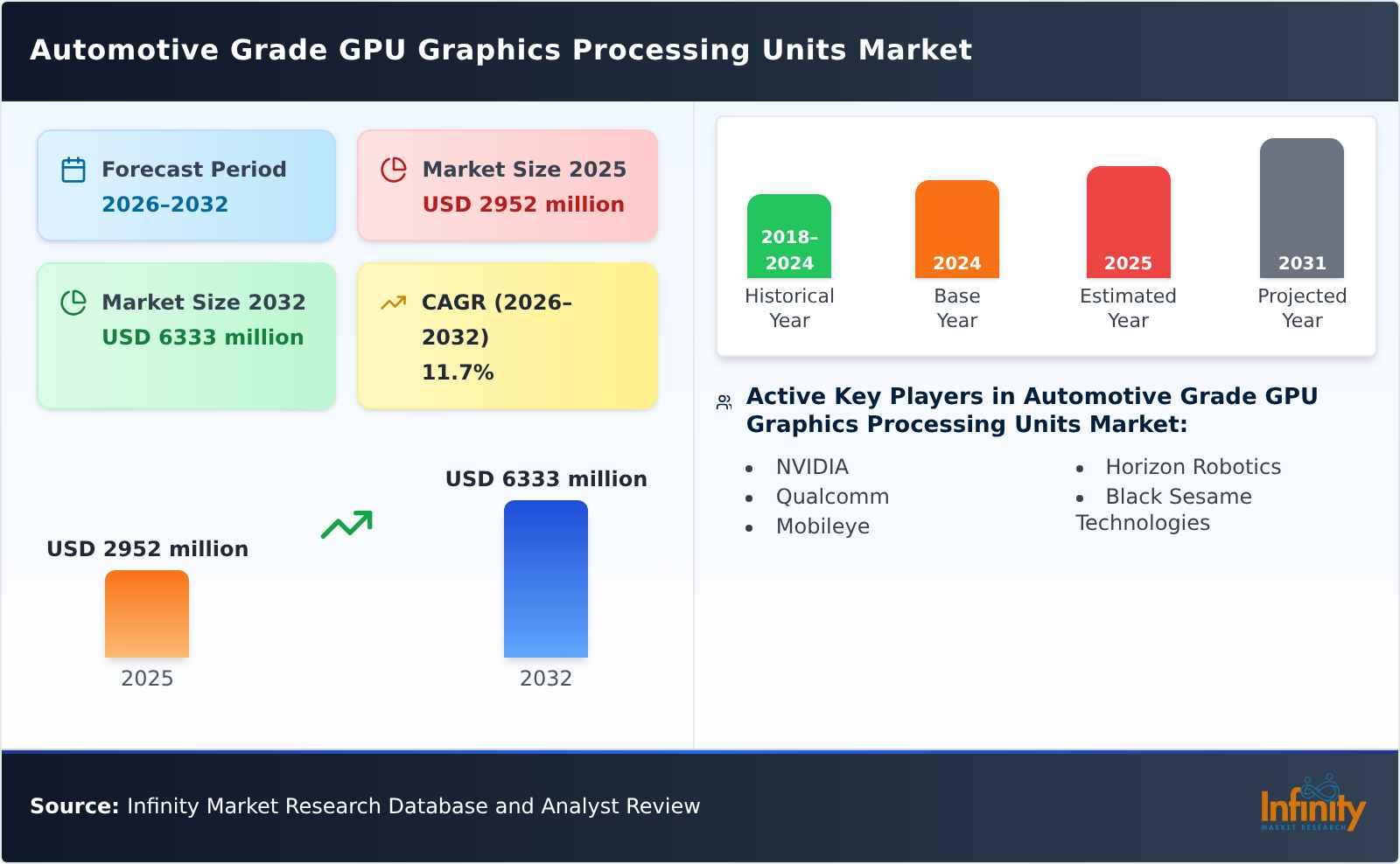
The global Automotive Grade GPU (Graphics Processing Units) market size is predicted to grow from US$ 2952 million in 2025 to US$ 6333 million in 2032; it is expected to grow at a CAGR of 11.7% from 2026 to 2032.
Explore this report in detail? Download a free sample copy
Download Free Sample Report
Automotive-grade GPUs (Graphics Processing Units) are graphics and parallel-compute processorseither discrete devices or GPU subsystems integrated into automotive SoCsengineered and qualified for the automotive operating environment and safety/reliability constraints, including wide temperature ranges, vibration, electromagnetic interference, strict quality control, and long-term availability. They primarily address the problem that modern vehicles demand workstation-like rendering and compute (digital clusters, infotainment, multi-display composition, AR-HUD, camera visualization, video encode/decode and post-processing, and increasingly heterogeneous acceleration alongside CPUs/NPUs/ISPs) while automotive systems must remain deterministic, durable, and safe over a decade-long lifecycle. In practice, an automotive GPU is designed not just for performance, but for predictable behavior, fault tolerance/diagnostics, functional safety readiness, cybersecurity considerations, and supply continuityso that critical HMI and visualization workloads avoid stalls, black screens, and thermal instability that could compromise driver awareness. Historically, in-car graphics started with basic 2D display controllers and simple accelerators; as navigation, 3D UI, and rich multimedia expanded, GPUs became stronger and were commonly integrated into automotive SoCs; over the last decade, the shift toward software-defined vehicles, centralized compute, and sensor-rich ADAS has pushed GPUs beyond UI into advanced visualization pipelines (surround view, camera stitching, 3D scene rendering) and selective parallel acceleration for perception-related workloads, forming part of an increasingly standard heterogeneous compute stack. Upstream, the supply chain spans raw materials and process consumables for semiconductor fabrication (ultra-high-purity silicon, photoresists, targets, specialty gases and chemicals), wafer foundry and front-end processing services, and packaging/test with associated materials (substrates, solder balls/bumps, underfill, molding compounds), plus critical supporting components such as automotive-grade memory (DRAM/LPDDR/GDDR/flash), power delivery parts (PMICs, MOSFETs, inductors/capacitors), clocking, high-speed interconnect and interface chips (SerDes, PCIe/Ethernet PHYs, display bridges), thermal solutions (TIMs, heat spreaders, heat pipes/vapor chambers, heatsinks), and protection/EMC components (ESD devices, filters, connectors and harnesses). Typically, Tier-1 suppliers integrate the GPU into an ECU/domain controller and complete vehicle-level validation and calibration, turning raw compute capability into production-grade, diagnosable, upgradable automotive functions.In 2025, the global production capacity of automotive-grade GPUs is 13 million units, global sales of automotive-grade GPUs reach 10.67 million units, the average selling price is USD 282.6 per chip, and corporate gross margins range between 50% and 70%.
The market today is shaped by two reinforcing demand poles and a rapid shift in system integration. On one side, digital cockpits have normalized multi-display, high-resolution, high-refresh, 3D-heavy user experiences with simultaneous media workloads; on the other, driver-assistance visualization and surround-view pipelines make low-latency video processing, composition, and rendering an increasingly standard requirement in production platforms. As architectures evolve from distributed ECUs toward cockpit domain controllers and centralized compute nodes, GPUs are most often delivered as integrated subsystems inside automotive SoCs, with only a limited set of premium platforms adopting more discrete, higher-performance approaches. Collaboration across chip vendors, Tier-1s, and OEMs is tightening around drivers, graphics stacks, virtualization, mixed-OS deployments, OTA practices, and diagnosticsyet the realities of qualification, safety cases, software adaptation, and long-term supply create long adoption cycles and strong platform lock-in, where ecosystem maturity and supply confidence often outweigh peak performance.
Looking ahead, the direction is likely to be a combined movement toward centralization, heterogeneous computing, and software-defined delivery. Centralization pushes fewer high-capability nodes to serve multiple displays and concurrent workloads (HMI, recording, playback, visualization) on shared hardware, making virtualization and isolation increasingly non-negotiable. Heterogeneity deepens as GPUs operate in tighter coordination with CPUs, NPUs, ISPs, video engines, and safety/security islands, with workloads dynamically partitioned across engines; success will be measured less by raw frame rates and more by end-to-end latency, sustained performance under strict power/thermal envelopes, and scheduling efficiency for mixed graphics-and-AI tasks. Software-defined development accelerates standardization around graphics APIs, middleware, containers, and toolchains, as OEMs aim to iterate cockpit experiences like software productsraising expectations for portability, observability, rollback safety, robust profiling, and secure update mechanisms, and encouraging selective adoption of open standards where they reduce integration friction.
The main tailwinds come from rising user expectations for immersive HMI and seamless multi-screen experiences, functional requirements for real-time visualization and higher-fidelity scene presentation (including AR overlays and camera-based parking/surround-view rendering), and engineering pressure to reuse platforms in domain/central compute architectures under the broader software-defined vehicle model. The headwinds are equally structural: qualification and safety compliance are costly and slow, and even small changes in drivers or graphics stacks can trigger extensive regression work; power and thermal constraints are far tighter than in consumer electronics, making sustained GPU loads challenging alongside noise, packaging, and reliability targets; supply-chain and long-term availability risks can disrupt consistency and requalification reuse; and ecosystem fragmentation across OS choices, graphics frameworks, virtualization approaches, and display/sensor configurations drives high porting and maintenance costs. In practice, the solutions that win tend to be those that balance good-enough performance with proven software maturity and a validation path thats predictable at scale, rather than those that simply maximize compute.
Infinity Market Research newest research report, the Automotive Grade GPU (Graphics Processing Units) Industry Forecast looks at past sales and reviews total world Automotive Grade GPU (Graphics Processing Units) sales in 2025, providing a comprehensive analysis by region and market sector of projected Automotive Grade GPU (Graphics Processing Units) sales for 2026 through 2032. With Automotive Grade GPU (Graphics Processing Units) sales broken down by region, market sector and sub-sector, this report provides a detailed analysis in US$ millions of the world Automotive Grade GPU (Graphics Processing Units) industry.
This Insight Report provides a comprehensive analysis of the global Automotive Grade GPU (Graphics Processing Units) landscape and highlights key trends related to product segmentation, company formation, revenue, and market share, latest development, and M&A activity. This report also analyzes the strategies of leading global companies with a focus on Automotive Grade GPU (Graphics Processing Units) portfolios and capabilities, market entry strategies, market positions, and geographic footprints, to better understand these firms unique position in an accelerating global Automotive Grade GPU (Graphics Processing Units) market.
This Insight Report evaluates the key market trends, drivers, and affecting factors shaping the global outlook for Automotive Grade GPU (Graphics Processing Units) and breaks down the forecast by Type, by Application, geography, and market size to highlight emerging pockets of opportunity. With a transparent methodology based on hundreds of bottom-up qualitative and quantitative market inputs, this study forecast offers a highly nuanced view of the current state and future trajectory in the global Automotive Grade GPU (Graphics Processing Units).
This report presents a comprehensive overview, market shares, and growth opportunities of Automotive Grade GPU (Graphics Processing Units) market by product type, application, key manufacturers and key regions and countries.
Segmentation by Type:
Integrated
Discrete
Segmentation by Compute Performance Tier:
Entry-Level
Mainstream
High-Performance
Ultra-High Performance
Segmentation by Workload Focus:
Graphics-Centric
Vision-Centric
AI Inference-Centric
Mixed Workloads
Segmentation by Application:
Passenger Car
Commercial Vehicle
This report also splits the market by region:
Americas
United States
Canada
Mexico
Brazil
APAC
China
Japan
Korea
Southeast Asia
India
Australia
Europe
Germany
France
UK
Italy
Russia
Middle East & Africa
Egypt
South Africa
Israel
Turkey
GCC Countries
The below companies that are profiled have been selected based on inputs gathered from primary experts and analysing the companys coverage, product portfolio, its market penetration.
NVIDIA
Qualcomm
Mobileye
Horizon Robotics
Black Sesame Technologies
Key Questions Addressed in this Report
What is the 10-year outlook for the global Automotive Grade GPU (Graphics Processing Units) market?
What factors are driving Automotive Grade GPU (Graphics Processing Units) market growth, globally and by region?
Which technologies are poised for the fastest growth by market and region?
How do Automotive Grade GPU (Graphics Processing Units) market opportunities vary by end market size?
How does Automotive Grade GPU (Graphics Processing Units) break out by Type, by Application?
Automotive Grade GPU Graphics Processing Units Market Scope
| Report Attribute | Details |
|---|---|
| Market Size (Start Year) | USD XX Million |
| Market Size (End Year) | USD XX Million |
| Compound Annual Growth Rate (CAGR) | USD XX Million |
| Forecast Period | USD XX Million |
| Base Year | USD XX Million |
| Historical Data | USD XX Million |
| Key Players | USD XX Million |
REPORT COVERAGE
Revenue forecast, Company Analysis, Industry landscape, Growth factors, and Trends
SEGMENT COVERED
By component, deployment, organization size, application, and industry.
REGIONAL SCOPE
North America, Europe, Asia Pacific, Middle East & Africa, South & Central America
COUNTRY SCOPE
Includes key countries across all major regions.
📘 Frequently Asked Questions
1. What is the market size of Global Automotive Grade GPU Graphics Processing Units Market?
Answer: The global Automotive Grade GPU (Graphics Processing Units) market size is predicted to grow from US$ 2952 million in 2025 to US$ 6333 million in 2032; it is expected to grow at a CAGR of 11.7% from 2026 to 2032.
2. Which regions are analyzed in the Global Automotive Grade GPU Graphics Processing Units Market report?
Answer: The Global Automotive Grade GPU Graphics Processing Units Market report covers major regions such as Europe, Middle East & Africa. Each region is analyzed for trends, opportunities, and market dynamics.
3. What methodology is used for forecasting of Global Automotive Grade GPU Graphics Processing Units Market?
Answer: The Global Automotive Grade GPU Graphics Processing Units Market report uses a mix of primary research, secondary data, and expert analysis.
4. Are emerging markets analyzed separately in the Global Automotive Grade GPU Graphics Processing Units Market?
Answer: Yes, the Global Automotive Grade GPU Graphics Processing Units Market report highlights high-growth emerging regions with dedicated insights.
5. Does the report include competitive benchmarking of Global Automotive Grade GPU Graphics Processing Units Market?
Answer: Yes, Global Automotive Grade GPU Graphics Processing Units Market report compares major players based on revenue, product portfolio, and innovation.
6. Can I access country-level data within the Global Automotive Grade GPU Graphics Processing Units Market report?
Answer: Yes, Global Automotive Grade GPU Graphics Processing Units Market report includes detailed data by country for major regions.
7. Can I get customized insights or data from the Global Automotive Grade GPU Graphics Processing Units Market report?
Answer: Yes, we offer customization options to align with your specific business needs. You can request tailored sections or regional breakdowns.