


Global Automotive Inbound to Manufacturing Market Size, Share and Opportunities 2026-2032
Feb 2026
Automobiles
Pages: 155
ILR4063
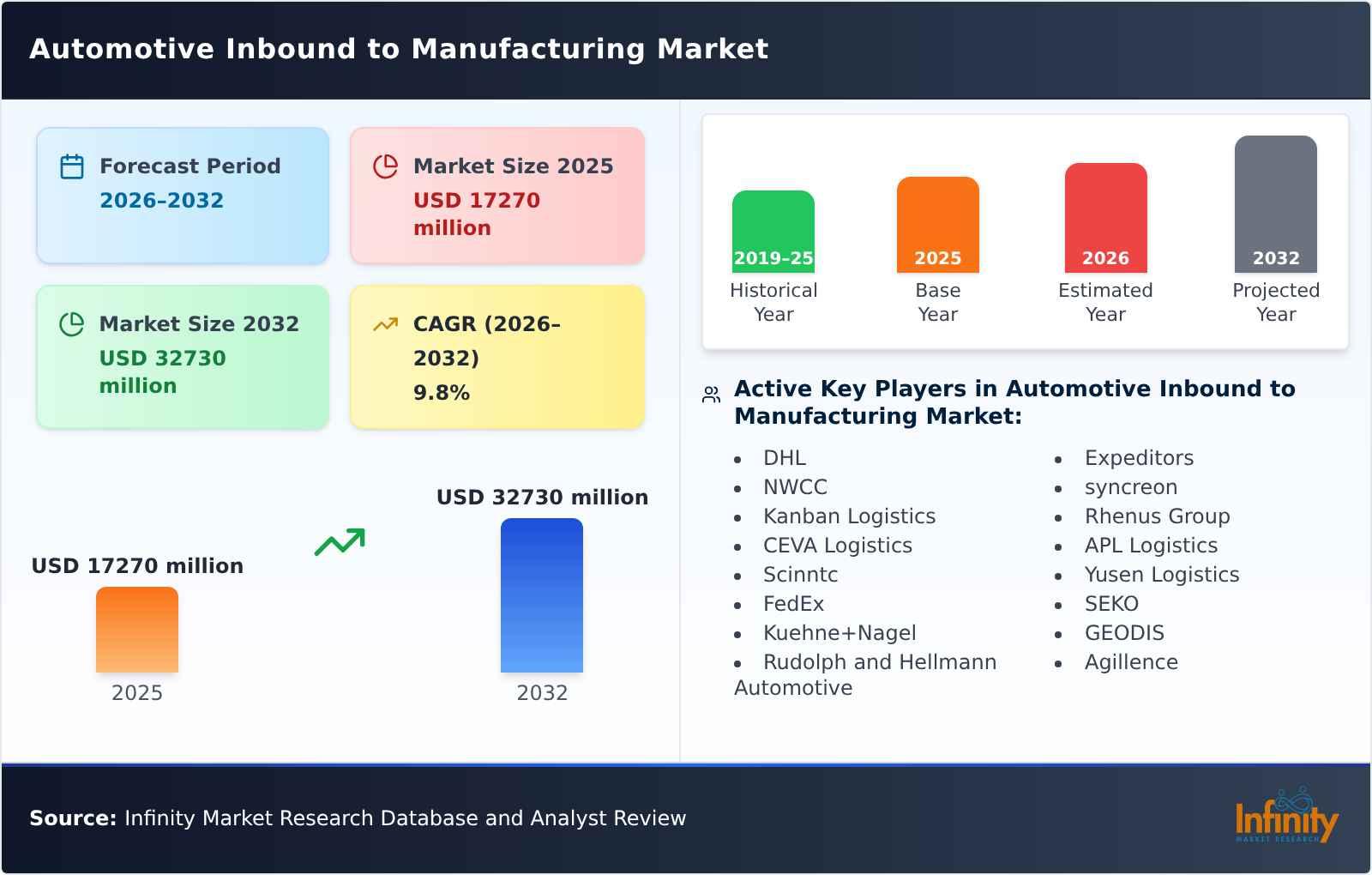
The global Automotive Inbound to Manufacturing market size is predicted to grow from US$ 17270 million in 2025 to US$ 32730 million in 2032; it is expected to grow at a CAGR of 9.8% from 2026 to 2032.
Explore this report in detail? Download a free sample copy
Download Free Sample Report
Automotive Inbound to Manufacturing refers to the process of managing the flow of materials, components, and parts from suppliers to the manufacturing facility in the automotive industry. This includes coordinating the delivery of raw materials and components needed for production, ensuring that they arrive on time and in the right quantities. It also involves managing inventory levels, optimizing transportation routes, and maintaining strong relationships with suppliers to ensure a smooth and efficient supply chain. By effectively managing the inbound logistics process, automotive manufacturers can reduce costs, improve production efficiency, and ultimately deliver high-quality vehicles to customers.
Automotive inbound to manufacturing encompasses the intricate network of processes that govern the flow of materials, components, and information from suppliers to automotive production facilities, serving as a critical backbone of the industrys operational efficiency. Currently, the market is shaped by a growing emphasis on agility and responsiveness, driven by the evolving demands of vehicle productionparticularly as the industry shifts toward electric and hybrid models, which require distinct supply chains compared to traditional internal combustion engine vehicles. Suppliers and manufacturers are increasingly collaborating to streamline inbound logistics, with a focus on reducing lead times and minimizing waste, aligning with broader sustainability goals that push for lower carbon footprints across the supply chain.?
Digitalization has emerged as a key enabler in this space, with many players adopting advanced software solutions to enhance visibility into inventory levels, track shipments in real time, and predict potential disruptions. This shift toward data-driven decision-making has fostered greater integration between suppliers and manufacturers, breaking down silos that once hindered communication and coordination. Additionally, the rise of modular production strategies, where components are preassembled by suppliers before reaching the factory floor, has simplified inbound processes, allowing manufacturers to focus on final assembly and customization.?
Looking to the future, the market is poised to undergo further transformation, driven by technological innovation and changing industry dynamics. The integration of artificial intelligence and machine learning is expected to deepen, enabling more accurate demand forecasting and proactive management of supply chain risks, such as geopolitical uncertainties or material shortages. These technologies will also facilitate more dynamic routing of shipments, optimizing delivery schedules based on real-time conditions like weather, traffic, or production line changes.?
Sustainability will continue to be a defining trend, with a growing push to incorporate circular economy principles into inbound manufacturing. This includes the increased use of recycled materials, the design of components for easier disassembly and reuse, and the adoption of eco-friendly transportation methodssuch as electric trucks or rail systemsfor inbound shipments. Collaboration between manufacturers and suppliers will evolve beyond transactional relationships to strategic partnerships focused on co-developing sustainable solutions, from packaging that reduces waste to processes that lower energy consumption.?
Another notable direction is the rise of regionalized supply chains, as manufacturers seek to reduce reliance on distant suppliers and shorten delivery routes. This shift, partly driven by a desire to enhance resilience against global disruptions, will lead to closer alignment between local suppliers and production facilities, fostering quicker response times and stronger community-based industrial ecosystems. Additionally, the growth of connected vehicles and smart factories will create new opportunities for inbound manufacturing to integrate with broader Industry 4.0 initiatives, where components arrive pre-equipped with sensors that communicate directly with production systems, enabling seamless integration into the manufacturing process and real-time quality checks.?
Overall, the future of automotive inbound to manufacturing lies in a blend of technological advancement, sustainable practices, and collaborative networks, all working together to create more efficient, resilient, and environmentally conscious supply chains that can adapt to the rapid changes defining the automotive industry.?
Infinity Market Research newest research report, the Automotive Inbound to Manufacturing Industry Forecast looks at past sales and reviews total world Automotive Inbound to Manufacturing sales in 2025, providing a comprehensive analysis by region and market sector of projected Automotive Inbound to Manufacturing sales for 2026 through 2032. With Automotive Inbound to Manufacturing sales broken down by region, market sector and sub-sector, this report provides a detailed analysis in US$ millions of the world Automotive Inbound to Manufacturing industry.
This Insight Report provides a comprehensive analysis of the global Automotive Inbound to Manufacturing landscape and highlights key trends related to product segmentation, company formation, revenue, and market share, latest development, and M&A activity. This report also analyses the strategies of leading global companies with a focus on Automotive Inbound to Manufacturing portfolios and capabilities, market entry strategies, market positions, and geographic footprints, to better understand these firms unique position in an accelerating global Automotive Inbound to Manufacturing market.
This Insight Report evaluates the key market trends, drivers, and affecting factors shaping the global outlook for Automotive Inbound to Manufacturing and breaks down the forecast by Type, by Application, geography, and market size to highlight emerging pockets of opportunity. With a transparent methodology based on hundreds of bottom-up qualitative and quantitative market inputs, this study forecast offers a highly nuanced view of the current state and future trajectory in the global Automotive Inbound to Manufacturing.
This report presents a comprehensive overview, market shares, and growth opportunities of Automotive Inbound to Manufacturing market by product type, application, key players and key regions and countries.
Segmentation by Type:
Complete Vehicles
Auto Parts
Segmentation by Application:
OEM
Tier 1 Supply
Others
This report also splits the market by region:
Americas
United States
Canada
Mexico
Brazil
APAC
China
Japan
Korea
Southeast Asia
India
Australia
Europe
Germany
France
UK
Italy
Russia
Middle East & Africa
Egypt
South Africa
Israel
Turkey
GCC Countries
The below companies that are profiled have been selected based on inputs gathered from primary experts and analyzing the companys coverage, product portfolio, its market penetration.
DHL
NWCC
Kanban Logistics
CEVA Logistics
Scinntc
FedEx
Kuehne+Nagel
Rudolph and Hellmann Automotive
Expeditors
syncreon
Rhenus Group
APL Logistics
Yusen Logistics
SEKO
GEODIS
Agillence
Penske Logistics
Ryder System
DSV
Huatong Automotive Logistics
SF Express
CCL
ANJI-CEVA Logistics
Automotive Inbound to Manufacturing Market Scope
| Report Attribute | Details |
|---|---|
| Market Size (Start Year) | USD XX Million |
| Market Size (End Year) | USD XX Million |
| Compound Annual Growth Rate (CAGR) | USD XX Million |
| Forecast Period | USD XX Million |
| Base Year | USD XX Million |
| Historical Data | USD XX Million |
| Key Players | USD XX Million |
REPORT COVERAGE
Revenue forecast, Company Analysis, Industry landscape, Growth factors, and Trends
SEGMENT COVERED
By component, deployment, organization size, application, and industry.
REGIONAL SCOPE
North America, Europe, Asia Pacific, Middle East & Africa, South & Central America
COUNTRY SCOPE
Includes key countries across all major regions.
Frequently Asked Questions
1. What is the market size of Global Automotive Inbound to Manufacturing Market?
Answer: The global Automotive Inbound to Manufacturing market size is predicted to grow from US$ 17270 million in 2025 to US$ 32730 million in 2032; it is expected to grow at a CAGR of 9.8% from 2026 to 2032.
2. Which regions are analyzed in the Global Automotive Inbound to Manufacturing Market report?
Answer: The Global Automotive Inbound to Manufacturing Market report covers major regions such as Europe, Middle East & Africa. Each region is analyzed for trends, opportunities, and market dynamics.
3. What methodology is used for forecasting of Global Automotive Inbound to Manufacturing Market?
Answer: The Global Automotive Inbound to Manufacturing Market report uses a mix of primary research, secondary data, and expert analysis.
4. Are emerging markets analyzed separately in the Global Automotive Inbound to Manufacturing Market?
Answer: Yes, the Global Automotive Inbound to Manufacturing Market report highlights high-growth emerging regions with dedicated insights.
5. Does the report include competitive benchmarking of Global Automotive Inbound to Manufacturing Market?
Answer: Yes, Global Automotive Inbound to Manufacturing Market report compares major players based on revenue, product portfolio, and innovation.
6. Can I access country-level data within the Global Automotive Inbound to Manufacturing Market report?
Answer: Yes, Global Automotive Inbound to Manufacturing Market report includes detailed data by country for major regions.
7. Can I get customized insights or data from the Global Automotive Inbound to Manufacturing Market report?
Answer: Yes, we offer customization options to align with your specific business needs. You can request tailored sections or regional breakdowns.