


Global Autonomous Driving GPU Chip Market Growth 2026-2032
Jan 2026
Semiconductor and Electronics
Pages: 78
ILR1591
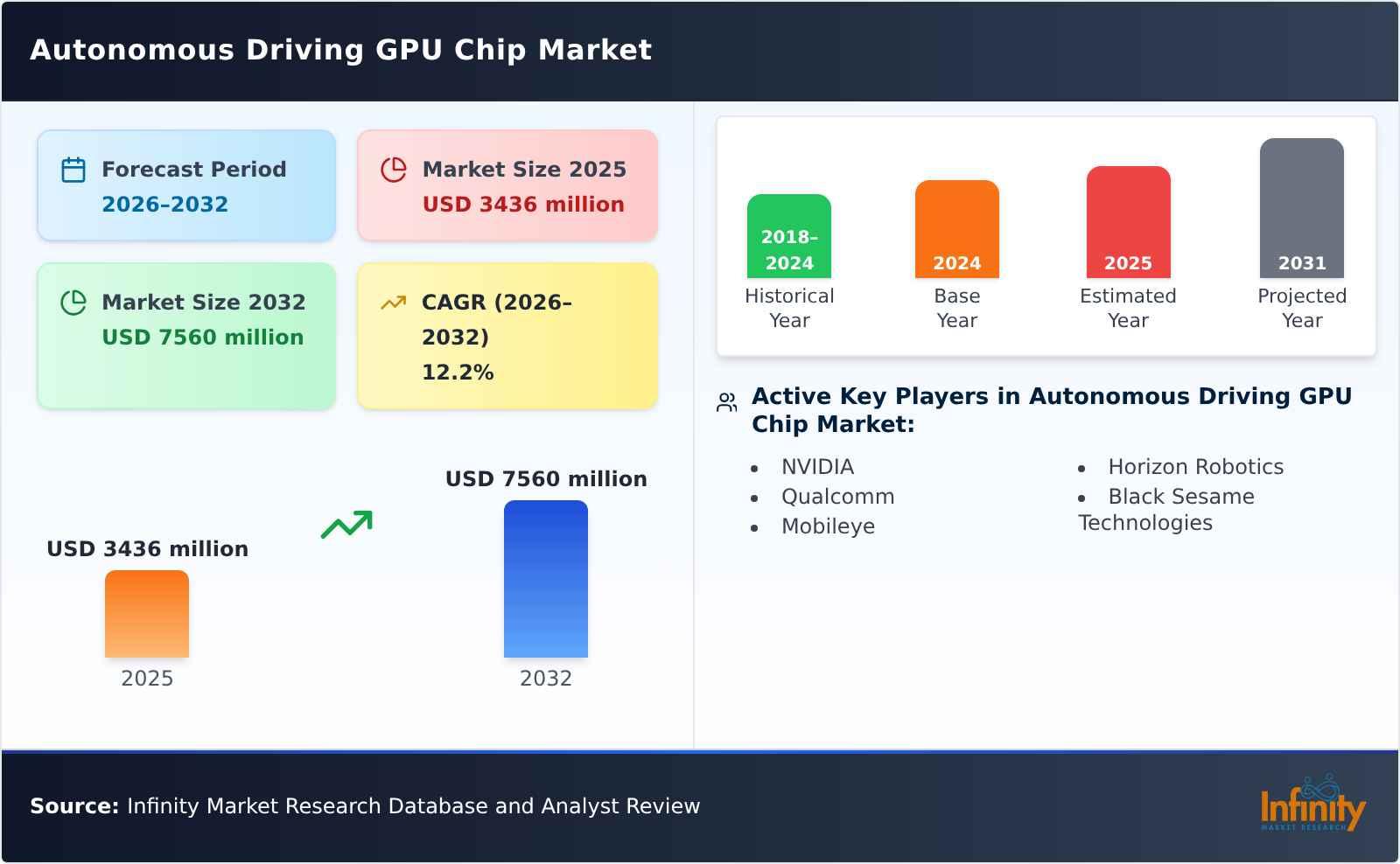
The global Autonomous Driving GPU Chip market size is predicted to grow from US$ 3436 million in 2025 to US$ 7560 million in 2032; it is expected to grow at a CAGR of 12.2% from 2026 to 2032.
Explore this report in detail? Download a free sample copy
Download Free Sample Report
An Autonomous Driving GPU Chip is a compute processor designed specifically for autonomous driving systems, meeting automotive-grade requirements for reliability, functional safety, and long-term operation, and serving as a core acceleration engine within ADAS or autonomous driving domain controllers and centralized compute platforms. Its primary purpose is to handle massive, highly parallel workloadssuch as sensor data processing, perception, sensor fusion, visualization, and increasingly AI inferenceunder strict constraints on power consumption, thermal dissipation, real-time determinism, and safety certification. Historically, the technology evolved from early stages where consumer GPUs were used mainly for research and prototyping, to automotive-adapted parallel processors, and ultimately to todays tightly integrated autonomous driving compute platforms in which the GPU works alongside CPUs, AI accelerators, ISPs, and safety subsystems as part of a unified heterogeneous architecture. Upstream, the supply chain spans semiconductor raw materials (silicon wafers, epitaxial layers, advanced packaging substrates, thermal interface materials), manufacturing and packaging inputs, and essential components and processes such as automotive-grade foundry services, advanced packaging and testing, memory devices, power management components, high-speed interconnects, and qualified passive components, all of which underpin the performance, safety, and production scalability of autonomous driving GPU chips.In 2025, global production capacity for autonomous driving GPU chips is estimated at 15 million units, while sales reached approximately 11.24 million units. The average selling price is about USD 312.4 per chip, and gross margins across suppliers generally range between 50% and 70%.
The current market is characterized by growing concentration and platform-oriented adoption, with autonomous driving programs increasingly centered on solutions that are production-ready, verifiable, and sustainable over long vehicle lifecycles. OEMs and Tier-1 suppliers place greater emphasis on real-world stability, consistency under multi-sensor concurrency, and alignment with vehicle E/E architectures than on raw peak performance. GPU capabilities are typically evaluated as part of an integrated autonomous driving compute platform, where their value lies in visualization, development and debugging efficiency, model validation, and data replay workflows. As a result, mature solutions with proven ecosystems tend to be reused across programs, while new entrants face extended validation cycles before achieving broad deployment.
Looking ahead, evolution will be driven by changes in workload structure, stronger requirements for system determinism, and deeper software industrialization. Autonomous driving workloads continue to move toward long-running, multi-task operation, raising expectations for sustained performance, memory efficiency, and predictable scheduling, and pushing tighter coordination between GPUs and other heterogeneous compute units. At the vehicle level, increasing safety and real-time constraints will accelerate the adoption of refined isolation, partitioning, and redundancy mechanisms to ensure predictable behavior under complex parallel execution. At the same time, software becomes central to differentiation: robust model deployment pipelines, version control, OTA updates, and traceability are becoming essential capabilities, and the maturity and maintainability of GPU software stacks will strongly influence platform longevity.
Key drivers include the rising complexity of autonomous driving functions, the need for higher development efficiency, and OEM demands for safety assurance and long-term cost control. Advanced driver assistance and automation require powerful parallel computing and effective visualization tools, while regulatory and liability considerations push systems toward verifiable and explainable operation. However, constraints remain significant: automotive-grade functional safety and reliability validation is time-consuming and expensive, real-time predictability under mixed GPU workloads is technically challenging, and long-term supply stability places pressure on both vendors and customers. In addition, ecosystem lock-in and limited tooling transparency can reduce OEM control and flexibility, making platform choices difficult to reverse once vehicles enter production. Together, these factors shape both the pace of adoption and the competitive landscape of the market.
Infinity Market Research newest research report, the Autonomous Driving GPU Chip Industry Forecast looks at past sales and reviews total world Autonomous Driving GPU Chip sales in 2025, providing a comprehensive analysis by region and market sector of projected Autonomous Driving GPU Chip sales for 2026 through 2032. With Autonomous Driving GPU Chip sales broken down by region, market sector and sub-sector, this report provides a detailed analysis in US$ millions of the world Autonomous Driving GPU Chip industry.
This Insight Report provides a comprehensive analysis of the global Autonomous Driving GPU Chip landscape and highlights key trends related to product segmentation, company formation, revenue, and market share, latest development, and M&A activity. This report also analyzes the strategies of leading global companies with a focus on Autonomous Driving GPU Chip portfolios and capabilities, market entry strategies, market positions, and geographic footprints, to better understand these firms unique position in an accelerating global Autonomous Driving GPU Chip market.
This Insight Report evaluates the key market trends, drivers, and affecting factors shaping the global outlook for Autonomous Driving GPU Chip and breaks down the forecast by Type, by Application, geography, and market size to highlight emerging pockets of opportunity. With a transparent methodology based on hundreds of bottom-up qualitative and quantitative market inputs, this study forecast offers a highly nuanced view of the current state and future trajectory in the global Autonomous Driving GPU Chip.
This report presents a comprehensive overview, market shares, and growth opportunities of Autonomous Driving GPU Chip market by product type, application, key manufacturers and key regions and countries.
Segmentation by Type:
Discrete GPU
Integrated GPU
Segmentation by Compute Performance Tier:
Entry-Level
Mainstream
High-Performance
Ultra-High Performance
Segmentation by Workload Focus:
Graphics-Centric
Vision-Centric
AI Inference-Centric
Mixed Workloads
Segmentation by Application:
Commercial Vehicles
Passenger Vehicles
This report also splits the market by region:
Americas
United States
Canada
Mexico
Brazil
APAC
China
Japan
Korea
Southeast Asia
India
Australia
Europe
Germany
France
UK
Italy
Russia
Middle East & Africa
Egypt
South Africa
Israel
Turkey
GCC Countries
The below companies that are profiled have been selected based on inputs gathered from primary experts and analysing the companys coverage, product portfolio, its market penetration.
NVIDIA
Qualcomm
Mobileye
Horizon Robotics
Black Sesame Technologies
Key Questions Addressed in this Report
What is the 10-year outlook for the global Autonomous Driving GPU Chip market?
What factors are driving Autonomous Driving GPU Chip market growth, globally and by region?
Which technologies are poised for the fastest growth by market and region?
How do Autonomous Driving GPU Chip market opportunities vary by end market size?
How does Autonomous Driving GPU Chip break out by Type, by Application?
Autonomous Driving GPU Chip Market Scope
| Report Attribute | Details |
|---|---|
| Market Size (Start Year) | USD XX Million |
| Market Size (End Year) | USD XX Million |
| Compound Annual Growth Rate (CAGR) | USD XX Million |
| Forecast Period | USD XX Million |
| Base Year | USD XX Million |
| Historical Data | USD XX Million |
| Key Players | USD XX Million |
REPORT COVERAGE
Revenue forecast, Company Analysis, Industry landscape, Growth factors, and Trends
SEGMENT COVERED
By component, deployment, organization size, application, and industry.
REGIONAL SCOPE
North America, Europe, Asia Pacific, Middle East & Africa, South & Central America
COUNTRY SCOPE
Includes key countries across all major regions.
📘 Frequently Asked Questions
1. What is the market size of Global Autonomous Driving GPU Chip Market?
Answer: The global Autonomous Driving GPU Chip market size is predicted to grow from US$ 3436 million in 2025 to US$ 7560 million in 2032; it is expected to grow at a CAGR of 12.2% from 2026 to 2032.
2. Which regions are analyzed in the Global Autonomous Driving GPU Chip Market report?
Answer: The Global Autonomous Driving GPU Chip Market report covers major regions such as Europe, Middle East & Africa. Each region is analyzed for trends, opportunities, and market dynamics.
3. What methodology is used for forecasting of Global Autonomous Driving GPU Chip Market?
Answer: The Global Autonomous Driving GPU Chip Market report uses a mix of primary research, secondary data, and expert analysis.
4. Are emerging markets analyzed separately in the Global Autonomous Driving GPU Chip Market?
Answer: Yes, the Global Autonomous Driving GPU Chip Market report highlights high-growth emerging regions with dedicated insights.
5. Does the report include competitive benchmarking of Global Autonomous Driving GPU Chip Market?
Answer: Yes, Global Autonomous Driving GPU Chip Market report compares major players based on revenue, product portfolio, and innovation.
6. Can I access country-level data within the Global Autonomous Driving GPU Chip Market report?
Answer: Yes, Global Autonomous Driving GPU Chip Market report includes detailed data by country for major regions.
7. Can I get customized insights or data from the Global Autonomous Driving GPU Chip Market report?
Answer: Yes, we offer customization options to align with your specific business needs. You can request tailored sections or regional breakdowns.