


Global Battery for Implantable Device Market Growth 2026-2032
Jan 2026
Energy and Power
Pages: 120
ILR1309
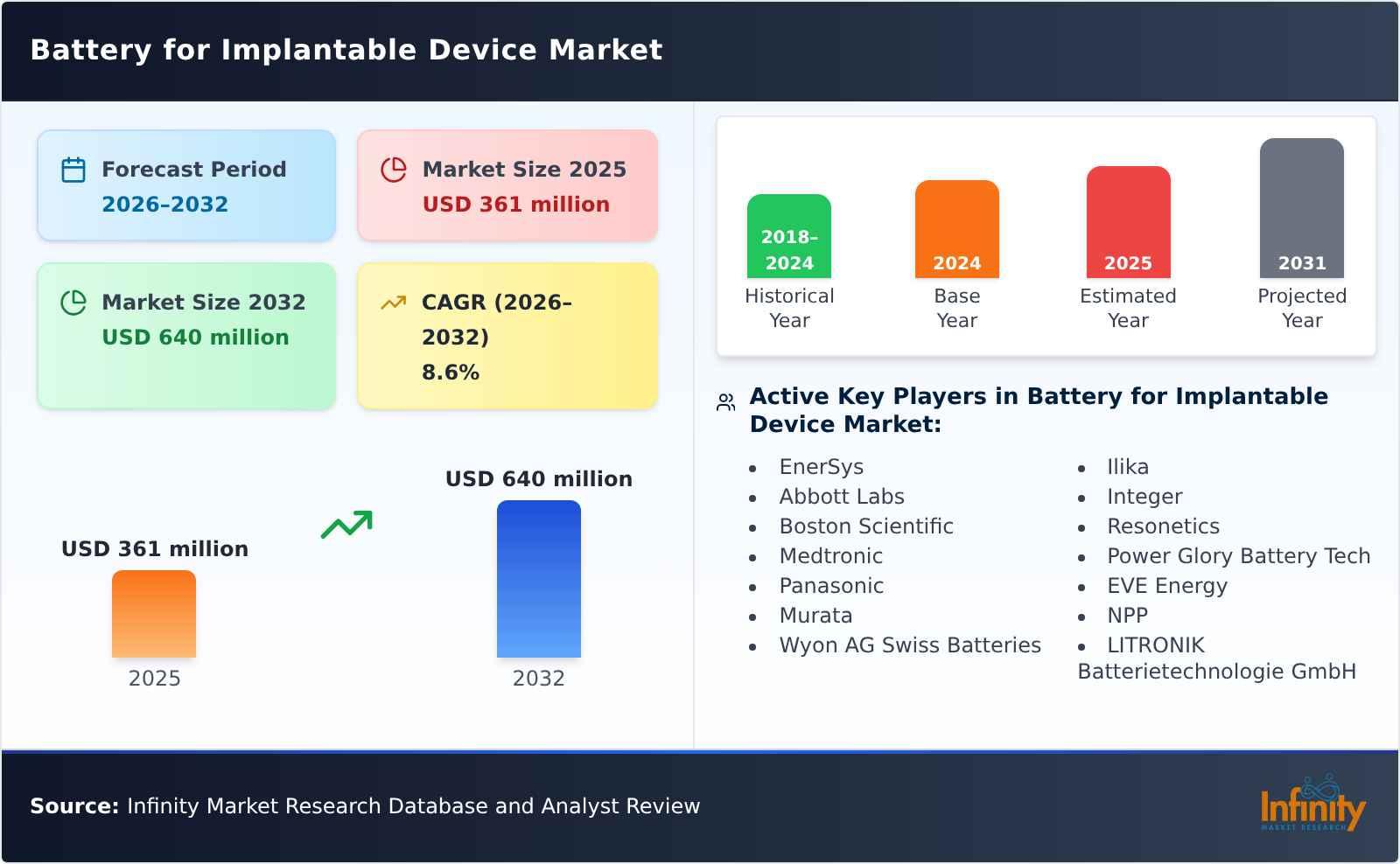
The global Battery for Implantable Device market size is predicted to grow from US$ 361 million in 2025 to US$ 640 million in 2032; it is expected to grow at a CAGR of 8.6% from 2026 to 2032.
Explore this report in detail? Download a free sample copy
Download Free Sample Report
Implantable medical device batteries are a type of high-safety miniature power system specifically designed for long-term power supply within the human body. They primarily provide stable and reliable power to active implantable devices such as pacemakers, implantable defibrillators, cochlear implants, neurostimulators, insulin pumps, and long-term blood glucose monitoring devices. Global sales in 2025 were approximately 108.04 MWh, equivalent to a unit price of approximately US$3.26 per watt-hour, with a single production line annual capacity of approximately 2.4 MWh. Upstream companies are mainly concentrated in precision chemical and electronic packaging fields such as medical-grade lithium metal, fluorinated carbon, silver oxide, titanium shell packaging, and ceramic sealing materials. Midstream companies are involved in the manufacturing and packaging of medical micro-power supplies, while downstream companies are manufacturers of medical devices for heart rhythm management, neuromodulation, artificial sensing, and long-term monitoring. The industrys average gross profit margin is approximately 41%, higher than the general lithium battery industry, mainly due to extremely high certification thresholds and long supply cycles. In the product cost structure, material costs account for approximately 45%, packaging and process verification account for approximately 35%, and the remainder is for quality testing and long-term aging tests. Products can be mainly categorized by parameters into high-power types (for defibrillators and neurostimulators), high-energy-density types (for pacemakers and monitoring devices), rechargeable types (for closed-loop therapy and continuous drug delivery systems), and miniature short-term types (for subcutaneous monitoring and sensing devices). In terms of demand, cardiovascular implantable devices account for approximately 38% of total demand, neuromodulation and brain-interface devices approximately 26%, cochlear implants and sensing devices approximately 20%, and subcutaneous minimally invasive monitoring devices approximately 16%. Downstream customers include international companies such as Abbott, Boston Scientific, Medtronic, Cochlear, Dexcom, Nevro, and Integer, as well as some regional medical device manufacturers. Business opportunities are primarily driven by three factors: policy support, technological innovation, and consumer demand. At the policy level, countries are continuously strengthening chronic disease management and the localization of high-end medical devices. In terms of technological innovation, the stability of high-voltage solid-state systems and titanium-ceramic packaging has significantly improved. At the consumer end, higher requirements are being placed on implantation comfort, battery life, and remote monitoring capabilities, propelling the implantable medical battery industry from a high-reliability niche market to a new stage of large-scale and intelligent development.
As a core energy component in critical medical devices such as pacemakers, neurostimulators, and implantable insulin pumps, batteries for implantable medical devices enjoy robust demand driven by their high safety, long cycle life, high energy density, and excellent biocompatibility. This demand is fueled by a growing global population aging, increasing numbers of patients with chronic diseases, and the widespread adoption of minimally invasive treatments, resulting in a steadily growing market. Technological development focuses on miniaturization, long lifespan, and intelligentization. New technologies such as solid-state batteries and silicon-based anode materials are rapidly being implemented. Intelligent batteries with embedded battery management systems enable real-time status monitoring, further enhancing safety and maintenance efficiency. Meanwhile, the application of high-performance materials such as lithium iron phosphate and lithium titanate continues to optimize product performance. In terms of the competitive landscape, international brands dominate the high-end market due to their mature technologies and long-term clinical validation, while domestic companies are rapidly rising thanks to policy support, cost advantages, and continuous technological breakthroughs, accelerating the process of domestic substitution. On the policy front, increasingly stringent safety standards for medical devices in various countries are driving the industry towards standardization and regulation, while the domestic production strategy for medical equipment and the concept of green manufacturing are further supporting the industrys development. Despite facing challenges such as stringent compliance certifications, high R&D investment, and breakthroughs in biocompatibility technology, companies with core technology R&D capabilities, full life-cycle compliance assurance capabilities, and customized service capabilities will continue to maintain a competitive advantage as new implantable medical devices emerge and their application scenarios expand, and the market growth potential is vast.
Infinity Market Research newest research report, the Battery for Implantable Device Industry Forecast looks at past sales and reviews total world Battery for Implantable Device sales in 2025, providing a comprehensive analysis by region and market sector of projected Battery for Implantable Device sales for 2026 through 2032. With Battery for Implantable Device sales broken down by region, market sector and sub-sector, this report provides a detailed analysis in US$ millions of the world Battery for Implantable Device industry.
This Insight Report provides a comprehensive analysis of the global Battery for Implantable Device landscape and highlights key trends related to product segmentation, company formation, revenue, and market share, latest development, and M&A activity. This report also analyzes the strategies of leading global companies with a focus on Battery for Implantable Device portfolios and capabilities, market entry strategies, market positions, and geographic footprints, to better understand these firms unique position in an accelerating global Battery for Implantable Device market.
This Insight Report evaluates the key market trends, drivers, and affecting factors shaping the global outlook for Battery for Implantable Device and breaks down the forecast by Type, by Application, geography, and market size to highlight emerging pockets of opportunity. With a transparent methodology based on hundreds of bottom-up qualitative and quantitative market inputs, this study forecast offers a highly nuanced view of the current state and future trajectory in the global Battery for Implantable Device.
This report presents a comprehensive overview, market shares, and growth opportunities of Battery for Implantable Device market by product type, application, key manufacturers and key regions and countries.
Segmentation by Type:
LiMnO2
Lithium/Hybrid CF?Silver
Vanadium Oxide (Li/CF?SVO)
Other
Segmentation by Battery Type:
Zinc-Mercury Batteries
Lithium Batteries
Others
Segmentation by Battery Shape:
Button Batteries
Cylindrical Batteries
Others
Segmentation by Application:
Minimally Invasive/Subcutaneous Device
Invasive Device
Implantable Device
This report also splits the market by region:
Americas
United States
Canada
Mexico
Brazil
APAC
China
Japan
Korea
Southeast Asia
India
Australia
Europe
Germany
France
UK
Italy
Russia
Middle East & Africa
Egypt
South Africa
Israel
Turkey
GCC Countries
The below companies that are profiled have been selected based on inputs gathered from primary experts and analysing the companys coverage, product portfolio, its market penetration.
EnerSys
Abbott Labs
Boston Scientific
Medtronic
Panasonic
Murata
Wyon AG Swiss Batteries
Ilika
Integer
Resonetics
Power Glory Battery Tech
EVE Energy
NPP
LITRONIK Batterietechnologie GmbH
Key Questions Addressed in this Report
What is the 10-year outlook for the global Battery for Implantable Device market?
What factors are driving Battery for Implantable Device market growth, globally and by region?
Which technologies are poised for the fastest growth by market and region?
How do Battery for Implantable Device market opportunities vary by end market size?
How does Battery for Implantable Device break out by Type, by Application?
Battery for Implantable Device Market Scope
| Report Attribute | Details |
|---|---|
| Market Size (Start Year) | USD XX Million |
| Market Size (End Year) | USD XX Million |
| Compound Annual Growth Rate (CAGR) | USD XX Million |
| Forecast Period | USD XX Million |
| Base Year | USD XX Million |
| Historical Data | USD XX Million |
| Key Players | USD XX Million |
REPORT COVERAGE
Revenue forecast, Company Analysis, Industry landscape, Growth factors, and Trends
SEGMENT COVERED
By component, deployment, organization size, application, and industry.
REGIONAL SCOPE
North America, Europe, Asia Pacific, Middle East & Africa, South & Central America
COUNTRY SCOPE
Includes key countries across all major regions.
Frequently Asked Questions
1. What is the market size of Global Battery for Implantable Device Market?
Answer: The global Battery for Implantable Device market size is predicted to grow from US$ 361 million in 2025 to US$ 640 million in 2032; it is expected to grow at a CAGR of 8.6% from 2026 to 2032.
2. Which regions are analyzed in the Global Battery for Implantable Device Market report?
Answer: The Global Battery for Implantable Device Market report covers major regions such as Europe, Middle East & Africa. Each region is analyzed for trends, opportunities, and market dynamics.
3. What methodology is used for forecasting of Global Battery for Implantable Device Market?
Answer: The Global Battery for Implantable Device Market report uses a mix of primary research, secondary data, and expert analysis.
4. Are emerging markets analyzed separately in the Global Battery for Implantable Device Market?
Answer: Yes, the Global Battery for Implantable Device Market report highlights high-growth emerging regions with dedicated insights.
5. Does the report include competitive benchmarking of Global Battery for Implantable Device Market?
Answer: Yes, Global Battery for Implantable Device Market report compares major players based on revenue, product portfolio, and innovation.
6. Can I access country-level data within the Global Battery for Implantable Device Market report?
Answer: Yes, Global Battery for Implantable Device Market report includes detailed data by country for major regions.
7. Can I get customized insights or data from the Global Battery for Implantable Device Market report?
Answer: Yes, we offer customization options to align with your specific business needs. You can request tailored sections or regional breakdowns.