


Global Carbon Sequestration Market Growth (Status and Outlook) 2026-2032
Jan 2026
Information and Communication Technology
Pages: 144
ILR1507
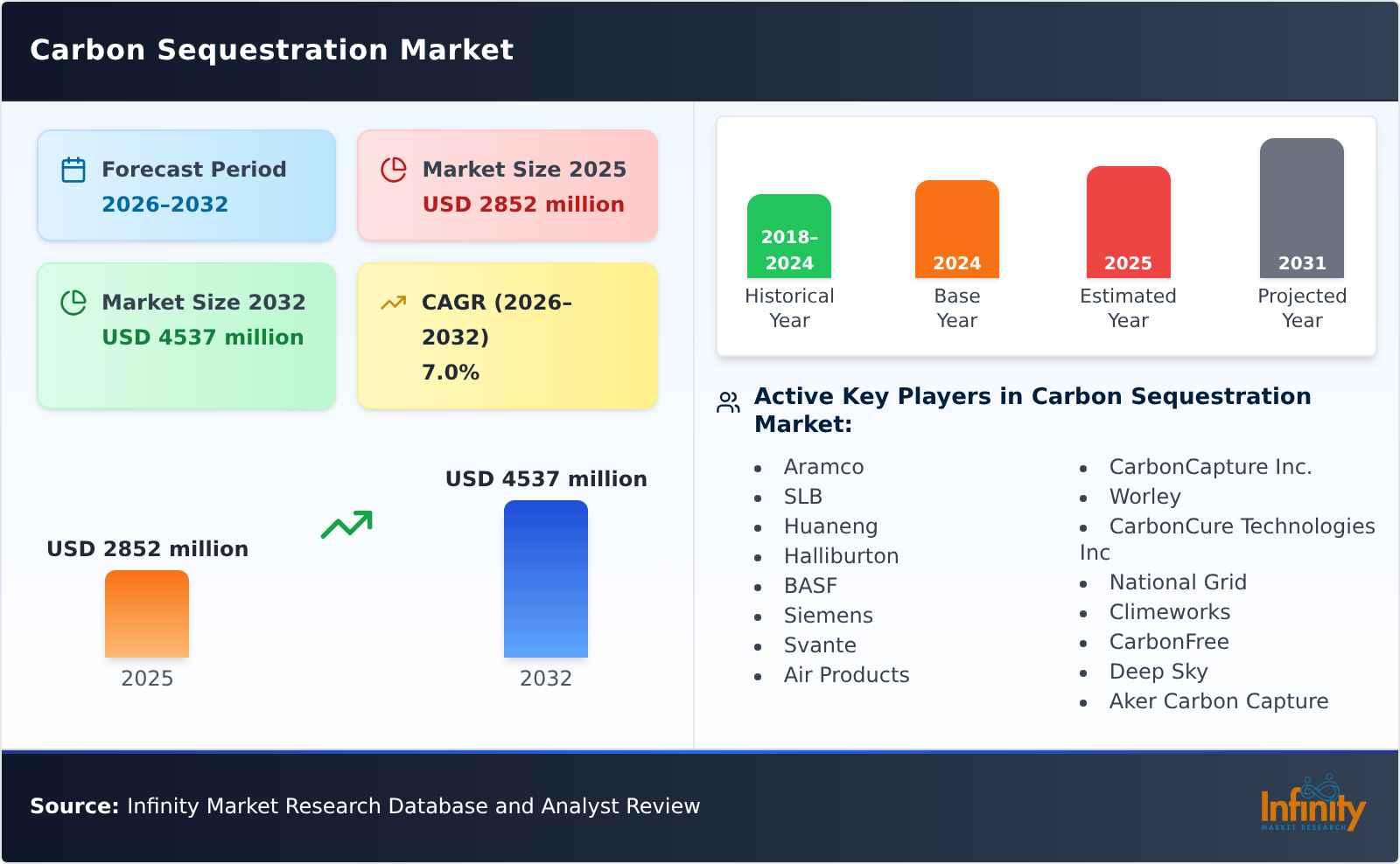
The global Carbon Sequestration market size is predicted to grow from US$ 2852 million in 2025 to US$ 4537 million in 2032; it is expected to grow at a CAGR of 7.0% from 2026 to 2032.
Explore this report in detail? Download a free sample copy
Download Free Sample Report
Carbon sequestration refers to engineering technologies that capture and store carbon dioxide in the atmosphere for long periods through natural or artificial means to reduce greenhouse gas concentrations and mitigate climate change. Its core process includes three stages: capture, transport, and storage. Capture primarily involves separating CO? from industrial emission sources or the air; transport uses pipelines or ships to deliver CO? to storage sites; and storage involves injecting it into deep underground geological structures, where it is permanently solidified through physical and chemical processes. This technology is considered one of the key pathways to achieving carbon neutrality, especially suitable for heavy industrial sectors where emissions reduction is difficult. However, its safety, monitoring capabilities, and long-term environmental risks still require rigorous assessment and need to be coordinated with emission reduction policies and the development of renewable energy to form a comprehensive climate governance system.
The cost of carbon sequestration primarily consists of site exploration and assessment, drilling and injection facility (CAPEX), operational compression and monitoring (OPEX), and long-term post-closure monitoring. Its cost is highly dependent on the type of sequestration: sequestration combined with oil recovery (EOR) can partially cover costs due to oil revenues, while pure brackish water sequestration has the highest cost. Scalability and application maturity are key to cost reduction; current costs are approximately $10 to $50 per tonne of carbon dioxide.
The global development of carbon sequestration exhibits significant regional imbalances. North America is the leader, with the United States focusing on EOR and saline aquifer sequestration, leveraging its well-developed infrastructure and tax credit policies; Canada, on the other hand, emphasizes emissions reduction in the oil and gas industry. Europe relies on strong policy drivers, with North Sea littoral states accelerating the development of transnational transportation and sequestration networks. The Asia-Pacific region, centered on China, is experiencing rapid growth in the number of demonstration projects, but commercialization models are still being explored. The Middle East and Australia, relying on their oil and gas resources, view CCUS as a strategic path to maintain fossil fuel exports. Overall, the strength of policy support, assessment of sequestration potential, and industrial base collectively determine the development stage and model of each region.
Infinity Market Research newest research report, the Carbon Sequestration Industry Forecast looks at past sales and reviews total world Carbon Sequestration sales in 2025, providing a comprehensive analysis by region and market sector of projected Carbon Sequestration sales for 2026 through 2032. With Carbon Sequestration sales broken down by region, market sector and sub-sector, this report provides a detailed analysis in US$ millions of the world Carbon Sequestration industry.
This Insight Report provides a comprehensive analysis of the global Carbon Sequestration landscape and highlights key trends related to product segmentation, company formation, revenue, and market share, latest development, and M&A activity. This report also analyses the strategies of leading global companies with a focus on Carbon Sequestration portfolios and capabilities, market entry strategies, market positions, and geographic footprints, to better understand these firms unique position in an accelerating global Carbon Sequestration market.
This Insight Report evaluates the key market trends, drivers, and affecting factors shaping the global outlook for Carbon Sequestration and breaks down the forecast by Type, by Application, geography, and market size to highlight emerging pockets of opportunity. With a transparent methodology based on hundreds of bottom-up qualitative and quantitative market inputs, this study forecast offers a highly nuanced view of the current state and future trajectory in the global Carbon Sequestration.
This report presents a comprehensive overview, market shares, and growth opportunities of Carbon Sequestration market by product type, application, key players and key regions and countries.
Segmentation by Type:
Geological Storage
Ocean Storage
Ore Carbonization
Industrial Utilization
Segmentation by Carbon Sources:
Point Source Carbon Sequestration
Direct Air Carbon Sequestration
Segmentation by Integration Model:
Distributed Carbon Sequestration
Full-Chain CCS Project
Segmentation by Application:
Industrial
Commercial
Municipal
This report also splits the market by region:
Americas
United States
Canada
Mexico
Brazil
APAC
China
Japan
Korea
Southeast Asia
India
Australia
Europe
Germany
France
UK
Italy
Russia
Middle East & Africa
Egypt
South Africa
Israel
Turkey
GCC Countries
The below companies that are profiled have been selected based on inputs gathered from primary experts and analyzing the companys coverage, product portfolio, its market penetration.
Aramco
SLB
Huaneng
Halliburton
BASF
Siemens
Svante
Air Products
CarbonCapture Inc.
Worley
CarbonCure Technologies Inc
1PointFive
National Grid
Climeworks
CarbonFree
Deep Sky
Aker Carbon Capture
Carbfix
Carbon Engineering
ExxonMobil
Linde
Shell
Mitsubishi Heavy Industries
Honeywell
Carbon Sequestration Market Scope
| Report Attribute | Details |
|---|---|
| Market Size (Start Year) | USD XX Million |
| Market Size (End Year) | USD XX Million |
| Compound Annual Growth Rate (CAGR) | USD XX Million |
| Forecast Period | USD XX Million |
| Base Year | USD XX Million |
| Historical Data | USD XX Million |
| Key Players | USD XX Million |
REPORT COVERAGE
Revenue forecast, Company Analysis, Industry landscape, Growth factors, and Trends
SEGMENT COVERED
By component, deployment, organization size, application, and industry.
REGIONAL SCOPE
North America, Europe, Asia Pacific, Middle East & Africa, South & Central America
COUNTRY SCOPE
Includes key countries across all major regions.
Frequently Asked Questions
1. What is the market size of Global Carbon Sequestration Market?
Answer: The global Carbon Sequestration market size is predicted to grow from US$ 2852 million in 2025 to US$ 4537 million in 2032; it is expected to grow at a CAGR of 7.0% from 2026 to 2032.
2. Which regions are analyzed in the Global Carbon Sequestration Market report?
Answer: The Global Carbon Sequestration Market report covers major regions such as North America, Europe, Asia-Pacific, Middle East & Africa. Each region is analyzed for trends, opportunities, and market dynamics.
3. What methodology is used for forecasting of Global Carbon Sequestration Market?
Answer: The Global Carbon Sequestration Market report uses a mix of primary research, secondary data, and expert analysis.
4. Are emerging markets analyzed separately in the Global Carbon Sequestration Market?
Answer: Yes, the Global Carbon Sequestration Market report highlights high-growth emerging regions with dedicated insights.
5. Does the report include competitive benchmarking of Global Carbon Sequestration Market?
Answer: Yes, Global Carbon Sequestration Market report compares major players based on revenue, product portfolio, and innovation.
6. Can I access country-level data within the Global Carbon Sequestration Market report?
Answer: Yes, Global Carbon Sequestration Market report includes detailed data by country for major regions.
7. Can I get customized insights or data from the Global Carbon Sequestration Market report?
Answer: Yes, we offer customization options to align with your specific business needs. You can request tailored sections or regional breakdowns.