


Global Cellulose Acetate Cotton Pulp Market Growth 2026-2032
Jan 2026
Chemicals and Materials
Pages: 95
ILR1866
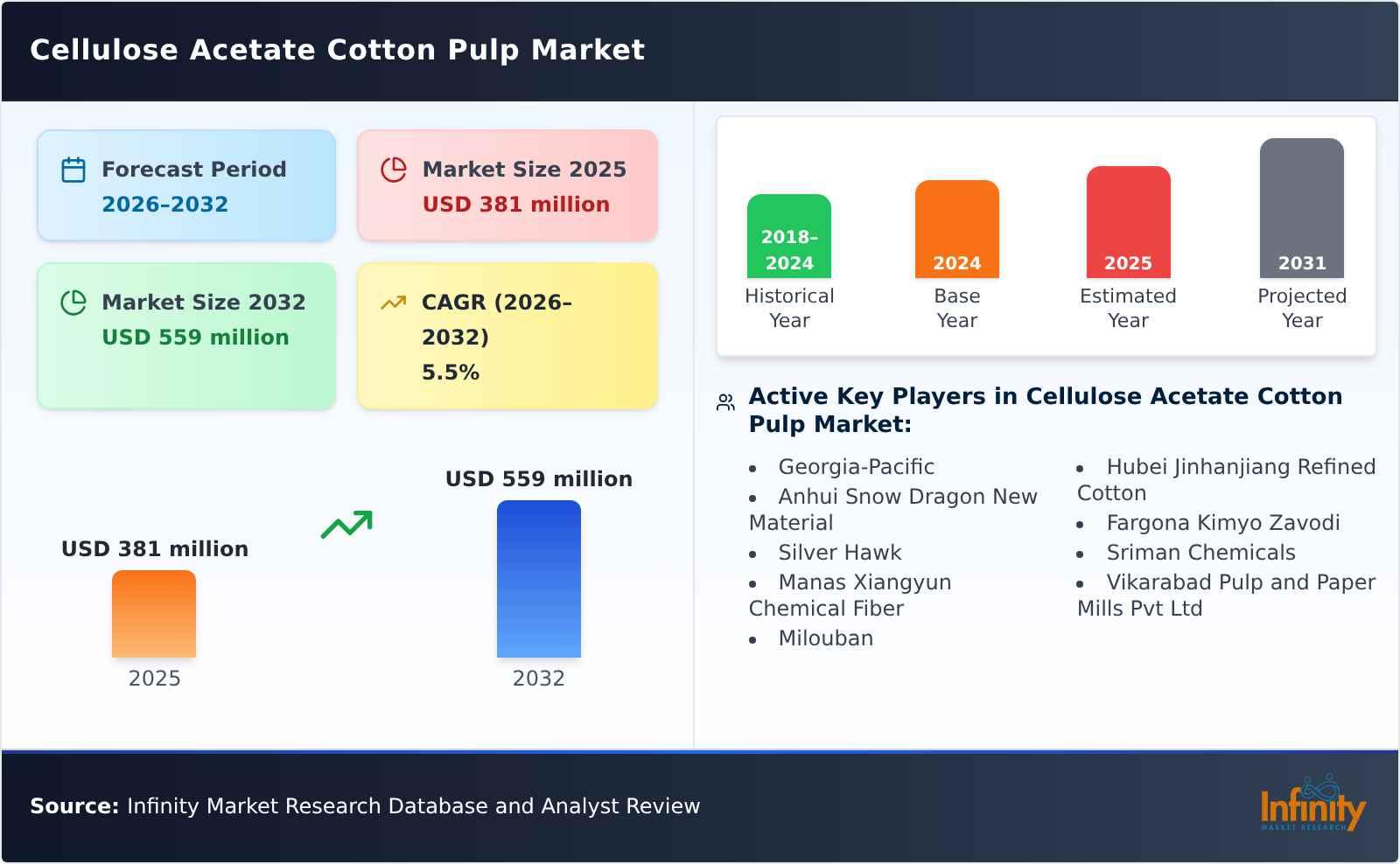
The global Cellulose Acetate Cotton Pulp market size is predicted to grow from US$ 381 million in 2025 to US$ 559 million in 2032; it is expected to grow at a CAGR of 5.5% from 2026 to 2032.
Explore this report in detail? Download a free sample copy
Download Free Sample Report
The medium- to long-term outlook for cellulose acetate cotton pulp remains that of a moderate growth market with increasingly attractive structural features. Over 20252031, total demand is projected to grow at a CAGR of around 5.5%, while market value expands at about 5.3%, slightly faster than in the previous five-year period. Cellulose diacetate pulp is expected to deliver volume and revenue CAGRs of roughly 5.2% and 4.7%, whereas cellulose triacetate pulp should grow at about 7.1% and 6.9% respectively. This indicates a clear shift towards higher value-added grades rather than a purely volume-driven expansion. By 2031, market size is expected to reach close to USD 531 million. The leading suppliers Georgia-Pacific, Anhui Snow Dragon New Material, Shandong Silver Hawk, Manas Xiangyun Chemical Fiber and Milouban are likely to retain more than 70% of global revenue, with industry concentration staying structurally high despite ongoing capacity additions and regional substitution.
From an end-use view, cigarette filters will continue to provide the backbone of capacity utilization and cash generation. Between 2025 and 2031, cellulose acetate pulp demand for cigarette filters is projected to grow at about 5.0% in volume and 4.7% in value, slightly below the overall market yet still adding more absolute tons than any other application. By 2031, cigarette filters are expected to consume roughly 187,000 tons, or about 68% of total demand. Persistent smoking prevalence and cigarette output in developing economies, combined with the qualification and switching costs on filter materials at major tobacco companies, will support this base business. However, its relatively lower growth profile versus TAC film and other specialty applications suggests that cigarette filters should be viewed primarily as a stabilizing core rather than the main source of upside.
Optical TAC film and other triacetate-related uses represent the most compelling structural growth opportunities. Over 20252031, TAC-film-related demand is forecast to grow at about 7.2% in both volume and value, materially above the market average. Triacetate pulp prices are expected to remain around USD 3,200 per ton, versus roughly USD 1,700 per ton for diacetate pulp, preserving a wide premium. As display panels, automotive displays, polarizers, optical lenses and high-performance films continue to upgrade, TACs superior optical, thermal and dimensional properties will remain in strong demand. This underpins the gradual increase of triacetate pulps share in total market revenue from about 24% in 2025 to nearly 27% in 2031. For upstream pulp producers, moving further into TAC-film-grade triacetate is the most effective way to lift EBITDA per ton and improve resilience through the cycle.
The other applications cluster including specialty and laboratory papers, medical device components and industrial filtration media embodies both sustainability and advanced-materials angles. Between 2025 and 2031 this segment is expected to deliver the fastest growth, with a volume CAGR of about 8.6% and a value CAGR of around 8.0%. Regulatory pressure on single-use plastics, rising hygiene and purity requirements in laboratory and medical environments, and the need for biodegradable filtration media in industrial and environmental applications all support increased use of cellulose acetate cotton pulp. Although todays base is still relatively small, this segment is well positioned to move towards a double-digit share of global revenue as new products and use cases are commercialized.
Regionally, Asia-Pacific and China in particular will remain the anchor of both supply and demand. Over 20252031, Asia-Pacific consumption is projected to grow at about 5.7% per annum, pushing its share of global demand above 56% by 2031. China not only dominates cigarette-filter applications but has also transitioned from import dependence to localized supply in TAC films, plastics and fabrics. Domestic champions such as Anhui Snow Dragon New Material, Shandong Silver Hawk, Manas Xiangyun Chemical Fiber and Hubei Jinhanjiang Refined Cotton are expanding capacity and upgrading product portfolios, while Georgia-Pacific continues to leverage its deep relationships with global tobacco and optical-material customers. With rising emphasis on supply-chain security, local certification and ESG performance among Asia-Pacific clients, regional leaders with access to cotton linter resources, competitive energy and established customer bases are likely to gain bargaining power.
From a competitive and supply-chain standpoint, key constraints lie in access to high-?-cellulose cotton linters, technical capability in acetylation and solvent recovery, and tightening environmental and energy regulations. Upstream raw materials are concentrated in a few geographies, making long-term offtake agreements, strategic cooperation or partial vertical integration important tools to manage cost volatility and geopolitical risk. At the same time, cellulose acetate production is capital- and process-intensive, involving acetic anhydride, solvent loops and wastewater treatment. Continuous tightening of impurity limits, residual monomer specifications and particle-size distributions by high-end customers raises the bar further. Leading producers are responding by investing in CHP units, closed-loop solvent systems and in-line quality analytics, which not only lower energy consumption and emissions per ton but also provide a strong advantage in customer audits and ESG scoring. These features help sustain the roughly 75% combined market share of the top five players.
On this basis, several strategic recommendations emerge for industry participants and investors. First, resource allocation should prioritize migration towards optical-grade triacetate pulp and premium filtration materials, while preserving the cigarette-filter business as a high-utilization, cash-generating base. Building deeper collaboration with downstream TAC-film, polarizer, display and lens manufacturers especially around low-odor, low-residual, plasticizer-free or fully biodegradable systems will be key to securing high-margin growth. Second, producers should enhance innovation and application-development capabilities, positioning cellulose acetate cotton pulp as a platform for advanced, sustainable materials rather than a simple commodity. This includes exploring blends with other bio-based polymers, designing new porous structures for filtration, and tailoring pulp properties for next-generation paper and nonwoven products.
Third, plant design and debottlenecking efforts should target flexibility: lines that can switch, within limits, between diacetate and triacetate output will allow better response to price cycles and end-market swings. Maintaining a balanced mix of long-term contracts with anchor customers and spot exposure will further support margin optimization. Finally, disciplined ESG and decarbonization strategies from raw-material sourcing and energy mix to lifecycle assessment and waste minimization will increasingly become prerequisites to win and retain Tier-1 customers across tobacco, display and medical sectors.
Looking ahead, the cellulose acetate cotton pulp industry is expected to evolve along three main trajectories: high-performance materialization, green and low-carbon transformation, and progressive localization of critical supply chains. High-performance materialization will be driven by deeper penetration of triacetate-based products into optical films and specialty filtration, shifting the sectors center of gravity from basic chemical feedstock towards a functional-materials platform. Green transformation will hinge on bio-based feedstocks, circular solvent systems and credible carbon-footprint management, unlocking policy and market benefits within the broader sustainable-materials narrative. Supply-chain localization will favor regional champions that combine resource access, permitting, and strong local customer relationships, positioning them for selective capacity expansions and M&A. Against this backdrop, companies that move early on product mix upgrade, process intensification and ESG differentiation are poised to capture outsized returns in the next upcycle of the cellulose acetate value chain.
Infinity Market Research newest research report, the Cellulose Acetate Cotton Pulp Industry Forecast looks at past sales and reviews total world Cellulose Acetate Cotton Pulp sales in 2025, providing a comprehensive analysis by region and market sector of projected Cellulose Acetate Cotton Pulp sales for 2026 through 2032. With Cellulose Acetate Cotton Pulp sales broken down by region, market sector and sub-sector, this report provides a detailed analysis in US$ millions of the world Cellulose Acetate Cotton Pulp industry.
This Insight Report provides a comprehensive analysis of the global Cellulose Acetate Cotton Pulp landscape and highlights key trends related to product segmentation, company formation, revenue, and market share, latest development, and M&A activity. This report also analyzes the strategies of leading global companies with a focus on Cellulose Acetate Cotton Pulp portfolios and capabilities, market entry strategies, market positions, and geographic footprints, to better understand these firms unique position in an accelerating global Cellulose Acetate Cotton Pulp market.
This Insight Report evaluates the key market trends, drivers, and affecting factors shaping the global outlook for Cellulose Acetate Cotton Pulp and breaks down the forecast by Type, by Application, geography, and market size to highlight emerging pockets of opportunity. With a transparent methodology based on hundreds of bottom-up qualitative and quantitative market inputs, this study forecast offers a highly nuanced view of the current state and future trajectory in the global Cellulose Acetate Cotton Pulp.
This report presents a comprehensive overview, market shares, and growth opportunities of Cellulose Acetate Cotton Pulp market by product type, application, key manufacturers and key regions and countries.
Segmentation by Type:
Cellulose Diacetate Cotton Pulp
Cellulose Triacetate Cotton Pulp
Segmentation by Physical Form:
Sheet
Roll
Segmentation by Process:
First-cut
Second-cut
Segmentation by Application:
Cigarette Filter
TAC Film
Plastic
Fabric
Others
This report also splits the market by region:
Americas
United States
Canada
Mexico
Brazil
APAC
China
Japan
Korea
Southeast Asia
India
Australia
Europe
Germany
France
UK
Italy
Russia
Middle East & Africa
Egypt
South Africa
Israel
Turkey
GCC Countries
The below companies that are profiled have been selected based on inputs gathered from primary experts and analysing the companys coverage, product portfolio, its market penetration.
Georgia-Pacific
Anhui Snow Dragon New Material
Silver Hawk
Manas Xiangyun Chemical Fiber
Milouban
Hubei Jinhanjiang Refined Cotton
Fargona Kimyo Zavodi
Sriman Chemicals
Vikarabad Pulp and Paper Mills Pvt Ltd
Key Questions Addressed in this Report
What is the 10-year outlook for the global Cellulose Acetate Cotton Pulp market?
What factors are driving Cellulose Acetate Cotton Pulp market growth, globally and by region?
Which technologies are poised for the fastest growth by market and region?
How do Cellulose Acetate Cotton Pulp market opportunities vary by end market size?
How does Cellulose Acetate Cotton Pulp break out by Type, by Application?
Cellulose Acetate Cotton Pulp Market Scope
| Report Attribute | Details |
|---|---|
| Market Size (Start Year) | USD XX Million |
| Market Size (End Year) | USD XX Million |
| Compound Annual Growth Rate (CAGR) | USD XX Million |
| Forecast Period | USD XX Million |
| Base Year | USD XX Million |
| Historical Data | USD XX Million |
| Key Players | USD XX Million |
REPORT COVERAGE
Revenue forecast, Company Analysis, Industry landscape, Growth factors, and Trends
SEGMENT COVERED
By component, deployment, organization size, application, and industry.
REGIONAL SCOPE
North America, Europe, Asia Pacific, Middle East & Africa, South & Central America
COUNTRY SCOPE
Includes key countries across all major regions.
Frequently Asked Questions
1. What is the market size of Global Cellulose Acetate Cotton Pulp Market?
Answer: The global Cellulose Acetate Cotton Pulp market size is predicted to grow from US$ 381 million in 2025 to US$ 559 million in 2032; it is expected to grow at a CAGR of 5.5% from 2026 to 2032.
2. Which regions are analyzed in the Global Cellulose Acetate Cotton Pulp Market report?
Answer: The Global Cellulose Acetate Cotton Pulp Market report covers major regions such as Europe, Asia-Pacific, Middle East & Africa. Each region is analyzed for trends, opportunities, and market dynamics.
3. What methodology is used for forecasting of Global Cellulose Acetate Cotton Pulp Market?
Answer: The Global Cellulose Acetate Cotton Pulp Market report uses a mix of primary research, secondary data, and expert analysis.
4. Are emerging markets analyzed separately in the Global Cellulose Acetate Cotton Pulp Market?
Answer: Yes, the Global Cellulose Acetate Cotton Pulp Market report highlights high-growth emerging regions with dedicated insights.
5. Does the report include competitive benchmarking of Global Cellulose Acetate Cotton Pulp Market?
Answer: Yes, Global Cellulose Acetate Cotton Pulp Market report compares major players based on revenue, product portfolio, and innovation.
6. Can I access country-level data within the Global Cellulose Acetate Cotton Pulp Market report?
Answer: Yes, Global Cellulose Acetate Cotton Pulp Market report includes detailed data by country for major regions.
7. Can I get customized insights or data from the Global Cellulose Acetate Cotton Pulp Market report?
Answer: Yes, we offer customization options to align with your specific business needs. You can request tailored sections or regional breakdowns.