


Global Cheese Rennet Market Growth 2026-2032
Jan 2026
Food Beverage and Nutrition
Pages: 141
ILR1475
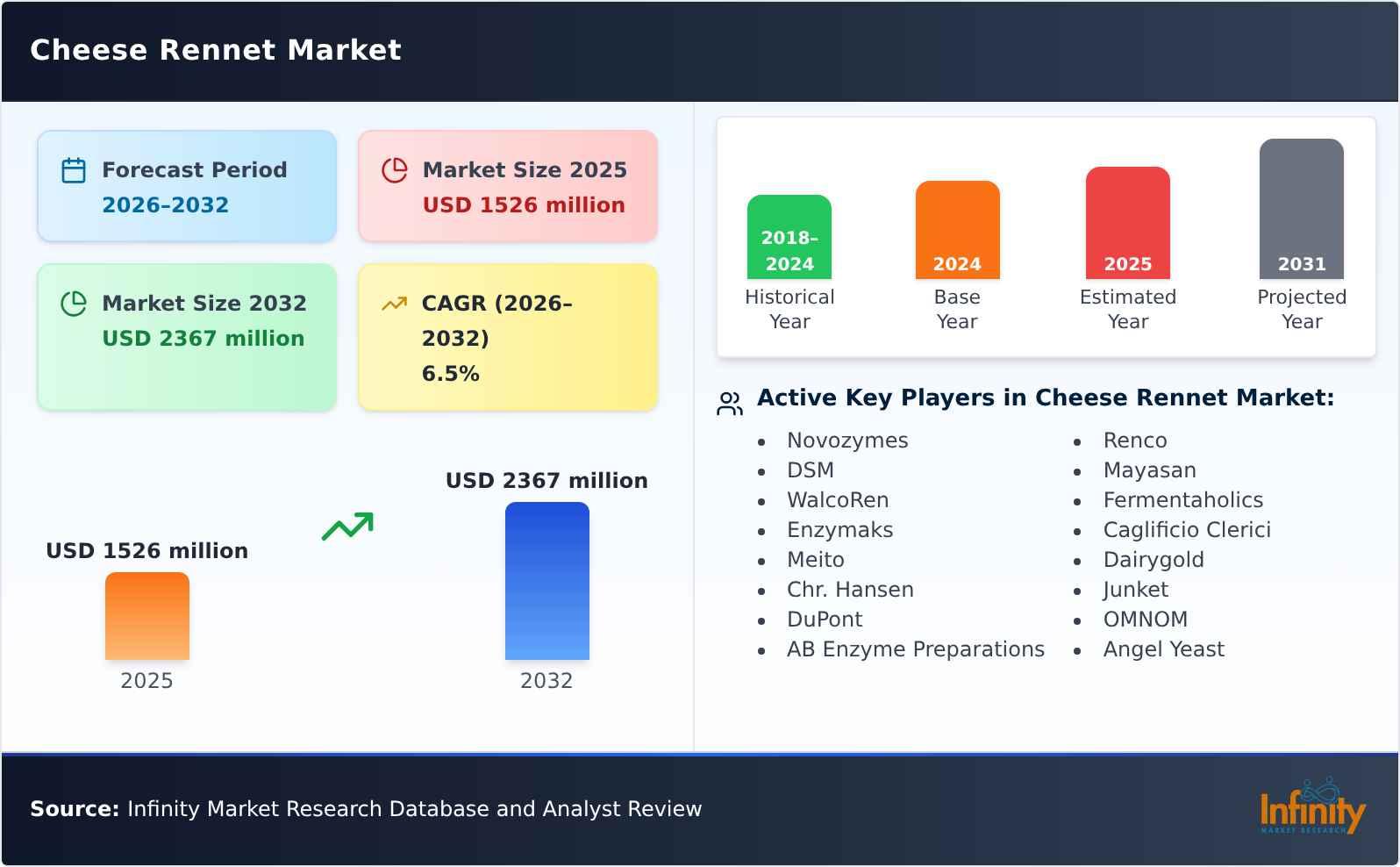
The global Cheese Rennet market size is predicted to grow from US$ 1526 million in 2025 to US$ 2367 million in 2032; it is expected to grow at a CAGR of 6.5% from 2026 to 2032.
Explore this report in detail? Download a free sample copy
Download Free Sample Report
In 2025, the production of cheese rennet reached 18,700 tons, with an average selling price of US$83.4 per kilogram.
Cheese rennet was developed to address the problems of low coagulation efficiency, unstable quality, and resource limitations due to reliance on extraction from animal gastric mucosa in traditional cheese production. Since the industrialization of rennet through microbial fermentation in the mid-20th century, the field of dairy enzyme preparations has seen breakthrough development. Currently, cheese rennet has evolved into a core food additive encompassing animal, plant, and microbial sources, widely used in whole cheese, processed cheese, and dairy beverage coagulation, capable of precisely controlling coagulation speed and improving cheese yield and quality stability.
In the global cheese rennet market in 2025, the average price of food-grade general-purpose rennet ranged from US$28 to US$65 per kilogram, while high-end specialized types (such as those suitable for low-salt cheese and low-temperature coagulation) could reach an average price of US$120 to US$220 per kilogram. In terms of production capacity, small and medium-sized enterprises typically have an annual production capacity of 300-500 tons per production line, while leading companies such as Novozymes of Denmark can reach over 800 tons. The industry average capacity utilization rate is approximately 72%, which can rise to 85% during the peak global cheese consumption season (winter in Europe and America, and before holidays). Gross profit margins vary significantly depending on product type: ordinary microbial rennet is approximately 15%-20%, while high-end specialized and customized solutions can reach 25%-35%.
Typical Transaction Case: In the second quarter of 2025, the French Danone Group purchased 230 tons of Novozymes NS50033 microbial rennet, totaling approximately US$20.7 million. The purchase requirements clearly stated that it was suitable for low-salt cheddar cheese production, with a coagulation temperature of 32-35?, enzyme activity stability ?90% (stored at 4? for 6 months), and residual protein content ?0.1ppm, for large-scale production in its core cheese factories in Europe.
In early 2025, Chinas Yili Group purchased 120 tons of Angel Yeast FY-10 plant-derived rennet at a unit price of US$58/kg. The requirements were that it be compatible with both goat milk and cow milk raw materials, with a coagulation time controlled within 12-15 minutes, and meeting clean label certification standards, for use in the research and mass production of high-end artisanal cheese and childrens cheese sticks.
Industry Chain Structure: The rennet industry chain begins with upstream raw materials and core technology support. The core raw materials required for its production include microbial strains for fermentation (such as patented and standard strains), culture media, and animal or plant extracts. Key production stages rely on sophisticated fermentation tanks, purification equipment, and testing instruments. The entire industry is driven by cutting-edge technologies such as genetic engineering, process optimization, and stabilization treatment. Downstream, the industry chain is primarily driven by the application market, with cheese production being the absolute core, accounting for approximately 78% of the application share, especially the manufacture of hard cheese. The remaining approximately 22% of the market is contributed by other dairy products (such as yogurt and cream cheese) and the continuously expanding diversified fields of food processing, baking, and even biopharmaceuticals.
Industry Trends and Challenges The cheese rennet industry is developing towards green and clean (plant/microbial alternatives), high-efficiency customization (high enzyme activity, specialized products), and functional integration (integrated solutions). This is primarily driven by the growth in cheese consumption in emerging markets (annual growth rate exceeding 12%) and the global trend towards vegetarianism and healthier options (such as plant-based cheese). Simultaneously, the scaling up of dairy companies has also spurred demand for stable and efficient enzyme solutions. However, the industry faces core challenges, including the monopoly of core technologies by international giants (domestic products lag behind in performance aspects such as high-temperature resistance), volatile raw material costs squeezing profits, and the lack of unified global industry standards increasing compliance risks.
Demand and Opportunity Analysis: As a core enzyme in cheese production, the demand for cheese rennet is driven by multiple rigid factors: Global cheese production is projected to reach 23 million tons in 2024, with an annual growth rate of 4.5%, and emerging markets growing at over 8%. Each 10,000 tons of cheese requires 5-8 tons of rennet. Using this enzyme can shorten the coagulation time from over 24 hours of natural fermentation to 10-30 minutes, increasing production efficiency by over 40 times and yield by 8%-12%. High-end cheeses rely 100% on specialized rennets, whose precise coagulation control reduces whey protein loss, improves taste and texture uniformity, and directly impacts product premium pricing. Driven by the trend of healthy consumption, plant-based... The proportion of rennet from organic/microbial sources increased from 65% in 2019 to 82% in 2024. Organic certified products, priced 30%-50% higher, are still in short supply. The global market of over 500 million vegetarians and the 15% annual growth rate of plant-based cheese have further fueled incremental demand. In terms of technological compatibility, leading products can be adapted to over 95% of raw materials, including cows milk, goats milk, camels milk, and plant-based milk. Microbial fermentation methods are more than 60% cheaper than animal-derived methods. High-efficiency enzymes can increase production capacity by 30%-50% and reduce unit costs by 15%-20%, significantly enhancing corporate profitability and forming a closed loop driven by a composite demand of production growth - quality improvement - health trends - technology optimization.
Infinity Market Research newest research report, the Cheese Rennet Industry Forecast looks at past sales and reviews total world Cheese Rennet sales in 2025, providing a comprehensive analysis by region and market sector of projected Cheese Rennet sales for 2026 through 2032. With Cheese Rennet sales broken down by region, market sector and sub-sector, this report provides a detailed analysis in US$ millions of the world Cheese Rennet industry.
This Insight Report provides a comprehensive analysis of the global Cheese Rennet landscape and highlights key trends related to product segmentation, company formation, revenue, and market share, latest development, and M&A activity. This report also analyzes the strategies of leading global companies with a focus on Cheese Rennet portfolios and capabilities, market entry strategies, market positions, and geographic footprints, to better understand these firms unique position in an accelerating global Cheese Rennet market.
This Insight Report evaluates the key market trends, drivers, and affecting factors shaping the global outlook for Cheese Rennet and breaks down the forecast by Type, by Application, geography, and market size to highlight emerging pockets of opportunity. With a transparent methodology based on hundreds of bottom-up qualitative and quantitative market inputs, this study forecast offers a highly nuanced view of the current state and future trajectory in the global Cheese Rennet.
This report presents a comprehensive overview, market shares, and growth opportunities of Cheese Rennet market by product type, application, key manufacturers and key regions and countries.
Segmentation by Type:
Enzyme Activity ?10000MCU/g
Enzyme Activity 3000-10000MCU/g
Enzyme Activity ?3000MCU/g
Segmentation by Source:
Animal Derivative
Plant Derivative
Microbial Derivative
Segmentation by Dosage Form:
Liquid
Powder
Granular
Segmentation by Application:
Cheese Production
Other Dairy Products
Food Processing
Other
This report also splits the market by region:
Americas
United States
Canada
Mexico
Brazil
APAC
China
Japan
Korea
Southeast Asia
India
Australia
Europe
Germany
France
UK
Italy
Russia
Middle East & Africa
Egypt
South Africa
Israel
Turkey
GCC Countries
The below companies that are profiled have been selected based on inputs gathered from primary experts and analysing the companys coverage, product portfolio, its market penetration.
Novozymes
DSM
WalcoRen
Enzymaks
Meito
Chr. Hansen
DuPont
AB Enzyme Preparations
Renco
Mayasan
Fermentaholics
Caglificio Clerici
Dairygold
Junket
OMNOM
Angel Yeast
Wuxi Genentech
Xiasheng Group
Key Questions Addressed in this Report
What is the 10-year outlook for the global Cheese Rennet market?
What factors are driving Cheese Rennet market growth, globally and by region?
Which technologies are poised for the fastest growth by market and region?
How do Cheese Rennet market opportunities vary by end market size?
How does Cheese Rennet break out by Type, by Application?
Cheese Rennet Market Scope
| Report Attribute | Details |
|---|---|
| Market Size (Start Year) | USD XX Million |
| Market Size (End Year) | USD XX Million |
| Compound Annual Growth Rate (CAGR) | USD XX Million |
| Forecast Period | USD XX Million |
| Base Year | USD XX Million |
| Historical Data | USD XX Million |
| Key Players | USD XX Million |
REPORT COVERAGE
Revenue forecast, Company Analysis, Industry landscape, Growth factors, and Trends
SEGMENT COVERED
By component, deployment, organization size, application, and industry.
REGIONAL SCOPE
North America, Europe, Asia Pacific, Middle East & Africa, South & Central America
COUNTRY SCOPE
Includes key countries across all major regions.
Frequently Asked Questions
1. What is the market size of Global Cheese Rennet Market?
Answer: The global Cheese Rennet market size is predicted to grow from US$ 1526 million in 2025 to US$ 2367 million in 2032; it is expected to grow at a CAGR of 6.5% from 2026 to 2032.
2. Which regions are analyzed in the Global Cheese Rennet Market report?
Answer: The Global Cheese Rennet Market report covers major regions such as Europe, Middle East & Africa. Each region is analyzed for trends, opportunities, and market dynamics.
3. What methodology is used for forecasting of Global Cheese Rennet Market?
Answer: The Global Cheese Rennet Market report uses a mix of primary research, secondary data, and expert analysis.
4. Are emerging markets analyzed separately in the Global Cheese Rennet Market?
Answer: Yes, the Global Cheese Rennet Market report highlights high-growth emerging regions with dedicated insights.
5. Does the report include competitive benchmarking of Global Cheese Rennet Market?
Answer: Yes, Global Cheese Rennet Market report compares major players based on revenue, product portfolio, and innovation.
6. Can I access country-level data within the Global Cheese Rennet Market report?
Answer: Yes, Global Cheese Rennet Market report includes detailed data by country for major regions.
7. Can I get customized insights or data from the Global Cheese Rennet Market report?
Answer: Yes, we offer customization options to align with your specific business needs. You can request tailored sections or regional breakdowns.