


Global Commercial-grade Surveillance Cameras Market Growth 2026-2032
Jan 2026
Consumer and Retails
Pages: 138
ILR1703
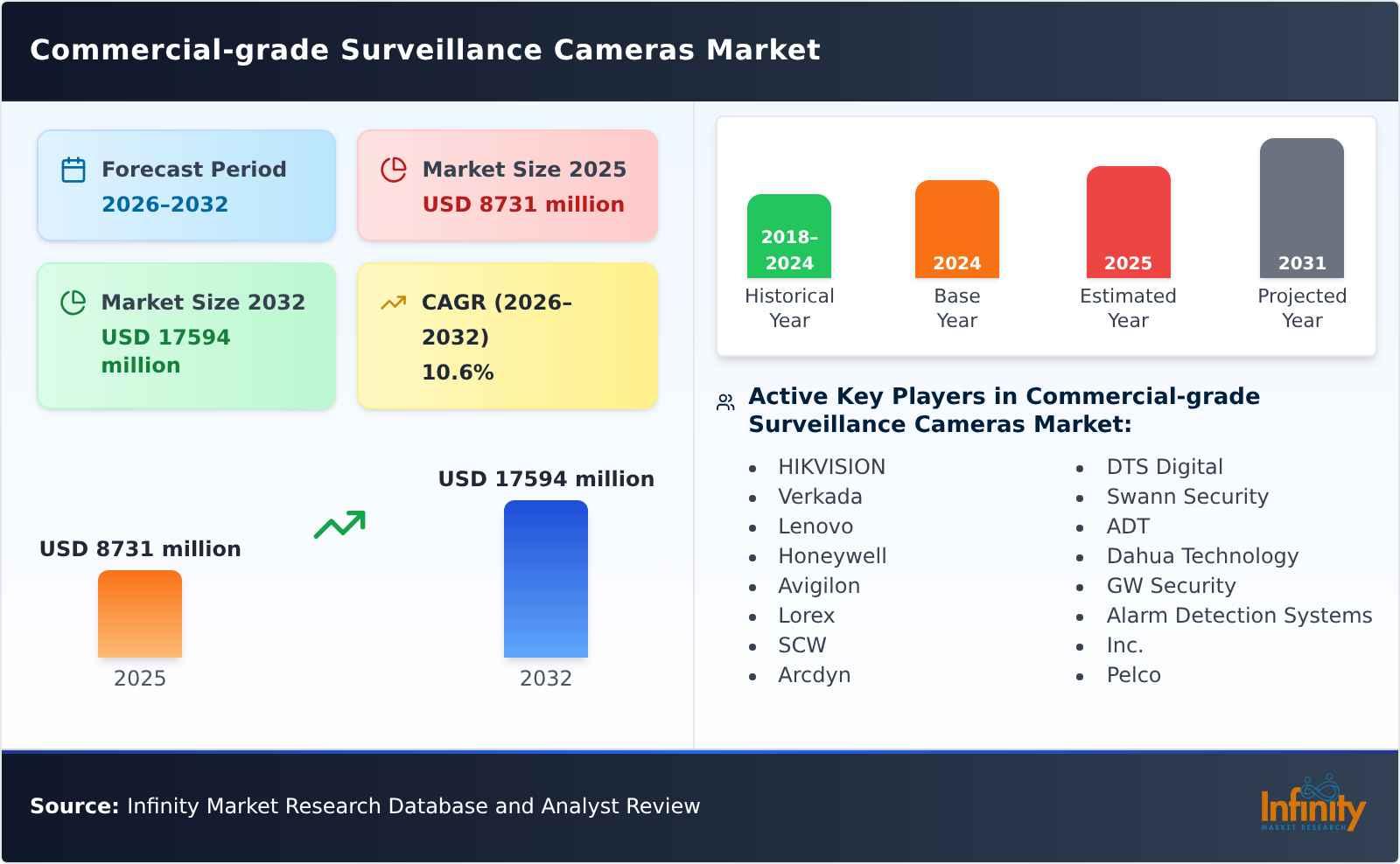
The global Commercial-grade Surveillance Cameras market size is predicted to grow from US$ 8731 million in 2025 to US$ 17594 million in 2032; it is expected to grow at a CAGR of 10.6% from 2026 to 2032.
Explore this report in detail? Download a free sample copy
Download Free Sample Report
In 2025, global sales of commercial-grade surveillance cameras reached 105 million units, with an average selling price of $85. Commercial-grade surveillance cameras are security devices designed for commercial scenarios, providing high-definition video capture, intelligent analysis, and network management. Their core features include 4K and above resolution, wide dynamic range, low-light imaging, AI edge recognition, and high stability. They are widely used in commercial complexes, office buildings, industrial parks, retail chains, transportation hubs, and public safety sectors, forming a crucial foundation for smart cities and digital security systems. Upstream raw materials and components mainly include CMOS image sensors, ISP chips, AISoCs, lens modules, PCBs, aluminum alloy or engineering plastic housings, power supplies, and network port devices. Material consumption is estimated at approximately 10,000 image sensors, 10,500 lenses, 0.6 tons of PCBs, and 1.2 tons of aluminum-plastic structural components per 10,000 units produced. Midstream production involves design, SMT, assembly, and testing by OEMs, with a global capacity of approximately 130 million units. Downstream production is channeled through system integrators, security engineers, and distributors into commercial real estate, chain retail, factory parks, schools, hospitals, and government projects. Consumption breakdown is as follows: commercial buildings and parks approximately 35%, retail and chain stores approximately 25%, transportation and public facilities approximately 20%, industry and warehousing approximately 12%, and others approximately 8%. The industry average gross profit margin is approximately 28%-35%, with manufacturers possessing self-developed chip and algorithm capabilities reaching over 38%. Demand and business opportunities mainly come from smart city construction, the deepening of AI vision applications, the replacement of old systems with high-definition versions, and the trend of cloud platform subscription services. The future way out lies in upgrading to front-end intelligence + cloud-edge collaboration + data services, expanding value-added applications such as people flow analysis, asset management, and compliance auditing, and achieving large-scale replication under the framework of privacy protection and network security compliance, so as to promote the extension of commercial-grade surveillance cameras from hardware sales to platformization and service value.
From an overall market perspective, commercial-grade surveillance cameras are transitioning from high-definition to intelligent and platform-based solutions. The traditional competition based on resolution and price is being replaced by AI algorithm capabilities, system compatibility, and the value of overall solutions. With the continued advancement of smart cities, smart parks, and new infrastructure, commercial scenarios are demanding greater stability, low maintenance, and scalability, giving manufacturers with integrated hardware and software capabilities more bargaining power, and potentially further increasing industry concentration.
From the demand side, new demand and replacement of existing systems are occurring simultaneously: on the one hand, new commercial complexes, data centers, transportation hubs, and industrial parks continue to generate installation demand; on the other hand, early 720P/1080P systems are entering their replacement cycle, coupled with upgrades to AI recognition, low-light color, and panoramic stitching, driving large-scale replacements. Retail chains and park management are focusing more on the operational value of customer flow analysis and behavior recognition, shifting surveillance equipment from a security cost to a data asset entry point, enhancing customers willingness to pay.
From a competition and profitability perspective, while the industry appears highly homogenized, core differentiation is shifting towards self-developed chips, algorithm models, firmware ecosystems, and cloud platform capabilities. Leading manufacturers maintain cost advantages through large-scale manufacturing and channel coverage, while improving long-term gross margins through software subscriptions and platform services. Smaller manufacturers, lacking technological barriers, are easily caught in price wars, resulting in squeezed profit margins and future pressure to consolidate or transform into niche application markets.
Regionally and in terms of trends, emerging markets in the Asia-Pacific and Middle East are experiencing faster growth driven by infrastructure and commercial real estate, while the European and American markets are primarily driven by compliance-driven upgrades and high-end intelligent applications. In the next 3-5 years, commercial-grade surveillance cameras will accelerate their evolution towards edge AI + cloud collaboration + multimodal perception, deeply integrating with access control, fire protection, energy consumption, and BMS systems to form a comprehensive sensing network. Against the backdrop of increasingly stringent data compliance and cybersecurity requirements, companies with secure, reliable, and industry-specific scenario-based solutions will be more likely to achieve sustained growth.
Infinity Market Research newest research report, the Commercial-grade Surveillance Cameras Industry Forecast looks at past sales and reviews total world Commercial-grade Surveillance Cameras sales in 2025, providing a comprehensive analysis by region and market sector of projected Commercial-grade Surveillance Cameras sales for 2026 through 2032. With Commercial-grade Surveillance Cameras sales broken down by region, market sector and sub-sector, this report provides a detailed analysis in US$ millions of the world Commercial-grade Surveillance Cameras industry.
This Insight Report provides a comprehensive analysis of the global Commercial-grade Surveillance Cameras landscape and highlights key trends related to product segmentation, company formation, revenue, and market share, latest development, and M&A activity. This report also analyzes the strategies of leading global companies with a focus on Commercial-grade Surveillance Cameras portfolios and capabilities, market entry strategies, market positions, and geographic footprints, to better understand these firms unique position in an accelerating global Commercial-grade Surveillance Cameras market.
This Insight Report evaluates the key market trends, drivers, and affecting factors shaping the global outlook for Commercial-grade Surveillance Cameras and breaks down the forecast by Type, by Application, geography, and market size to highlight emerging pockets of opportunity. With a transparent methodology based on hundreds of bottom-up qualitative and quantitative market inputs, this study forecast offers a highly nuanced view of the current state and future trajectory in the global Commercial-grade Surveillance Cameras.
This report presents a comprehensive overview, market shares, and growth opportunities of Commercial-grade Surveillance Cameras market by product type, application, key manufacturers and key regions and countries.
Segmentation by Type:
Tube Camera
Dome Camera
PTZ Camera
Others
Segmentation by Resolution:
High Definition
Full High Definition
Ultra High Definition 4K
Segmentation by Imaging Technology:
CMOS Image Sensor
Starlight/Ultra-low Light
Thermal Imaging
Panoramic Multi-view Camera
Segmentation by Application:
Shopping Malls
Banks
Office Buildings
Hotels
Others
This report also splits the market by region:
Americas
United States
Canada
Mexico
Brazil
APAC
China
Japan
Korea
Southeast Asia
India
Australia
Europe
Germany
France
UK
Italy
Russia
Middle East & Africa
Egypt
South Africa
Israel
Turkey
GCC Countries
The below companies that are profiled have been selected based on inputs gathered from primary experts and analysing the companys coverage, product portfolio, its market penetration.
HIKVISION
Verkada
Lenovo
Honeywell
Avigilon
Lorex
SCW
Arcdyn
DTS Digital
Swann Security
ADT
Dahua Technology
GW Security
Alarm Detection Systems, Inc.
Pelco
OMNIVISION
Revo America
Hanwha Vision
Key Questions Addressed in this Report
What is the 10-year outlook for the global Commercial-grade Surveillance Cameras market?
What factors are driving Commercial-grade Surveillance Cameras market growth, globally and by region?
Which technologies are poised for the fastest growth by market and region?
How do Commercial-grade Surveillance Cameras market opportunities vary by end market size?
How does Commercial-grade Surveillance Cameras break out by Type, by Application?
Commercial-grade Surveillance Cameras Market Scope
| Report Attribute | Details |
|---|---|
| Market Size (Start Year) | USD XX Million |
| Market Size (End Year) | USD XX Million |
| Compound Annual Growth Rate (CAGR) | USD XX Million |
| Forecast Period | USD XX Million |
| Base Year | USD XX Million |
| Historical Data | USD XX Million |
| Key Players | USD XX Million |
REPORT COVERAGE
Revenue forecast, Company Analysis, Industry landscape, Growth factors, and Trends
SEGMENT COVERED
By component, deployment, organization size, application, and industry.
REGIONAL SCOPE
North America, Europe, Asia Pacific, Middle East & Africa, South & Central America
COUNTRY SCOPE
Includes key countries across all major regions.
Frequently Asked Questions
1. What is the market size of Global Commercial-grade Surveillance Cameras Market?
Answer: The global Commercial-grade Surveillance Cameras market size is predicted to grow from US$ 8731 million in 2025 to US$ 17594 million in 2032; it is expected to grow at a CAGR of 10.6% from 2026 to 2032.
2. Which regions are analyzed in the Global Commercial-grade Surveillance Cameras Market report?
Answer: The Global Commercial-grade Surveillance Cameras Market report covers major regions such as Europe, Asia-Pacific, Middle East & Africa. Each region is analyzed for trends, opportunities, and market dynamics.
3. What methodology is used for forecasting of Global Commercial-grade Surveillance Cameras Market?
Answer: The Global Commercial-grade Surveillance Cameras Market report uses a mix of primary research, secondary data, and expert analysis.
4. Are emerging markets analyzed separately in the Global Commercial-grade Surveillance Cameras Market?
Answer: Yes, the Global Commercial-grade Surveillance Cameras Market report highlights high-growth emerging regions with dedicated insights.
5. Does the report include competitive benchmarking of Global Commercial-grade Surveillance Cameras Market?
Answer: Yes, Global Commercial-grade Surveillance Cameras Market report compares major players based on revenue, product portfolio, and innovation.
6. Can I access country-level data within the Global Commercial-grade Surveillance Cameras Market report?
Answer: Yes, Global Commercial-grade Surveillance Cameras Market report includes detailed data by country for major regions.
7. Can I get customized insights or data from the Global Commercial-grade Surveillance Cameras Market report?
Answer: Yes, we offer customization options to align with your specific business needs. You can request tailored sections or regional breakdowns.