


🔐 Secure Payment Guaranteed
Safe checkout with trusted global payment methods.
🌟 Why Choose Infinity Market Research?
At Infinity Market Research, we dont just deliver data — we deliver clarity, confidence, and competitive edge.
In a world driven by insights, we help businesses unlock the infinite potential of informed decisions.
Here why global brands, startups, and decision-makers choose us:
Industry-Centric Expertise
With deep domain knowledge across sectors — from healthcare and technology to manufacturing and consumer goods — our team delivers insights that matter.
Custom Research, Not Cookie-Cutter Reports
Every business is unique, and so are its challenges. Thats why we tailor our research to your specific goals, offering solutions that are actionable, relevant, and reliable.
Data You Can Trust
Our research methodology is rigorous, transparent, and validated at every step. We believe in delivering not just numbers, but numbers that drive real impact.
Client-Centric Approach
Your success is our priority. From first contact to final delivery, our team is responsive, collaborative, and committed to your goals — because you re more than a client; you re a partner.
Recent Reports
IoT-based Smart Aquaculture System Market
Subsea Life of Field Services Market

Global Dike Risk Monitoring and Early Warning System Market Size, Share and Analysis Report 2026-2032
Feb 2026
Information and Communication Technology
Pages: 106
ILR4604
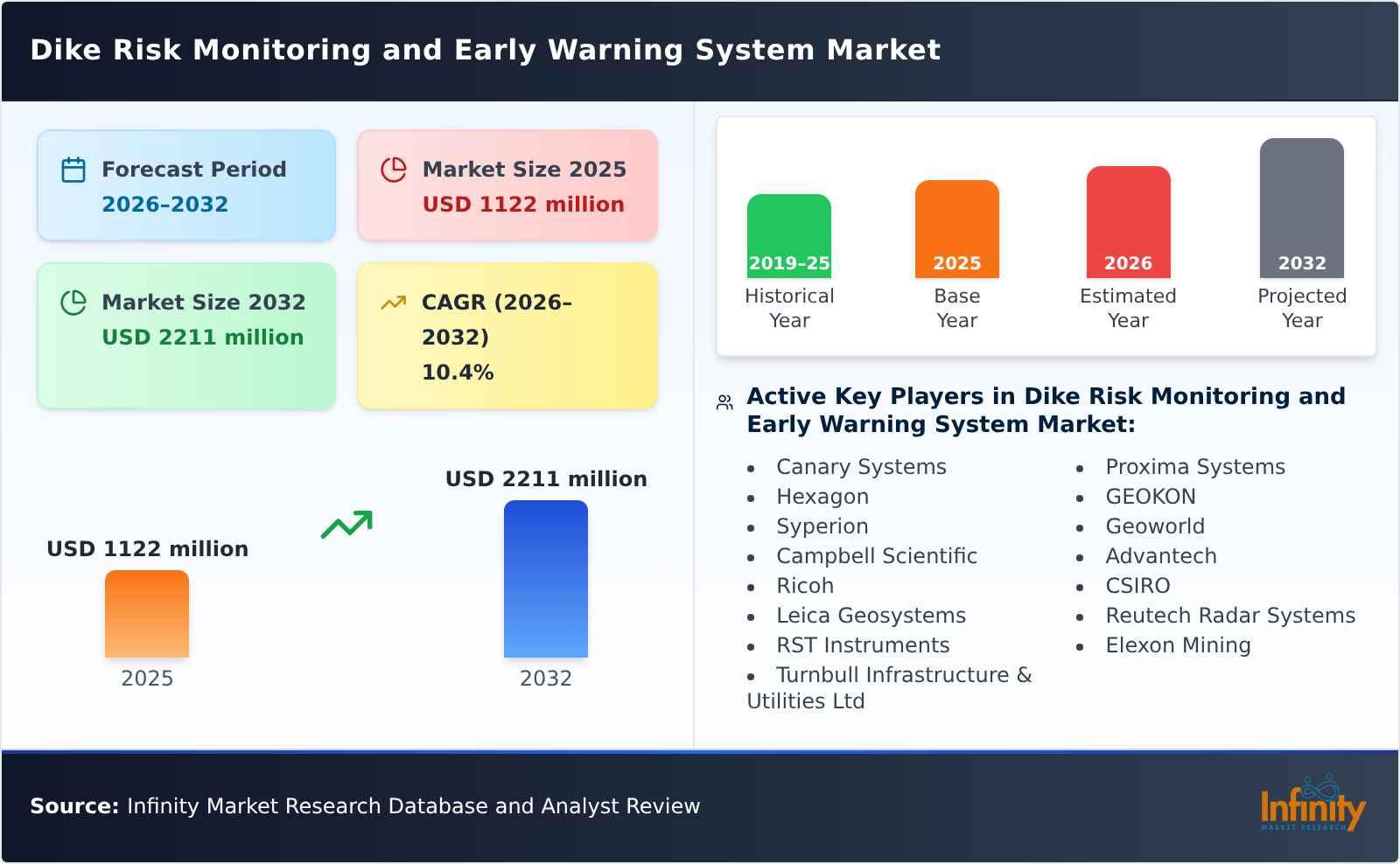
The global Dike Risk Monitoring and Early Warning System market size is predicted to grow from US$ 1122 million in 2025 to US$ 2211 million in 2032; it is expected to grow at a CAGR of 10.4% from 2026 to 2032.
Explore this report in detail? Download a free sample copy
Download Free Sample Report
The levee risk monitoring and early warning system is a smart monitoring system designed for projects such as river levees and flood control dikes around reservoir dams. It utilizes sensors, the Internet of Things (IoT), and a monitoring platform to conduct real-time checks on the safety of the levee structure. It typically deploys multiple monitoring points on the levee itself and in the surrounding area, including those for displacement, settlement, seepage pressure, pore water pressure, rainfall, water level, and video feeds. Data is collected to the platform via wired/wireless methods. Combined with model algorithms and early warning thresholds, the system automatically identifies risk conditions such as abnormal seepage, piping, landslide deformation, exceeding water levels, and excessive rainfall. It promptly sends early warning information to flood control command, river management, and local emergency departments, coordinating with levee patrol personnel and emergency response plans. This shifts the focus from post-disaster emergency response to pre-disaster warning + early intervention, improving the overall flood control safety of the levees.
1. Market Segmentation by System Components
Classification by Monitoring Elements:Seepage Monitoring System: Monitors seepage pressure, water level, and pore water pressure to analyze seepage stability.Deformation Monitoring System: Monitors structural deformation parameters such as embankment displacement, settlement, and crack changes.Rainfall and Water Level Monitoring System: Collects hydrological information such as rainfall, river water level, and flow rate changes.Video Surveillance and Image Recognition System: Automates patrols and identifies anomalies using cameras and AI algorithms.Environmental and Basic Information Monitoring System: Includes environmental indicators such as temperature, humidity, air pressure, wind speed, and ground temperature.Integrated Early Warning and Dispatch System: Integrates multi-source data to achieve risk identification, early warning push, and emergency response.
Classification by Communication and Power Supply Methods:
Wired Communication System: Uses fiber optic or industrial Ethernet transmission, stable and reliable, suitable for core embankment sections.
Wireless Communication System: Supports 4G/5G, NB-IoT, BeiDou short message protocols, etc., facilitating distributed deployment. Hybrid Power Supply System: Combining mains power, solar energy, and energy storage devices, suitable for remote or unpowered dike sections.
Classified by Application Scenarios: Urban flood control dikes and riverside dikes: Enabling real-time monitoring and emergency early warning for urban flood control; Small and medium-sized reservoirs and canal dams: Ensuring the safe operation of small and medium-sized water conservancy facilities; Seawalls and reclamation projects: Used for tide and seepage prevention monitoring; Key flood control areas and watershed control systems: Constructing a watershed-level dike safety monitoring network.
2. Case Study: In a riverside city in Central China, dike safety management had long relied on manual patrols, resulting in long monitoring cycles, data lag, and slow risk response. In 2023, the city launched the Smart Flood Control and Dike Safety Monitoring Integration Project, deploying 800 sets of automated dike monitoring terminals, covering key dike sections throughout the city. The system uses NB-IoT wireless communication and solar power, integrating seepage pressure, displacement, rainfall, water level, and video monitoring functions. After completion, the project will enable automatic data collection, real-time uploading, and intelligent analysis through a cloud platform. The data upload cycle will be reduced from 3 hours to 5 minutes, early warning response time will be shortened by 60%, and the efficiency of dike safety inspections will be improved by 70%. The system also supports remote dispatching by the flood control command center, enabling multi-departmental collaboration and providing a scientific basis for flood season defense decisions.
3. Upstream and Downstream Analysis
Upstream: Primarily includes key components such as sensors, communication modules, power systems, edge computing terminals, solar panels, protective housings, and monitoring software platforms. Core technologies are concentrated in high-precision sensors, low-power communication modules, and data acquisition units (DTUs).
Midstream: Involves system integrators and water conservancy information equipment manufacturers, responsible for system design, equipment assembly, network access, platform development, and operation and maintenance services.
Downstream: Main users are water conservancy departments at all levels, flood control command centers, dike management units, and smart watershed operation agencies. Typical applications include flood control dispatching, dike health assessment, disaster early warning, and digital twin watershed construction.
4. Technological Trends and Innovation Directions
Multi-source Sensing and Intelligent Fusion: Integrating radar, hydrological, geological, and meteorological monitoring to achieve multi-dimensional sensing and fusion analysis of dike status.
Edge Computing and AI Early Warning Models: Achieving preliminary data analysis and anomaly identification at monitoring terminals, reducing cloud pressure and improving real-time early warning.
Digital Twin and 3D Visualization Management: Constructing digital twin models of dikes to achieve simultaneous virtual and real-world monitoring and risk prediction.
Low Power Consumption and Green Energy Supply: Adopting solar energy + energy storage battery solutions to extend equipment endurance and support operation in remote areas.
Standardization and Modular Construction: Promoting the standardization of sensor interfaces, communication protocols, and data formats to achieve cross-platform interconnection.
5. Market Prospects and Development Trends
With the continuous advancement of smart water conservancy, modern watershed management, and disaster prevention and mitigation system construction, automated dike safety monitoring systems are transforming from single-point monitoring to comprehensive sensing, intelligent early warning, and digital twin management. The global market size for dike and water conservancy safety monitoring systems is projected to reach US$2.1 billion by 2031, with the Asia-Pacific region experiencing the fastest growth, and the Chinese market expected to have a compound annual growth rate exceeding 12%. The core drivers of future market growth include: national-level policy support for flood control, disaster reduction, and smart water conservancy projects; the deep integration of AI and IoT technologies in monitoring systems; and the demand for the construction of digital twin river basins and intelligent prevention and control systems. Automated monitoring systems for dike safety will become an important supporting technology for smart water conservancy, and a key infrastructure for ensuring flood control safety, improving flood control command efficiency, and achieving refined river basin management.
LPI (LP Information) newest research report, the ?Dike Risk Monitoring and Early Warning System Industry Forecast? looks at past sales and reviews total world Dike Risk Monitoring and Early Warning System sales in 2025, providing a comprehensive analysis by region and market sector of projected Dike Risk Monitoring and Early Warning System sales for 2026 through 2032. With Dike Risk Monitoring and Early Warning System sales broken down by region, market sector and sub-sector, this report provides a detailed analysis in US$ millions of the world Dike Risk Monitoring and Early Warning System industry.
This Insight Report provides a comprehensive analysis of the global Dike Risk Monitoring and Early Warning System landscape and highlights key trends related to product segmentation, company formation, revenue, and market share, latest development, and M&A activity. This report also analyses the strategies of leading global companies with a focus on Dike Risk Monitoring and Early Warning System portfolios and capabilities, market entry strategies, market positions, and geographic footprints, to better understand these firms? unique position in an accelerating global Dike Risk Monitoring and Early Warning System market.
This Insight Report evaluates the key market trends, drivers, and affecting factors shaping the global outlook for Dike Risk Monitoring and Early Warning System and breaks down the forecast by Type, by Application, geography, and market size to highlight emerging pockets of opportunity. With a transparent methodology based on hundreds of bottom-up qualitative and quantitative market inputs, this study forecast offers a highly nuanced view of the current state and future trajectory in the global Dike Risk Monitoring and Early Warning System.
This report presents a comprehensive overview, market shares, and growth opportunities of Dike Risk Monitoring and Early Warning System market by product type, application, key players and key regions and countries.
Segmentation by Type:
Static Monitoring System
Dynamic Monitoring System
Segmentation by Monitoring Parameters:
Water Level Monitoring System
Soil Moisture Monitoring System
Others
Segmentation by System Integration Level:
Standalone Monitoring System
Regional Integrated Monitoring System
Others
Segmentation by Application:
Water Resources Management Industry
Emergency Management
Environmental and Ecological Protection
Others
This report also splits the market by region:
Americas
United States
Canada
Mexico
Brazil
APAC
China
Japan
Korea
Southeast Asia
India
Australia
Europe
Germany
France
UK
Italy
Russia
Middle East & Africa
Egypt
South Africa
Israel
Turkey
GCC Countries
The below companies that are profiled have been selected based on inputs gathered from primary experts and analyzing the companys coverage, product portfolio, its market penetration.
Canary Systems
Hexagon
Syperion
Campbell Scientific
Ricoh
Leica Geosystems
RST Instruments
Turnbull Infrastructure & Utilities Ltd
Proxima Systems
GEOKON
Geoworld
Advantech
CSIRO
Reutech Radar Systems
Elexon Mining
Dike Risk Monitoring and Early Warning System Market Scope
| Report Attribute | Details |
|---|---|
| Market Size (Start Year) | USD XX Million |
| Market Size (End Year) | USD XX Million |
| Compound Annual Growth Rate (CAGR) | USD XX Million |
| Forecast Period | USD XX Million |
| Base Year | USD XX Million |
| Historical Data | USD XX Million |
| Key Players | USD XX Million |
REPORT COVERAGE
Revenue forecast, Company Analysis, Industry landscape, Growth factors, and Trends
SEGMENT COVERED
By component, deployment, organization size, application, and industry.
REGIONAL SCOPE
North America, Europe, Asia Pacific, Middle East & Africa, South & Central America
COUNTRY SCOPE
Includes key countries across all major regions.
📘 Frequently Asked Questions
1. What is the market size of Global Dike Risk Monitoring and Early Warning System Market?
Answer: The global Dike Risk Monitoring and Early Warning System market size is predicted to grow from US$ 1122 million in 2025 to US$ 2211 million in 2032; it is expected to grow at a CAGR of 10.4% from 2026 to 2032.
2. Which regions are analyzed in the Global Dike Risk Monitoring and Early Warning System Market report?
Answer: The Global Dike Risk Monitoring and Early Warning System Market report covers major regions such as Europe, Asia-Pacific, Middle East & Africa. Each region is analyzed for trends, opportunities, and market dynamics.
3. What methodology is used for forecasting of Global Dike Risk Monitoring and Early Warning System Market?
Answer: The Global Dike Risk Monitoring and Early Warning System Market report uses a mix of primary research, secondary data, and expert analysis to build its forecasts. Models include both qualitative and quantitative approaches.
4. Are emerging markets analyzed separately in the Global Dike Risk Monitoring and Early Warning System Market?
Answer: Yes, the Global Dike Risk Monitoring and Early Warning System Market report highlights high-growth emerging regions with dedicated insights. These include untapped opportunities, risks, and potential for expansion.
5. Does the report include competitive benchmarking of Global Dike Risk Monitoring and Early Warning System Market?
Answer: Yes, Global Dike Risk Monitoring and Early Warning System Market report compares major players based on revenue, product portfolio, innovation, and regional presence. This helps assess competitive positioning.
6. Can I access country-level data within the Global Dike Risk Monitoring and Early Warning System Market report?
Answer: Yes, Global Dike Risk Monitoring and Early Warning System Market report includes detailed data by country, especially for key markets. This allows for localized insights and decision-making.
7. Can I get customized insights or data from the Global Dike Risk Monitoring and Early Warning System Market report?
Answer: Yes, we offer customization options to align with your specific business needs. You can request tailored sections or regional breakdowns.

🔐 Secure Payment Guaranteed
Safe checkout with trusted global payment methods.
🌟 Why Choose Infinity Market Research?
At Infinity Market Research, we dont just deliver data — we deliver clarity, confidence, and competitive edge.
In a world driven by insights, we help businesses unlock the infinite potential of informed decisions.
Here why global brands, startups, and decision-makers choose us:
Industry-Centric Expertise
With deep domain knowledge across sectors — from healthcare and technology to manufacturing and consumer goods — our team delivers insights that matter.
Custom Research, Not Cookie-Cutter Reports
Every business is unique, and so are its challenges. Thats why we tailor our research to your specific goals, offering solutions that are actionable, relevant, and reliable.
Data You Can Trust
Our research methodology is rigorous, transparent, and validated at every step. We believe in delivering not just numbers, but numbers that drive real impact.
Client-Centric Approach
Your success is our priority. From first contact to final delivery, our team is responsive, collaborative, and committed to your goals — because you re more than a client; you re a partner.