


Global Electronic Heat Sinks Market Size, Share and Analysis Report 2026-2032
Feb 2026
Machinery And Equipment
Pages: 138
ILR4340
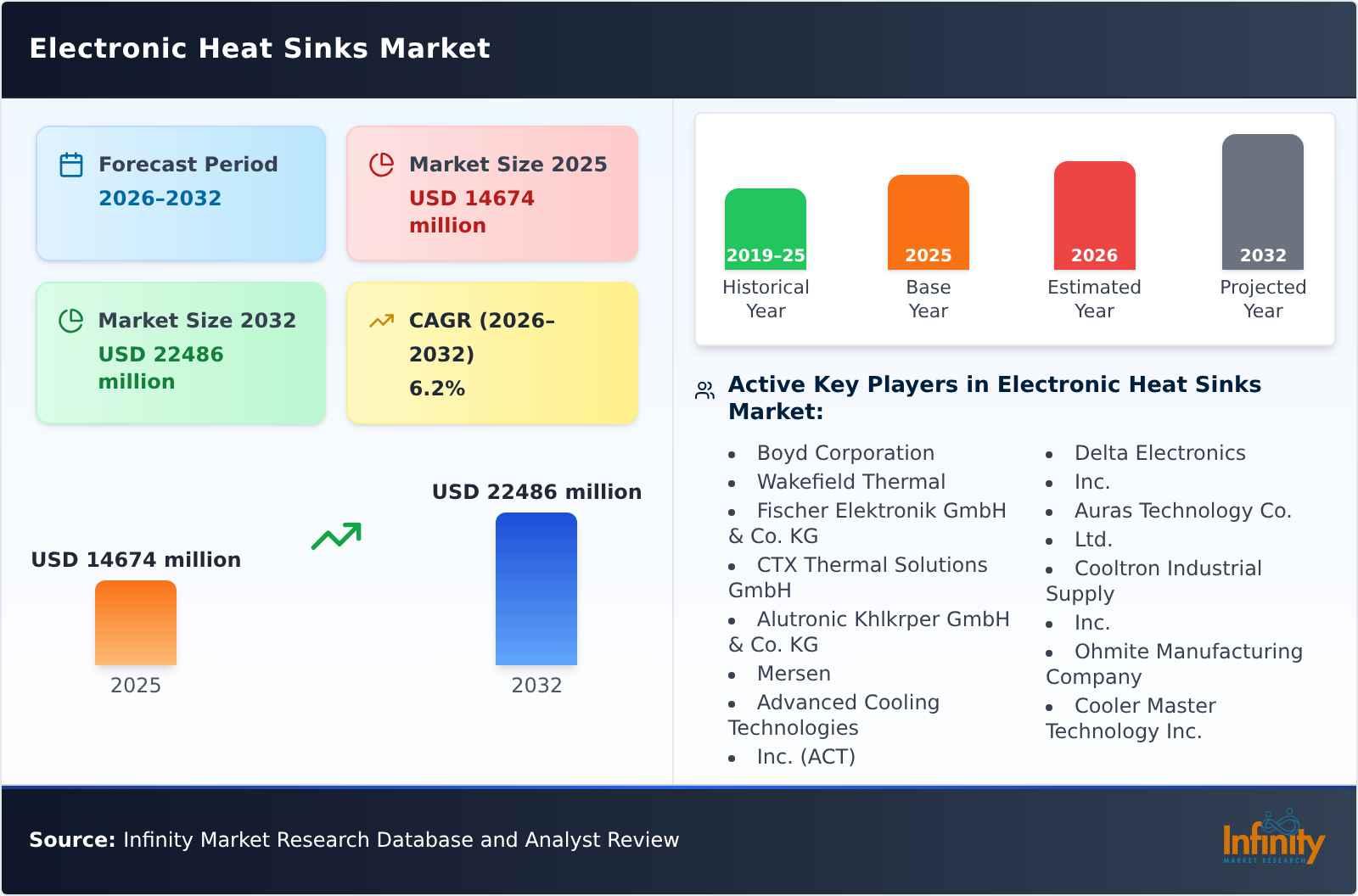
The global Electronic Heat Sinks market size is predicted to grow from US$ 14674 million in 2025 to US$ 22486 million in 2032; it is expected to grow at a CAGR of 6.2% from 2026 to 2032.
Explore this report in detail? Download a free sample copy
Download Free Sample Report
Electronic Heat Sinks are passive or semi-passive thermal management components designed to dissipate heat generated by electronic devices into the surrounding environment through conduction, convection, and radiation. A typical heat sink consists of a base and fin or pin structures, commonly manufactured from aluminum alloys, copper, or aluminum?copper composites, and may be integrated with heat pipes, vapor chambers, or forced-air cooling systems for enhanced performance. By structure and technology, electronic heat sinks include extruded, stamped, die-cast, bonded/brazed, and hybrid heat pipe or vapor chamber designs. They are widely applied across consumer electronics, telecommunications equipment, data center servers, power semiconductor modules, electric vehicles, renewable energy systems, and industrial electronics, serving as a critical component for thermal stability, system reliability, and performance optimization.
In 2025, global Electronic Heat Sink shipments reached approximately 4.5?6.5 billion units, covering passive and hybrid heat sink solutions across consumer, industrial, and infrastructure electronics. Typical FOB prices ranged from USD 0.3 to USD 8 per unit, with standardized aluminum heat sinks for consumer electronics at the lower end, and high-performance solutions for servers, power electronics, and new energy applications commanding significantly higher prices.
Amid the long-term trend toward higher computing intensity and increasing power density in electronic systems, electronic heat sinks have become a critical foundational component for ensuring performance and reliability. Applications such as data centers, AI accelerators, power semiconductors, and telecommunications equipment continue to raise requirements for thermal efficiency, power density, and system stability, directly driving upgrades in heat sink materials, structural design, and manufacturing processes. While conventional aluminum and copper heat sinks maintain steady demand in general electronics, advanced electronic heat sinks integrating heat pipes, vapor chambers, and hybrid structures are rapidly gaining adoption in high-heat-flux applications, significantly enhancing product value and technical differentiation.
At the same time, the market faces notable challenges and risks. Volatility in metal raw material prices places ongoing pressure on cost management, while downstream customers increasingly demand customized solutions, faster validation cycles, and closer system-level integration, adding complexity to development and delivery. As electronic devices continue to shrink and integrate more functions, limited thermal space and reduced design margins are raising the bar for precision engineering and manufacturing consistency, intensifying competition around technical capability rather than scale alone.
From a downstream demand perspective, electronic heat sinks are seeing a clear shift toward high-reliability and infrastructure-level applications. Growing demand from data centers, cloud computing, and AI servers for continuous operation and energy efficiency is driving sustained procurement of high-performance thermal solutions. In parallel, electric vehicles, charging infrastructure, energy storage systems, and industrial power electronics are placing greater emphasis on thermal management and component lifetime. Overall, electronic heat sinks are evolving from passive functional components into essential engineering modules that enable system performance, reliability, and energy efficiency across global electronics markets.
Infinity Market Research newest research report, the ?Electronic Heat Sinks Industry Forecast? looks at past sales and reviews total world Electronic Heat Sinks sales in 2025, providing a comprehensive analysis by region and market sector of projected Electronic Heat Sinks sales for 2026 through 2032. With Electronic Heat Sinks sales broken down by region, market sector and sub-sector, this report provides a detailed analysis in US$ millions of the world Electronic Heat Sinks industry.
This Insight Report provides a comprehensive analysis of the global Electronic Heat Sinks landscape and highlights key trends related to product segmentation, company formation, revenue, and market share, latest development, and M&A activity. This report also analyzes the strategies of leading global companies with a focus on Electronic Heat Sinks portfolios and capabilities, market entry strategies, market positions, and geographic footprints, to better understand these firms? unique position in an accelerating global Electronic Heat Sinks market.
This Insight Report evaluates the key market trends, drivers, and affecting factors shaping the global outlook for Electronic Heat Sinks and breaks down the forecast by Cooling Method, by Application, geography, and market size to highlight emerging pockets of opportunity. With a transparent methodology based on hundreds of bottom-up qualitative and quantitative market inputs, this study forecast offers a highly nuanced view of the current state and future trajectory in the global Electronic Heat Sinks.
This report presents a comprehensive overview, market shares, and growth opportunities of Electronic Heat Sinks market by product type, application, key manufacturers and key regions and countries.
Segmentation by Cooling Method:
Passive Heat Sink
Active Heat Sink
Hybrid Heat Sink
Segmentation by Material Type:
Aluminum
Copper
Aluminum Copper Composite
Others
Segmentation by Manufacturing Process:
Extruded
Die Cast
Stamped
Segmentation by Power Density Class:
Low Power
Medium Power
High Power
Segmentation by Application:
Consumer Electronics
Data Center and Servers
Automotive Electronics
This report also splits the market by region:
Americas
United States
Canada
Mexico
Brazil
APAC
China
Japan
Korea
Southeast Asia
India
Australia
Europe
Germany
France
UK
Italy
Russia
Middle East & Africa
Egypt
South Africa
Israel
Turkey
GCC Countries
The below companies that are profiled have been selected based on inputs gathered from primary experts and analysing the companys coverage, product portfolio, its market penetration.
Boyd Corporation
Wakefield Thermal
Fischer Elektronik GmbH & Co. KG
CTX Thermal Solutions GmbH
Alutronic Khlkrper GmbH & Co. KG
Mersen
Advanced Cooling Technologies, Inc. (ACT)
Delta Electronics, Inc.
Auras Technology Co., Ltd.
Cooltron Industrial Supply, Inc.
Ohmite Manufacturing Company
Cooler Master Technology Inc.
Beijing DeepCool Industries Co., Ltd. (DeepCool)
Shenzhen Fluence Technology PLC (PCCOOLER)
Shenzhen Wanjinghua Technology Co., Ltd. (ID-COOLING)
Zerode Heatsink Manufacturing (Shenzhen) Co., Ltd.
Dongguan Tongyu Electronics Co., Ltd.
Dongguan Songde Hardware & Electronics Co., Ltd.
Key Questions Addressed in this Report
What is the 10-year outlook for the global Electronic Heat Sinks market?
What factors are driving Electronic Heat Sinks market growth, globally and by region?
Which technologies are poised for the fastest growth by market and region?
How do Electronic Heat Sinks market opportunities vary by end market size?
How does Electronic Heat Sinks break out by Cooling Method, by Application?
Electronic Heat Sinks Market Scope
| Report Attribute | Details |
|---|---|
| Market Size (Start Year) | USD XX Million |
| Market Size (End Year) | USD XX Million |
| Compound Annual Growth Rate (CAGR) | USD XX Million |
| Forecast Period | USD XX Million |
| Base Year | USD XX Million |
| Historical Data | USD XX Million |
| Key Players | USD XX Million |
REPORT COVERAGE
Revenue forecast, Company Analysis, Industry landscape, Growth factors, and Trends
SEGMENT COVERED
By component, deployment, organization size, application, and industry.
REGIONAL SCOPE
North America, Europe, Asia Pacific, Middle East & Africa, South & Central America
COUNTRY SCOPE
Includes key countries across all major regions.
Frequently Asked Questions
1. What is the market size of Global Electronic Heat Sinks Market?
Answer: The global Electronic Heat Sinks market size is predicted to grow from US$ 14674 million in 2025 to US$ 22486 million in 2032; it is expected to grow at a CAGR of 6.2% from 2026 to 2032.
2. Which regions are analyzed in the Global Electronic Heat Sinks Market report?
Answer: The Global Electronic Heat Sinks Market report covers major regions such as Europe, Middle East & Africa. Each region is analyzed for trends, opportunities, and market dynamics.
3. What methodology is used for forecasting of Global Electronic Heat Sinks Market?
Answer: The Global Electronic Heat Sinks Market report uses a mix of primary research, secondary data, and expert analysis.
4. Are emerging markets analyzed separately in the Global Electronic Heat Sinks Market?
Answer: Yes, the Global Electronic Heat Sinks Market report highlights high-growth emerging regions with dedicated insights.
5. Does the report include competitive benchmarking of Global Electronic Heat Sinks Market?
Answer: Yes, Global Electronic Heat Sinks Market report compares major players based on revenue, product portfolio, and innovation.
6. Can I access country-level data within the Global Electronic Heat Sinks Market report?
Answer: Yes, Global Electronic Heat Sinks Market report includes detailed data by country for major regions.
7. Can I get customized insights or data from the Global Electronic Heat Sinks Market report?
Answer: Yes, we offer customization options to align with your specific business needs. You can request tailored sections or regional breakdowns.