


Global End-to-end Autonomous Driving Market Growth (Status and Outlook) 2026-2032
Jan 2026
Information and Communication Technology
Pages: 156
ILR1807
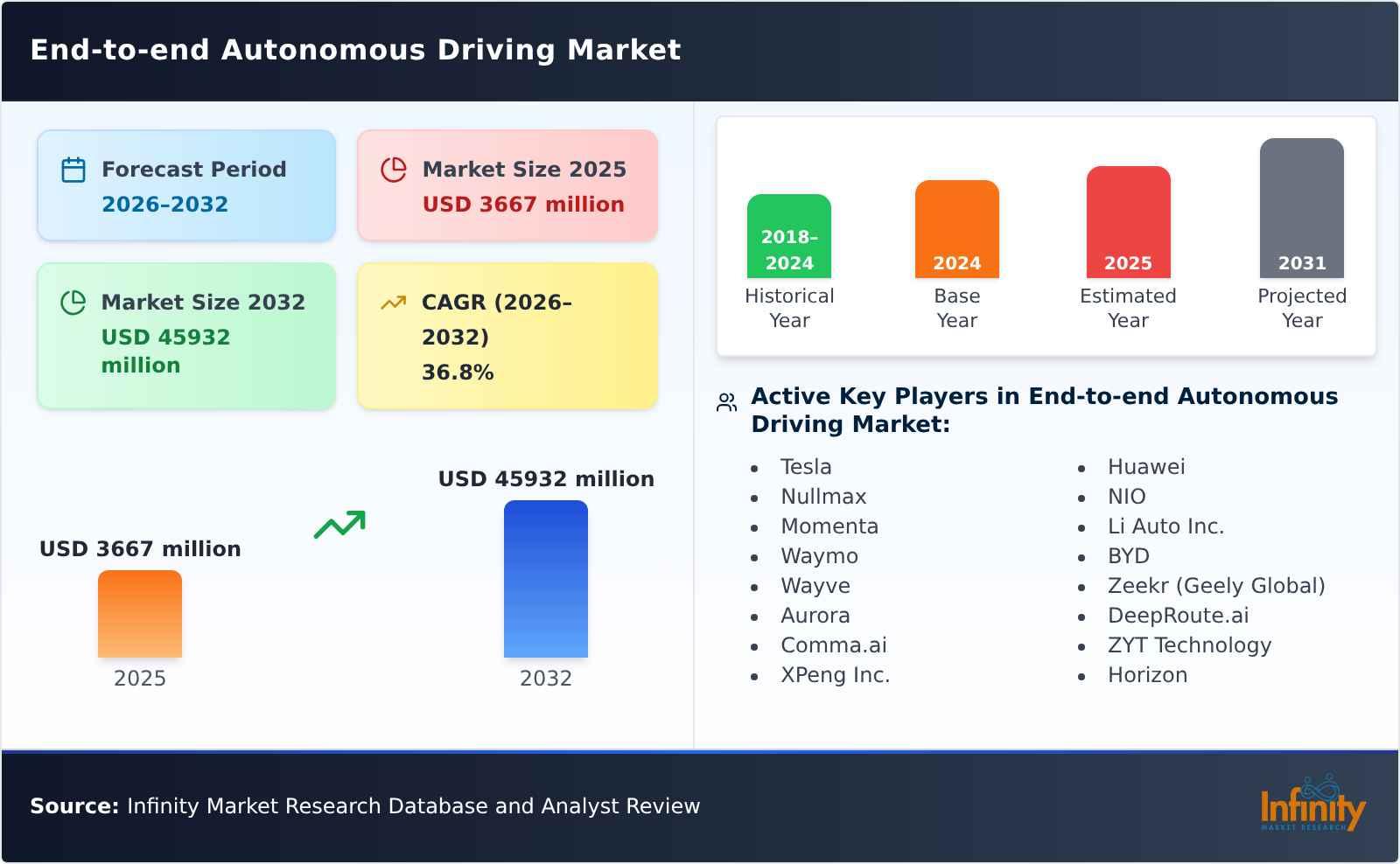
The global End-to-end Autonomous Driving market size is predicted to grow from US$ 3667 million in 2025 to US$ 45932 million in 2032; it is expected to grow at a CAGR of 36.8% from 2026 to 2032.
Explore this report in detail? Download a free sample copy
Download Free Sample Report
In 2025, the global End-to-end Autonomous Driving industry will be in its early stages of commercialization, with gross profit margins ranging from 3.26% to 87.13%, depending on the companys R&D progress and commercialization level. End-to-end autonomous driving (E2E) refers to an intelligent-driving architecture in which a data-driven unified deep-learning model (or a tightly coupled small set of models) maps multi-sensor inputscameras, radar, LiDAR where applicable, localization, and vehicle stateswith minimal hand-crafted rules and interfaces, directly to actionable driving outputs, including intent, target trajectories, and steering/throttle/brake controls. The capability is continuously improved through a closed loop of data collection, training, evaluation, and deployment, enabling policy generalization to complex traffic conditions and long-tail scenarios. In practice, two major technical forms are commonly used. Modular E2E employs neural networks for both perception and decision/planning while retaining human-designed interfaces (e.g., object lists, occupancy grids, BEV features) to support engineering decomposition, staged verification, and faster productionization. Unified (One-piece) E2E further collapses perception, prediction, and planning (and sometimes parts of control) into a single policy network/large model, jointly optimized against end objectives for the final driving task, thereby reducing interface-induced information loss and error accumulation. Industrial roadmaps typically evolve smoothly from learning-based planning and E2E-to-trajectory/behavior toward tighter unification, and under higher safety requirements increasingly adopt a redundant architectureE2E plus multimodal foundation models (e.g., VLMs)together with system guardrails to balance capability ceilings, interpretability, and safety-assurable deployment.
Compared with the traditional modular perceptionpredictionplanningcontrol stack, E2E differs in three core ways. First, modular pipelines optimize components independently and rely heavily on rule engineering; cross-module interfaces can introduce mismatches and compounding errors, and long-tail coverage often depends on continuous rule additions and tuning. E2E reduces cross-module loss via data-driven joint training and is optimized toward task-level objectives. Second, iteration in modular stacks is frequently constrained by rule maintenance and interface-change costs, whereas E2E scales primarily with data, training infrastructure, and evaluation systemsenabling release-driven expansion of ODD coverage and improvements in availability and behavioral consistency within controlled engineering boundaries. Third, E2E imposes higher demands on compute, data, and validation; consequently, commercialization rarely deploys E2E as a standalone black box. Instead, it is integrated as the core policy layer within a full intelligent-driving system: the E2E model outputs decisions/trajectories/controls, while surrounding layers provide safety constraints and graceful degradation, driver monitoring (for L2/L3), simulation and regression validation, diagnostics and observability, andunder L4 operationsremote assistance, fleet dispatch, and safety operations to satisfy production and compliance requirements. Commercially, passenger-vehicle scale is realized primarily through L2/L2+ driver-assistance feature bundles monetized via vehicle standard/option + subscription/feature unlock + OTA. L3 commercialization is more tightly driven by regulation and liability boundaries and typically emerges first as limited-ODD, small-scale enablement. At L4, E2E value is most often delivered as operated services, monetized per mile/per trip or through long-term contracts to mobility or freight operators, where scale is measured more by trips and miles than by retail installation base. Overall, E2E is not only an algorithmic architecture choice but a restructuring of capability production and delivery: replacing rule stacking with a data loop, bounding learning with system engineering for safety assurance, and scaling through both mass production and operational-service pathways.
In industry practice, two major implementation paths are common: Modular E2E, which preserves engineered interfaces to enable staged verification and faster productionization, and Unified (One-piece) E2E, which further consolidates perception/prediction/planning (and sometimes parts of control) into a single policy network.
The global E2E Autonomous Driving market is projected to grow from US$ 1,511.61 million in 2024 to US$ 74,761.67 million by 2035. The period 20242028 represents a rapid commercialization and scaling phase, expanding from US$ 1,511.61 million to US$ 19,042.39 million. From 2028 to 2035, the market is expected to increase from US$ 19,042.39 million to US$ 74,761.67 million, implying a CAGR of 21.58% over 20282035.
A structural value shift is underway from hardware-led early deployments toward a higher software-and-service mix. Hardwareon-board compute, sensing suites, domain controllers, and system integrationremains the largest revenue component through the forecast horizon, but its share declines as software and service monetization expands. Software & Servicesincluding E2E model development and licensing, OTA feature enablement, validation and safety toolchains, data operations, cloud support, and lifecycle servicesrises steadily as deployments scale and functional upgrades become a recurring revenue lever.
By application, passenger vehicles remain the primary revenue base, while commercial vehicles gain share over time due to stronger utilization and cost-per-mile economics. By 2035, passenger-vehicle E2E revenue is projected at US$ 56,362.82 million (75.39%), while commercial-vehicle E2E revenue reaches US$ 18,398.85 million (24.61%). This reflects broad passenger-vehicle penetration via production-grade L2/L2+ packaging and OTA-driven feature expansion, alongside accelerating commercial adoption as fleet toolchains, route-scale deployment, and auditable safety cases mature.
Regionally, Asia-Pacific is expected to remain the largest market and continue increasing its share, reaching US$ 38,165.50 million (51.05%) by 2035, followed by North America at US$ 22,271.57 million (29.79%) and Europe at US$ 12,253.66 million (16.39%). Latin America and the Middle East & Africa together account for roughly 2.77% by 2035.
The competitive landscape spans OEMs, autonomous-driving technology providers, and robotaxi/operational players. As E2E transitions from capability demonstration to scalable delivery, differentiation increasingly depends on long-tail data-loop efficiency, compute and cost engineering, validation and safety toolchains, auditable compliance, and sustainable monetization models.
Infinity Market Research newest research report, the End-to-end Autonomous Driving Industry Forecast looks at past sales and reviews total world End-to-end Autonomous Driving sales in 2025, providing a comprehensive analysis by region and market sector of projected End-to-end Autonomous Driving sales for 2026 through 2032. With End-to-end Autonomous Driving sales broken down by region, market sector and sub-sector, this report provides a detailed analysis in US$ millions of the world End-to-end Autonomous Driving industry.
This Insight Report provides a comprehensive analysis of the global End-to-end Autonomous Driving landscape and highlights key trends related to product segmentation, company formation, revenue, and market share, latest development, and M&A activity. This report also analyses the strategies of leading global companies with a focus on End-to-end Autonomous Driving portfolios and capabilities, market entry strategies, market positions, and geographic footprints, to better understand these firms unique position in an accelerating global End-to-end Autonomous Driving market.
This Insight Report evaluates the key market trends, drivers, and affecting factors shaping the global outlook for End-to-end Autonomous Driving and breaks down the forecast by Type, by Application, geography, and market size to highlight emerging pockets of opportunity. With a transparent methodology based on hundreds of bottom-up qualitative and quantitative market inputs, this study forecast offers a highly nuanced view of the current state and future trajectory in the global End-to-end Autonomous Driving.
This report presents a comprehensive overview, market shares, and growth opportunities of End-to-end Autonomous Driving market by product type, application, key players and key regions and countries.
Segmentation by Type:
Hardware
Software/Services
Segmentation by Driving Level:
L2/L2+
L3
L4
Segmentation by Technology:
Modular E2E
One-piece E2E
Segmentation by Application:
Passenger Vehicle
Commercial Vehicles
This report also splits the market by region:
Americas
United States
Canada
Mexico
Brazil
APAC
China
Japan
Korea
Southeast Asia
India
Australia
Europe
Germany
France
UK
Italy
Russia
Middle East & Africa
Egypt
South Africa
Israel
Turkey
GCC Countries
The below companies that are profiled have been selected based on inputs gathered from primary experts and analyzing the companys coverage, product portfolio, its market penetration.
Tesla
Nullmax
Momenta
Waymo
Wayve
Aurora
Comma.ai
XPeng Inc.
Huawei
NIO
Li Auto Inc.
BYD
Zeekr (Geely Global)
DeepRoute.ai
ZYT Technology
Horizon
SenseTime
CHERY
Xiaomi
GAC Group
Apollo (Baidu Apollo Go)
WeRide
End-to-end Autonomous Driving Market Scope
| Report Attribute | Details |
|---|---|
| Market Size (Start Year) | USD XX Million |
| Market Size (End Year) | USD XX Million |
| Compound Annual Growth Rate (CAGR) | USD XX Million |
| Forecast Period | USD XX Million |
| Base Year | USD XX Million |
| Historical Data | USD XX Million |
| Key Players | USD XX Million |
REPORT COVERAGE
Revenue forecast, Company Analysis, Industry landscape, Growth factors, and Trends
SEGMENT COVERED
By component, deployment, organization size, application, and industry.
REGIONAL SCOPE
North America, Europe, Asia Pacific, Middle East & Africa, South & Central America
COUNTRY SCOPE
Includes key countries across all major regions.
Frequently Asked Questions
1. What is the market size of Global End-to-end Autonomous Driving Market?
Answer: The global End-to-end Autonomous Driving market size is predicted to grow from US$ 3667 million in 2025 to US$ 45932 million in 2032; it is expected to grow at a CAGR of 36.8% from 2026 to 2032.
2. Which regions are analyzed in the Global End-to-end Autonomous Driving Market report?
Answer: The Global End-to-end Autonomous Driving Market report covers major regions such as North America, Europe, Asia-Pacific, Latin America, Middle East & Africa. Each region is analyzed for trends, opportunities, and market dynamics.
3. What methodology is used for forecasting of Global End-to-end Autonomous Driving Market?
Answer: The Global End-to-end Autonomous Driving Market report uses a mix of primary research, secondary data, and expert analysis.
4. Are emerging markets analyzed separately in the Global End-to-end Autonomous Driving Market?
Answer: Yes, the Global End-to-end Autonomous Driving Market report highlights high-growth emerging regions with dedicated insights.
5. Does the report include competitive benchmarking of Global End-to-end Autonomous Driving Market?
Answer: Yes, Global End-to-end Autonomous Driving Market report compares major players based on revenue, product portfolio, and innovation.
6. Can I access country-level data within the Global End-to-end Autonomous Driving Market report?
Answer: Yes, Global End-to-end Autonomous Driving Market report includes detailed data by country for major regions.
7. Can I get customized insights or data from the Global End-to-end Autonomous Driving Market report?
Answer: Yes, we offer customization options to align with your specific business needs. You can request tailored sections or regional breakdowns.