


Global Fluid Film Journal Bearings Market Growth 2026-2032
Jan 2026
Machinery And Equipment
Pages: 106
ILR1401
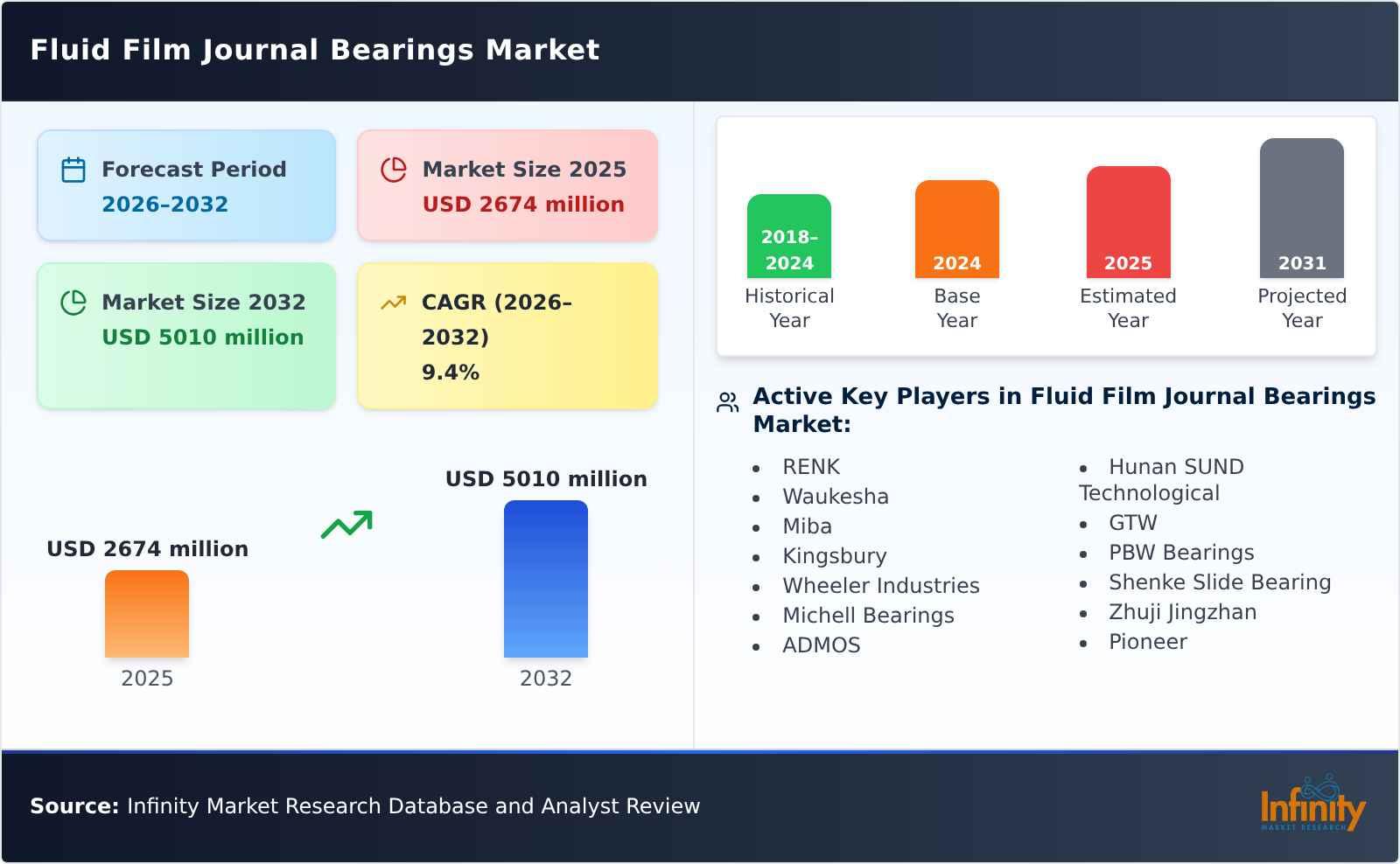
The global Fluid Film Journal Bearings market size is predicted to grow from US$ 2674 million in 2025 to US$ 5010 million in 2032; it is expected to grow at a CAGR of 9.4% from 2026 to 2032.
Explore this report in detail? Download a free sample copy
Download Free Sample Report
Fluid Film Journal Bearings, as a core rotor support unit in heavy rotating machinery such as steam turbines, gas turbines, generators, and large compressors, the essential value of oil film radial bearings lies in solving the problems of traditional rolling bearings or simple sliding bearings in high speed + high load + The long-standing pain points of insufficient fatigue life, uncontrollable vibration and noise, severe wear during start-up and shutdown, and unplanned downtime, high downtime losses, and safety risks in long-life operating conditionsin typical scenarios such as 300MW and above steam turbine generator sets, ethylene cracking/long-distance pipeline compressors, and large blowersif rolling bearings or poorly designed sliding bearings are used, raceway spalling, cage fracture, or boundary friction failure often occur under long-term high temperature, high speed, and variable load conditions. This not only shortens maintenance cycles and increases total life cycle costs but also amplifies vibration problems caused by rotor imbalance and system resonance. Oil film radial bearings, by establishing a stable full-fluid lubricating oil film between the journal and the bearing bush, transform direct metal-to-metal contact into oil film bearing. During operation, they form a liquid spring with stiffness and damping characteristics, capable of withstanding huge radial loads and a certain amount of axial disturbance, while also attenuating and filtering rotor vibration. This transforms what was originally a high-risk part highly dependent on field experience and frequent maintenance into an engineering module that can be designed, calculated, and monitored according to specifications. In 2025, the global shipment volume of fluid film journal bearings in various application scenarios is approximately 1,885,000 sets. The average purchase price of OEMs, calculated based on the assemblies including the mounting base, is approximately USD 1,450 per set. The price will mainly increase with the customization from small equipment to large equipment, and the corresponding gross profit margin is roughly in the range of 26%34%. Fluid film journal bearings describes radial film bearings as radial sliding bearing assemblies that use a lubricating oil film as the bearing medium to support high-speed rotors. A typical assembly consists of a bearing housing (cast steel/ductile iron), bearing bushes (high-tin Babbitt alloy/copper alloy/aluminum-tin alloy), cylindrical bearings or multiple tilting bearings, oil supply grooves and return channels, labyrinth or combined seals, and temperature/vibration/displacement monitoring interfaces located on the housing. Common parameters include: shaft diameter range of approximately 80800 mm (120450 mm is common for large steam turbine generators and long-distance compressors), design specific pressure of 1.54.5 MPa, rated speed of 1,50015,000 rpm (gas turbine-driven compressors and some high-speed units can reach over 20,000 rpm with specialized designs), design oil film thickness of tens to hundreds of micrometers, and a design life typically considered to be 2030 years, the same as the main units life. In terms of typical usage: a 300600 MW steam turbine generator set is generally equipped with 46 sets of fluid film journal bearings and 24 sets of thrust bearings; a high-power ethylene compressor or long-distance natural gas compressor unit is usually equipped with 24 sets of fluid film journal bearings. Upstream supply mainly relies on high-quality alloy steel and ductile iron billets, high-tin Babbitt alloys and copper/aluminum-tin alloys, industrial lubricants and additives, precision casting and machining capabilities, and online monitoring sensors; downstream supply is concentrated in large steam turbine and gas turbine plants, power generation equipment and compressor EPC contractors, refining and LNG equipment plants, and OEM clusters providing high-power rotating machinery for the power, petrochemical, and metallurgical industries.
Supply Situation
Upstream raw materials and key components mainly include alloy steel and ductile iron billets for the bearing housing (requiring high strength and good machinability), high-tin Babbitt alloy and copper/aluminum-tin alloy for the bearing bush liner, turbine oil and lubricant additives meeting high temperature and shear conditions, carbide cutting tools and abrasives for finishing, as well as vibration/temperature/displacement monitoring sensors, sealing materials, and fasteners. The combined costs of raw materials and casting/heat treatment/finishing typically account for 60%72% of the total cost of a fluid film journal bearing. High-tin Babbitt alloy and large-size, high-precision machining have the greatest cost elasticity and significantly impact the gross profit margin of a single project. Typical upstream suppliers include ArcelorMittal, Nippon Steel, Aurubis, Shell, and BASF.
Manufacturer Characteristics
Waukesha has cultivated deep expertise in the North American and Middle Eastern refining, long-distance pipeline, and power generation markets for many years, specializing in providing complete sliding bearing solutions for high-power compressors and steam turbines; Miba, leveraging its comprehensive product line and engineering capabilities in power, refining, and marine propulsion bearings in Europe and globally, possesses strong bargaining power in high-end project tenders; Kingsbury, as one of the key originators of tilting pad bearing technology, enjoys high brand recognition and engineering experience in high-load, demanding operating conditions, especially in the field of bearings for large steam turbine generator sets and critical process compressors.
Example
In 2024, a newly built 1,500 MW combined cycle power plant and its supporting seawater desalination project in the Middle East had specific technical requirements for the bearing systems of the turbine generator sets and key auxiliary equipment in the main equipment: the fluid film journal bearings of the main turbine generator section must adopt a multi-tilting pad structure, with a specific pressure capacity of not less than 3.5 MPa, a design speed of 3,000 rpm, and the operating vibration and temperature rise indicators must meet relevant ISO standards and be included in performance evaluation; it is required that vibration, shaft displacement, and metal temperature monitoring interfaces be reserved on the bearing housing, and a 25-year life design certificate and a complete spare parts plan be provided; the key units used for process air compression and seawater transportation are required to adopt a dynamic and static pressure composite fluid film journal bearing to ensure the continuity and reliability of the oil film under low-speed start-up and frequent start-stop conditions. Miba ultimately supplied over 40 sets of fluid film journal bearings and matching thrust bearings for two steam turbine generator sets and multiple key auxiliary machines. They were also responsible for on-site installation guidance, commissioning, and first-year operational data analysis. Bearing vibration and temperature rise parameters were included in the overall machine performance guarantee clauses, becoming one of the important technical foundations for the O&M agreement signed between the EPC contractor and the owner.
Applications
Fluid film journal bearings are widely used in large-scale thermal and nuclear power steam turbine generator sets, gas turbine combined cycle units, process compressors and blowers in oil refining and chemical plants, turbines and compressors in LNG liquefaction and regasification plants, rolling mills and blower systems in the steel and non-ferrous metallurgical industries, large water pumps and seawater desalination units, marine main engines and propulsion shaft systems, as well as ground test benches for aero-engines and various high-power test benches. They are one of the core supporting components in rotating machinery with high speed + high load + long life. Typical downstream customers include OEMs and owners such as GE Vernova, Siemens Energy, Mitsubishi Power, MAN Energy Solutions, and Saudi Aramco. They often incorporate fluid film journal bearings into their contracts along with overall machine design, rotor dynamics analysis, and condition monitoring systems through long-term framework agreements with bearing manufacturers or project-based turnkey procurement.
Product Advantages
For downstream turbine/compressor OEMs and power and petrochemical owners, the real advantage of fluid film journal bearings lies not in the gross profit per unit, but in transforming the rotor support problemwhich could easily drag down the overall units MTBF and availabilityinto a calculable, verifiable, and monitorable standardized module. Relying on a full-fluid lubricating oil film, fluid film journal bearings exhibit lower friction loss and higher load-bearing capacity than rolling bearings under stable operating conditions. During operation, the fluid film itself provides adjustable stiffness and damping, helping to shift the systems critical speed and resonance range towards a safer direction, significantly reducing vibration and noise in high-speed units. This makes the most critical indicators for ownerssuch as stable operation, long-term operation, and no major accidentsmore controllable. Simultaneously, the design specifications and test database established around parameters such as specific pressure, oil film thickness, temperature rise, and vibration spectrum allow OEMs to quickly select and perform rotor dynamics matching during new model development and unit modification, reducing on-site trial and error and rework, and shortening project delivery cycles. From the owners perspective, a well-designed radial bearing with online monitoring means a significant reduction in unplanned downtime, extended maintenance cycles, and the ability to recoup substantial bearing and service investments with just one less downtime throughout its lifespan. This transforms the unit from a high-failure, high-volume mining truck into a predictable, maintainable cash flow tool.
Technological Trends
Technological upgrades mainly focus on four directions: First, the deep coupling of fluid dynamics and rotor dynamics. Through 3D CFD + finite element/multibody dynamics joint simulation, the bearing geometry (elliptical, eccentric, multi-tilting pads), oil wedge shape, and oil supply/throttling structure are optimized in an integrated manner. This further reduces friction loss and oil temperature while ensuring sufficient oil film thickness and stability, thereby improving unit efficiency and reducing cooling load. Second, the application of hydrostatic/dynamic pressure hybrid and adjustable stiffness/damping structures is expanded. By switching between hydrostatic support during low-speed/start-stop phases and hydrodynamic support during normal operation, or by adjusting oil supply pressure, throttling clearance, and pad tilt angle, bearing performance can adapt to the operating conditions of frequent start-stop, variable load, and even flexible peak-shaving units. Third, monitoring and digital operation and maintenance are embedded in the bearing body design. Temperature, vibration, shaft displacement, and even oil film thickness sensors are reserved or integrated in the bearing housing, combined with online CMS. The platform and digital twin model enable a shift from post-incident maintenance to condition-based maintenance and life prediction, upgrading bearings from passive components to critical sensing nodes. Fourthly, material and process upgrades are implemented. By developing composite Babbitt alloy liners with higher fatigue resistance, scratch resistance, and corrosion resistance, and employing laser cladding, precision welding, and high-precision grinding/scraping processes, reliability and repairability under high-temperature, high-load, and oil-contaminated conditions are improved. The overall trend is to evolve oil film radial bearings from traditional static supports into adjustable, sensing, and predictable system-level components, closely integrated with rotor design, lubrication systems, and maintenance services.
Market Influencing Factors
The market growth of fluid film journal bearings is largely reflected in a combination of rigid existing stock + structural incremental growth: On the one hand, the global stock of thermal power and nuclear power units is huge. Even with the slowdown in new thermal power construction, the overhaul, technical upgrade, and life extension projects of existing units continue unabated, ensuring the steady replacement of turbine generator bearings and the demand for spare parts. Gas turbine combined cycle, industrial steam turbines, and distributed energy units are still under construction in some regions, creating incremental space for bearings in small and medium-sized units. On the other hand, investment in high-power compressors and turbine equipment in the refining/chemical, long-distance natural gas transportation, and LNG industry chains continues, especially in the Middle East, North America, and some Asian countries, where a number of large-scale integrated refining and chemical projects and LNG projects have commenced, driving a phased increase in demand for project-based oil film radial bearings. Simultaneously, equipment upgrades in energy-intensive industries such as pumped storage, electrolytic aluminum, and metallurgy are also driving related bearing demand to some extent. In terms of cost and competition, the cyclical fluctuations in the prices of high-tin Babbitt alloys, copper alloys, and high-quality cast and forged materials, coupled with the concentration of large-scale precision machining and assembly capabilities in Europe, America, and parts of Asia, make it difficult for small and medium-sized manufacturers to challenge the technological and pricing dominance of established international brands such as Miba, Kingsbury, and RENK in large-scale, high-end key equipment projects. However, in the fields of medium-pressure and medium-speed units and some general equipment, sliding bearing companies in emerging manufacturing bases such as China are continuously penetrating local and regional markets through cost and delivery advantages, forming a tiered pattern where high-end key projects are dominated by a few leading companies, while mid-to-low-end and localized demands are undertaken by regional manufacturers. Overall, fluid film journal bearings do not have the basis for explosive growth in the short term, but with the dual support of long-cycle replacement + maintenance of existing units in power and petrochemical large units, relatively stable rigid demand will be maintained. The high-end market will further concentrate on leading manufacturers with system simulation, testing and verification, and global service capabilities, while competition in the mid-to-low-end and regional markets will revolve around cost, delivery, and local services.
Infinity Market Research newest research report, the Fluid Film Journal Bearings Industry Forecast looks at past sales and reviews total world Fluid Film Journal Bearings sales in 2025, providing a comprehensive analysis by region and market sector of projected Fluid Film Journal Bearings sales for 2026 through 2032. With Fluid Film Journal Bearings sales broken down by region, market sector and sub-sector, this report provides a detailed analysis in US$ millions of the world Fluid Film Journal Bearings industry.
This Insight Report provides a comprehensive analysis of the global Fluid Film Journal Bearings landscape and highlights key trends related to product segmentation, company formation, revenue, and market share, latest development, and M&A activity. This report also analyzes the strategies of leading global companies with a focus on Fluid Film Journal Bearings portfolios and capabilities, market entry strategies, market positions, and geographic footprints, to better understand these firms unique position in an accelerating global Fluid Film Journal Bearings market.
This Insight Report evaluates the key market trends, drivers, and affecting factors shaping the global outlook for Fluid Film Journal Bearings and breaks down the forecast by Type, by Application, geography, and market size to highlight emerging pockets of opportunity. With a transparent methodology based on hundreds of bottom-up qualitative and quantitative market inputs, this study forecast offers a highly nuanced view of the current state and future trajectory in the global Fluid Film Journal Bearings.
This report presents a comprehensive overview, market shares, and growth opportunities of Fluid Film Journal Bearings market by product type, application, key manufacturers and key regions and countries.
Segmentation by Type:
Hydrostatic Bearings
Hydrodynamic Bearings
Segmentation by Diameter:
1?
15?
30?
Others
Segmentation by Load Capacity:
1.52.0 MPa
23.5 MPa
> 3.5 MPa
Segmentation by Application:
Power Generation
Oil Refineries
Petrochemical
Marine Propulsion Machinery
Aerospace
Others
This report also splits the market by region:
Americas
United States
Canada
Mexico
Brazil
APAC
China
Japan
Korea
Southeast Asia
India
Australia
Europe
Germany
France
UK
Italy
Russia
Middle East & Africa
Egypt
South Africa
Israel
Turkey
GCC Countries
The below companies that are profiled have been selected based on inputs gathered from primary experts and analysing the companys coverage, product portfolio, its market penetration.
RENK
Waukesha
Miba
Kingsbury
Wheeler Industries
Michell Bearings
ADMOS
Hunan SUND Technological
GTW
PBW Bearings
Shenke Slide Bearing
Zhuji Jingzhan
Pioneer
Key Questions Addressed in this Report
What is the 10-year outlook for the global Fluid Film Journal Bearings market?
What factors are driving Fluid Film Journal Bearings market growth, globally and by region?
Which technologies are poised for the fastest growth by market and region?
How do Fluid Film Journal Bearings market opportunities vary by end market size?
How does Fluid Film Journal Bearings break out by Type, by Application?
Fluid Film Journal Bearings Market Scope
| Report Attribute | Details |
|---|---|
| Market Size (Start Year) | USD XX Million |
| Market Size (End Year) | USD XX Million |
| Compound Annual Growth Rate (CAGR) | USD XX Million |
| Forecast Period | USD XX Million |
| Base Year | USD XX Million |
| Historical Data | USD XX Million |
| Key Players | USD XX Million |
REPORT COVERAGE
Revenue forecast, Company Analysis, Industry landscape, Growth factors, and Trends
SEGMENT COVERED
By component, deployment, organization size, application, and industry.
REGIONAL SCOPE
North America, Europe, Asia Pacific, Middle East & Africa, South & Central America
COUNTRY SCOPE
Includes key countries across all major regions.
Frequently Asked Questions
1. What is the market size of Global Fluid Film Journal Bearings Market?
Answer: The global Fluid Film Journal Bearings market size is predicted to grow from US$ 2674 million in 2025 to US$ 5010 million in 2032; it is expected to grow at a CAGR of 9.4% from 2026 to 2032.
2. Which regions are analyzed in the Global Fluid Film Journal Bearings Market report?
Answer: The Global Fluid Film Journal Bearings Market report covers major regions such as North America, Europe, Middle East & Africa. Each region is analyzed for trends, opportunities, and market dynamics.
3. What methodology is used for forecasting of Global Fluid Film Journal Bearings Market?
Answer: The Global Fluid Film Journal Bearings Market report uses a mix of primary research, secondary data, and expert analysis.
4. Are emerging markets analyzed separately in the Global Fluid Film Journal Bearings Market?
Answer: Yes, the Global Fluid Film Journal Bearings Market report highlights high-growth emerging regions with dedicated insights.
5. Does the report include competitive benchmarking of Global Fluid Film Journal Bearings Market?
Answer: Yes, Global Fluid Film Journal Bearings Market report compares major players based on revenue, product portfolio, and innovation.
6. Can I access country-level data within the Global Fluid Film Journal Bearings Market report?
Answer: Yes, Global Fluid Film Journal Bearings Market report includes detailed data by country for major regions.
7. Can I get customized insights or data from the Global Fluid Film Journal Bearings Market report?
Answer: Yes, we offer customization options to align with your specific business needs. You can request tailored sections or regional breakdowns.