


Global Freezer Workwear Market Size, Share and Opportunities 2026-2032
Feb 2026
Consumer and Retails
Pages: 126
ILR4034
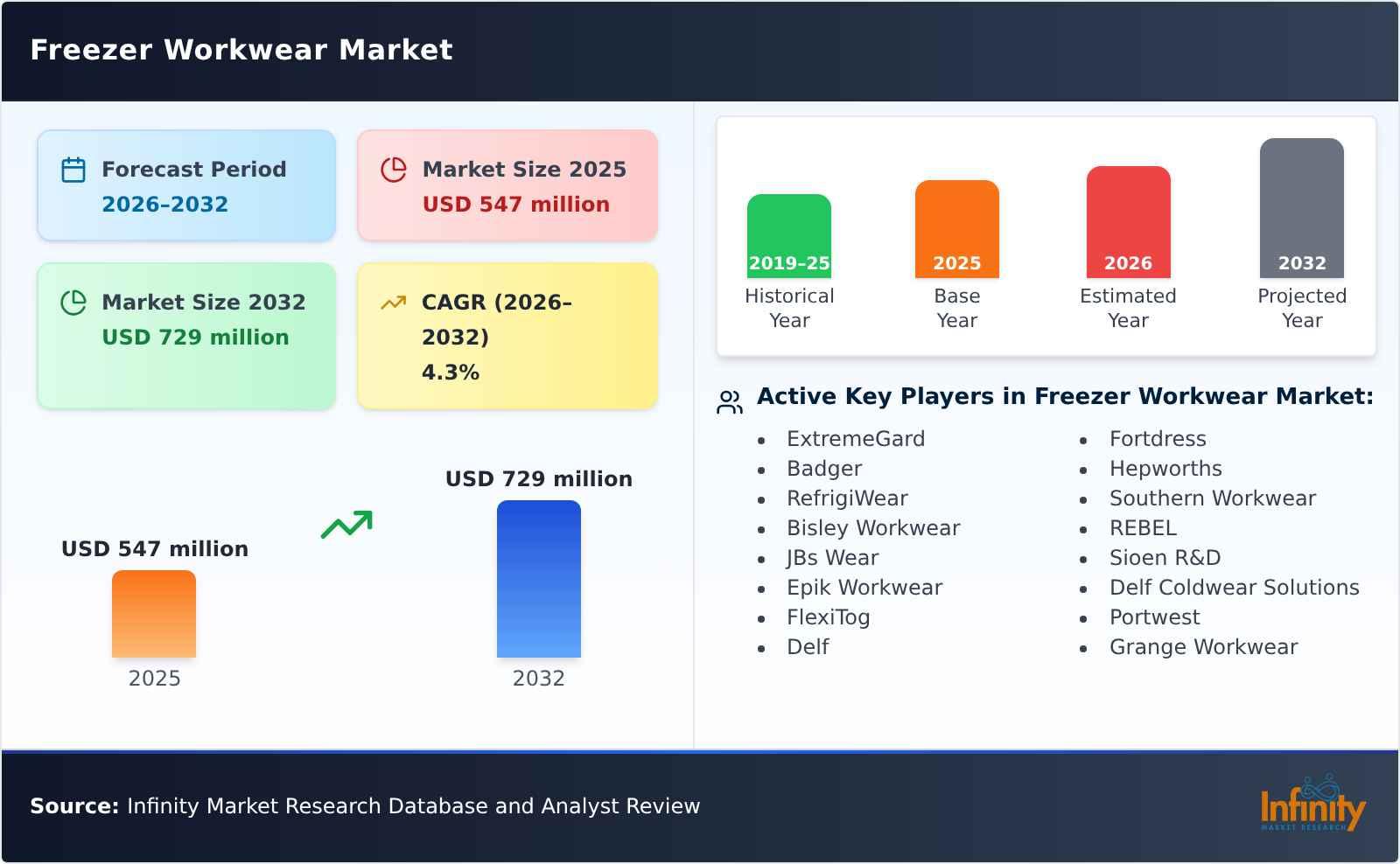
The global Freezer Workwear market size is predicted to grow from US$ 547 million in 2025 to US$ 729 million in 2032; it is expected to grow at a CAGR of 4.3% from 2026 to 2032.
Explore this report in detail? Download a free sample copy
Download Free Sample Report
In 2024, global Freezer Workwear production reached approximately 7,103.4 units, with an average global market price of around US$ 75.4 per unit.
Freezer workwear, also known as cold storage workwear, is a type of professional protective clothing designed for workers engaged in operations in low-temperature environments (typically ranging from -40C to 10C). It integrates thermal insulation, waterproof, windproof, and wear-resistant functions, and is scientifically designed and processed using special materials and structures to effectively isolate the external low-temperature environment, maintain the human bodys core temperature, and prevent cold damage to the body. In addition to meeting basic thermal insulation needs, it often incorporates safety design elements such as reflective strips to enhance the visibility of workers in dim cold storage environments, and its overall performance must comply with relevant industry safety and protective standards to ensure the safety and comfort of workers during long-term low-temperature operations.
The cost structure of freezer workwear is composed of multiple components with distinct weight distributions. Raw materials account for the largest proportion, approximately 45%-55% of the total cost, mainly including high-performance insulation materials (such as polyurethane fiber, down cotton, and thermal fleece), waterproof and windproof outer fabrics (like Oxford cloth with PVC coating), and auxiliary materials (such as thermal zippers, reflective strips, and wear-resistant patches). Labor costs take up 20%-25% of the total cost, covering expenses for cutting, sewing, quality inspection, and assembly, which are affected by production scale and regional labor price differences. Manufacturing and overhead costs account for 10%-15%, including equipment depreciation, factory rental, energy consumption during production, and management fees. R&D and quality certification costs occupy 5%-8%, involving the development of cold-resistant, waterproof, and durable product technologies, as well as the certification fees for meeting industry safety and thermal insulation standards. Finally, logistics and marketing costs make up 3%-7%, covering product transportation, storage, and promotional expenses on e-commerce platforms or through offline channels.
The industry chain of freezer workwear forms a complete ecological system with close collaboration among upstream, midstream, and downstream links. The upstream segment focuses on the supply of raw materials and basic components, including manufacturers of insulation materials (e.g., polyurethane and down cotton suppliers), fabric producers (specializing in waterproof and cold-resistant textile production), and auxiliary material suppliers (providing reflective strips, thermal zippers, etc.). These upstream enterprises provide high-quality raw materials to ensure the core performance of freezer workwear, such as thermal insulation and durability. The midstream segment mainly consists of workwear manufacturers and processing enterprises, which are responsible for product design, R&D, cutting, sewing, and finished product assembly. They transform upstream raw materials into finished products that meet market demands, and some enterprises also provide customized services according to customer requirements (e.g., adding company logos or adjusting size specifications for enterprises). The downstream segment covers the application and sales links, with core demand coming from B-end enterprises such as cold chain logistics companies, food processing plants, pharmaceutical cold storage facilities, and retail supermarkets, as well as individual consumers in special cold environments. Sales channels include offline industrial and commercial supply stores, enterprise bulk procurement, and online e-commerce platforms, forming a multi-channel distribution network to deliver products to end users.
The single-line production capacity of Freezer Workwear is 303 to 307 K units per year, the average gross profit margin was 37.6%.
Infinity Market Research newest research report, the Freezer Workwear Industry Forecast looks at past sales and reviews total world Freezer Workwear sales in 2025, providing a comprehensive analysis by region and market sector of projected Freezer Workwear sales for 2026 through 2032. With Freezer Workwear sales broken down by region, market sector and sub-sector, this report provides a detailed analysis in US$ millions of the world Freezer Workwear industry.
This Insight Report provides a comprehensive analysis of the global Freezer Workwear landscape and highlights key trends related to product segmentation, company formation, revenue, and market share, latest development, and M&A activity. This report also analyzes the strategies of leading global companies with a focus on Freezer Workwear portfolios and capabilities, market entry strategies, market positions, and geographic footprints, to better understand these firms unique position in an accelerating global Freezer Workwear market.
This Insight Report evaluates the key market trends, drivers, and affecting factors shaping the global outlook for Freezer Workwear and breaks down the forecast by Insulation Material, by Application, geography, and market size to highlight emerging pockets of opportunity. With a transparent methodology based on hundreds of bottom-up qualitative and quantitative market inputs, this study forecast offers a highly nuanced view of the current state and future trajectory in the global Freezer Workwear.
This report presents a comprehensive overview, market shares, and growth opportunities of Freezer Workwear market by product type, application, key manufacturers and key regions and countries.
Segmentation by Insulation Material:
Synthetic Fiber Insulated
Down Insulated
Foam Insulated
Segmentation by Garment Type:
Jackets
Coveralls
Bib Overalls
Segmentation by Temperature Rating:
Light Cold Protection (-5C to -15C)
Medium Cold Protection (-15C to -30C)
Extreme Cold Protection (Below -30C)
Segmentation by Application:
Food Processing and Storage
Pharmaceutical Cold Chain Logistics
Others
This report also splits the market by region:
Americas
United States
Canada
Mexico
Brazil
APAC
China
Japan
Korea
Southeast Asia
India
Australia
Europe
Germany
France
UK
Italy
Russia
Middle East & Africa
Egypt
South Africa
Israel
Turkey
GCC Countries
The below companies that are profiled have been selected based on inputs gathered from primary experts and analysing the companys coverage, product portfolio, its market penetration.
ExtremeGard
Badger
RefrigiWear
Bisley Workwear
JBs Wear
Epik Workwear
FlexiTog
Delf
Fortdress
Hepworths
Southern Workwear
REBEL
Sioen R&D
Delf Coldwear Solutions
Portwest
Grange Workwear
Engelbert Strauss
Key Questions Addressed in this Report
What is the 10-year outlook for the global Freezer Workwear market?
What factors are driving Freezer Workwear market growth, globally and by region?
Which technologies are poised for the fastest growth by market and region?
How do Freezer Workwear market opportunities vary by end market size?
How does Freezer Workwear break out by Insulation Material, by Application?
Freezer Workwear Market Scope
| Report Attribute | Details |
|---|---|
| Market Size (Start Year) | USD XX Million |
| Market Size (End Year) | USD XX Million |
| Compound Annual Growth Rate (CAGR) | USD XX Million |
| Forecast Period | USD XX Million |
| Base Year | USD XX Million |
| Historical Data | USD XX Million |
| Key Players | USD XX Million |
REPORT COVERAGE
Revenue forecast, Company Analysis, Industry landscape, Growth factors, and Trends
SEGMENT COVERED
By component, deployment, organization size, application, and industry.
REGIONAL SCOPE
North America, Europe, Asia Pacific, Middle East & Africa, South & Central America
COUNTRY SCOPE
Includes key countries across all major regions.
Frequently Asked Questions
1. What is the market size of Global Freezer Workwear Market?
Answer: The global Freezer Workwear market size is predicted to grow from US$ 547 million in 2025 to US$ 729 million in 2032; it is expected to grow at a CAGR of 4.3% from 2026 to 2032.
2. Which regions are analyzed in the Global Freezer Workwear Market report?
Answer: The Global Freezer Workwear Market report covers major regions such as Europe, Middle East & Africa. Each region is analyzed for trends, opportunities, and market dynamics.
3. What methodology is used for forecasting of Global Freezer Workwear Market?
Answer: The Global Freezer Workwear Market report uses a mix of primary research, secondary data, and expert analysis.
4. Are emerging markets analyzed separately in the Global Freezer Workwear Market?
Answer: Yes, the Global Freezer Workwear Market report highlights high-growth emerging regions with dedicated insights.
5. Does the report include competitive benchmarking of Global Freezer Workwear Market?
Answer: Yes, Global Freezer Workwear Market report compares major players based on revenue, product portfolio, and innovation.
6. Can I access country-level data within the Global Freezer Workwear Market report?
Answer: Yes, Global Freezer Workwear Market report includes detailed data by country for major regions.
7. Can I get customized insights or data from the Global Freezer Workwear Market report?
Answer: Yes, we offer customization options to align with your specific business needs. You can request tailored sections or regional breakdowns.