


🔐 Secure Payment Guaranteed
Safe checkout with trusted global payment methods.
🌟 Why Choose Infinity Market Research?
At Infinity Market Research, we dont just deliver data — we deliver clarity, confidence, and competitive edge.
In a world driven by insights, we help businesses unlock the infinite potential of informed decisions.
Here why global brands, startups, and decision-makers choose us:
Industry-Centric Expertise
With deep domain knowledge across sectors — from healthcare and technology to manufacturing and consumer goods — our team delivers insights that matter.
Custom Research, Not Cookie-Cutter Reports
Every business is unique, and so are its challenges. Thats why we tailor our research to your specific goals, offering solutions that are actionable, relevant, and reliable.
Data You Can Trust
Our research methodology is rigorous, transparent, and validated at every step. We believe in delivering not just numbers, but numbers that drive real impact.
Client-Centric Approach
Your success is our priority. From first contact to final delivery, our team is responsive, collaborative, and committed to your goals — because you re more than a client; you re a partner.
Recent Reports
Diaphragm Pressure Sensor Market
Wideband Sensor Market

Global GPS Timing Server Market Size, Share and Analysis Report 2026-2032
Apr 2026
Machinery And Equipment
Pages: 147
ILR4992
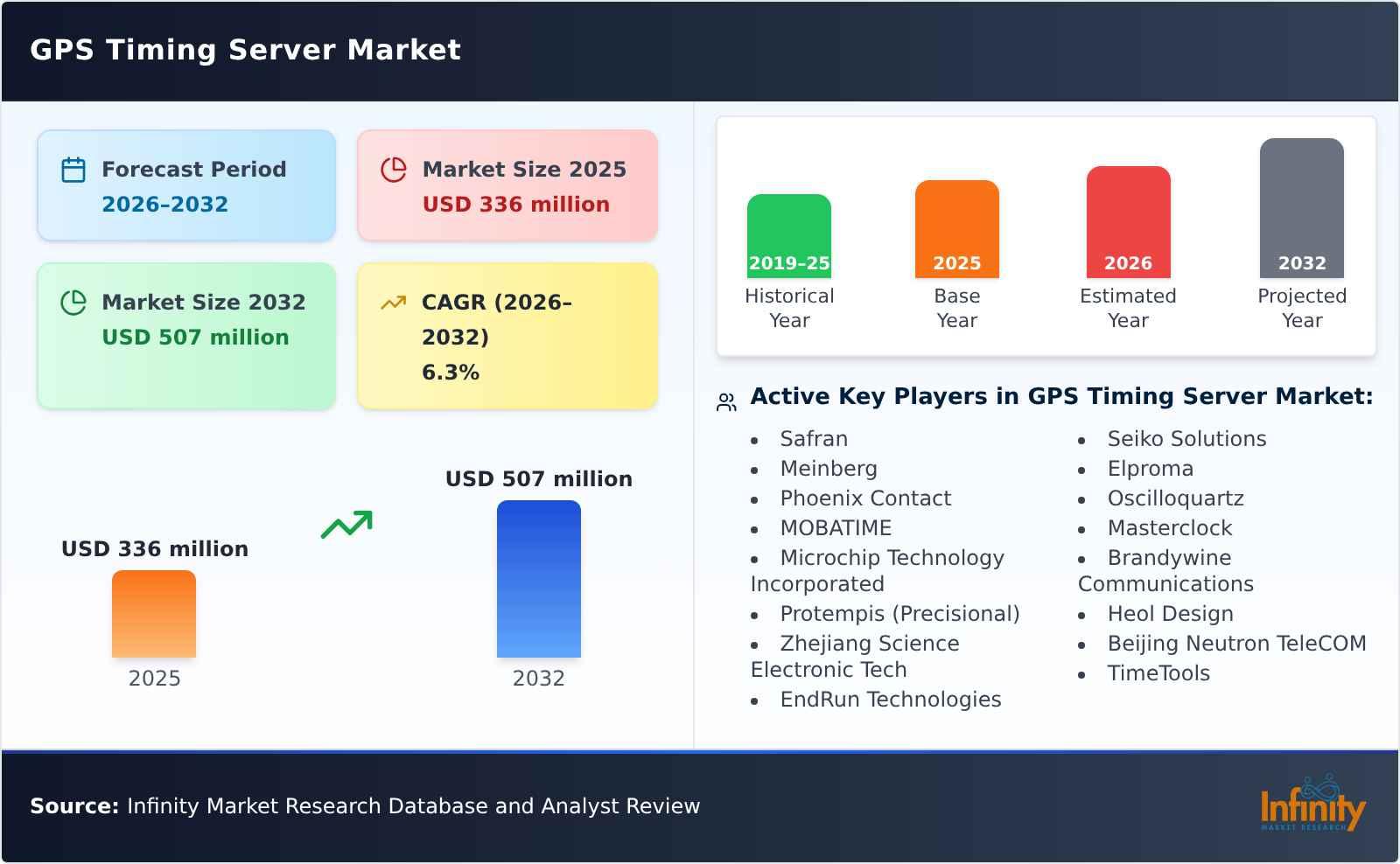
The global GPS Timing Server market size is predicted to grow from US$ 336 million in 2025 to US$ 507 million in 2032; it is expected to grow at a CAGR of 6.3% from 2026 to 2032.
Explore this report in detail? Download a free sample copy
Download Free Sample Report
GPS time servers are a type of network time synchronization device that uses satellite navigation signals as the reference time source. They acquire and maintain UTC time through a built-in GNSS receiver and a highly stable local oscillator, and provide high-precision NTP and PTP time synchronization, as well as standard time and frequency outputs such as pulse second and 10 MHz, to data center network equipment, communication base station systems, power dispatching and substation automation, financial transaction and clearing systems, broadcasting control and industrial control networks. This ensures key functions such as consistency of multi-system logs, synchronization of communication frame structure and phasor measurement time synchronization. Global sales in 2025 are estimated at 73,850 units, with an average selling price of approximately US$4,650 per unit. The annual production capacity of a single production line is estimated at 3,500 units. Upstream companies mainly come from fields such as GNSS RF and baseband chips, clock and oscillator devices, power and interface devices, network communication chips, high-reliability power supplies and heat dissipation structures, antennas and RF cables, and industrial-grade chassis processing and testing equipment. Midstream companies are time synchronization server design, manufacturing, and system integration companies. Downstream companies include telecom operators and equipment manufacturers, power grid companies and power automation manufacturers, financial institutions and exchanges, data center operators and cloud service providers, broadcasting system integrators, and rail transit and industrial control users. The industrys gross profit margin is approximately 38.00%. In the product cost structure, timing and clock devices and high-stability local oscillators account for approximately 27.00%; main control and network interfaces and switching chips account for approximately 19.00%; power supply, EMC filtering, and connectors account for approximately 13.00%; chassis heat dissipation and structural components account for approximately 11.00%; antenna RF and cables and lightning protection account for approximately 9.00%; and testing, calibration, aging, and software firmware development and certification account for approximately 21.00%. Products can be mainly categorized by parameters into single GNSS and multi-constellation multi-frequency types, NTP and PTP master clock types, and types that simultaneously support NTP and PTP. Timekeeping levels are categorized by TCXO and OCXO and rubidium clocks. Ports and outputs are categorized by single-port and multi-port, and whether they support synchronous Ethernet and pulse seconds. Furthermore, they are classified into standard and enhanced types based on anti-interference and security hardening capabilities. On the demand side, the downstream demand list includes telecommunications network clock synchronization and cell time alignment requirements, power phasor measurement and substation time synchronization requirements, financial transaction matching and auditing time synchronization requirements, data center distributed system log consistency and timestamp requirements, broadcast control and media production time synchronization requirements, and industrial control and rail transit system event sequencing requirements. The downstream customer list includes AT&T, Verizon, Deutsche Telekom, Vodafone, NTT, China Mobile, China Telecom, State Grid, National Grid, NYSE and NASDAQ related data center operation systems, AWS, Microsoft, Google, and large data center and broadcast system integrators. In terms of business opportunities, policy-driven factors are reflected in the increasing requirements for resilience and anti-interference capabilities of critical infrastructure, as well as the strengthening of compliance checks and the process of domestic substitution. Technological innovation-driven factors are reflected in the accelerated implementation of multi-source fusion timing, interference detection and alarm, network observability and high-precision timestamps, and stronger timekeeping algorithms. Changes in consumer demands are reflected in users paying more attention to availability, ease of operation and maintenance, total lifecycle cost, and stronger security redundancy. These factors together drive the upgrade of GPS timing servers from single timing devices to highly reliable and secure time and frequency infrastructure nodes and the expansion of deployment scale.
United States market for GPS Timing Server is estimated to increase from US$ million in 2025 to US$ million by 2032, at a CAGR of % from 2026 through 2032.
China market for GPS Timing Server is estimated to increase from US$ million in 2025 to US$ million by 2032, at a CAGR of % from 2026 through 2032.
Europe market for GPS Timing Server is estimated to increase from US$ million in 2025 to US$ million by 2032, at a CAGR of % from 2026 through 2032.
Global key GPS Timing Server players cover Safran, Meinberg, Phoenix Contact, MOBATIME, Microchip Technology Incorporated, etc. In terms of revenue, the global two largest companies occupied for a share nearly % in 2025.
Infinity Market Research newest research report, the ?GPS Timing Server Industry Forecast? looks at past sales and reviews total world GPS Timing Server sales in 2025, providing a comprehensive analysis by region and market sector of projected GPS Timing Server sales for 2026 through 2032. With GPS Timing Server sales broken down by region, market sector and sub-sector, this report provides a detailed analysis in US$ millions of the world GPS Timing Server industry.
This Insight Report provides a comprehensive analysis of the global GPS Timing Server landscape and highlights key trends related to product segmentation, company formation, revenue, and market share, latest development, and M&A activity. This report also analyzes the strategies of leading global companies with a focus on GPS Timing Server portfolios and capabilities, market entry strategies, market positions, and geographic footprints, to better understand these firms? unique position in an accelerating global GPS Timing Server market.
This Insight Report evaluates the key market trends, drivers, and affecting factors shaping the global outlook for GPS Timing Server and breaks down the forecast by Type, by Application, geography, and market size to highlight emerging pockets of opportunity. With a transparent methodology based on hundreds of bottom-up qualitative and quantitative market inputs, this study forecast offers a highly nuanced view of the current state and future trajectory in the global GPS Timing Server.
This report presents a comprehensive overview, market shares, and growth opportunities of GPS Timing Server market by product type, application, key manufacturers and key regions and countries.
Segmentation by Type:
Desktop Type
Railmount Type
Rackmount Type
Other
Segmentation by Accuracy:
High-Precision Type
General Type
Economy Type
Segmentation by Port:
IRIG-B TTL/AM Port
NTP Output Port
PTP Output Port
Other
Segmentation by Application:
Electricity and Industrial
Telecommunications
Education and Scientific Research
Medical
Financial
Other
This report also splits the market by region:
Americas
United States
Canada
Mexico
Brazil
APAC
China
Japan
Korea
Southeast Asia
India
Australia
Europe
Germany
France
UK
Italy
Russia
Middle East & Africa
Egypt
South Africa
Israel
Turkey
GCC Countries
The below companies that are profiled have been selected based on inputs gathered from primary experts and analysing the companys coverage, product portfolio, its market penetration.
Safran
Meinberg
Phoenix Contact
MOBATIME
Microchip Technology Incorporated
Protempis (Precisional)
Zhejiang Science Electronic Tech
EndRun Technologies
Seiko Solutions
Elproma
Oscilloquartz
Masterclock
Brandywine Communications
Heol Design
Beijing Neutron TeleCOM
TimeTools
Septentrio
AccuBeat
Arbiter System
BDStar TIME
Shanghai Ruicheng Electric
Cool Shark
GEMS
Shandong Weishang
Key Questions Addressed in this Report
What is the 10-year outlook for the global GPS Timing Server market?
What factors are driving GPS Timing Server market growth, globally and by region?
Which technologies are poised for the fastest growth by market and region?
How do GPS Timing Server market opportunities vary by end market size?
How does GPS Timing Server break out by Type, by Application?
GPS Timing Server Market Scope
| Report Attribute | Details |
|---|---|
| Market Size (Start Year) | USD XX Million |
| Market Size (End Year) | USD XX Million |
| Compound Annual Growth Rate (CAGR) | USD XX Million |
| Forecast Period | USD XX Million |
| Base Year | USD XX Million |
| Historical Data | USD XX Million |
| Key Players | USD XX Million |
REPORT COVERAGE
Revenue forecast, Company Analysis, Industry landscape, Growth factors, and Trends
SEGMENT COVERED
By component, deployment, organization size, application, and industry.
REGIONAL SCOPE
North America, Europe, Asia Pacific, Middle East & Africa, South & Central America
COUNTRY SCOPE
Includes key countries across all major regions.
📘 Frequently Asked Questions
1. What is the market size of Global GPS Timing Server Market?
Answer: The global GPS Timing Server market size is predicted to grow from US$ 336 million in 2025 to US$ 507 million in 2032; it is expected to grow at a CAGR of 6.3% from 2026 to 2032.
2. Which regions are analyzed in the Global GPS Timing Server Market report?
Answer: The Global GPS Timing Server Market report covers major regions such as Europe, Middle East & Africa. Each region is analyzed for trends, opportunities, and market dynamics.
3. What methodology is used for forecasting of Global GPS Timing Server Market?
Answer: The Global GPS Timing Server Market report uses a mix of primary research, secondary data, and expert analysis to build its forecasts. Models include both qualitative and quantitative approaches.
4. Are emerging markets analyzed separately in the Global GPS Timing Server Market?
Answer: Yes, the Global GPS Timing Server Market report highlights high-growth emerging regions with dedicated insights. These include untapped opportunities, risks, and potential for expansion.
5. Does the report include competitive benchmarking of Global GPS Timing Server Market?
Answer: Yes, Global GPS Timing Server Market report compares major players based on revenue, product portfolio, innovation, and regional presence. This helps assess competitive positioning.
6. Can I access country-level data within the Global GPS Timing Server Market report?
Answer: Yes, Global GPS Timing Server Market report includes detailed data by country, especially for key markets. This allows for localized insights and decision-making.
7. Can I get customized insights or data from the Global GPS Timing Server Market report?
Answer: Yes, we offer customization options to align with your specific business needs. You can request tailored sections or regional breakdowns.

🔐 Secure Payment Guaranteed
Safe checkout with trusted global payment methods.
🌟 Why Choose Infinity Market Research?
At Infinity Market Research, we dont just deliver data — we deliver clarity, confidence, and competitive edge.
In a world driven by insights, we help businesses unlock the infinite potential of informed decisions.
Here why global brands, startups, and decision-makers choose us:
Industry-Centric Expertise
With deep domain knowledge across sectors — from healthcare and technology to manufacturing and consumer goods — our team delivers insights that matter.
Custom Research, Not Cookie-Cutter Reports
Every business is unique, and so are its challenges. Thats why we tailor our research to your specific goals, offering solutions that are actionable, relevant, and reliable.
Data You Can Trust
Our research methodology is rigorous, transparent, and validated at every step. We believe in delivering not just numbers, but numbers that drive real impact.
Client-Centric Approach
Your success is our priority. From first contact to final delivery, our team is responsive, collaborative, and committed to your goals — because you re more than a client; you re a partner.