


Global Healthcare Label Market Growth 2026-2032
Jan 2026
Packaging And Transportation
Pages: 158
ILR1419
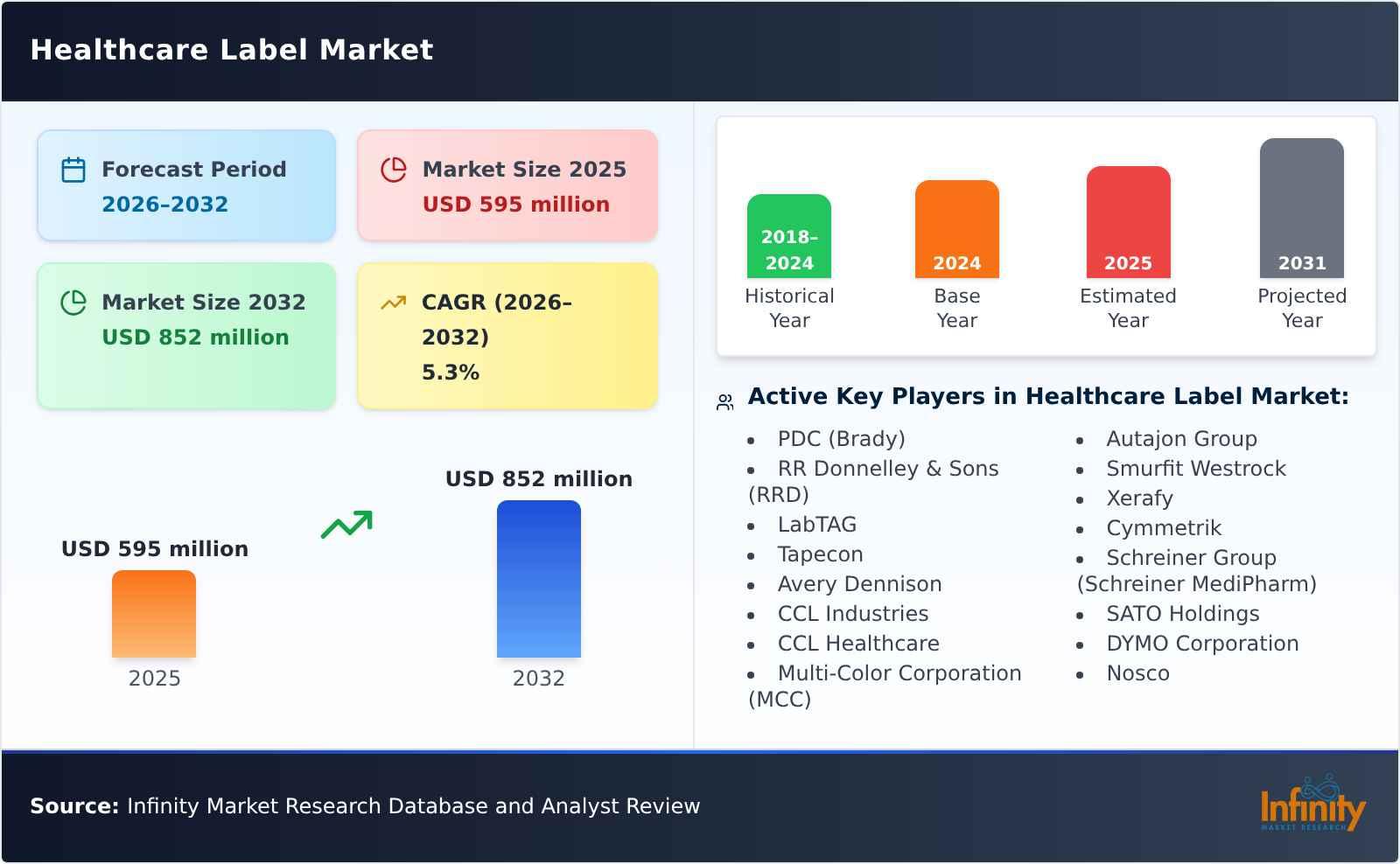
The global Healthcare Label market size is predicted to grow from US$ 595 million in 2025 to US$ 852 million in 2032; it is expected to grow at a CAGR of 5.3% from 2026 to 2032.
Explore this report in detail? Download a free sample copy
Download Free Sample Report
A Healthcare Label is a specialized labeling and identification solution used across healthcare delivery and health-related supply chains, covering patient and specimen identification within facilities, pharmaceutical and medical device packaging labels, sterilization and surgical instrument management, consumables and inventory rotation, cold-chain logistics, as well as elder care, home healthcare, and regulated health consumer products. It solves the fundamental problem of accurate and consistent information transfer in high-risk, tightly regulated, multi-step workflowsenabling closed-loop identification, correct use, traceability, recall readiness, and auditabilitywhile reducing errors such as mislabeling, mismatching, misuse, missing checks, and data inconsistencies. Healthcare labels must remain legible and securely adhered under harsh conditions including moisture, disinfectant wiping, abrasion, flexing, chemical exposure, and in some cases sterilization processes, without contaminating the contents they accompany. Historically, healthcare labeling progressed from handwritten tags and basic paper stickers to pre-printed labels and standardized barcodes; as hospital IT and supply-chain practices matured, labels increasingly carried variable data and standardized identifiers. Over the past two decades, regulatory pressure (device identification, drug traceability, anti-counterfeit requirements) and digital integration (HIS/LIS/ERP/MES) have transformed healthcare labels from printed items into integrated solutions combining materials science, printing process control, and data governance, with selective adoption of RFID/NFC, timetemperature indicators, tamper evidence, and security features where operational value is clear. Upstream supply typically includes facestocks (medical-grade papers, synthetic papers, PP/PET/PE films, specialty substrates for extreme temperatures and chemical exposure), pressure-sensitive adhesives (low-migration/low-extractable formulations; removable or permanent; solvent/cryogenic/sterilization resistant), release liners, inks and coatings (low-migration ink systems, protective varnishes, abrasion-resistant and barrier or antimicrobial coatings), variable-data consumables (thermal-transfer ribbons, often resin-rich for durability), and printing/identification components (printheads, sensors, barcode scan modules, and RFID inlays/antenna/chips), enabling a balance of safety, compliance, durability, and cost.In 2025, global medical label production capacity reached 26 billion units, while sales volume amounted to 24.3 billion units. The average unit price was USD 0.025 per label, and corporate gross margins generally ranged between 20% to 30%.
The market today is shaped by stronger compliance and quality-system pull, highly fragmented demand, and accelerating supplier segmentation. Buyers increasingly evaluate not just delivery and price, but auditability, change control discipline, batch-to-batch consistency, documentation integrity, and proven performance under real conditions such as disinfectant wiping, condensation, cold-chain handling, abrasion, flexing, and sterilization workflows. Use cases span inpatient clinical operations, labs, pharmacies, operating rooms, back-of-house logistics, and expanding out-of-facility care and regulated health retail channelseach with distinct requirements for materials, adhesives, data fields, layouts, readability, and system interfaces. This drives a many variants, frequent changes demand pattern and shifts the industry from generic supply to workflow-specific solution delivery. As organizations operate across multiple sites and channels, resilience and consistent service become critical, favoring suppliers that combine quality support, regulatory fluency, data governance capabilities, and on-site implementation know-how; platform-scale providers and niche specialists are increasingly coexisting.
Future development will likely center on deeper data governance, value-led smart adoption, and parallel upgrades in sustainability and risk control. On the content layer, labels will be more tightly governed through master data linkage, standardized templates, versioning, role-based approvals, automated validation, and exception closurereducing manual edits and ad-hoc revisions that create risk. Operationally, on-demand and variable-data workflows, in-line inspection/verification, and traceable production records will become more common to support faster turnaround and higher change frequency while embedding consistency upstream in the process. Smart capabilitiesRFID/NFC, tamper-evident designs, security/anti-counterfeit elements, and timetemperature indicatorswill keep expanding, but adoption will be driven by demonstrable workflow gains such as fewer handoff errors, easier inventory visibility, faster recalls, and stronger control over cold-chain or high-risk categories rather than blanket replacement. Materials and compliance work will increasingly emphasize low-migration/low-extractable systems, chemical and disinfectant resistance, and constructions better aligned with broader sustainability expectations, alongside efforts to reduce SKU complexity through standardization and platform approaches.
The main forces accelerating change are the visibility of patient-safety and operational risk, continuously strengthening regulatory and audit expectations, and sustained investment in supply-chain resilience and digitization. When errors, recalls, or audit failures translate into disruption and reputational damage, organizations become more willing to pay for reliability and control; and as management maturity rises, label-related master-data consistency, change control, and execution discipline become unavoidable gaps to close. Barriers are equally real and often rooted in implementation complexity: unclear ownership across quality, regulatory, IT, procurement, and frontline users complicates governance; interoperability across systems and devices, barcode quality management, training, and behavior change lengthen rollout; upstream volatility triggers qualification cycles for substitutions; and regional regulatory/language differences can fragment versions and undermine standardization. Many initiatives stall where the technology works but the workflow doesnt, so successful programs typically translate solutions into executable process redesign, validated change pathways, sustainable operating models, and cross-functional alignment on outcomes.
Infinity Market Research newest research report, the Healthcare Label Industry Forecast looks at past sales and reviews total world Healthcare Label sales in 2025, providing a comprehensive analysis by region and market sector of projected Healthcare Label sales for 2026 through 2032. With Healthcare Label sales broken down by region, market sector and sub-sector, this report provides a detailed analysis in US$ millions of the world Healthcare Label industry.
This Insight Report provides a comprehensive analysis of the global Healthcare Label landscape and highlights key trends related to product segmentation, company formation, revenue, and market share, latest development, and M&A activity. This report also analyzes the strategies of leading global companies with a focus on Healthcare Label portfolios and capabilities, market entry strategies, market positions, and geographic footprints, to better understand these firms unique position in an accelerating global Healthcare Label market.
This Insight Report evaluates the key market trends, drivers, and affecting factors shaping the global outlook for Healthcare Label and breaks down the forecast by Type, by Application, geography, and market size to highlight emerging pockets of opportunity. With a transparent methodology based on hundreds of bottom-up qualitative and quantitative market inputs, this study forecast offers a highly nuanced view of the current state and future trajectory in the global Healthcare Label.
This report presents a comprehensive overview, market shares, and growth opportunities of Healthcare Label market by product type, application, key manufacturers and key regions and countries.
Segmentation by Type:
Paper Label
Plastic Label
Medical Tape Label
Composite Material Label
Special Material Label
Segmentation by Technology Type:
Thermal Transfer Labels
Cryogenic Labels
Chemical-Resistant Labels
Others
Segmentation by Adhesive Type:
Permanent Adhesives
Removable Adhesives
Segmentation by Application:
Drug Management
Medical Device Management
Patient Identification
Product Identification and Tracing
Other
This report also splits the market by region:
Americas
United States
Canada
Mexico
Brazil
APAC
China
Japan
Korea
Southeast Asia
India
Australia
Europe
Germany
France
UK
Italy
Russia
Middle East & Africa
Egypt
South Africa
Israel
Turkey
GCC Countries
The below companies that are profiled have been selected based on inputs gathered from primary experts and analysing the companys coverage, product portfolio, its market penetration.
PDC (Brady)
3M
RR Donnelley & Sons (RRD)
LabTAG
Tapecon
Avery Dennison
CCL Industries
CCL Healthcare
Multi-Color Corporation (MCC)
Autajon Group
Smurfit Westrock
Xerafy
Cymmetrik
Schreiner Group (Schreiner MediPharm)
SATO Holdings
DYMO Corporation
Nosco
Resource Label Group
Royal Label
PRO-TECH Design
Imprint Enterprises
JN White
Suzhou Thunder Weiye Information Technology
Zaosin
Key Questions Addressed in this Report
What is the 10-year outlook for the global Healthcare Label market?
What factors are driving Healthcare Label market growth, globally and by region?
Which technologies are poised for the fastest growth by market and region?
How do Healthcare Label market opportunities vary by end market size?
How does Healthcare Label break out by Type, by Application?
Healthcare Label Market Scope
| Report Attribute | Details |
|---|---|
| Market Size (Start Year) | USD XX Million |
| Market Size (End Year) | USD XX Million |
| Compound Annual Growth Rate (CAGR) | USD XX Million |
| Forecast Period | USD XX Million |
| Base Year | USD XX Million |
| Historical Data | USD XX Million |
| Key Players | USD XX Million |
REPORT COVERAGE
Revenue forecast, Company Analysis, Industry landscape, Growth factors, and Trends
SEGMENT COVERED
By component, deployment, organization size, application, and industry.
REGIONAL SCOPE
North America, Europe, Asia Pacific, Middle East & Africa, South & Central America
COUNTRY SCOPE
Includes key countries across all major regions.
Frequently Asked Questions
1. What is the market size of Global Healthcare Label Market?
Answer: The global Healthcare Label market size is predicted to grow from US$ 595 million in 2025 to US$ 852 million in 2032; it is expected to grow at a CAGR of 5.3% from 2026 to 2032.
2. Which regions are analyzed in the Global Healthcare Label Market report?
Answer: The Global Healthcare Label Market report covers major regions such as Europe, Middle East & Africa. Each region is analyzed for trends, opportunities, and market dynamics.
3. What methodology is used for forecasting of Global Healthcare Label Market?
Answer: The Global Healthcare Label Market report uses a mix of primary research, secondary data, and expert analysis.
4. Are emerging markets analyzed separately in the Global Healthcare Label Market?
Answer: Yes, the Global Healthcare Label Market report highlights high-growth emerging regions with dedicated insights.
5. Does the report include competitive benchmarking of Global Healthcare Label Market?
Answer: Yes, Global Healthcare Label Market report compares major players based on revenue, product portfolio, and innovation.
6. Can I access country-level data within the Global Healthcare Label Market report?
Answer: Yes, Global Healthcare Label Market report includes detailed data by country for major regions.
7. Can I get customized insights or data from the Global Healthcare Label Market report?
Answer: Yes, we offer customization options to align with your specific business needs. You can request tailored sections or regional breakdowns.