


Global High Speed Cine Primes Market Trends, Growth and Outlook 2026-2032
Jan 2026
Consumer and Retails
Pages: 134
ILR2941
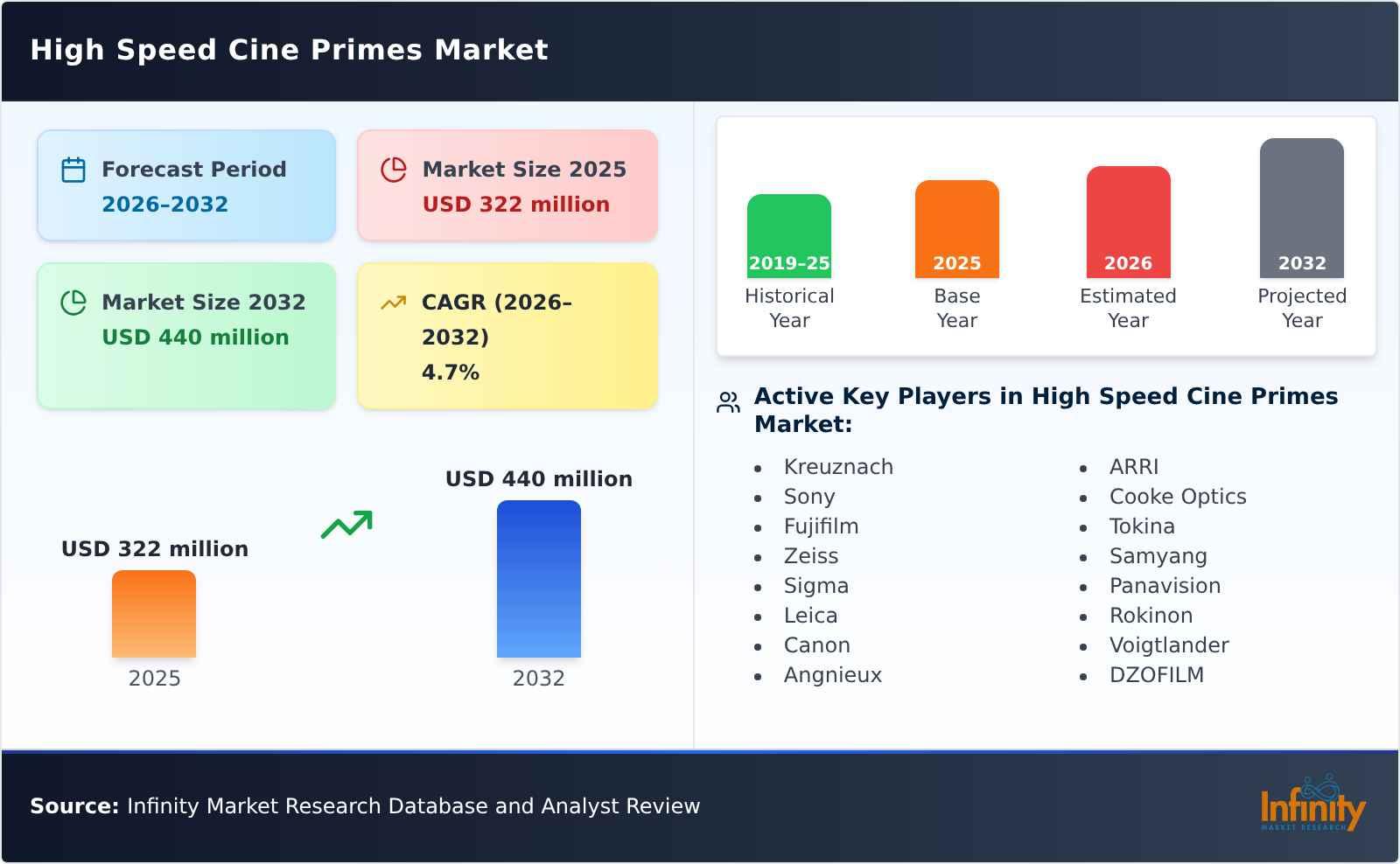
The global High Speed Cine Primes market size is predicted to grow from US$ 322 million in 2025 to US$ 440 million in 2032; it is expected to grow at a CAGR of 4.7% from 2026 to 2032.
Explore this report in detail? Download a free sample copy
Download Free Sample Report
In 2024, the global production of high-speed cinema prime lenses reached 78,500 units, with an average selling price of US$13,800 per unit.
High-speed cinema prime lenses were developed to address issues such as insufficient focusing accuracy, image quality loss at high frame rates, and harsh bokeh in dynamic image shooting. Since the breakthrough in aspherical high-speed lens technology in the 1990s, the film and television optical equipment field has achieved leapfrog development. Today, they have become core optical equipment with characteristics such as high frame rate adaptation, large aperture bokeh, and low dispersion imaging, widely used in film production, sports broadcasting, documentary shooting, and advertising creation.
Regarding the global production capacity of high-speed cinema prime lenses in 2024, small and medium-sized enterprises typically had an annual production capacity of 1,000-3,000 units per production line, while leading companies such as Sony Imaging could achieve a capacity of over 6,000 units. The industry average capacity utilization rate was approximately 72%, which could rise to 85% during peak periods of major film and television projects. Gross profit margins vary significantly depending on positioning: consumer professional models are around 20%-30%, while custom-made models and supporting optical systems for the film industry can reach 35%-45%.
A typical transaction example: In the second quarter of 2024, Disney Studios purchased 150 sets of Schneider Kreuznach Xenon FF series high-speed prime lenses, including 25mm, 50mm, and 85mm F1.5 models, for a total of approximately $2.5 million. The purchase requirements explicitly stated that the lenses should be compatible with 6K cinema cameras, support 120fps high frame rate shooting, and have a flare suppression rate of ?98% in backlit environments, for use in shooting high-speed action scenes for the science fiction film *Timebound*.
CCTV Sports plans to purchase 90 sets of Sony FE 16mm F1.8 G high-speed prime lenses in early 2025, at a unit price of $8,499 USD. The requirements include compatibility with 4K 120p video format, a breathing effect error of ?1%, and support for optical image stabilization in conjunction with the camera body. These lenses will be used for close-up, high-speed tracking of track and field events at the Paris Olympics.
The high-speed cinema prime lens industry has a complete and technology-intensive supply chain. Upstream, it relies on specialized optical glass and coating materials from companies such as Schott (Germany) and HOYA (Japan), as well as precision motors and optical components from Sony and Canon. It also utilizes professional design software such as Zemax and high-end manufacturing equipment from companies like Trumpf (Germany). Downstream, it is mainly used in three major areas: film production (especially high frame rate action and science fiction films), high-speed broadcasting of sports events, and the rapidly growing civilian professional creative industry, all driving the industrys development.
Industry Trends and Challenges: High-speed cinema prime lenses are showing three major development trends: In terms of lightweight integration, the penetration rate of polymer lens bodies is increasing by 9% annually, and the weight of full-frame prime lenses is breaking through to below 300 grams, such as the Sony FE 16mm F1.8 G which weighs only 304 grams; High frame rate upgrades are significant, with the proportion of models above 120fps increasing from 28% in 2022 to 52% in 2024, and the demand for 240fps cinema-grade lenses is surging; Video optimization design is becoming standard, covering technologies such as breathing effect suppression, stepless aperture, and image stabilization collaboration, among which Sonys lens breathing compensation error can be controlled within 1%. The market presents both opportunities and challenges: Opportunities include the global adoption of high frame rate films (Hollywoods share of high frame rate films reached 41% in 2024), the explosive growth of the short video industry (domestic MCN agencies annual procurement growth rate exceeded 50%), and the implementation of 8K broadcasting technology (CCTV, BBC, and other institutions replacement demand reached 150,000 sets); challenges lie in high optical patent barriers (European, American, and Japanese companies control more than 90% of core coating and lens technologies), high-end market monopoly (domestic companies focusing failure rate in -20? low-temperature environments is 22% higher than Sonys), and high R&D costs (the average R&D cycle for cinema-grade prime lenses is 24 months, with an investment exceeding US$30 million).
Demand and Business Opportunity Analysis: Demand Drivers and Business Opportunity Discovery: Upgrades in film and television technology drive demand for high-speed prime lensesHollywoods 2025 Film and Television Technology Standards lists 120fps as standard for action films, Disney purchased 150 sets in a single transaction, and domestic film and television investment increased by 8.3% annually; high-speed lenses improve the clarity of dynamic scenes by 4 times, reducing the reshoot rate of action scenes from 27% to 3%. The diversification of content creation is driving new demands: the completion rate of short video ads and high-speed slow-motion content has increased by 65%, and the demand for super-telephoto high-speed lenses for wildlife documentaries has increased by 40% annually. The technology boasts significant compatibility advantages, adapting to 12 mainstream cinema camera interfaces, and covering 96% of 15 Sony models, with a 5x faster motorized focus response time of 0.02 seconds. Business opportunities include: developing lightweight mid-range civilian lenses in the $3,000-$5,000 price range (covering 5 million independent creators), customizing models suitable for extreme environments to enter the scientific research and military market, and achieving breakthroughs in ED lens and linear motor technology to reduce import dependence.
Infinity Market Research newest research report, the High Speed Cine Primes Industry Forecast looks at past sales and reviews total world High Speed Cine Primes sales in 2025, providing a comprehensive analysis by region and market sector of projected High Speed Cine Primes sales for 2026 through 2032. With High Speed Cine Primes sales broken down by region, market sector and sub-sector, this report provides a detailed analysis in US$ millions of the world High Speed Cine Primes industry.
This Insight Report provides a comprehensive analysis of the global High Speed Cine Primes landscape and highlights key trends related to product segmentation, company formation, revenue, and market share, latest development, and M&A activity. This report also analyzes the strategies of leading global companies with a focus on High Speed Cine Primes portfolios and capabilities, market entry strategies, market positions, and geographic footprints, to better understand these firms unique position in an accelerating global High Speed Cine Primes market.
This Insight Report evaluates the key market trends, drivers, and affecting factors shaping the global outlook for High Speed Cine Primes and breaks down the forecast by Type, by Application, geography, and market size to highlight emerging pockets of opportunity. With a transparent methodology based on hundreds of bottom-up qualitative and quantitative market inputs, this study forecast offers a highly nuanced view of the current state and future trajectory in the global High Speed Cine Primes.
This report presents a comprehensive overview, market shares, and growth opportunities of High Speed Cine Primes market by product type, application, key manufacturers and key regions and countries.
Segmentation by Type:
Focal Length 12-24mm
Focal Length 28-85mm
Focal Length 100-300mm
Focal Length 300mm and Above
Segmentation by Frame Rate Ratio:
Supports 60-120fps
Supports 240-1000fps
1000fps and Above
Segmentation by Aperture Specifications:
Aperture ? F1.8
Aperture F2.0-F4.0
Segmentation by Application:
Film Production
Industrial Inspection
Medical
Security
Other
This report also splits the market by region:
Americas
United States
Canada
Mexico
Brazil
APAC
China
Japan
Korea
Southeast Asia
India
Australia
Europe
Germany
France
UK
Italy
Russia
Middle East & Africa
Egypt
South Africa
Israel
Turkey
GCC Countries
The below companies that are profiled have been selected based on inputs gathered from primary experts and analysing the companys coverage, product portfolio, its market penetration.
Kreuznach
Sony
Fujifilm
Zeiss
Sigma
Leica
Canon
Angnieux
ARRI
Cooke Optics
Tokina
Samyang
Panavision
Rokinon
Voigtlander
DZOFILM
Schneider
ZY Optics
RED
Key Questions Addressed in this Report
What is the 10-year outlook for the global High Speed Cine Primes market?
What factors are driving High Speed Cine Primes market growth, globally and by region?
Which technologies are poised for the fastest growth by market and region?
How do High Speed Cine Primes market opportunities vary by end market size?
How does High Speed Cine Primes break out by Type, by Application?
High Speed Cine Primes Market Scope
| Report Attribute | Details |
|---|---|
| Market Size (Start Year) | USD XX Million |
| Market Size (End Year) | USD XX Million |
| Compound Annual Growth Rate (CAGR) | USD XX Million |
| Forecast Period | USD XX Million |
| Base Year | USD XX Million |
| Historical Data | USD XX Million |
| Key Players | USD XX Million |
REPORT COVERAGE
Revenue forecast, Company Analysis, Industry landscape, Growth factors, and Trends
SEGMENT COVERED
By component, deployment, organization size, application, and industry.
REGIONAL SCOPE
North America, Europe, Asia Pacific, Middle East & Africa, South & Central America
COUNTRY SCOPE
Includes key countries across all major regions.
Frequently Asked Questions
1. What is the market size of Global High Speed Cine Primes Market?
Answer: The global High Speed Cine Primes market size is predicted to grow from US$ 322 million in 2025 to US$ 440 million in 2032; it is expected to grow at a CAGR of 4.7% from 2026 to 2032.
2. Which regions are analyzed in the Global High Speed Cine Primes Market report?
Answer: The Global High Speed Cine Primes Market report covers major regions such as Europe, Middle East & Africa. Each region is analyzed for trends, opportunities, and market dynamics.
3. What methodology is used for forecasting of Global High Speed Cine Primes Market?
Answer: The Global High Speed Cine Primes Market report uses a mix of primary research, secondary data, and expert analysis.
4. Are emerging markets analyzed separately in the Global High Speed Cine Primes Market?
Answer: Yes, the Global High Speed Cine Primes Market report highlights high-growth emerging regions with dedicated insights.
5. Does the report include competitive benchmarking of Global High Speed Cine Primes Market?
Answer: Yes, Global High Speed Cine Primes Market report compares major players based on revenue, product portfolio, and innovation.
6. Can I access country-level data within the Global High Speed Cine Primes Market report?
Answer: Yes, Global High Speed Cine Primes Market report includes detailed data by country for major regions.
7. Can I get customized insights or data from the Global High Speed Cine Primes Market report?
Answer: Yes, we offer customization options to align with your specific business needs. You can request tailored sections or regional breakdowns.