


Global High-speed Sheet-fed Scanner Market Growth 2026-2032
Jan 2026
Machinery And Equipment
Pages: 122
ILR1665
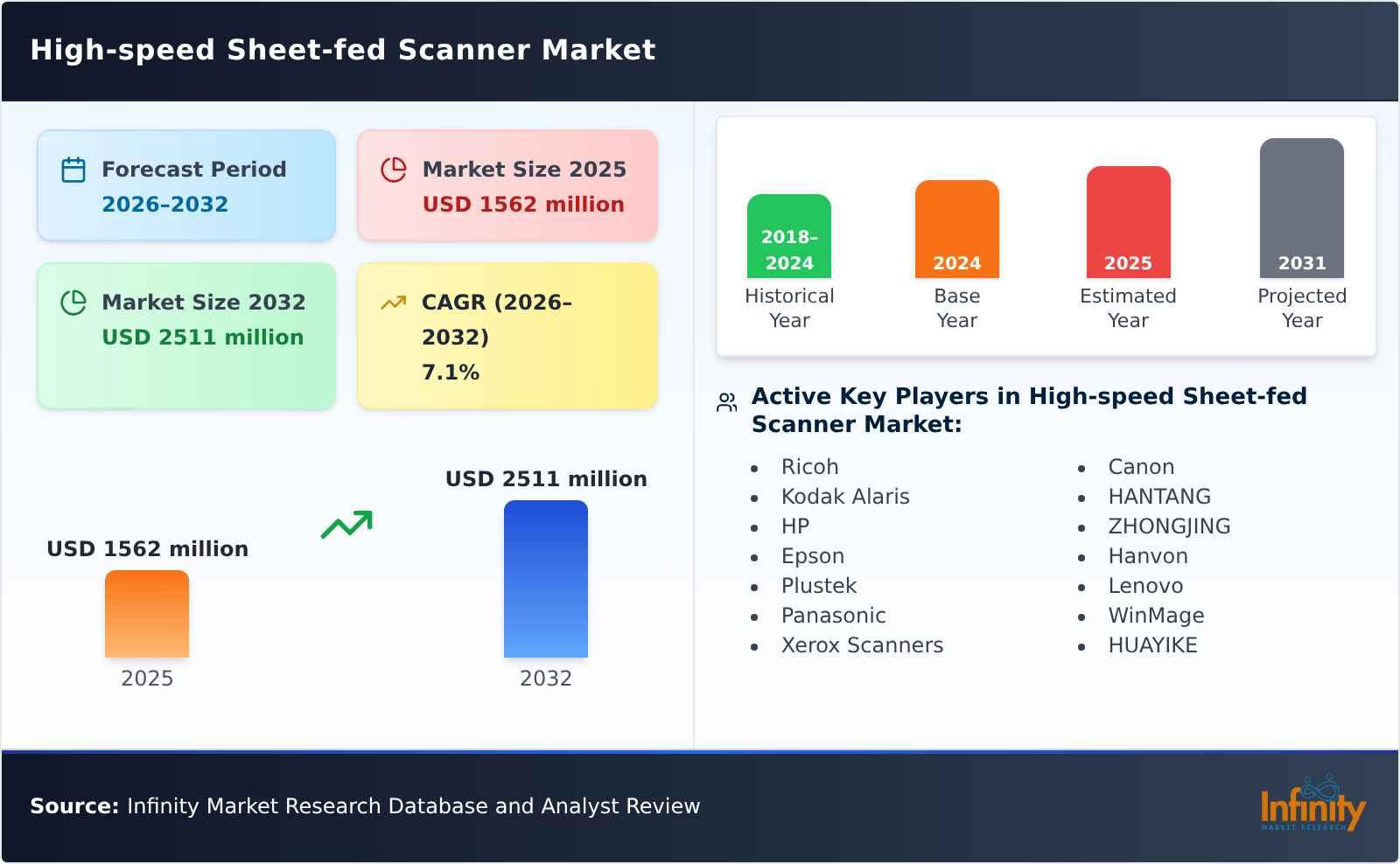
The global High-speed Sheet-fed Scanner market size is predicted to grow from US$ 1562 million in 2025 to US$ 2511 million in 2032; it is expected to grow at a CAGR of 7.1% from 2026 to 2032.
Explore this report in detail? Download a free sample copy
Download Free Sample Report
In 2025, global sales of high-speed sheet-fed scanners reached approximately 3.8 million units, with an average selling price of about US$420 per unit. High-speed sheet-fed scanners are document digitization devices that use an automatic document feeder (ADF) to achieve continuous high-speed duplex scanning. A single machine typically operates at a speed of 40-120 pages per minute, with a resolution of up to 600 dpi. They are widely used in government archives, financial documents, corporate office automation (OA) systems, medical records, and outsourced data processing centers, enabling efficient conversion of paper documents to electronic data. Upstream raw materials mainly include CMOS/CIS image sensors, optical lens assemblies, stepper motors and roller assemblies, main control chips and memory, metal and engineering plastic housings, and power modules. Upstream suppliers are concentrated in electronic component and precision manufacturing companies. Downstream, they are mainly supplied to government agencies, banks and insurance companies, logistics companies, hospitals, call centers, and BPO outsourcing companies through system integrators, office equipment distributors, and leasing service providers. In 2025, the global total production capacity was approximately 5 million units, with an overall industry capacity utilization rate of approximately 76% and an average gross profit margin of approximately 28%-35%. From the perspective of downstream consumption composition, government and enterprise document digitization accounts for approximately 30%, financial and bill processing for approximately 25%, medical and educational for approximately 20%, and commercial service outsourcing and other scenarios for approximately 25%. From the perspective of upstream material consumption, photoelectric sensors and main control chips account for approximately 32% of the total BOM cost, motors and transmission components for approximately 20%, structural components and housings for approximately 18%, and power supplies and other electronic components for approximately 30%. The future lies in upgrading towards higher speed and stability, ultrasonic multi-sheet detection, long-life paper feed modules, and AI image enhancement and OCR integration, as well as deep integration with cloud document management and process automation. Demand and business opportunities mainly come from the digitization of existing archives by governments and large enterprises, financial compliance retention, medical informatization, and lightweight office upgrades for SMEs. At the same time, replacing one-time sales with leasing and hosting services, replacing high-end models with domestically produced ones, and providing equipment + software + service integrated solutions in conjunction with RPA and low-code platforms will become important opportunities for the continued growth of the high-speed sheet-fed scanner market.
The high-speed sheet-fed scanner market is experiencing steady growth, driven primarily by the digitization of government and large enterprise archives, compliance data retention by financial institutions, and the development of medical information systems. While the trend towards paperless office persists, a large volume of existing paper documents still requires digitization. Furthermore, increasing regulatory requirements for data retention and traceability ensure that high-speed batch scanning equipment remains irreplaceable in the short to medium term, exhibiting both rigid and cyclical demand characteristics.
From a competitive and product structure perspective, international brands maintain an advantage in high-reliability, high-speed, and high-load models. Domestic manufacturers, however, are rapidly penetrating the mainstream mid-to-high-speed models through cost-effectiveness, distribution channels, and local services. The market is characterized by a stable high-end market and accelerated domestic substitution in the mainstream segment. Product competition is shifting from simple hardware comparisons to a comprehensive experience competition focusing on paper feeding stability, ultrasonic multi-sheet detection, long-life roller modules, and software usability and compatibility. Differentiation is primarily concentrated in niche industry applications.
At the application level, financial instruments, government and enterprise archives, medical records, and BPO outsourcing are the four most stable scenarios. Among these, financial and government/enterprise projects have the highest requirements for speed, accuracy, and continuous workload capacity, driving the increase in the proportion of mid-to-high-end scanners. SMEs and branch offices prefer mid-speed, desktop, and integrated solutions. With the growth of remote work and distributed business, the demand for small, high-speed scanners deployed at multiple locations is also increasing.
In terms of technology and trends, scanners are accelerating their integration with OCR, ICR, layout recognition, and AI image enhancement, upgrading from collection devices to data entry points. Cloud connectivity, API openness, and integration capabilities with RPA and document management systems will become important selling points, meaning that software ecosystems and solution capabilities will gradually surpass pure hardware performance, expanding the potential for continuous service revenue for vendors.
In terms of business models, leasing, pay-as-you-go, and equipment + software + maintenance managed models are emerging, especially popular among project-based and outsourcing clients, helping to reduce initial investment for clients and increase customer stickiness for vendors. For vendors, stable revenue from consumables, maintenance, and software subscriptions will improve the profit structure and reduce the pressure from declining unit prices.
In summary, the high-speed sheet-fed scanner market is affected by short-term fluctuations in digitization projects, but in the medium to long term, it will maintain moderate growth as existing paper files are digested, compliance is strengthened, and AI automation becomes more widespread. In the future, the winners will be those comprehensive manufacturers that possess industry understanding, software capabilities, and service networks in addition to hardware reliability, while players relying solely on low-price competition will gradually find their survival space shrinking.
Infinity Market Research newest research report, the High-speed Sheet-fed Scanner Industry Forecast looks at past sales and reviews total world High-speed Sheet-fed Scanner sales in 2025, providing a comprehensive analysis by region and market sector of projected High-speed Sheet-fed Scanner sales for 2026 through 2032. With High-speed Sheet-fed Scanner sales broken down by region, market sector and sub-sector, this report provides a detailed analysis in US$ millions of the world High-speed Sheet-fed Scanner industry.
This Insight Report provides a comprehensive analysis of the global High-speed Sheet-fed Scanner landscape and highlights key trends related to product segmentation, company formation, revenue, and market share, latest development, and M&A activity. This report also analyzes the strategies of leading global companies with a focus on High-speed Sheet-fed Scanner portfolios and capabilities, market entry strategies, market positions, and geographic footprints, to better understand these firms unique position in an accelerating global High-speed Sheet-fed Scanner market.
This Insight Report evaluates the key market trends, drivers, and affecting factors shaping the global outlook for High-speed Sheet-fed Scanner and breaks down the forecast by Type, by Application, geography, and market size to highlight emerging pockets of opportunity. With a transparent methodology based on hundreds of bottom-up qualitative and quantitative market inputs, this study forecast offers a highly nuanced view of the current state and future trajectory in the global High-speed Sheet-fed Scanner.
This report presents a comprehensive overview, market shares, and growth opportunities of High-speed Sheet-fed Scanner market by product type, application, key manufacturers and key regions and countries.
Segmentation by Type:
Scan Speed: 20 - 40 ppm / 40 - 80 ipm
Scan Speed: 60 - 80 ppm / 120 - 160 ipm
Others
Segmentation by Paper Feeder Capacity:
Paper Feeder Capacity: 100 - 300 Sheets
Paper Feeder Capacity: 500 - 1000+ Sheets
Segmentation by Function:
Image Enhancement
Intelligent Cropping and Classification
OCR and Recognition
Barcode Recognition and Sorting
Segmentation by Application:
Schools
Government
Enterprises
Others
This report also splits the market by region:
Americas
United States
Canada
Mexico
Brazil
APAC
China
Japan
Korea
Southeast Asia
India
Australia
Europe
Germany
France
UK
Italy
Russia
Middle East & Africa
Egypt
South Africa
Israel
Turkey
GCC Countries
The below companies that are profiled have been selected based on inputs gathered from primary experts and analysing the companys coverage, product portfolio, its market penetration.
Ricoh
Kodak Alaris
HP
Epson
Plustek
Panasonic
Xerox Scanners
Canon
HANTANG
ZHONGJING
Hanvon
Lenovo
WinMage
HUAYIKE
Key Questions Addressed in this Report
What is the 10-year outlook for the global High-speed Sheet-fed Scanner market?
What factors are driving High-speed Sheet-fed Scanner market growth, globally and by region?
Which technologies are poised for the fastest growth by market and region?
How do High-speed Sheet-fed Scanner market opportunities vary by end market size?
How does High-speed Sheet-fed Scanner break out by Type, by Application?
High-speed Sheet-fed Scanner Market Scope
| Report Attribute | Details |
|---|---|
| Market Size (Start Year) | USD XX Million |
| Market Size (End Year) | USD XX Million |
| Compound Annual Growth Rate (CAGR) | USD XX Million |
| Forecast Period | USD XX Million |
| Base Year | USD XX Million |
| Historical Data | USD XX Million |
| Key Players | USD XX Million |
REPORT COVERAGE
Revenue forecast, Company Analysis, Industry landscape, Growth factors, and Trends
SEGMENT COVERED
By component, deployment, organization size, application, and industry.
REGIONAL SCOPE
North America, Europe, Asia Pacific, Middle East & Africa, South & Central America
COUNTRY SCOPE
Includes key countries across all major regions.
Frequently Asked Questions
1. What is the market size of Global High-speed Sheet-fed Scanner Market?
Answer: The global High-speed Sheet-fed Scanner market size is predicted to grow from US$ 1562 million in 2025 to US$ 2511 million in 2032; it is expected to grow at a CAGR of 7.1% from 2026 to 2032.
2. Which regions are analyzed in the Global High-speed Sheet-fed Scanner Market report?
Answer: The Global High-speed Sheet-fed Scanner Market report covers major regions such as Europe, Middle East & Africa. Each region is analyzed for trends, opportunities, and market dynamics.
3. What methodology is used for forecasting of Global High-speed Sheet-fed Scanner Market?
Answer: The Global High-speed Sheet-fed Scanner Market report uses a mix of primary research, secondary data, and expert analysis.
4. Are emerging markets analyzed separately in the Global High-speed Sheet-fed Scanner Market?
Answer: Yes, the Global High-speed Sheet-fed Scanner Market report highlights high-growth emerging regions with dedicated insights.
5. Does the report include competitive benchmarking of Global High-speed Sheet-fed Scanner Market?
Answer: Yes, Global High-speed Sheet-fed Scanner Market report compares major players based on revenue, product portfolio, and innovation.
6. Can I access country-level data within the Global High-speed Sheet-fed Scanner Market report?
Answer: Yes, Global High-speed Sheet-fed Scanner Market report includes detailed data by country for major regions.
7. Can I get customized insights or data from the Global High-speed Sheet-fed Scanner Market report?
Answer: Yes, we offer customization options to align with your specific business needs. You can request tailored sections or regional breakdowns.