


Global Household Energy Management Software Market Growth (Status and Outlook) 2026-2032
Jan 2026
Information and Communication Technology
Pages: 110
ILR1596
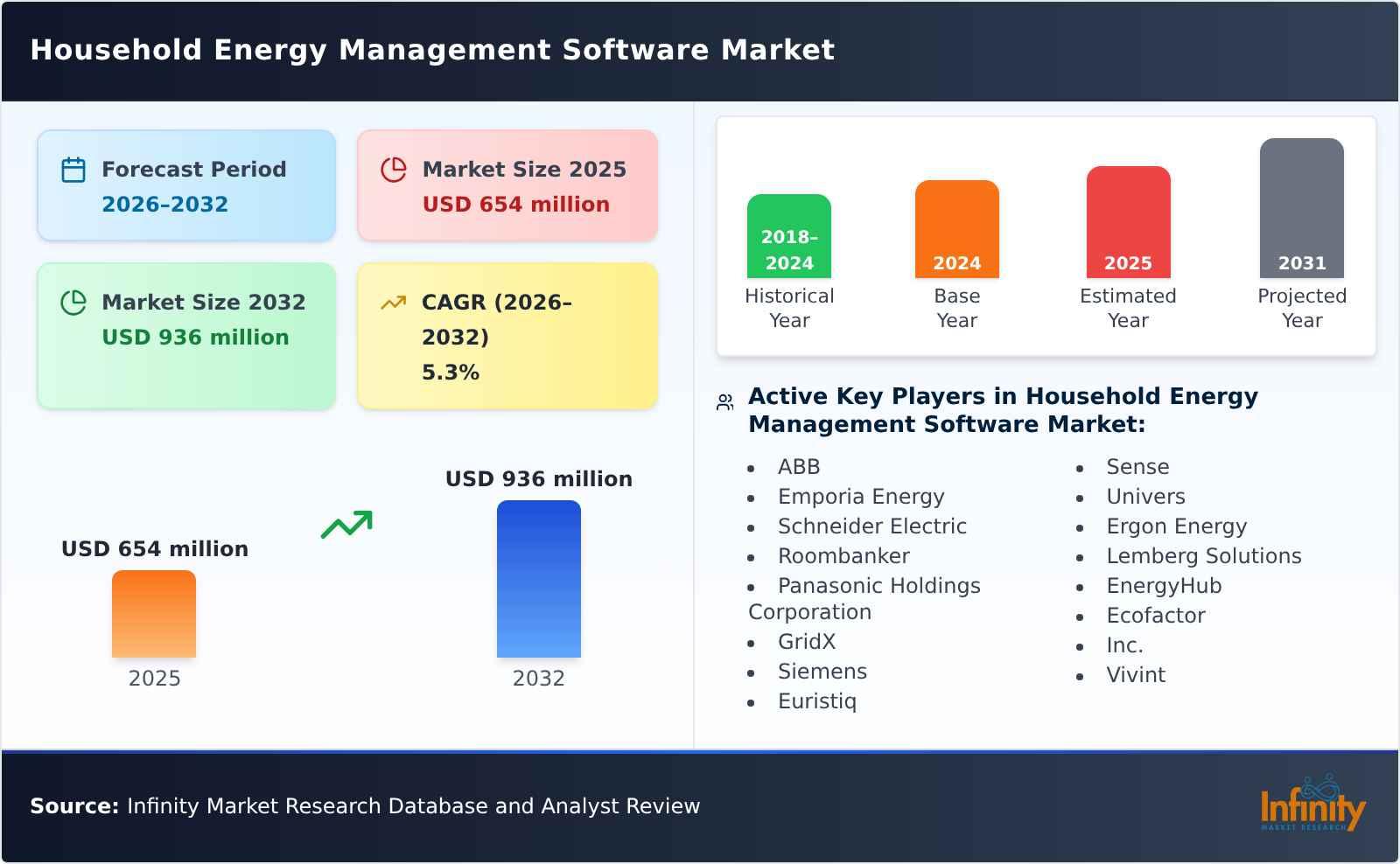
The global Household Energy Management Software market size is predicted to grow from US$ 654 million in 2025 to US$ 936 million in 2032; it is expected to grow at a CAGR of 5.3% from 2026 to 2032.
Explore this report in detail? Download a free sample copy
Download Free Sample Report
Household Energy Management Software typically refers to a comprehensive software platform deployed on home gateways, smart meters, local servers, or cloud platforms. It aims to optimize home energy systems and achieve cost savings through data monitoring, intelligent analysis, and automated control. Its core function is to utilize IoT technology to collect, integrate, and visualize real-time electricity consumption data from smart meters, photovoltaic inverters, energy storage batteries, electric vehicle charging stations, and various smart appliances. Based on this, the software analyzes household energy consumption habits, electricity price signals, and local power generation through built-in algorithms, automatically formulating and executing optimal energy consumption strategies. For example, it may schedule energy storage power supply during peak electricity price periods, arrange electric vehicle charging during off-peak hours, or temporarily shut down unnecessary loads. Its ultimate goal is to help users reduce electricity bills, increase clean energy self-sufficiency, participate in grid demand response, and enhance electricity safety and comfort. It serves as a key digital hub connecting home users, distributed energy resources, and the smart grid.
The Household Energy Management Software market has a promising future and is currently experiencing rapid growth and transformation, accelerating its penetration from early adopters to the mass market. The core driving force stems from the profound changes in household energy structures under the global energy transition: the rapid popularization of residential photovoltaics and energy storage has created a rigid demand for integrated and coordinated scheduling of power generation, storage, and consumption. Simultaneously, the promotion of dynamic pricing mechanisms and grid demand response projects has created direct economic incentives for household users to participate in the market and generate revenue through software. At the policy level, support for building energy efficiency and smart homes in many countries has further catalyzed the market. In the future, this field will exhibit three major trends: first, functional integration, evolving from single electricity consumption monitoring to a one-stop home virtual power plant operating system integrating photovoltaic optimization, energy storage control, electric vehicle charging and discharging management, and smart appliance control; second, deep application of artificial intelligence, using machine learning to more accurately predict power generation and load, achieving fully automated strategy optimization; and third, business model innovation, combining software services with hardware sales, energy storage revenue sharing, and demand response aggregation models, continuously expanding the value space. It is expected that this software will become the standard configuration and core brain of future smart homes.
Infinity Market Research newest research report, the Household Energy Management Software Industry Forecast looks at past sales and reviews total world Household Energy Management Software sales in 2025, providing a comprehensive analysis by region and market sector of projected Household Energy Management Software sales for 2026 through 2032. With Household Energy Management Software sales broken down by region, market sector and sub-sector, this report provides a detailed analysis in US$ millions of the world Household Energy Management Software industry.
This Insight Report provides a comprehensive analysis of the global Household Energy Management Software landscape and highlights key trends related to product segmentation, company formation, revenue, and market share, latest development, and M&A activity. This report also analyses the strategies of leading global companies with a focus on Household Energy Management Software portfolios and capabilities, market entry strategies, market positions, and geographic footprints, to better understand these firms unique position in an accelerating global Household Energy Management Software market.
This Insight Report evaluates the key market trends, drivers, and affecting factors shaping the global outlook for Household Energy Management Software and breaks down the forecast by Type, by Application, geography, and market size to highlight emerging pockets of opportunity. With a transparent methodology based on hundreds of bottom-up qualitative and quantitative market inputs, this study forecast offers a highly nuanced view of the current state and future trajectory in the global Household Energy Management Software.
This report presents a comprehensive overview, market shares, and growth opportunities of Household Energy Management Software market by product type, application, key players and key regions and countries.
Segmentation by Type:
On-premises
Cloud-based
Segmentation by Deployment Method:
Energy Monitoring and Visualization Software
Intelligent Optimization and Control Software
Other
Segmentation by Business Model:
Hardware Bundled with Software
Standalone Third-Party Software
Other
Segmentation by Application:
Civilian
Commercial
Others
This report also splits the market by region:
Americas
United States
Canada
Mexico
Brazil
APAC
China
Japan
Korea
Southeast Asia
India
Australia
Europe
Germany
France
UK
Italy
Russia
Middle East & Africa
Egypt
South Africa
Israel
Turkey
GCC Countries
The below companies that are profiled have been selected based on inputs gathered from primary experts and analyzing the companys coverage, product portfolio, its market penetration.
ABB
Emporia Energy
Schneider Electric
Roombanker
Panasonic Holdings Corporation
GridX
Siemens
Euristiq
Sense
Univers
Ergon Energy
Lemberg Solutions
EnergyHub
Ecofactor, Inc.
Vivint, Inc.
Household Energy Management Software Market Scope
| Report Attribute | Details |
|---|---|
| Market Size (Start Year) | USD XX Million |
| Market Size (End Year) | USD XX Million |
| Compound Annual Growth Rate (CAGR) | USD XX Million |
| Forecast Period | USD XX Million |
| Base Year | USD XX Million |
| Historical Data | USD XX Million |
| Key Players | USD XX Million |
REPORT COVERAGE
Revenue forecast, Company Analysis, Industry landscape, Growth factors, and Trends
SEGMENT COVERED
By component, deployment, organization size, application, and industry.
REGIONAL SCOPE
North America, Europe, Asia Pacific, Middle East & Africa, South & Central America
COUNTRY SCOPE
Includes key countries across all major regions.
Frequently Asked Questions
1. What is the market size of Global Household Energy Management Software Market?
Answer: The global Household Energy Management Software market size is predicted to grow from US$ 654 million in 2025 to US$ 936 million in 2032; it is expected to grow at a CAGR of 5.3% from 2026 to 2032.
2. Which regions are analyzed in the Global Household Energy Management Software Market report?
Answer: The Global Household Energy Management Software Market report covers major regions such as Europe, Middle East & Africa. Each region is analyzed for trends, opportunities, and market dynamics.
3. What methodology is used for forecasting of Global Household Energy Management Software Market?
Answer: The Global Household Energy Management Software Market report uses a mix of primary research, secondary data, and expert analysis.
4. Are emerging markets analyzed separately in the Global Household Energy Management Software Market?
Answer: Yes, the Global Household Energy Management Software Market report highlights high-growth emerging regions with dedicated insights.
5. Does the report include competitive benchmarking of Global Household Energy Management Software Market?
Answer: Yes, Global Household Energy Management Software Market report compares major players based on revenue, product portfolio, and innovation.
6. Can I access country-level data within the Global Household Energy Management Software Market report?
Answer: Yes, Global Household Energy Management Software Market report includes detailed data by country for major regions.
7. Can I get customized insights or data from the Global Household Energy Management Software Market report?
Answer: Yes, we offer customization options to align with your specific business needs. You can request tailored sections or regional breakdowns.