


🔐 Secure Payment Guaranteed
Safe checkout with trusted global payment methods.
🌟 Why Choose Infinity Market Research?
At Infinity Market Research, we dont just deliver data — we deliver clarity, confidence, and competitive edge.
In a world driven by insights, we help businesses unlock the infinite potential of informed decisions.
Here why global brands, startups, and decision-makers choose us:
Industry-Centric Expertise
With deep domain knowledge across sectors — from healthcare and technology to manufacturing and consumer goods — our team delivers insights that matter.
Custom Research, Not Cookie-Cutter Reports
Every business is unique, and so are its challenges. Thats why we tailor our research to your specific goals, offering solutions that are actionable, relevant, and reliable.
Data You Can Trust
Our research methodology is rigorous, transparent, and validated at every step. We believe in delivering not just numbers, but numbers that drive real impact.
Client-Centric Approach
Your success is our priority. From first contact to final delivery, our team is responsive, collaborative, and committed to your goals — because you re more than a client; you re a partner.
Recent Reports
Shore Connection and Charging Solutions Market
Rope Water Sensor Market

Global Image Sensor for Mobile Market Size, Share and Analysis Report 2026-2032
Apr 2026
Semiconductor and Electronics
Pages: 101
ILR4870
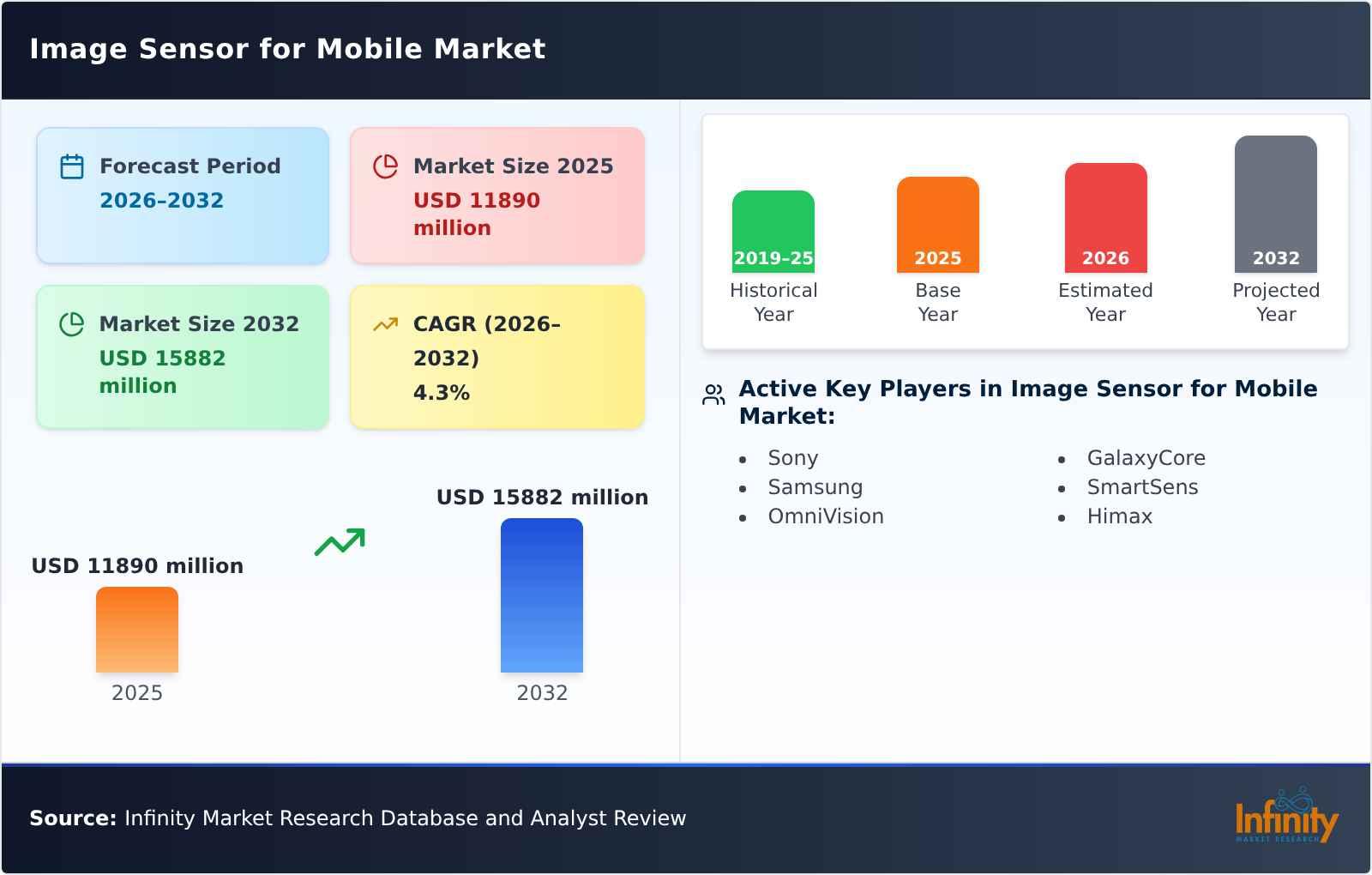
The global Image Sensor for Mobile market size is predicted to grow from US$ 11890 million in 2025 to US$ 15882 million in 2032; it is expected to grow at a CAGR of 4.3% from 2026 to 2032.
Explore this report in detail? Download a free sample copy
Download Free Sample Report
An image sensor for mobile?typically a CMOS image sensor (CIS) used in smartphones and other mobile devices?is the core semiconductor component that converts light projected by the lens onto a photosensitive pixel array into electrical signals, then reads out and digitizes those signals into image data. It solves the fundamental challenge of producing consistently high-quality photos and video under the stringent constraints of mobile devices?thin form factors, limited space, low power budgets, restricted thermal headroom, cost sensitivity, and highly variable real-world scenes (low light, backlight, motion, indoor settings, portraits, and video capture)?while also enabling functions such as code scanning, biometric authentication (often with depth/IR assistance), augmented reality, and computational photography. Historically, early mobile imaging suffered from low resolution, weak sensitivity, slow readout, and high noise; CMOS became the dominant approach thanks to lower power consumption and stronger on-chip integration. The industry first scaled through higher pixel counts and process shrinks, then addressed the low-light penalty of smaller pixels with back-side illumination (BSI) to improve quantum efficiency, and advanced further with stacked sensor architectures that separate the pixel layer from the logic layer to increase readout bandwidth, add on-chip features, and improve video and high-speed capture performance. In parallel, mobile devices evolved from single to multi-camera systems, with sensors increasingly co-designed with optics, stabilization, ISP/SoC pipelines, and algorithms?making final image quality a product of both hardware and computational processing. Upstream, the sensor relies on high-purity silicon wafers and semiconductor process materials (photoresists, developer/cleaning chemicals, specialty gases, deposition/etch consumables, and metal interconnect/dielectric materials), along with packaging substrates and bumping/solder materials. At the component and module level, the broader ecosystem includes lenses and coating materials, color filter array and microlens materials, IR-cut filters (IRCF), packaging and test services, module mechanics and connectors, plus closely coupled parts such as autofocus actuators (VCM/linear motors), OIS mechanisms, LED flash/driver circuits, power management, and timing devices?supplied by an ecosystem of materials vendors, wafer fabs/foundries, OSATs, optical/filter makers, precision mechanical/module assemblers, and semiconductor equipment/metrology providers.In 2025, global production capacity for mobile image sensors is estimated at 4.0 billion units, with shipments of approximately 3.74 billion units. The average selling price is about USD 3.25 per unit, and corporate gross margins generally range between 30% and 40%.
The current market is shifting from spec-driven comparisons toward experience delivery, with clear tiering and more structured roles across segments. At the premium end, competition is defined by real-world performance in low light, portraits, action capture, video stability, and cross-camera consistency, where vendors win by orchestrating the full stack?sensor choices, optics, OIS/AF mechanisms, module assembly and calibration, and ISP/algorithm tuning?rather than relying on a single standout component metric. In mid-range and entry tiers, the focus is on cost efficiency, supply stability, and rapid time-to-market; once baseline specs are met, differentiation compresses and shifts toward software tuning, scenario optimization, and supply-chain execution. Multi-camera systems have also become more role-defined: the main camera targets dependable all-around output, ultrawide prioritizes edge quality and distortion control, telephoto leans on resolution and stabilization synergy, and front-facing modules emphasize skin tones, focus behavior, and video-call reliability. As a result, manufacturability?yield, packaging/test capability, module consistency, and factory calibration?has become a decisive competitive factor, often determining whether promising designs translate into consistent user satisfaction at scale.
Future development will continue along three reinforcing vectors: stronger readout capability, deeper stacked integration, and tighter computational co-design. Advances in high-speed readout, expanded dynamic range, reduced rolling-shutter artifacts, lower noise, and more stable low-light behavior will be pursued to better feed multi-frame fusion, HDR video, and real-time segmentation pipelines. At the same time, roadmaps are becoming more pragmatic: instead of chasing megapixels alone, designs will increasingly balance pixel size, full-well capacity, on-chip logic/memory, and the readout chain to produce outputs that are stable, predictable, and easier to tune across challenging lighting and motion. Ecosystem-wide platformization will intensify, with cross-camera color matching, seamless zoom transitions, and standardized calibration/tuning frameworks emerging as key differentiators. Rising on-device AI compute will also reshape image processing, with more traditional ISP tasks being reimplemented as real-time algorithmic pipelines?pushing mobile imaging toward a continuous ?capture-to-create? system, while packaging and module design evolve to squeeze better performance out of thin form-factor constraints through tighter opto-mechanical-electrical co-optimization.
The main tailwinds are sustained demand for social sharing and short-form video creation, smartphone brands? need for perceptible upgrade levers in mature markets, and the expanding toolkit enabled by upstream process innovation and stronger on-device compute. However, constraints remain stubborn: physical trade-offs between sensor area, lens aperture, stabilization travel, and industrial design thickness are structural; higher performance typically increases power and heat, limiting sustained high-frame-rate recording and compute-heavy imaging; and supply-side realities?long technology adoption cycles, high capex, yield ramp challenges, test coverage requirements, and stringent consistency control?directly shape cost and launch cadence. Finally, ?spec fatigue? reduces the payoff of simple hardware escalation, making it harder to justify upgrades through numbers alone. Sustainable differentiation will increasingly come from reliable performance in everyday scenes, deliberate rendering and aesthetic choices, and smoother end-to-end creation workflows that make high-quality results easier to capture, edit, and share.
Infinity Market Research newest research report, the ?Image Sensor for Mobile Industry Forecast? looks at past sales and reviews total world Image Sensor for Mobile sales in 2025, providing a comprehensive analysis by region and market sector of projected Image Sensor for Mobile sales for 2026 through 2032. With Image Sensor for Mobile sales broken down by region, market sector and sub-sector, this report provides a detailed analysis in US$ millions of the world Image Sensor for Mobile industry.
This Insight Report provides a comprehensive analysis of the global Image Sensor for Mobile landscape and highlights key trends related to product segmentation, company formation, revenue, and market share, latest development, and M&A activity. This report also analyzes the strategies of leading global companies with a focus on Image Sensor for Mobile portfolios and capabilities, market entry strategies, market positions, and geographic footprints, to better understand these firms? unique position in an accelerating global Image Sensor for Mobile market.
This Insight Report evaluates the key market trends, drivers, and affecting factors shaping the global outlook for Image Sensor for Mobile and breaks down the forecast by Type, by Application, geography, and market size to highlight emerging pockets of opportunity. With a transparent methodology based on hundreds of bottom-up qualitative and quantitative market inputs, this study forecast offers a highly nuanced view of the current state and future trajectory in the global Image Sensor for Mobile.
This report presents a comprehensive overview, market shares, and growth opportunities of Image Sensor for Mobile market by product type, application, key manufacturers and key regions and countries.
Segmentation by Type:
1
1/1.3
1/1.31
1/1.4
1/1.56
1/2.0
1/2.55
Others
Segmentation by Resolution:
13MP
16?32MP
48?50MP
64?108MP
200MP
Segmentation by Pixel Pitch:
Small Pixel
Mainstream Pixel
Large Pixel
Ultra-large Pixel
Others
Segmentation by Application:
Smartphone
Tablet
Laptop / 2-in-1 / PC Webcam
Action Cam / 360 Camera
Others
This report also splits the market by region:
Americas
United States
Canada
Mexico
Brazil
APAC
China
Japan
Korea
Southeast Asia
India
Australia
Europe
Germany
France
UK
Italy
Russia
Middle East & Africa
Egypt
South Africa
Israel
Turkey
GCC Countries
The below companies that are profiled have been selected based on inputs gathered from primary experts and analysing the companys coverage, product portfolio, its market penetration.
Sony
Samsung
OmniVision
GalaxyCore
SmartSens
Himax
Key Questions Addressed in this Report
What is the 10-year outlook for the global Image Sensor for Mobile market?
What factors are driving Image Sensor for Mobile market growth, globally and by region?
Which technologies are poised for the fastest growth by market and region?
How do Image Sensor for Mobile market opportunities vary by end market size?
How does Image Sensor for Mobile break out by Type, by Application?
Image Sensor for Mobile Market Scope
| Report Attribute | Details |
|---|---|
| Market Size (Start Year) | USD XX Million |
| Market Size (End Year) | USD XX Million |
| Compound Annual Growth Rate (CAGR) | USD XX Million |
| Forecast Period | USD XX Million |
| Base Year | USD XX Million |
| Historical Data | USD XX Million |
| Key Players | USD XX Million |
REPORT COVERAGE
Revenue forecast, Company Analysis, Industry landscape, Growth factors, and Trends
SEGMENT COVERED
By component, deployment, organization size, application, and industry.
REGIONAL SCOPE
North America, Europe, Asia Pacific, Middle East & Africa, South & Central America
COUNTRY SCOPE
Includes key countries across all major regions.
📘 Frequently Asked Questions
1. What is the market size of Global Image Sensor for Mobile Market?
Answer: The global Image Sensor for Mobile market size is predicted to grow from US$ 11890 million in 2025 to US$ 15882 million in 2032; it is expected to grow at a CAGR of 4.3% from 2026 to 2032.
2. Which regions are analyzed in the Global Image Sensor for Mobile Market report?
Answer: The Global Image Sensor for Mobile Market report covers major regions such as Europe, Middle East & Africa. Each region is analyzed for trends, opportunities, and market dynamics.
3. What methodology is used for forecasting of Global Image Sensor for Mobile Market?
Answer: The Global Image Sensor for Mobile Market report uses a mix of primary research, secondary data, and expert analysis to build its forecasts. Models include both qualitative and quantitative approaches.
4. Are emerging markets analyzed separately in the Global Image Sensor for Mobile Market?
Answer: Yes, the Global Image Sensor for Mobile Market report highlights high-growth emerging regions with dedicated insights. These include untapped opportunities, risks, and potential for expansion.
5. Does the report include competitive benchmarking of Global Image Sensor for Mobile Market?
Answer: Yes, Global Image Sensor for Mobile Market report compares major players based on revenue, product portfolio, innovation, and regional presence. This helps assess competitive positioning.
6. Can I access country-level data within the Global Image Sensor for Mobile Market report?
Answer: Yes, Global Image Sensor for Mobile Market report includes detailed data by country, especially for key markets. This allows for localized insights and decision-making.
7. Can I get customized insights or data from the Global Image Sensor for Mobile Market report?
Answer: Yes, we offer customization options to align with your specific business needs. You can request tailored sections or regional breakdowns.

🔐 Secure Payment Guaranteed
Safe checkout with trusted global payment methods.
🌟 Why Choose Infinity Market Research?
At Infinity Market Research, we dont just deliver data — we deliver clarity, confidence, and competitive edge.
In a world driven by insights, we help businesses unlock the infinite potential of informed decisions.
Here why global brands, startups, and decision-makers choose us:
Industry-Centric Expertise
With deep domain knowledge across sectors — from healthcare and technology to manufacturing and consumer goods — our team delivers insights that matter.
Custom Research, Not Cookie-Cutter Reports
Every business is unique, and so are its challenges. Thats why we tailor our research to your specific goals, offering solutions that are actionable, relevant, and reliable.
Data You Can Trust
Our research methodology is rigorous, transparent, and validated at every step. We believe in delivering not just numbers, but numbers that drive real impact.
Client-Centric Approach
Your success is our priority. From first contact to final delivery, our team is responsive, collaborative, and committed to your goals — because you re more than a client; you re a partner.