


Global Industrial Centrifugal Pump Market Growth 2026-2032
Jan 2026
Machinery And Equipment
Pages: 152
ILR1557
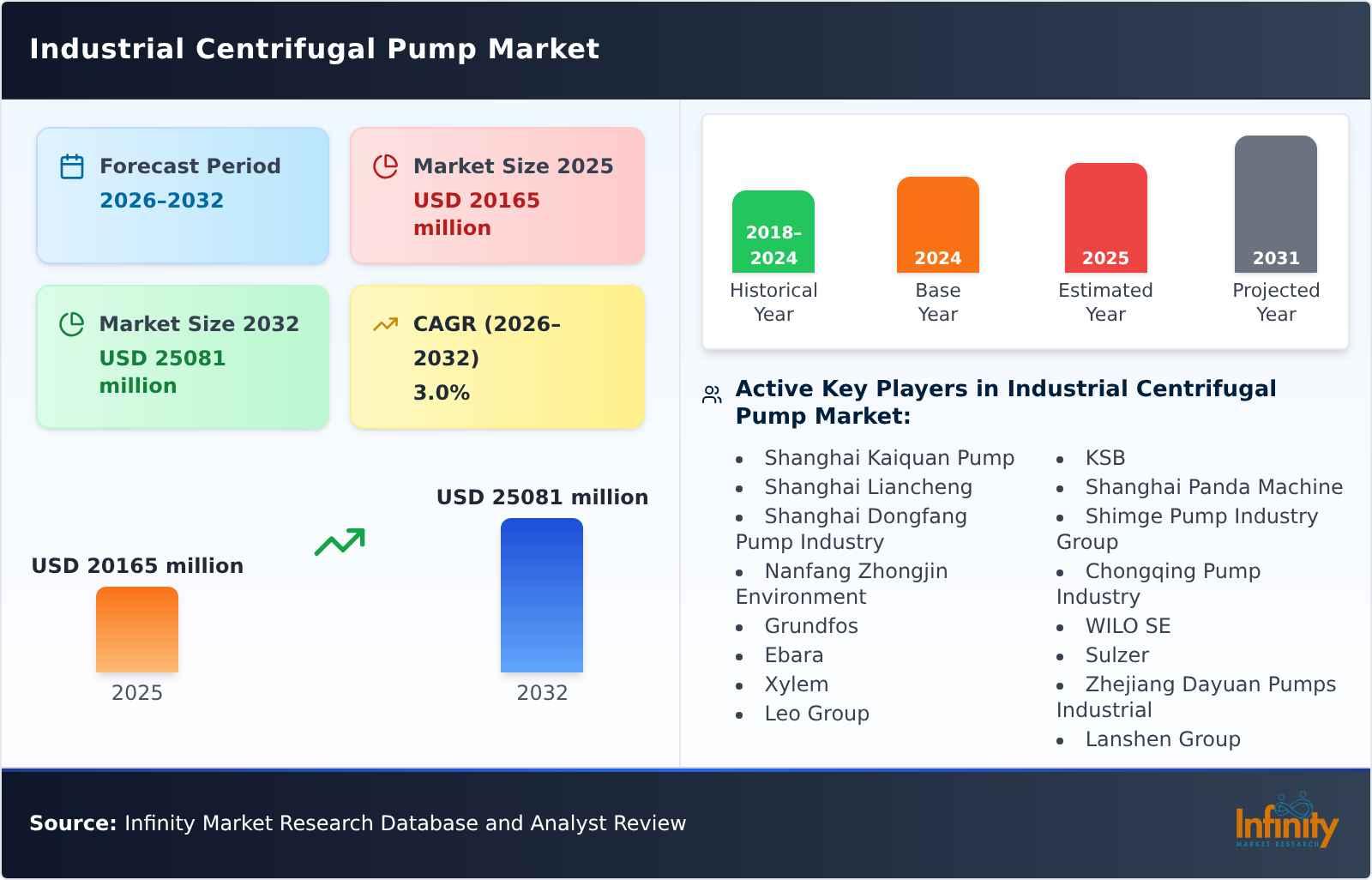
The global Industrial Centrifugal Pump market size is predicted to grow from US$ 20165 million in 2025 to US$ 25081 million in 2032; it is expected to grow at a CAGR of 3.0% from 2026 to 2032.
Explore this report in detail? Download a free sample copy
Download Free Sample Report
Industrial Centrifugal Pumps refer to non-positive displacement pumps. These pumps are designed to utilize kinetic energy from rotating impellers to move denser fluid or slurry to its intended location. The rotational energy typically comes from an engine or electric motor. These pumps are beneficial when fluids need to maintain a certain pressure or flow. This type of pump will require priming, meaning that it will not function properly at startup without fluid first. Lubricant is vital to any pumping system requiring centrifugal pumps. In summary, fluids that need consistent, constant pressure are best transported with this type of pump. In 2025, global output of industrial centrifugal pumps reached 152 million units, with an average selling price of US$135.7 per unit.
Industrial centrifugal pumps are among the most widely used fluid-transfer equipment in process industries and general industrial utility systems. By converting mechanical energy into fluid kinetic and pressure energy through a rotating impeller, they support a broad range of duties such as process fluid transfer, circulating cooling, boiler feedwater, condensate recovery, plant utilities, and industrial water and wastewater treatment. Demand is closely tied to manufacturing activity, investment in energy and chemical projects, and the maintenance, overhaul, and retrofit cycles of installed assets. It is driven both by new project construction and by replacement needs and energy-efficiency upgrades.
From a regional perspective, production and consumption are concentrated in Asia in line with industrial capacity and engineering construction activity, while Europe and North America retain advantages in high-end material systems, special-duty design capabilities, engineering certifications, and onboarding of leading customers. Overall, the industry shows a pattern of Asia-based scale manufacturing with global project delivery. In terms of product structure, industrial centrifugal pumps form a complete spectrum across mutually exclusive dimensions such as horizontal versus vertical, single-stage versus multistage, end-suction versus axially split double-suction, in-line pumps versus long-shaft vertical pumps, and process pumps versus abrasion-resistant slurry pumps. Material systemssuch as cast iron, carbon steel, stainless steel, duplex stainless steel, and high-alloy materialsare used to match corrosive, abrasive, high-temperature/high-pressure, and high-cleanliness operating conditions, resulting in clear product stratification and a relatively high degree of customization.
By application, the energy/chemicals and power sectors impose higher requirements for reliability, sealing systems, corrosion and wear resistance, and continuous-duty capability, making them segments where technical barriers and profitability are more concentrated. General industry, plant utilities, and industrial water services emphasize energy efficiency, operational stability, and delivery lead time, driving substantial scale demand. On the cost side, castings and machining are typically the largest components, followed by motors, mechanical seals, bearings, variable-frequency drives and controls, assembly and testing, labor and energy, and after-sales service. Mid-to-high-end products require greater investment in hydraulic design, sealing concepts, material systems, and reliability validation, which underpins pricing power. The manufacturing flow typically includes casting/forging, machining, rotor balancing, surface treatment, assembly, and performance testing. Under standardized production of general industrial models, single-line capacity is typically 100,000300,000 units per year, constrained by casting supply, machining takt time, test-stand throughput, and changeover frequency. Gross margin varies with product mix and project characteristics; industry gross margin typically ranges from 22.00% to 35.00%, with general-purpose products relying more on scale and yield management, while process-industry and special-duty products achieve higher margins.
Upstream, the value chain includes steel and alloy materials, castings/forgings, motors, seals and bearings, and variable-speed drives and control systems. Midstream covers pump OEM manufacturing, system integration, testing, and certifications. Downstream demand comes from energy and chemicals, power, metals and mining, general manufacturing, industrial water services, and EPC contracting ecosystems. In terms of competition, the market exhibits a structure of concentration among leading players in mid-to-high-end and project markets, and fragmentation among long-tail suppliers in general-purpose products. Leading companies build barriers through hydraulic modeling and efficiency optimization, advanced materials and sealing technologies, reliability validation, global service networks, and proven engineering references. Key trends going forward include higher efficiency and system-level integration with variable-speed drives, online condition monitoring and predictive maintenance, upgrades in corrosion- and wear-resistant materials, low-leakage and high-reliability sealing solutions, and lifecycle-oriented maintenance service models. By reducing energy consumption and downtime risks, these trends improve total cost of ownership and push the industry from stand-alone equipment supply toward integrated system solutions.
Infinity Market Research newest research report, the Industrial Centrifugal Pump Industry Forecast looks at past sales and reviews total world Industrial Centrifugal Pump sales in 2025, providing a comprehensive analysis by region and market sector of projected Industrial Centrifugal Pump sales for 2026 through 2032. With Industrial Centrifugal Pump sales broken down by region, market sector and sub-sector, this report provides a detailed analysis in US$ millions of the world Industrial Centrifugal Pump industry.
This Insight Report provides a comprehensive analysis of the global Industrial Centrifugal Pump landscape and highlights key trends related to product segmentation, company formation, revenue, and market share, latest development, and M&A activity. This report also analyzes the strategies of leading global companies with a focus on Industrial Centrifugal Pump portfolios and capabilities, market entry strategies, market positions, and geographic footprints, to better understand these firms unique position in an accelerating global Industrial Centrifugal Pump market.
This Insight Report evaluates the key market trends, drivers, and affecting factors shaping the global outlook for Industrial Centrifugal Pump and breaks down the forecast by Type, by Application, geography, and market size to highlight emerging pockets of opportunity. With a transparent methodology based on hundreds of bottom-up qualitative and quantitative market inputs, this study forecast offers a highly nuanced view of the current state and future trajectory in the global Industrial Centrifugal Pump.
This report presents a comprehensive overview, market shares, and growth opportunities of Industrial Centrifugal Pump market by product type, application, key manufacturers and key regions and countries.
Segmentation by Type:
Single-stage Centrifugal Pump
Multi-stage Centrifugal Pump
Segmentation by Work Pressure:
Low-pressure Pump
Medium-pressure Pump
High-pressure Pump
Segmentation by Installation Method:
Horizontal Pump
Vertical Pump
Segmentation by Application:
Oil and Gas Industry
Chemical Industry
Power
Others
This report also splits the market by region:
Americas
United States
Canada
Mexico
Brazil
APAC
China
Japan
Korea
Southeast Asia
India
Australia
Europe
Germany
France
UK
Italy
Russia
Middle East & Africa
Egypt
South Africa
Israel
Turkey
GCC Countries
The below companies that are profiled have been selected based on inputs gathered from primary experts and analysing the companys coverage, product portfolio, its market penetration.
Shanghai Kaiquan Pump
Shanghai Liancheng
Shanghai Dongfang Pump Industry
Nanfang Zhongjin Environment
Grundfos
Ebara
Xylem
Leo Group
KSB
Shanghai Panda Machine
Shimge Pump Industry Group
Chongqing Pump Industry
WILO SE
Sulzer
Zhejiang Dayuan Pumps Industrial
Lanshen Group
Guangdong Lingxiao Pump Industry
Flowserve
Hanyu Group Joint-stock
Danai Pump Campus
North Chemical Industries
Shanghai Sunshine Pump
Zhejiang Taifu Pump
ITT
Key Questions Addressed in this Report
What is the 10-year outlook for the global Industrial Centrifugal Pump market?
What factors are driving Industrial Centrifugal Pump market growth, globally and by region?
Which technologies are poised for the fastest growth by market and region?
How do Industrial Centrifugal Pump market opportunities vary by end market size?
How does Industrial Centrifugal Pump break out by Type, by Application?
Industrial Centrifugal Pump Market Scope
| Report Attribute | Details |
|---|---|
| Market Size (Start Year) | USD XX Million |
| Market Size (End Year) | USD XX Million |
| Compound Annual Growth Rate (CAGR) | USD XX Million |
| Forecast Period | USD XX Million |
| Base Year | USD XX Million |
| Historical Data | USD XX Million |
| Key Players | USD XX Million |
REPORT COVERAGE
Revenue forecast, Company Analysis, Industry landscape, Growth factors, and Trends
SEGMENT COVERED
By component, deployment, organization size, application, and industry.
REGIONAL SCOPE
North America, Europe, Asia Pacific, Middle East & Africa, South & Central America
COUNTRY SCOPE
Includes key countries across all major regions.
Frequently Asked Questions
1. What is the market size of Global Industrial Centrifugal Pump Market?
Answer: The global Industrial Centrifugal Pump market size is predicted to grow from US$ 20165 million in 2025 to US$ 25081 million in 2032; it is expected to grow at a CAGR of 3.0% from 2026 to 2032.
2. Which regions are analyzed in the Global Industrial Centrifugal Pump Market report?
Answer: The Global Industrial Centrifugal Pump Market report covers major regions such as North America, Europe, Middle East & Africa. Each region is analyzed for trends, opportunities, and market dynamics.
3. What methodology is used for forecasting of Global Industrial Centrifugal Pump Market?
Answer: The Global Industrial Centrifugal Pump Market report uses a mix of primary research, secondary data, and expert analysis.
4. Are emerging markets analyzed separately in the Global Industrial Centrifugal Pump Market?
Answer: Yes, the Global Industrial Centrifugal Pump Market report highlights high-growth emerging regions with dedicated insights.
5. Does the report include competitive benchmarking of Global Industrial Centrifugal Pump Market?
Answer: Yes, Global Industrial Centrifugal Pump Market report compares major players based on revenue, product portfolio, and innovation.
6. Can I access country-level data within the Global Industrial Centrifugal Pump Market report?
Answer: Yes, Global Industrial Centrifugal Pump Market report includes detailed data by country for major regions.
7. Can I get customized insights or data from the Global Industrial Centrifugal Pump Market report?
Answer: Yes, we offer customization options to align with your specific business needs. You can request tailored sections or regional breakdowns.