


Global Instrument Reprocessing Detergent Market Size, Share and Analysis Report 2026-2032
Apr 2026
Healthcare
Pages: 93
ILR4915
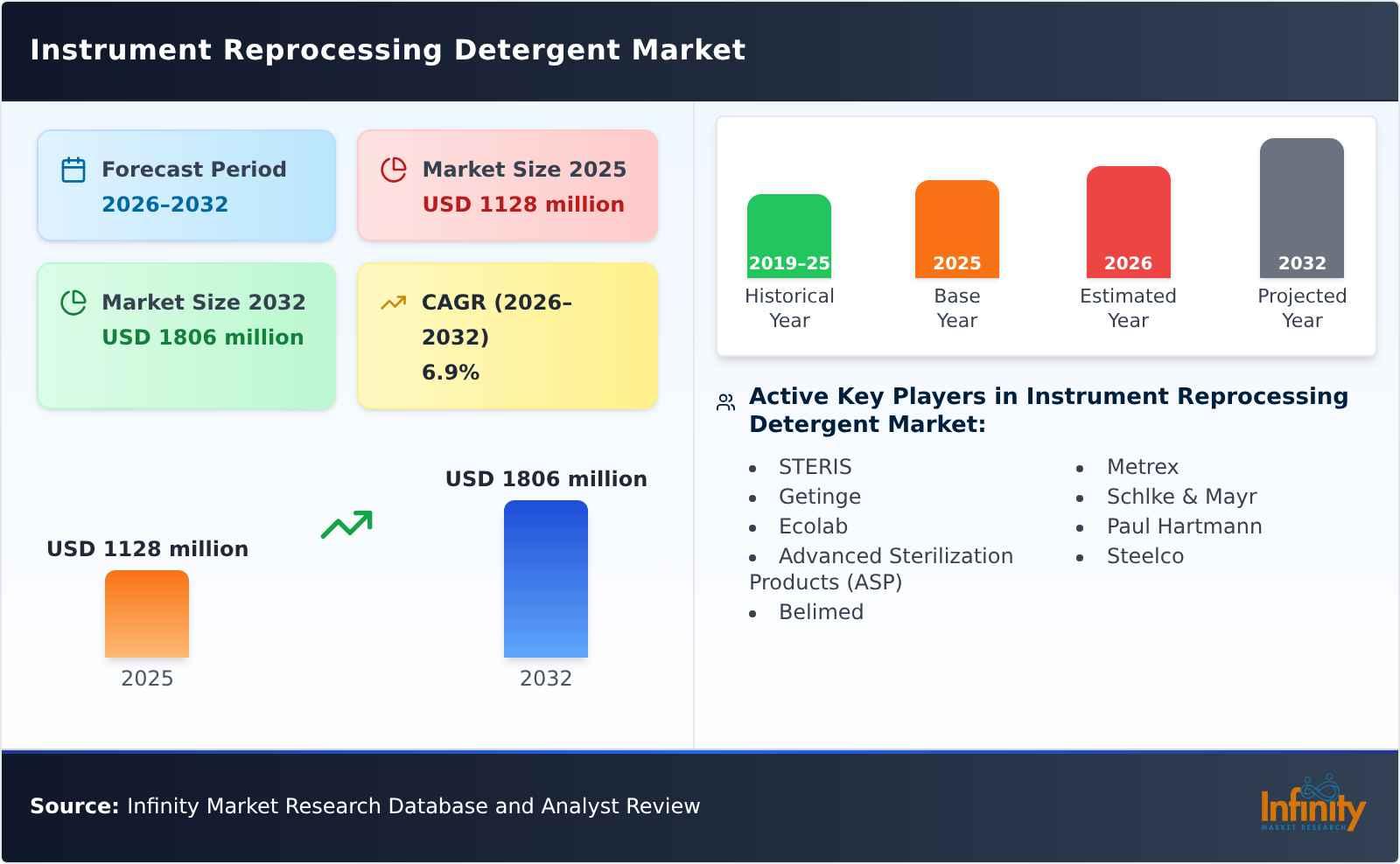
The global Instrument Reprocessing Detergent market size is predicted to grow from US$ 1128 million in 2025 to US$ 1806 million in 2032; it is expected to grow at a CAGR of 6.9% from 2026 to 2032.
Explore this report in detail? Download a free sample copy
Download Free Sample Report
Instrument Reprocessing Detergent refers to specialized chemical formulations used in the cleaning stage of medical device reprocessing (collection, pre-treatment, cleaning, rinsing, disinfection/sterilization, drying, and storage). Designed for reusable surgical instruments, anesthesia/respiratory components, endoscopes and accessories, and CSSD circulation items, it aims to efficiently remove blood, proteins, lipids, biofilm, drug residues, and inorganic deposits without damaging device materials or precision structures?thereby creating a verifiable cleanliness baseline for high-level disinfection or sterilization. Products typically include neutral/alkaline and enzymatic systems with low-foam or foam-controlled designs, compatible with manual cleaning, ultrasonic cleaning, and automated washer-disinfectors (including endoscope reprocessors). Key value propositions include material compatibility, process robustness under variable temperature/water quality, and controllable residues (easy rinsing, low residue, low odor), making it a critical consumable within hospital infection prevention and reprocessing quality management.The average gross profit margin of this product is 25%.
Rising emphasis on infection prevention and patient safety makes ?verifiable cleaning quality and traceable workflows? core KPIs in hospital reprocessing systems, creating rigid demand for professional detergents. With the growth of minimally invasive procedures and high-value reusable devices, instruments become more delicate, channel-complex, and material-sensitive?driving an upgrade from generic cleaners to scenario-specific formulations paired with validated processes. In parallel, the adoption of automated washer-disinfectors and standardized CSSD construction accelerates, favoring low-foam, foam-controlled, fast-rinsing detergents compatible with multiple machine platforms. Outsourced reprocessing, regional CSSD hubs, and multi-site healthcare groups further amplify centralized procurement and brand substitution opportunities.This category is often ?invisible when it works, costly when it fails,? so procurement can be dominated by price and legacy habits. Vendors must invest in validation evidence, training, and on-site workflow management, leading to longer adoption cycles. There is an inherent trade-off between cleaning power and material compatibility: stronger chemistry may increase risks of corrosion, coating dulling, or polymer aging. Poor residue control may compromise downstream disinfection/sterilization or trigger odor/irritation complaints. On the supply side, volatility in key inputs (surfactants, enzymes, chelators) and stringent batch-to-batch consistency requirements raise operational risk; any batch deviation or misuse can escalate into compliance scrutiny or amplified infection-control incidents.End users are shifting from ?cleaning completed? to ?cleaning outcomes measurable and auditable.? Hospitals increasingly value protein/residue testing, process-parameter recording, detergent concentration management, and automated dosing/closed-loop delivery?pushing products toward easier monitoring, simpler dilution, and reduced human error. For endoscopes and lumened devices, enzymatic performance, biofilm removal, and low-foam behavior are becoming more critical. To improve throughput, fast-acting, low-temperature-effective, easy-rinsing solutions that help reduce water consumption are gaining traction. Environmental and occupational exposure considerations also encourage low-odor, low-irritation, more biodegradable formulas and packaging innovations such as concentrates and recyclable containers.Key upstream materials include functional surfactant systems (non-ionic, amphoteric, and blends), enzyme actives (protease, lipase, amylase, etc.), chelating/dispersing and anti-redeposition agents, alkalinity/buffer systems (carbonates, amines, buffer salts), preservation and stabilization systems, foam-control/defoaming additives, optional fragrance/odor-masking components, purified water, and packaging materials. Requirements vary significantly by device materials and processes (manual, ultrasonic, automated), making scenario-based formulation essential. Enzyme-activity stability, low-temperature performance, and hard-water tolerance are decisive factors for product consistency and user experience?typically managed through raw-material grade control, multi-sourcing, and robust release specifications.
LPI (LP Information) newest research report, the ?Instrument Reprocessing Detergent Industry Forecast? looks at past sales and reviews total world Instrument Reprocessing Detergent sales in 2025, providing a comprehensive analysis by region and market sector of projected Instrument Reprocessing Detergent sales for 2026 through 2032. With Instrument Reprocessing Detergent sales broken down by region, market sector and sub-sector, this report provides a detailed analysis in US$ millions of the world Instrument Reprocessing Detergent industry.
This Insight Report provides a comprehensive analysis of the global Instrument Reprocessing Detergent landscape and highlights key trends related to product segmentation, company formation, revenue, and market share, latest development, and M&A activity. This report also analyses the strategies of leading global companies with a focus on Instrument Reprocessing Detergent portfolios and capabilities, market entry strategies, market positions, and geographic footprints, to better understand these firms? unique position in an accelerating global Instrument Reprocessing Detergent market.
This Insight Report evaluates the key market trends, drivers, and affecting factors shaping the global outlook for Instrument Reprocessing Detergent and breaks down the forecast by Type, by Application, geography, and market size to highlight emerging pockets of opportunity. With a transparent methodology based on hundreds of bottom-up qualitative and quantitative market inputs, this study forecast offers a highly nuanced view of the current state and future trajectory in the global Instrument Reprocessing Detergent.
This report presents a comprehensive overview, market shares, and growth opportunities of Instrument Reprocessing Detergent market by product type, application, key players and key regions and countries.
Segmentation by Type:
Enzymatic Detergents
Alkaline Detergents
Neutral Detergents
Other
Segmentation by Process Step:
Manual Cleaning
Washer-Disinfector Detergents
Ultrasonic Cleaning
Other
Segmentation by Instrument Category:
General Surgical Instruments
Robotic/Complex Instruments
Dental Instruments
Other
Segmentation by Application:
Hospitals
Ambulatory Surgery Centers
Other
This report also splits the market by region:
Americas
United States
Canada
Mexico
Brazil
APAC
China
Japan
Korea
Southeast Asia
India
Australia
Europe
Germany
France
UK
Italy
Russia
Middle East & Africa
Egypt
South Africa
Israel
Turkey
GCC Countries
The below companies that are profiled have been selected based on inputs gathered from primary experts and analyzing the companys coverage, product portfolio, its market penetration.
STERIS
Getinge
Ecolab
3M
Advanced Sterilization Products (ASP)
Belimed
Metrex
Schlke & Mayr
Paul Hartmann
Steelco
Instrument Reprocessing Detergent Market Scope
| Report Attribute | Details |
|---|---|
| Market Size (Start Year) | USD XX Million |
| Market Size (End Year) | USD XX Million |
| Compound Annual Growth Rate (CAGR) | USD XX Million |
| Forecast Period | USD XX Million |
| Base Year | USD XX Million |
| Historical Data | USD XX Million |
| Key Players | USD XX Million |
REPORT COVERAGE
Revenue forecast, Company Analysis, Industry landscape, Growth factors, and Trends
SEGMENT COVERED
By component, deployment, organization size, application, and industry.
REGIONAL SCOPE
North America, Europe, Asia Pacific, Middle East & Africa, South & Central America
COUNTRY SCOPE
Includes key countries across all major regions.
📘 Frequently Asked Questions
1. What is the market size of Global Instrument Reprocessing Detergent Market?
Answer: The global Instrument Reprocessing Detergent market size is predicted to grow from US$ 1128 million in 2025 to US$ 1806 million in 2032; it is expected to grow at a CAGR of 6.9% from 2026 to 2032.
2. Which regions are analyzed in the Global Instrument Reprocessing Detergent Market report?
Answer: The Global Instrument Reprocessing Detergent Market report covers major regions such as Europe, Middle East & Africa. Each region is analyzed for trends, opportunities, and market dynamics.
3. What methodology is used for forecasting of Global Instrument Reprocessing Detergent Market?
Answer: The Global Instrument Reprocessing Detergent Market report uses a mix of primary research, secondary data, and expert analysis.
4. Are emerging markets analyzed separately in the Global Instrument Reprocessing Detergent Market?
Answer: Yes, the Global Instrument Reprocessing Detergent Market report highlights high-growth emerging regions with dedicated insights.
5. Does the report include competitive benchmarking of Global Instrument Reprocessing Detergent Market?
Answer: Yes, Global Instrument Reprocessing Detergent Market report compares major players based on revenue, product portfolio, and innovation.
6. Can I access country-level data within the Global Instrument Reprocessing Detergent Market report?
Answer: Yes, Global Instrument Reprocessing Detergent Market report includes detailed data by country for major regions.
7. Can I get customized insights or data from the Global Instrument Reprocessing Detergent Market report?
Answer: Yes, we offer customization options to align with your specific business needs. You can request tailored sections or regional breakdowns.