


🔐 Secure Payment Guaranteed
Safe checkout with trusted global payment methods.
🌟 Why Choose Infinity Market Research?
At Infinity Market Research, we dont just deliver data — we deliver clarity, confidence, and competitive edge.
In a world driven by insights, we help businesses unlock the infinite potential of informed decisions.
Here why global brands, startups, and decision-makers choose us:
Industry-Centric Expertise
With deep domain knowledge across sectors — from healthcare and technology to manufacturing and consumer goods — our team delivers insights that matter.
Custom Research, Not Cookie-Cutter Reports
Every business is unique, and so are its challenges. Thats why we tailor our research to your specific goals, offering solutions that are actionable, relevant, and reliable.
Data You Can Trust
Our research methodology is rigorous, transparent, and validated at every step. We believe in delivering not just numbers, but numbers that drive real impact.
Client-Centric Approach
Your success is our priority. From first contact to final delivery, our team is responsive, collaborative, and committed to your goals — because you re more than a client; you re a partner.
Recent Reports
Shore Connection and Charging Solutions Market
Rope Water Sensor Market

Global IoT Wireless Connectivity Chip Market Size, Share and Analysis Report 2026-2032
Apr 2026
Semiconductor and Electronics
Pages: 152
ILR4822
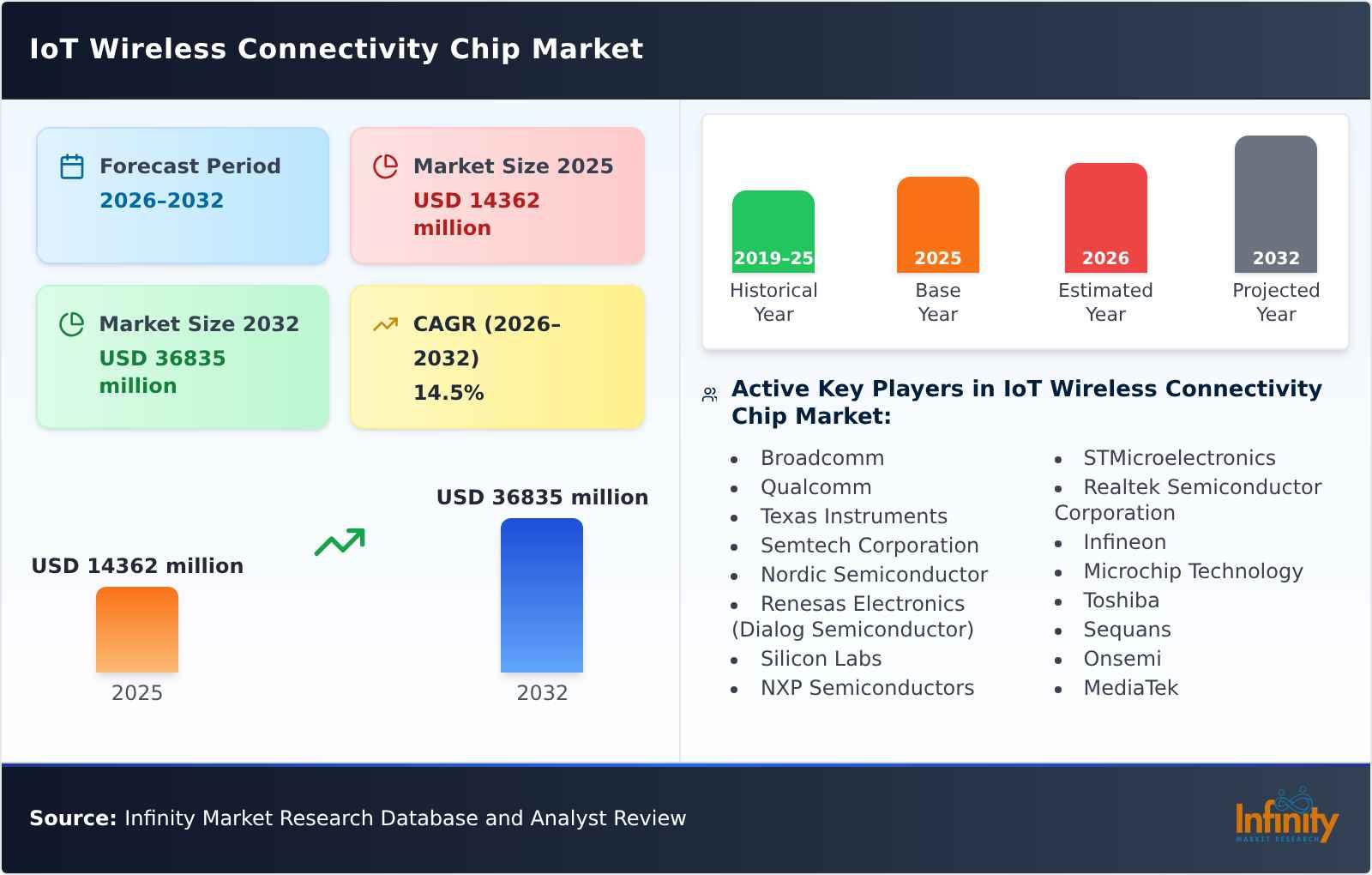
The global IoT Wireless Connectivity Chip market size is predicted to grow from US$ 14362 million in 2025 to US$ 36835 million in 2032; it is expected to grow at a CAGR of 14.5% from 2026 to 2032.
Explore this report in detail? Download a free sample copy
Download Free Sample Report
IoT Wireless Connectivity Chips refer to application-specific integrated circuits (ICs) designed for IoT terminals and edge nodes, with wireless connectivity as their core capability. They typically appear as single-chip SoCs, SiP module chips, or key communication chips. Under constraints of power consumption, size, and cost, they integrate wireless transceiver and protocol processing capabilities (RF transceiver, baseband/modulation/demodulation, protocol stack acceleration, etc.) with local control/computing capabilities (MCU/lightweight SoC), storage interfaces, power management, and security capabilities (hardware encryption, key management, secure boot, etc.) at the system level. This enables devices to complete data acquisition, edge processing, and reliable transmission to other devices or the cloud, supporting full lifecycle functions such as remote monitoring, control, and OTA upgrades. The key performance indicators for wireless IoT chips are not simply computing power, but rather system performance under comprehensive constraints such as connectivity coverage, link reliability, power consumption and battery life, RF performance, anti-interference capabilities, certification compliance, and security levels. It supports various wireless standards, including short-range connections (such as Wi-Fi, Bluetooth LE, Zigbee/Thread, UWB, etc.), LPWAN, and cellular IoT (such as LoRa/LoRaWAN, NB-IoT, LTE-M, etc.), to meet the diverse needs of consumer IoT and commercial/industrial IoT in terms of coverage, latency, throughput, cost, and reliability. In 2025, global IoT Wireless Connectivity Chip production reached 5,521.83 million units, with an average price of approximately US$2.66 per unit and a gross margin of 20.05%-55.26%. Downstream customers include Apple, Google, Amazon, Xiaomi, Logitech, Lenovo, Skyworth, Changhong, Haier, JBL, Sony, and Narwal.
From a competitive landscape perspective, core IoT Wireless Connectivity Chip vendors primarily include Qualcomm, Texas Instruments, Semtech Corporation, Nordic Semiconductor, and Renesas Electronics, while also encompassing key players such as Broadcom, MediaTek, Realtek, NXP, Infineon, and STMicroelectronics. In 2024, industry concentration was high, with the top ten vendors holding approximately 71.0% of the market share. The leading global vendors were primarily Broadcom, Qualcomm, and MediaTek, collectively holding approximately 30.2% of the market share; the second tier included Realtek, NXP, Infineon, and Renesas Electronics, collectively holding approximately 27.0%. As leading vendors continue to strengthen their advantages in multi-protocol platform-based SoCs, ecosystems and channels, and customer certification systems, market share will continue to concentrate on the top players in the short term. However, in high-growth regions like China, structural substitution will accelerate the redistribution of market share.
From a regional perspective, the Chinese market is one of the core variables determining global economic conditions and market share changes. In 2024, the Chinese market size was US$4,770.67 million, accounting for approximately 36.3% of the global market; it is projected to reach US$12,742.03 million by 2031, increasing its global share to 38.8%. Strong consumer demand will further accelerate local supply chain collaboration and the pace of domestic substitution, making the Chinese market one of the most competitive and fastest-evolving regions for products in the coming years.
In terms of product type and technological evolution, Bluetooth and Bluetooth Low Energy (BLE) remain the most prevalent technology (approximately 57.3% share in 2024, projected to reach 52.5% in 2031), with advantages in ultra-low power consumption and a mature ecosystem. Meanwhile, the share of Wi-Fi IoT continues to increase (approximately 21.7% in 2024, projected to reach 23.6% in 2031), primarily benefiting from the growth in direct-connect networks and the demand for higher bandwidth. Multi-protocol interconnectivity, represented by Zigbee/Thread/Matter, is steadily increasing its market share in smart homes under the trend of platformization (approximately 9.9% by 2031), while cellular and LPWAN routes are more reflected in structural growth in specific industry scenarios.
From the application perspective, smart homes remain the core scenario for large-scale deployment, with a stable market share of approximately 34.1% in 2024. Revenue is projected to grow at a CAGR of approximately 14.2% from 2025 to 2031, continuing to benefit from home network upgrades, increased demand for cross-brand interconnectivity, and the penetration of multi-protocol integrated SoCs. Overall, industry competition will intensify in the coming years, especially in the Chinese market, where price, delivery, and ecosystem integration will jointly determine market share changes. Long-term winners will primarily depend on low power consumption and RF performance, protocol stacks and software ecosystems, platform-based product iteration efficiency, and the ability to replicate success at scale with leading customers and channel systems.
Infinity Market Research newest research report, the ?IoT Wireless Connectivity Chip Industry Forecast? looks at past sales and reviews total world IoT Wireless Connectivity Chip sales in 2025, providing a comprehensive analysis by region and market sector of projected IoT Wireless Connectivity Chip sales for 2026 through 2032. With IoT Wireless Connectivity Chip sales broken down by region, market sector and sub-sector, this report provides a detailed analysis in US$ millions of the world IoT Wireless Connectivity Chip industry.
This Insight Report provides a comprehensive analysis of the global IoT Wireless Connectivity Chip landscape and highlights key trends related to product segmentation, company formation, revenue, and market share, latest development, and M&A activity. This report also analyzes the strategies of leading global companies with a focus on IoT Wireless Connectivity Chip portfolios and capabilities, market entry strategies, market positions, and geographic footprints, to better understand these firms? unique position in an accelerating global IoT Wireless Connectivity Chip market.
This Insight Report evaluates the key market trends, drivers, and affecting factors shaping the global outlook for IoT Wireless Connectivity Chip and breaks down the forecast by Type, by Application, geography, and market size to highlight emerging pockets of opportunity. With a transparent methodology based on hundreds of bottom-up qualitative and quantitative market inputs, this study forecast offers a highly nuanced view of the current state and future trajectory in the global IoT Wireless Connectivity Chip.
This report presents a comprehensive overview, market shares, and growth opportunities of IoT Wireless Connectivity Chip market by product type, application, key manufacturers and key regions and countries.
Segmentation by Type:
BLE
Wi-Fi IoT
Zigbee/Thread/Matter
Cellular IoT
LoRaWAN IoT
Others
Segmentation by Area:
Consumer IoT
Commercial IoT
Segmentation by Process:
22nm
40nm
55nm
Others
Segmentation by Application:
Smart Home
Smart Healthcare
Retail Logistics
Consumer Electronics
Automotive Electronics
Other
This report also splits the market by region:
Americas
United States
Canada
Mexico
Brazil
APAC
China
Japan
Korea
Southeast Asia
India
Australia
Europe
Germany
France
UK
Italy
Russia
Middle East & Africa
Egypt
South Africa
Israel
Turkey
GCC Countries
The below companies that are profiled have been selected based on inputs gathered from primary experts and analysing the companys coverage, product portfolio, its market penetration.
Broadcomm
Qualcomm
Texas Instruments
Semtech Corporation
Nordic Semiconductor
Renesas Electronics (Dialog Semiconductor)
Silicon Labs
NXP Semiconductors
STMicroelectronics
Realtek Semiconductor Corporation
Infineon
Microchip Technology
Toshiba
Sequans
Onsemi
MediaTek
Qorvo
UNISOC
Telink Semiconductor (shanghai)co.,ltd.
Shenzhen HiSilicon Technologies
ASR Microelectronics Co., Ltd.
Zhuhai All Winner Technology
Espressif Systems
Beken Corporation
Key Questions Addressed in this Report
What is the 10-year outlook for the global IoT Wireless Connectivity Chip market?
What factors are driving IoT Wireless Connectivity Chip market growth, globally and by region?
Which technologies are poised for the fastest growth by market and region?
How do IoT Wireless Connectivity Chip market opportunities vary by end market size?
How does IoT Wireless Connectivity Chip break out by Type, by Application?
IoT Wireless Connectivity Chip Market Scope
| Report Attribute | Details |
|---|---|
| Market Size (Start Year) | USD XX Million |
| Market Size (End Year) | USD XX Million |
| Compound Annual Growth Rate (CAGR) | USD XX Million |
| Forecast Period | USD XX Million |
| Base Year | USD XX Million |
| Historical Data | USD XX Million |
| Key Players | USD XX Million |
REPORT COVERAGE
Revenue forecast, Company Analysis, Industry landscape, Growth factors, and Trends
SEGMENT COVERED
By component, deployment, organization size, application, and industry.
REGIONAL SCOPE
North America, Europe, Asia Pacific, Middle East & Africa, South & Central America
COUNTRY SCOPE
Includes key countries across all major regions.
📘 Frequently Asked Questions
1. What is the market size of Global IoT Wireless Connectivity Chip Market?
Answer: The global IoT Wireless Connectivity Chip market size is predicted to grow from US$ 14362 million in 2025 to US$ 36835 million in 2032; it is expected to grow at a CAGR of 14.5% from 2026 to 2032.
2. Which regions are analyzed in the Global IoT Wireless Connectivity Chip Market report?
Answer: The Global IoT Wireless Connectivity Chip Market report covers major regions such as Europe, Middle East & Africa. Each region is analyzed for trends, opportunities, and market dynamics.
3. What methodology is used for forecasting of Global IoT Wireless Connectivity Chip Market?
Answer: The Global IoT Wireless Connectivity Chip Market report uses a mix of primary research, secondary data, and expert analysis to build its forecasts. Models include both qualitative and quantitative approaches.
4. Are emerging markets analyzed separately in the Global IoT Wireless Connectivity Chip Market?
Answer: Yes, the Global IoT Wireless Connectivity Chip Market report highlights high-growth emerging regions with dedicated insights. These include untapped opportunities, risks, and potential for expansion.
5. Does the report include competitive benchmarking of Global IoT Wireless Connectivity Chip Market?
Answer: Yes, Global IoT Wireless Connectivity Chip Market report compares major players based on revenue, product portfolio, innovation, and regional presence. This helps assess competitive positioning.
6. Can I access country-level data within the Global IoT Wireless Connectivity Chip Market report?
Answer: Yes, Global IoT Wireless Connectivity Chip Market report includes detailed data by country, especially for key markets. This allows for localized insights and decision-making.
7. Can I get customized insights or data from the Global IoT Wireless Connectivity Chip Market report?
Answer: Yes, we offer customization options to align with your specific business needs. You can request tailored sections or regional breakdowns.

🔐 Secure Payment Guaranteed
Safe checkout with trusted global payment methods.
🌟 Why Choose Infinity Market Research?
At Infinity Market Research, we dont just deliver data — we deliver clarity, confidence, and competitive edge.
In a world driven by insights, we help businesses unlock the infinite potential of informed decisions.
Here why global brands, startups, and decision-makers choose us:
Industry-Centric Expertise
With deep domain knowledge across sectors — from healthcare and technology to manufacturing and consumer goods — our team delivers insights that matter.
Custom Research, Not Cookie-Cutter Reports
Every business is unique, and so are its challenges. Thats why we tailor our research to your specific goals, offering solutions that are actionable, relevant, and reliable.
Data You Can Trust
Our research methodology is rigorous, transparent, and validated at every step. We believe in delivering not just numbers, but numbers that drive real impact.
Client-Centric Approach
Your success is our priority. From first contact to final delivery, our team is responsive, collaborative, and committed to your goals — because you re more than a client; you re a partner.