
Global Labels in Pharmaceutical Market Growth 2026-2032
Jan 2026
Chemicals and Materials
Pages: 164
ILR1223
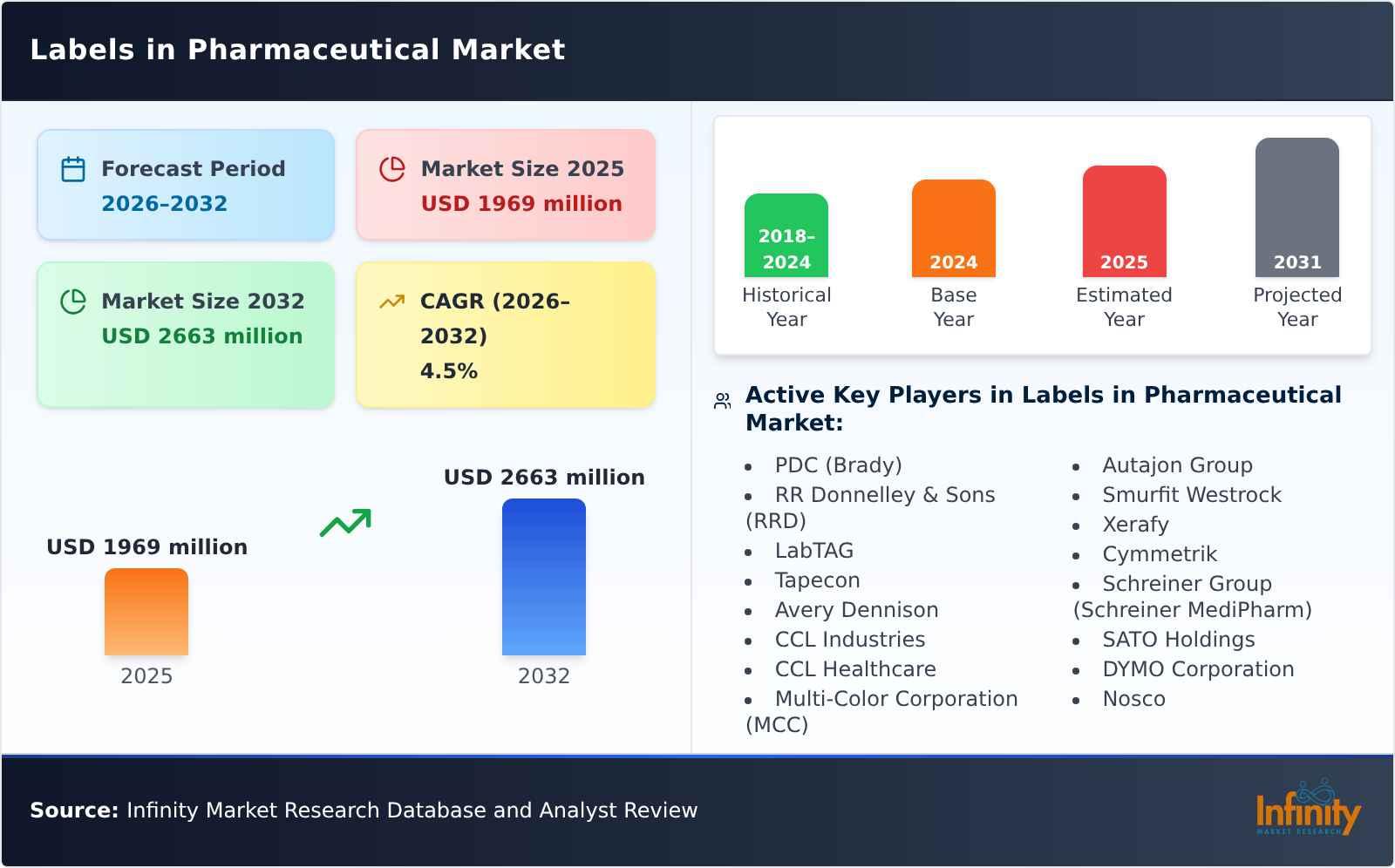
The global Labels in Pharmaceutical market size is predicted to grow from US$ 1969 million in 2025 to US$ 2663 million in 2032; it is expected to grow at a CAGR of 4.5% from 2026 to 2032.
Explore this report in detail? Download a free sample copy
Download Free Sample Report
Labels in Pharmaceutical are specialized identification and information carriers used across the pharmaceutical lifecyclefrom R&D and clinical operations to packaging, warehousing, distribution, dispensing, and patient useto ensure compliant, consistent communication and robust traceability in multi-regulatory, multi-language, multi-batch, and multi-channel environments. They address critical problems such as mislabeling and mis-dispensing, batch mix-ups, inconsistent content across markets, delayed or inefficient recalls, diversion, and counterfeiting by enabling standardized presentation of regulated information, accurate identity and lot/serial capture, and audit-ready records that support release and quality-event response. Historically, pharmaceutical labeling evolved from simple text-based printed or handwritten identifiers to template-driven, standardized formats as modern manufacturing and GMP quality systems matured; barcoding later introduced operational visibility for batch and logistics control. Over the past two decades, expanding requirements for track-and-trace, serialization, tamper evidence, and cross-market compliance have driven labeling toward an integrated variable data + in-line verification + electronic recordkeeping capability connected to packaging lines, vision inspection, and master-data/regulatory rule governance. In selected use cases, the market has also adopted security constructions, covert/overt authentication features, digital verification, and RFID/NFC to strengthen channel validation and risk control. Upstream supply typically includes facestocks (pharmaceutical-grade papers, coated papers, synthetic papers, PP/PET/PE films, specialty substrates for low-temperature, abrasion, and chemical resistance), pressure-sensitive adhesives (low-migration/low-extractable formulations; condensation and solvent resistant; permanent or removable for glass/plastics/metal), release liners, inks and coatings (low-migration ink systems, scuff-resistant varnishes, anti-scratch/barrier or security coatings), variable-data consumables (thermal-transfer ribbons and coding/marking materials), and packaging/inspection components (printheads, sensors, vision cameras, barcode scan modules, serialization controllers, and RFID inlays/antenna/chips), collectively enabling validated compliance, readability, durability, and traceability.In 2025, global drug label production capacity reached 100 billion units, while sales volume amounted to 87.5 billion units. The average unit price was USD 0.023 per label, and corporate gross margins generally ranged between 20% and 30%.
The pharmaceutical labeling market is increasingly managed as a compliance- and operations-critical discipline rather than a simple print-and-deliver activity, with complexity amplified by globalization and multi-channel distribution. Regulatory and audit expectations require label content, layout, languages, warnings, coding rules, and change records to be traceable and verifiable, where even small inconsistencies can delay batch release, trigger recall exposure, or create cross-market compliance issues. Meanwhile, the pharmaceutical supply chain spans many handoffsfrom manufacturing sites to distributors, hospitals, retail pharmacies, and e-commerceso labels must support high-throughput packaging operations while remaining consistent, readable, and fit-for-purpose downstream. Trends such as clinical programs, specialized therapies, and more frequent product variations sustain a small runs, many versions, frequent changes environment, making variable data, short lead times, and rapid compliance checks baseline capabilities. This has further stratified suppliers: those with strong quality documentation, validated processes, multi-site reliability, and information security are more likely to be embedded in core supply chains, while local agile providers can still compete but must meet rising governance expectations.
Future development will likely be driven by data-governed content control, automated verification across production and distribution, and parallel advances in security and sustainability. Content will increasingly be generated or constrained by master data and regulatory rule libraries, using standardized templates, rigorous versioning, role-based approvals, electronic signatures, and automated language consistency checks to reduce human error; stronger linkage across labels, leaflets, packaging components, and regulatory dossiers will be emphasized to prevent cross-document mismatches. On the line and release side, vision inspection, barcode grading, serialization association checks, and exception stops will be more deeply integrated into packaging operations, creating a tighter printverifyrecordtrace loop. In response to diversion and counterfeiting risks, digital verification and channel-side collaboration will strengthen, expanding practical adoption of tamper evidence, variable security printing, digital watermarking, and selective RFID/NFC where it delivers measurable workflow benefit. Materials and processes will continue to favor low-migration/low-extractable systems, chemical and wipe resistance, and constructions suited to cold-chain and special storage, while sustainability efforts push toward lightweighting and more recyclable designsonly where validated compliance, readability, and line stability are preserved.
Key drivers include the high sensitivity to patient-safety and compliance risk, the need for supply-chain resilience, and renewed investment in operational efficiency and information security. Labeling failures can create cascading impacts across batch release, availability, recalls, and brand reputation, elevating governance and validated execution to a strategic priority. Supply volatility also encourages dual sourcing and alternative-material strategies, increasing expectations for continuity planning and robust qualification pathways. Barriers are largely about cross-functional alignment and implementation cost: unclear ownership across regulatory, quality, packaging engineering, supply chain, IT, and market access can prevent single-version control and closed-loop change management; inconsistent master data can propagate errors across plants and markets; and differences in line capabilities, outsourced partners record integrity, and security/access controls can extend timelines. Security and digital verification choices also require trade-offs among cost, user experience, verifiability, and channel participation, while sustainability-driven material changes demand rigorous validation and stability assessmentpushing many organizations toward phased rollouts. Programs tend to move fastest when governance is unified, rules are embedded in systems and daily operations, and ongoing maintenance and audit readiness are treated as continuous processes rather than one-off projects.
Infinity Market Research newest research report, the Labels in Pharmaceutical Industry Forecast looks at past sales and reviews total world Labels in Pharmaceutical sales in 2025, providing a comprehensive analysis by region and market sector of projected Labels in Pharmaceutical sales for 2026 through 2032. With Labels in Pharmaceutical sales broken down by region, market sector and sub-sector, this report provides a detailed analysis in US$ millions of the world Labels in Pharmaceutical industry.
This Insight Report provides a comprehensive analysis of the global Labels in Pharmaceutical landscape and highlights key trends related to product segmentation, company formation, revenue, and market share, latest development, and M&A activity. This report also analyzes the strategies of leading global companies with a focus on Labels in Pharmaceutical portfolios and capabilities, market entry strategies, market positions, and geographic footprints, to better understand these firms unique position in an accelerating global Labels in Pharmaceutical market.
This Insight Report evaluates the key market trends, drivers, and affecting factors shaping the global outlook for Labels in Pharmaceutical and breaks down the forecast by Type, by Application, geography, and market size to highlight emerging pockets of opportunity. With a transparent methodology based on hundreds of bottom-up qualitative and quantitative market inputs, this study forecast offers a highly nuanced view of the current state and future trajectory in the global Labels in Pharmaceutical.
This report presents a comprehensive overview, market shares, and growth opportunities of Labels in Pharmaceutical market by product type, application, key manufacturers and key regions and countries.
Segmentation by Type:
Paper Label
Plastic Label
Composite Material Label
Segmentation by Technology Type:
Thermal Transfer Labels
Cryogenic Labels
Chemical-Resistant Labels
Others
Segmentation by Adhesive Type:
Permanent Adhesives
Removable Adhesives
Segmentation by Application:
Hospital
Clinic
Others
This report also splits the market by region:
Americas
United States
Canada
Mexico
Brazil
APAC
China
Japan
Korea
Southeast Asia
India
Australia
Europe
Germany
France
UK
Italy
Russia
Middle East & Africa
Egypt
South Africa
Israel
Turkey
GCC Countries
The below companies that are profiled have been selected based on inputs gathered from primary experts and analysing the companys coverage, product portfolio, its market penetration.
PDC (Brady)
3M
RR Donnelley & Sons (RRD)
LabTAG
Tapecon
Avery Dennison
CCL Industries
CCL Healthcare
Multi-Color Corporation (MCC)
Autajon Group
Smurfit Westrock
Xerafy
Cymmetrik
Schreiner Group (Schreiner MediPharm)
SATO Holdings
DYMO Corporation
Nosco
Resource Label Group
Royal Label
PRO-TECH Design
Imprint Enterprises
JN White
Suzhou Thunder Weiye Information Technology Co., Ltd.
Zaosin
Key Questions Addressed in this Report
What is the 10-year outlook for the global Labels in Pharmaceutical market?
What factors are driving Labels in Pharmaceutical market growth, globally and by region?
Which technologies are poised for the fastest growth by market and region?
How do Labels in Pharmaceutical market opportunities vary by end market size?
How does Labels in Pharmaceutical break out by Type, by Application?
Labels in Pharmaceutical Market Scope
| Report Attribute | Details |
|---|---|
| Market Size (Start Year) | USD XX Million |
| Market Size (End Year) | USD XX Million |
| Compound Annual Growth Rate (CAGR) | USD XX Million |
| Forecast Period | USD XX Million |
| Base Year | USD XX Million |
| Historical Data | USD XX Million |
| Key Players | USD XX Million |
REPORT COVERAGE
Revenue forecast, Company Analysis, Industry landscape, Growth factors, and Trends
SEGMENT COVERED
By component, deployment, organization size, application, and industry.
REGIONAL SCOPE
North America, Europe, Asia Pacific, Middle East & Africa, South & Central America
COUNTRY SCOPE
Includes key countries across all major regions.
Frequently Asked Questions
1. What is the market size of Global Labels in Pharmaceutical Market?
Answer: The global Labels in Pharmaceutical market size is predicted to grow from US$ 1969 million in 2025 to US$ 2663 million in 2032; it is expected to grow at a CAGR of 4.5% from 2026 to 2032.
2. Which regions are analyzed in the Global Labels in Pharmaceutical Market report?
Answer: The Global Labels in Pharmaceutical Market report covers major regions such as Europe, Middle East & Africa. Each region is analyzed for trends, opportunities, and market dynamics.
3. What methodology is used for forecasting of Global Labels in Pharmaceutical Market?
Answer: The Global Labels in Pharmaceutical Market report uses a mix of primary research, secondary data, and expert analysis.
4. Are emerging markets analyzed separately in the Global Labels in Pharmaceutical Market?
Answer: Yes, the Global Labels in Pharmaceutical Market report highlights high-growth emerging regions with dedicated insights.
5. Does the report include competitive benchmarking of Global Labels in Pharmaceutical Market?
Answer: Yes, Global Labels in Pharmaceutical Market report compares major players based on revenue, product portfolio, and innovation.
6. Can I access country-level data within the Global Labels in Pharmaceutical Market report?
Answer: Yes, Global Labels in Pharmaceutical Market report includes detailed data by country for major regions.
7. Can I get customized insights or data from the Global Labels in Pharmaceutical Market report?
Answer: Yes, we offer customization options to align with your specific business needs. You can request tailored sections or regional breakdowns.