


Global Lightweight Loitering Munitions Market Growth 2026-2032
Jan 2026
Machinery And Equipment
Pages: 111
ILR1539
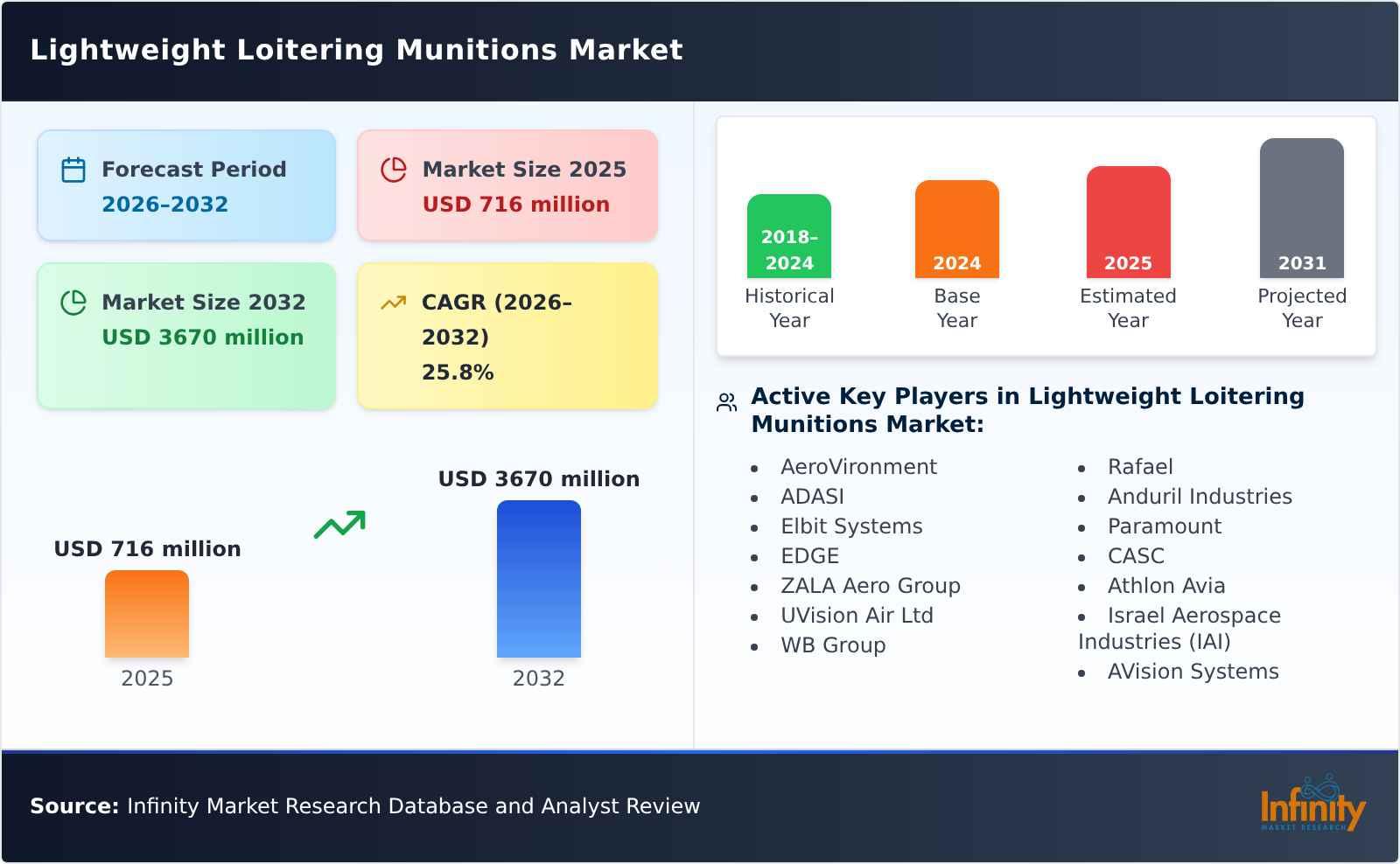
The global Lightweight Loitering Munitions market size is predicted to grow from US$ 716 million in 2025 to US$ 3670 million in 2032; it is expected to grow at a CAGR of 25.8% from 2026 to 2032.
Explore this report in detail? Download a free sample copy
Download Free Sample Report
Lightweight loitering munitions typically refer to unmanned aerial weapon systems equipped with warheads. These systems fly autonomously or remotely controlled via their own propulsion systems, loitering (coasting/lingering) over target areas to identify, locate, and track targets, and then engage them upon confirmation. Unlike traditional missiles, rockets, or bombs, these munitions emphasize lightweight design, autonomy, precision strike capabilities, and intelligence reconnaissance integration, making them suitable for real-time target processing scenarios in dynamic battlefield environments.
Lightweight loitering munitions (typically man-portable or deployable from light platforms, combining searchidentifytrackstrike in one expendable system that can loiter over an area and attack on command) have expanded rapidly because they sit at the intersection of firepower decentralization, sensor/compute miniaturization, and the operational need to compress kill chains against fleeting or low-signature targets. The first driver is tactical: small units increasingly require organic precision effects that are faster than calling for air support, more flexible than indirect fires, and more adaptive than traditional point-and-shoot missiles. The ability to loiter, re-route, and abort enables engagement of time-sensitive targets and reduces the OODA loop from find to finish. The second driver is technological and industrial: electric propulsion, lightweight composites, low-cost EO/IR payloads, robust datalinks, GNSS/INS fusion, and edge-enabled target cueing have made affordable precision manufacturable at scale; modular warheads and common control stations further support product families and multi-platform launch options (tube-launched by infantry, vehicle-mounted, shipborne, or UAV-carried). The third driver is doctrinal and system-level: when integrated with ISR drones, forward observers, EW cueing, and fires networks, lightweight loitering munitions become a node in the kill chain rather than a standalone weapon, adaptable across anti-armor, anti-personnel, suppression of strongpoints, strikes on sensors/communications, and in some cases counter-UAS roles.
The key challenges define the categorys ceiling. The central tension is between low-cost expendability and survivable, reliable effects in a contested environment. Electronic warfare (GNSS jamming/spoofing, datalink disruption, attacks on control nodes) can directly degrade navigation and command, pushing systems toward anti-jam waveforms, frequency agility, stronger inertial navigation, vision/terrain-aided guidance, and increased autonomyeach of which raises cost, power, and complexity and erodes the cheap in volume premise. Target identification and authorization are another bottleneck: clutter, obscurants, camouflage, and look-alike objects elevate misidentification risk, and moving closer to autonomous terminal behavior demands stricter human-in-the-loop concepts, rules of engagement, training, and compliance frameworks. Supply chain and regulatory constraints also matter: critical components (optics, processors, encrypted comms, IMUs/gyros, energetics and fuzing) are often shaped by export controls and defense trade rules, creating tiered performance and delivery realities across suppliers and countries. Finally, counter-measures are proliferatingsoft-kill jammers, hard-kill interceptors, and integrated counter-UAS sensorsshrinking permissive loiter windows and forcing an evolution toward lower signatures, stronger resilience, faster terminal profiles, smarter mission planning, and more layered, role-specialized product architectures rather than purely scaling quantities.
Infinity Market Research newest research report, the Lightweight Loitering Munitions Industry Forecast looks at past sales and reviews total world Lightweight Loitering Munitions sales in 2025, providing a comprehensive analysis by region and market sector of projected Lightweight Loitering Munitions sales for 2026 through 2032. With Lightweight Loitering Munitions sales broken down by region, market sector and sub-sector, this report provides a detailed analysis in US$ millions of the world Lightweight Loitering Munitions industry.
This Insight Report provides a comprehensive analysis of the global Lightweight Loitering Munitions landscape and highlights key trends related to product segmentation, company formation, revenue, and market share, latest development, and M&A activity. This report also analyzes the strategies of leading global companies with a focus on Lightweight Loitering Munitions portfolios and capabilities, market entry strategies, market positions, and geographic footprints, to better understand these firms unique position in an accelerating global Lightweight Loitering Munitions market.
This Insight Report evaluates the key market trends, drivers, and affecting factors shaping the global outlook for Lightweight Loitering Munitions and breaks down the forecast by Type, by Application, geography, and market size to highlight emerging pockets of opportunity. With a transparent methodology based on hundreds of bottom-up qualitative and quantitative market inputs, this study forecast offers a highly nuanced view of the current state and future trajectory in the global Lightweight Loitering Munitions.
This report presents a comprehensive overview, market shares, and growth opportunities of Lightweight Loitering Munitions market by product type, application, key manufacturers and key regions and countries.
Segmentation by Type:
Fixed-wing Loitering Munition
Rotary-wing Loitering Munition
Segmentation by Combat Range:
Medium to Long Distance (Over 30 Kilometers)
Short Distance (30 Kilometers And Below)
Segmentation by Warhead Type:
Explosive-Formed Warhead
Fragmentation Warhead
Others
Segmentation by Application:
Army
Navy
Air Force
This report also splits the market by region:
Americas
United States
Canada
Mexico
Brazil
APAC
China
Japan
Korea
Southeast Asia
India
Australia
Europe
Germany
France
UK
Italy
Russia
Middle East & Africa
Egypt
South Africa
Israel
Turkey
GCC Countries
The below companies that are profiled have been selected based on inputs gathered from primary experts and analysing the companys coverage, product portfolio, its market penetration.
AeroVironment
ADASI
Elbit Systems
EDGE
ZALA Aero Group
UVision Air Ltd
WB Group
Rafael
Anduril Industries
Paramount
CASC
Athlon Avia
Israel Aerospace Industries (IAI)
AVision Systems
Key Questions Addressed in this Report
What is the 10-year outlook for the global Lightweight Loitering Munitions market?
What factors are driving Lightweight Loitering Munitions market growth, globally and by region?
Which technologies are poised for the fastest growth by market and region?
How do Lightweight Loitering Munitions market opportunities vary by end market size?
How does Lightweight Loitering Munitions break out by Type, by Application?
Lightweight Loitering Munitions Market Scope
| Report Attribute | Details |
|---|---|
| Market Size (Start Year) | USD XX Million |
| Market Size (End Year) | USD XX Million |
| Compound Annual Growth Rate (CAGR) | USD XX Million |
| Forecast Period | USD XX Million |
| Base Year | USD XX Million |
| Historical Data | USD XX Million |
| Key Players | USD XX Million |
REPORT COVERAGE
Revenue forecast, Company Analysis, Industry landscape, Growth factors, and Trends
SEGMENT COVERED
By component, deployment, organization size, application, and industry.
REGIONAL SCOPE
North America, Europe, Asia Pacific, Middle East & Africa, South & Central America
COUNTRY SCOPE
Includes key countries across all major regions.
Frequently Asked Questions
1. What is the market size of Global Lightweight Loitering Munitions Market?
Answer: The global Lightweight Loitering Munitions market size is predicted to grow from US$ 716 million in 2025 to US$ 3670 million in 2032; it is expected to grow at a CAGR of 25.8% from 2026 to 2032.
2. Which regions are analyzed in the Global Lightweight Loitering Munitions Market report?
Answer: The Global Lightweight Loitering Munitions Market report covers major regions such as Europe, Middle East & Africa. Each region is analyzed for trends, opportunities, and market dynamics.
3. What methodology is used for forecasting of Global Lightweight Loitering Munitions Market?
Answer: The Global Lightweight Loitering Munitions Market report uses a mix of primary research, secondary data, and expert analysis.
4. Are emerging markets analyzed separately in the Global Lightweight Loitering Munitions Market?
Answer: Yes, the Global Lightweight Loitering Munitions Market report highlights high-growth emerging regions with dedicated insights.
5. Does the report include competitive benchmarking of Global Lightweight Loitering Munitions Market?
Answer: Yes, Global Lightweight Loitering Munitions Market report compares major players based on revenue, product portfolio, and innovation.
6. Can I access country-level data within the Global Lightweight Loitering Munitions Market report?
Answer: Yes, Global Lightweight Loitering Munitions Market report includes detailed data by country for major regions.
7. Can I get customized insights or data from the Global Lightweight Loitering Munitions Market report?
Answer: Yes, we offer customization options to align with your specific business needs. You can request tailored sections or regional breakdowns.