


Global Long-term Artificial Heart Support Market Growth 2026-2032
Jan 2026
Healthcare
Pages: 92
ILR1795
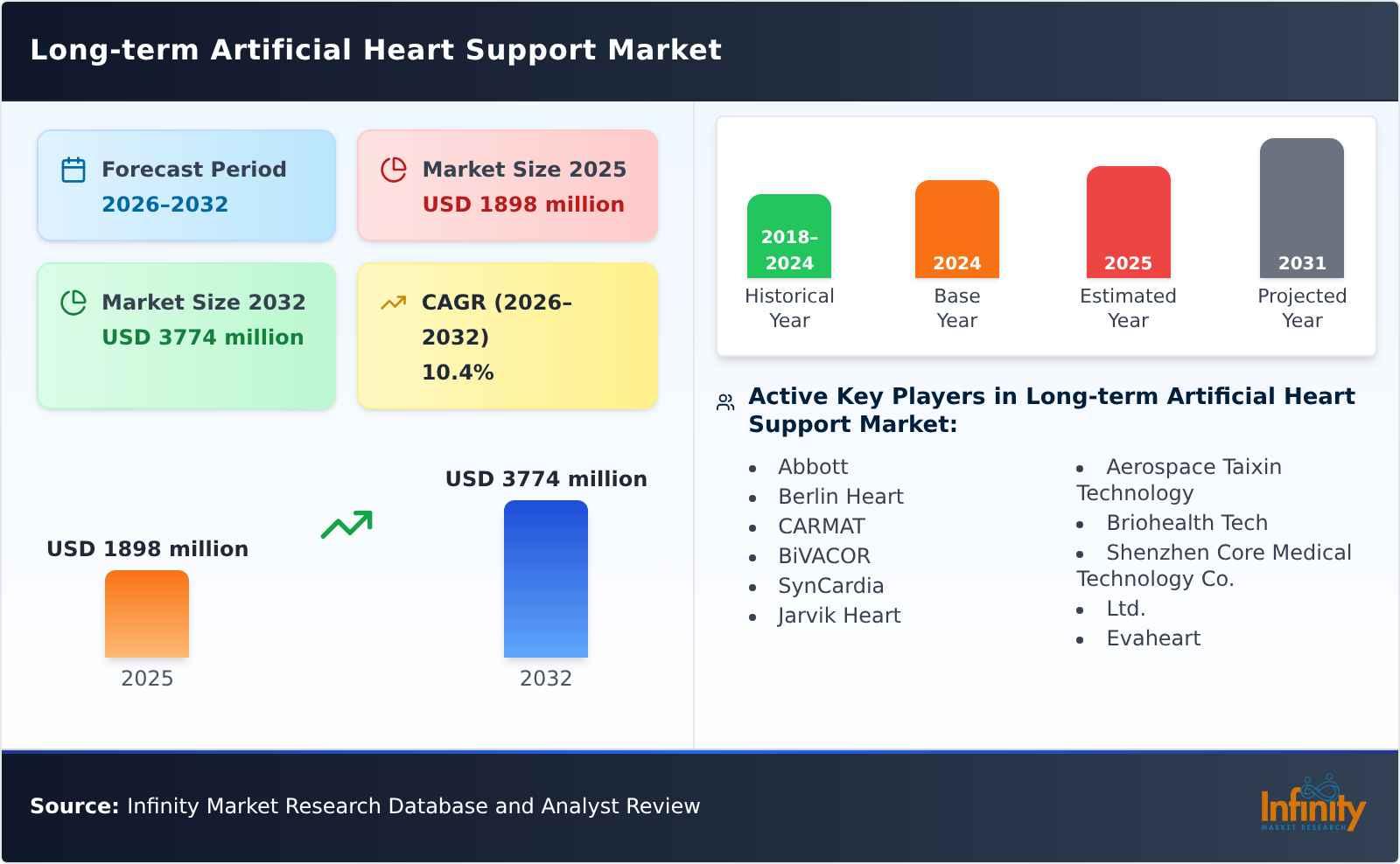
The global Long-term Artificial Heart Support market size is predicted to grow from US$ 1898 million in 2025 to US$ 3774 million in 2032; it is expected to grow at a CAGR of 10.4% from 2026 to 2032.
Explore this report in detail? Download a free sample copy
Download Free Sample Report
In 2025, global Long-term Artificial Heart Support production reached approximately 19,000 units, with an average global market price of around US$100,000 per unit. In 2025, the global s total production capacity of Long-term Artificial Heart Support reached 23,000 units. The industry average gross profit margin of this product reached 70%.Long-term assist devices (LADs) are implantable medical devices designed to replace or partially replace the pumping function of a damaged natural heart, providing long-term life support for patients with end-stage heart failure. They use a mechanical pump to pump blood from the heart and deliver it throughout the body. LADs are mainly categorized into total artificial hearts that replace the function of both ventricles and left ventricular assist devices that assist the function of a single ventricle. Unlike short-term transitional devices, the core design principle of LADs is extremely high durability, biocompatibility, and reliability to support patients in maintaining a high quality of life outside the hospital. Their goal is to serve as an endpoint treatment or a long-term bridging therapy, significantly extending patient survival and improving exercise tolerance and quality of life.
The long-term assistive artificial heart (LTA) industry chain is highly integrated and has extremely high technological barriers. The upstream mainly includes the supply of core materials and components, such as biocompatible materials like titanium alloys and bioceramics; core drive and control components such as high-efficiency micromotors, magnetic levitation bearings, and precision sensors; and high-performance batteries and transcutaneous energy transfer systems. The midstream is the core of the industry chain, involving equipment design and development, precision manufacturing, animal and clinical trials, and stringent registration and approval processes. Representative companies include international giants such as Abbott and Medtronic. The downstream is the clinical application end, including large heart centers and cardiac surgery teams in transplant hospitals, responsible for patient screening, implantation surgery, long-term postoperative management, and anticoagulation therapy. The industry chain also relies heavily on continuous R&D investment, a strict regulatory system, and professional technical support and training services.
The long-term assistive artificial heart has a promising future, driven by both huge clinical demand and technological innovation. The global number of heart failure patients is large and continues to grow, while there is a severe shortage of heart donors, making long-term assistive devices an irreplaceable solution. Technological advancements are moving towards miniaturization, full implantability, intelligence, and high biocompatibility. For example, improved blood contact interface design can significantly reduce the risk of thrombosis and bleeding; wireless power transfer technology can eliminate the risk of infection associated with percutaneous leads; and artificial intelligence algorithms can achieve adaptive adjustment of pump speed. Indications are expanding from the traditional transplant transition to earlier endpoint treatment and disease-modifying therapy. With technological maturity and cost control, market penetration is expected to increase, bringing hope to more patients.
Infinity Market Research newest research report, the Long-term Artificial Heart Support Industry Forecast looks at past sales and reviews total world Long-term Artificial Heart Support sales in 2025, providing a comprehensive analysis by region and market sector of projected Long-term Artificial Heart Support sales for 2026 through 2032. With Long-term Artificial Heart Support sales broken down by region, market sector and sub-sector, this report provides a detailed analysis in US$ millions of the world Long-term Artificial Heart Support industry.
This Insight Report provides a comprehensive analysis of the global Long-term Artificial Heart Support landscape and highlights key trends related to product segmentation, company formation, revenue, and market share, latest development, and M&A activity. This report also analyzes the strategies of leading global companies with a focus on Long-term Artificial Heart Support portfolios and capabilities, market entry strategies, market positions, and geographic footprints, to better understand these firms unique position in an accelerating global Long-term Artificial Heart Support market.
This Insight Report evaluates the key market trends, drivers, and affecting factors shaping the global outlook for Long-term Artificial Heart Support and breaks down the forecast by Type, by Application, geography, and market size to highlight emerging pockets of opportunity. With a transparent methodology based on hundreds of bottom-up qualitative and quantitative market inputs, this study forecast offers a highly nuanced view of the current state and future trajectory in the global Long-term Artificial Heart Support.
This report presents a comprehensive overview, market shares, and growth opportunities of Long-term Artificial Heart Support market by product type, application, key manufacturers and key regions and countries.
Segmentation by Type:
Left Ventricular Assist
Right Ventricular Assist
Biventricular Assist
Segmentation by Assist Time:
Temporary Support
Permanent Support
Segmentation by Mode of Contact with Blood:
Contact Type
Non-contact Type
Segmentation by Application:
Heart Failure
Cardiomyopathy
Others
This report also splits the market by region:
Americas
United States
Canada
Mexico
Brazil
APAC
China
Japan
Korea
Southeast Asia
India
Australia
Europe
Germany
France
UK
Italy
Russia
Middle East & Africa
Egypt
South Africa
Israel
Turkey
GCC Countries
The below companies that are profiled have been selected based on inputs gathered from primary experts and analysing the companys coverage, product portfolio, its market penetration.
Abbott
Berlin Heart
CARMAT
BiVACOR
SynCardia
Jarvik Heart
Aerospace Taixin Technology
Briohealth Tech
Shenzhen Core Medical Technology Co., Ltd.
Evaheart
Key Questions Addressed in this Report
What is the 10-year outlook for the global Long-term Artificial Heart Support market?
What factors are driving Long-term Artificial Heart Support market growth, globally and by region?
Which technologies are poised for the fastest growth by market and region?
How do Long-term Artificial Heart Support market opportunities vary by end market size?
How does Long-term Artificial Heart Support break out by Type, by Application?
Long-term Artificial Heart Support Market Scope
| Report Attribute | Details |
|---|---|
| Market Size (Start Year) | USD XX Million |
| Market Size (End Year) | USD XX Million |
| Compound Annual Growth Rate (CAGR) | USD XX Million |
| Forecast Period | USD XX Million |
| Base Year | USD XX Million |
| Historical Data | USD XX Million |
| Key Players | USD XX Million |
REPORT COVERAGE
Revenue forecast, Company Analysis, Industry landscape, Growth factors, and Trends
SEGMENT COVERED
By component, deployment, organization size, application, and industry.
REGIONAL SCOPE
North America, Europe, Asia Pacific, Middle East & Africa, South & Central America
COUNTRY SCOPE
Includes key countries across all major regions.
Frequently Asked Questions
1. What is the market size of Global Long-term Artificial Heart Support Market?
Answer: The global Long-term Artificial Heart Support market size is predicted to grow from US$ 1898 million in 2025 to US$ 3774 million in 2032; it is expected to grow at a CAGR of 10.4% from 2026 to 2032.
2. Which regions are analyzed in the Global Long-term Artificial Heart Support Market report?
Answer: The Global Long-term Artificial Heart Support Market report covers major regions such as Europe, Middle East & Africa. Each region is analyzed for trends, opportunities, and market dynamics.
3. What methodology is used for forecasting of Global Long-term Artificial Heart Support Market?
Answer: The Global Long-term Artificial Heart Support Market report uses a mix of primary research, secondary data, and expert analysis.
4. Are emerging markets analyzed separately in the Global Long-term Artificial Heart Support Market?
Answer: Yes, the Global Long-term Artificial Heart Support Market report highlights high-growth emerging regions with dedicated insights.
5. Does the report include competitive benchmarking of Global Long-term Artificial Heart Support Market?
Answer: Yes, Global Long-term Artificial Heart Support Market report compares major players based on revenue, product portfolio, and innovation.
6. Can I access country-level data within the Global Long-term Artificial Heart Support Market report?
Answer: Yes, Global Long-term Artificial Heart Support Market report includes detailed data by country for major regions.
7. Can I get customized insights or data from the Global Long-term Artificial Heart Support Market report?
Answer: Yes, we offer customization options to align with your specific business needs. You can request tailored sections or regional breakdowns.