


Global Low Frequency Omnidirectional Antenna Market Growth 2026-2032
Jan 2026
Information and Communication Technology
Pages: 131
ILR1116
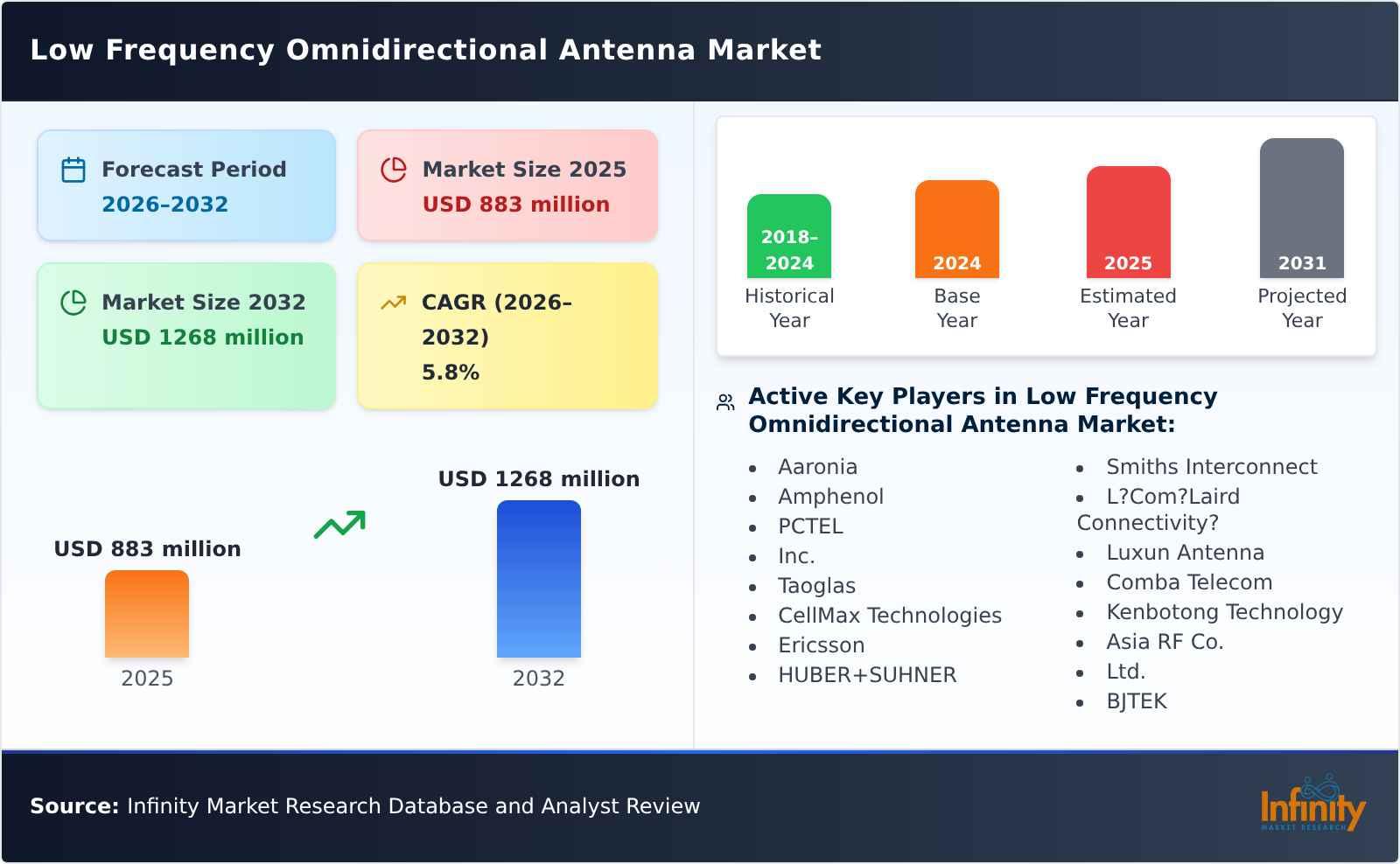
The global Low Frequency Omnidirectional Antenna market size is predicted to grow from US$ 883 million in 2025 to US$ 1268 million in 2032; it is expected to grow at a CAGR of 5.8% from 2026 to 2032.
Explore this report in detail? Download a free sample copy
Download Free Sample Report
A low frequency omnidirectional antenna operates in the lower frequency range, typically 30?kHz to 3?MHz, providing near-360 horizontal radiation and reception. It is commonly used in wireless systems requiring wide-area coverage and strong penetration, such as long-range wireless communication, maritime communication, underground or underwater signal transmission, and emergency networks. While generally larger in size, low-frequency omnidirectional antennas offer advantages in long-distance propagation, obstacle penetration, and interference resistance, making them essential components of critical communication infrastructure. In 2025, global low frequency omnidirectional antenna sales reached approximately 1,900 K Units, with an average price of 475 US$/Unit.
The growth of the low frequency omnidirectional antenna market is driven by several factors: first, the increasing use of low-frequency communication in maritime, aviation, underground, and remote areas creates higher demand for reliable coverage; second, emergency communication, public safety networks, and military applications require long-range, high-penetration antennas; third, IoT and smart infrastructure applications push for stable long-distance signal transmission, driving updates and expansion of low-frequency antennas; fourth, technological improvements and miniaturization enhance installation convenience and reduce maintenance costs, expanding the potential market.
Infinity Market Research newest research report, the Low Frequency Omnidirectional Antenna Industry Forecast looks at past sales and reviews total world Low Frequency Omnidirectional Antenna sales in 2025, providing a comprehensive analysis by region and market sector of projected Low Frequency Omnidirectional Antenna sales for 2026 through 2032. With Low Frequency Omnidirectional Antenna sales broken down by region, market sector and sub-sector, this report provides a detailed analysis in US$ millions of the world Low Frequency Omnidirectional Antenna industry.
This Insight Report provides a comprehensive analysis of the global Low Frequency Omnidirectional Antenna landscape and highlights key trends related to product segmentation, company formation, revenue, and market share, latest development, and M&A activity. This report also analyzes the strategies of leading global companies with a focus on Low Frequency Omnidirectional Antenna portfolios and capabilities, market entry strategies, market positions, and geographic footprints, to better understand these firms unique position in an accelerating global Low Frequency Omnidirectional Antenna market.
This Insight Report evaluates the key market trends, drivers, and affecting factors shaping the global outlook for Low Frequency Omnidirectional Antenna and breaks down the forecast by Type, by Application, geography, and market size to highlight emerging pockets of opportunity. With a transparent methodology based on hundreds of bottom-up qualitative and quantitative market inputs, this study forecast offers a highly nuanced view of the current state and future trajectory in the global Low Frequency Omnidirectional Antenna.
This report presents a comprehensive overview, market shares, and growth opportunities of Low Frequency Omnidirectional Antenna market by product type, application, key manufacturers and key regions and countries.
Segmentation by Type:
Fixed Tower
Vehicle / Mobile
Integrated Module
Segmentation by Frequency Range:
Very Low Frequency (VLF, 330 kHz)
Low Frequency (LF, 30300 kHz)
Upper LF (300 kHz3 MHz)
Segmentation by Gain Level:
Low Gain (02 dBi)
Medium Gain (25 dBi)
High Gain (5+ dBi)
Segmentation by Application:
Maritime/Submarine
Underground/Tunnel
Emergency & Tactical
Others
This report also splits the market by region:
Americas
United States
Canada
Mexico
Brazil
APAC
China
Japan
Korea
Southeast Asia
India
Australia
Europe
Germany
France
UK
Italy
Russia
Middle East & Africa
Egypt
South Africa
Israel
Turkey
GCC Countries
The below companies that are profiled have been selected based on inputs gathered from primary experts and analysing the companys coverage, product portfolio, its market penetration.
Aaronia
Amphenol
PCTEL, Inc.
Taoglas
CellMax Technologies
Ericsson
HUBER+SUHNER
Smiths Interconnect
L?Com?Laird Connectivity?
Luxun Antenna
Comba Telecom
Kenbotong Technology
Asia RF Co., Ltd.
BJTEK
Alpha Wireless
Pasternack
Key Questions Addressed in this Report
What is the 10-year outlook for the global Low Frequency Omnidirectional Antenna market?
What factors are driving Low Frequency Omnidirectional Antenna market growth, globally and by region?
Which technologies are poised for the fastest growth by market and region?
How do Low Frequency Omnidirectional Antenna market opportunities vary by end market size?
How does Low Frequency Omnidirectional Antenna break out by Type, by Application?
Low Frequency Omnidirectional Antenna Market Scope
| Report Attribute | Details |
|---|---|
| Market Size (Start Year) | USD XX Million |
| Market Size (End Year) | USD XX Million |
| Compound Annual Growth Rate (CAGR) | USD XX Million |
| Forecast Period | USD XX Million |
| Base Year | USD XX Million |
| Historical Data | USD XX Million |
| Key Players | USD XX Million |
REPORT COVERAGE
Revenue forecast, Company Analysis, Industry landscape, Growth factors, and Trends
SEGMENT COVERED
By component, deployment, organization size, application, and industry.
REGIONAL SCOPE
North America, Europe, Asia Pacific, Middle East & Africa, South & Central America
COUNTRY SCOPE
Includes key countries across all major regions.
Frequently Asked Questions
1. What is the market size of Global Low Frequency Omnidirectional Antenna Market?
Answer: The global Low Frequency Omnidirectional Antenna market size is predicted to grow from US$ 883 million in 2025 to US$ 1268 million in 2032; it is expected to grow at a CAGR of 5.8% from 2026 to 2032.
2. Which regions are analyzed in the Global Low Frequency Omnidirectional Antenna Market report?
Answer: The Global Low Frequency Omnidirectional Antenna Market report covers major regions such as Europe, Middle East & Africa. Each region is analyzed for trends, opportunities, and market dynamics.
3. What methodology is used for forecasting of Global Low Frequency Omnidirectional Antenna Market?
Answer: The Global Low Frequency Omnidirectional Antenna Market report uses a mix of primary research, secondary data, and expert analysis.
4. Are emerging markets analyzed separately in the Global Low Frequency Omnidirectional Antenna Market?
Answer: Yes, the Global Low Frequency Omnidirectional Antenna Market report highlights high-growth emerging regions with dedicated insights.
5. Does the report include competitive benchmarking of Global Low Frequency Omnidirectional Antenna Market?
Answer: Yes, Global Low Frequency Omnidirectional Antenna Market report compares major players based on revenue, product portfolio, and innovation.
6. Can I access country-level data within the Global Low Frequency Omnidirectional Antenna Market report?
Answer: Yes, Global Low Frequency Omnidirectional Antenna Market report includes detailed data by country for major regions.
7. Can I get customized insights or data from the Global Low Frequency Omnidirectional Antenna Market report?
Answer: Yes, we offer customization options to align with your specific business needs. You can request tailored sections or regional breakdowns.