


Global Low on Resistance MOSFET Market Trends, Growth and Outlook 2026-2032
Feb 2026
Semiconductor and Electronics
Pages: 147
ILR3447
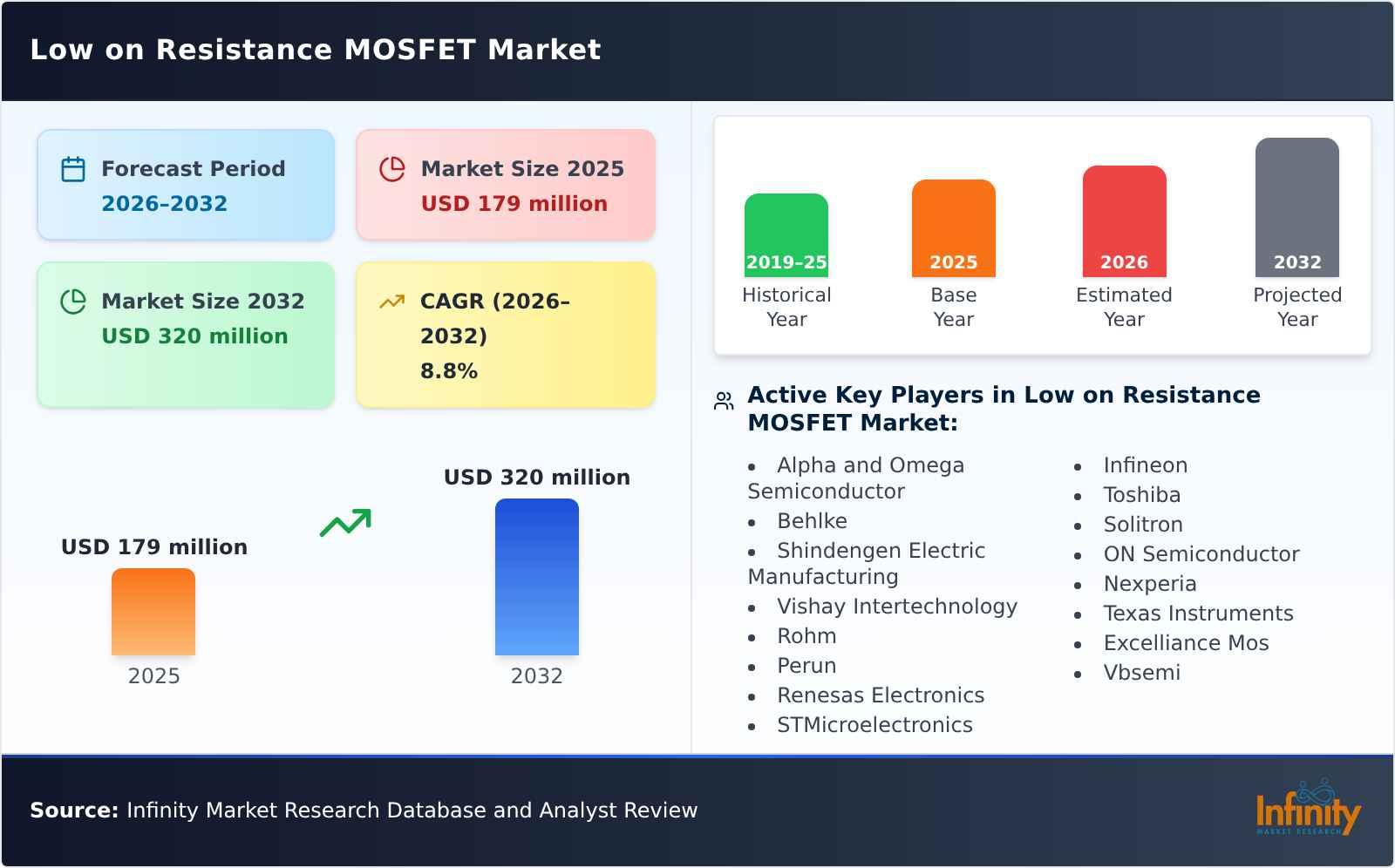
The global Low on Resistance MOSFET market size is predicted to grow from US$ 179 million in 2025 to US$ 320 million in 2032; it is expected to grow at a CAGR of 8.8% from 2026 to 2032.
Explore this report in detail? Download a free sample copy
Download Free Sample Report
In 2024, global low on-resistance MOSFET production reached approximately 17 m units , with an average global market price of around US$ 8 per unit.A low on-resistance MOSFET is a field effect transistor whose on-resistance is very low, usually between a few milliohms and tens of milliohms. This low on-resistance makes the MOSFET produce almost no voltage drop in the on-state, thus reducing power loss and improving the efficiency of the system.
The market demand for low on-resistance MOSFETs continues to expand with the increase in energy efficiency requirements, especially in the field of pursuing high efficiency and energy saving, such as electric drive systems for new energy vehicles, vehicle power supplies and high-density power supplies for server data centers. Frequency conversion control of industrial automation equipment and fast charging applications for various intelligent equipment also provide a steadily growing market space. Its core business opportunity lies in the continuous optimization of existing silicon-based technologies to dominate the broad consumer electronics and industrial markets by establishing advantages in cost performance and reliability, while competing with wide bandgap semiconductor technologies.
The annual production capacity of a single low-resistance MOSFET production line is typically 30,000-50,000 units per year, with a gross profit margin of around 28%.
The downstream consumption of low-resistance MOSFETs is as follows: new energy vehicles 26%, data centers 20%, industry 16%, consumer electronics 28%, and others 10%.
Market Concentration and Key Players:
Internationally, the market concentration of low resistance MOSFETs is relatively high, mainly concentrated in developed countries such as Europe, America and Japan. For example, Toshiba and Infineon and other large manufacturers; from the domestic point of view, low resistance MOSFET manufacturers have Xintang Technology.
Manufacturing Processes and Market Trends:
The core technology of low resistance MOSFET is to reduce the cell size continuously to increase the channel density, so as to significantly reduce the on-resistance. The mainstream trench gate technology achieves higher cell density and better conduction characteristics by embedding the gate into the silicon wafer. In order to further optimize the performance, the superjunction structure is widely used. It breaks through the limit of silicon material by introducing alternating P-type and N-type columns in the drift region, and realizes a better trade-off between on-resistance and breakdown voltage under high voltage environment. In addition, wafer thinning techniques and improved metallization soldering processes also effectively reduce the overall impedance and thermal resistance of the device. Together, these process advances drive the continued improvement of low-impedance MOSFET performance.
In terms of market trends, the demand for low resistance MOSFETs is being strongly driven by new energy vehicles, 5G communications and industrial automation. In electric vehicles, they are widely used in key systems such as electric drive control, on-board charging and low-voltage DC-DC converters, which require high efficiency and high temperature stability. Power modules for servers and communication base stations require higher power densities and faster switching speeds, prompting manufacturers to continuously introduce more advanced devices. At the same time, in pursuit of extreme efficiency, wide bandgap semiconductors such as silicon carbide and gallium nitride are challenging traditional silicon-based MOSFETs in the medium and high voltage field, but in low voltage and high current applications, optimized silicon-based low resistance MOSFETs still dominate the market due to their mature supply chain and cost advantages. Future process innovation and cost control will be the focus of competition.
Infinity Market Research newest research report, the Low on Resistance MOSFET Industry Forecast looks at past sales and reviews total world Low on Resistance MOSFET sales in 2025, providing a comprehensive analysis by region and market sector of projected Low on Resistance MOSFET sales for 2026 through 2032. With Low on Resistance MOSFET sales broken down by region, market sector and sub-sector, this report provides a detailed analysis in US$ millions of the world Low on Resistance MOSFET industry.
This Insight Report provides a comprehensive analysis of the global Low on Resistance MOSFET landscape and highlights key trends related to product segmentation, company formation, revenue, and market share, latest development, and M&A activity. This report also analyzes the strategies of leading global companies with a focus on Low on Resistance MOSFET portfolios and capabilities, market entry strategies, market positions, and geographic footprints, to better understand these firms unique position in an accelerating global Low on Resistance MOSFET market.
This Insight Report evaluates the key market trends, drivers, and affecting factors shaping the global outlook for Low on Resistance MOSFET and breaks down the forecast by Type, by Application, geography, and market size to highlight emerging pockets of opportunity. With a transparent methodology based on hundreds of bottom-up qualitative and quantitative market inputs, this study forecast offers a highly nuanced view of the current state and future trajectory in the global Low on Resistance MOSFET.
This report presents a comprehensive overview, market shares, and growth opportunities of Low on Resistance MOSFET market by product type, application, key manufacturers and key regions and countries.
Segmentation by Type:
N-Channel
P-Channel
Segmentation by Function:
Enhancement Mode
Depletion Mode
Segmentation by Voltage:
Below 50V
50V-300V
Above 300V
Segmentation by Application:
New Energy Vehicle
Data Centre
Consumer Electronics
Industrial
Others
This report also splits the market by region:
Americas
United States
Canada
Mexico
Brazil
APAC
China
Japan
Korea
Southeast Asia
India
Australia
Europe
Germany
France
UK
Italy
Russia
Middle East & Africa
Egypt
South Africa
Israel
Turkey
GCC Countries
The below companies that are profiled have been selected based on inputs gathered from primary experts and analysing the companys coverage, product portfolio, its market penetration.
Alpha and Omega Semiconductor
Behlke
Shindengen Electric Manufacturing
Vishay Intertechnology
Rohm
Perun
Renesas Electronics
STMicroelectronics
Infineon
Toshiba
Solitron
ON Semiconductor
Nexperia
Texas Instruments
Excelliance Mos
Vbsemi
Fuzetec Technology
Nuvoton Technology
Guangdong Shikues
Shenzhen Qinuo Technology
Shenzhen Huinengtai Semiconductor Technology
Key Questions Addressed in this Report
What is the 10-year outlook for the global Low on Resistance MOSFET market?
What factors are driving Low on Resistance MOSFET market growth, globally and by region?
Which technologies are poised for the fastest growth by market and region?
How do Low on Resistance MOSFET market opportunities vary by end market size?
How does Low on Resistance MOSFET break out by Type, by Application?
Low on Resistance MOSFET Market Scope
| Report Attribute | Details |
|---|---|
| Market Size (Start Year) | USD XX Million |
| Market Size (End Year) | USD XX Million |
| Compound Annual Growth Rate (CAGR) | USD XX Million |
| Forecast Period | USD XX Million |
| Base Year | USD XX Million |
| Historical Data | USD XX Million |
| Key Players | USD XX Million |
REPORT COVERAGE
Revenue forecast, Company Analysis, Industry landscape, Growth factors, and Trends
SEGMENT COVERED
By component, deployment, organization size, application, and industry.
REGIONAL SCOPE
North America, Europe, Asia Pacific, Middle East & Africa, South & Central America
COUNTRY SCOPE
Includes key countries across all major regions.
Frequently Asked Questions
1. What is the market size of Global Low on Resistance MOSFET Market?
Answer: The global Low on Resistance MOSFET market size is predicted to grow from US$ 179 million in 2025 to US$ 320 million in 2032; it is expected to grow at a CAGR of 8.8% from 2026 to 2032.
2. Which regions are analyzed in the Global Low on Resistance MOSFET Market report?
Answer: The Global Low on Resistance MOSFET Market report covers major regions such as Europe, Middle East & Africa. Each region is analyzed for trends, opportunities, and market dynamics.
3. What methodology is used for forecasting of Global Low on Resistance MOSFET Market?
Answer: The Global Low on Resistance MOSFET Market report uses a mix of primary research, secondary data, and expert analysis.
4. Are emerging markets analyzed separately in the Global Low on Resistance MOSFET Market?
Answer: Yes, the Global Low on Resistance MOSFET Market report highlights high-growth emerging regions with dedicated insights.
5. Does the report include competitive benchmarking of Global Low on Resistance MOSFET Market?
Answer: Yes, Global Low on Resistance MOSFET Market report compares major players based on revenue, product portfolio, and innovation.
6. Can I access country-level data within the Global Low on Resistance MOSFET Market report?
Answer: Yes, Global Low on Resistance MOSFET Market report includes detailed data by country for major regions.
7. Can I get customized insights or data from the Global Low on Resistance MOSFET Market report?
Answer: Yes, we offer customization options to align with your specific business needs. You can request tailored sections or regional breakdowns.