

Global Medical Label Market Growth 2026-2032
Jan 2026
Chemicals and Materials
Pages: 160
ILR1418
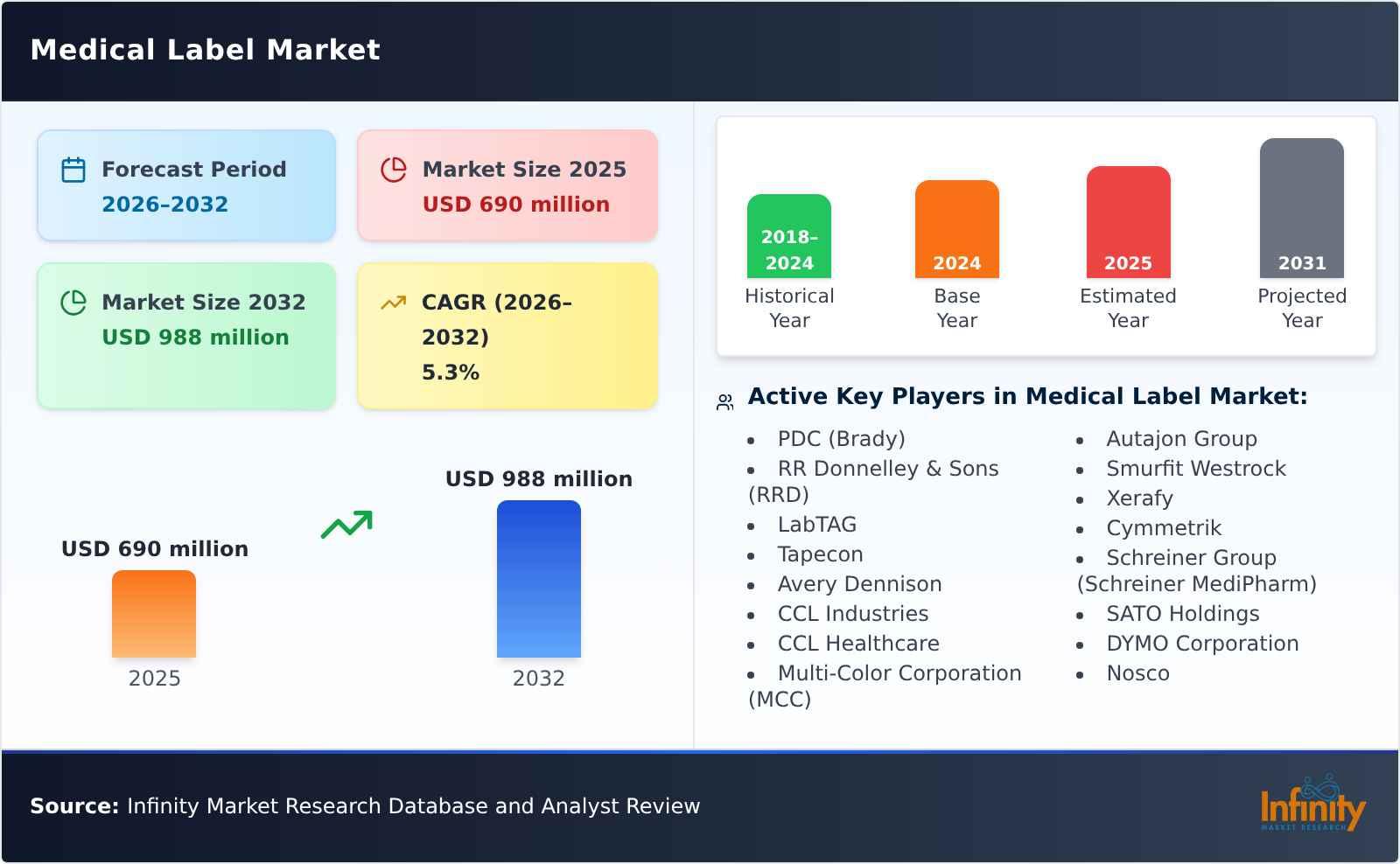
The global Medical Label market size is predicted to grow from US$ 690 million in 2025 to US$ 988 million in 2032; it is expected to grow at a CAGR of 5.3% from 2026 to 2032.
Explore this report in detail? Download a free sample copy
Download Free Sample Report
A Medical Label is a purpose-built identification and information carrier used in healthcare to ensure correct patient/sample/medication/device matching, regulatory compliance, and end-to-end traceability across clinical and supply-chain workflows. It addresses high-stakes problems such as mislabeling, specimen mix-ups, medication and device errors, and missing documentation by providing durable, machine-readable (and often human-readable) data that remains legible and securely attached under harsh conditionsdisinfectant wiping, moisture, abrasion, autoclave/sterilization processes, and cryogenic storage. Historically, medical labeling evolved from handwritten tags and stamps to pre-printed labels as hospitals and pharmaceutical manufacturing scaled; it then adopted barcode standards once retail/logistics barcoding matured, followed by variable-data printing and specialized constructions (chemical-resistant films, low-migration inks, sterilization-tolerant adhesives) to meet clinical realities. Over the past two decades, regulatory programs (e.g., UDI and drug serialization/track-and-trace) and digitization (HIS/LIS/ERP integration) have pushed medical labels into a compliance + data + materials engineering discipline, accelerating adoption of tamper-evident, security, and smart labels such as RFID/NFC and anti-counterfeit features. Upstream supply typically includes facestocks (medical-grade papers, PP/PET/PE films, synthetic paper, specialty substrates for low/high temperatures and chemical exposure), pressure-sensitive adhesives (low-extractable, low-migration formulations; removable or permanent; solvent/cryogenic/sterilization resistant), release liners, inks and coatings (low-migration ink systems, protective varnishes, abrasion and fog resistance, antimicrobial or barrier coatings), variable-data consumables (thermal-transfer ribbons, often resin-rich for durability), and printing/identification components (printheads, sensors, barcode scan modules, and RFID inlays/antenna/chips), which together enable reliable identification, safety, and compliance at scale.In 2025, the global production capacity of medical labels reached 30 billion units, with sales volume amounting to 28.2 billion units. The average unit price was USD 0.025 per label, and corporate gross margins generally ranged between 20% and 30%.
The market today is characterized by stronger compliance pull, highly fragmented use cases, and increasing specialization across the supply chain. Organizations are treating labeling less as a commodity print purchase and more as a controlled, quality-critical element within regulated operationsprioritizing validation, auditability, and real-world durability under disinfectants, cold-chain handling, sterilization, and mechanical wear. At the same time, requirements differ widely across departments and workflows, which drives a multi-variant, frequently changing demand structure; this favors suppliers who can combine materials know-how, process validation, regulatory understanding, and tight integration with operational systems rather than simply offering low unit prices. Procurement and vendor management are increasingly shaped by continuity of supply, change control discipline, traceability practices, and consistent delivery performance across sites.
Looking forward, the direction of travel is toward tighter digital governance, selective smart-label adoption, and a dual upgrade in sustainability and compliance readiness. On the data side, label content will be managed more like a governed assetlinked to master data, version control, approvals, and exception handlingto reduce manual edits and ad-hoc revisions. On the production side, on-demand and variable-data capabilities will keep expanding, raising expectations for inspection, verification, and consistency under rapid iteration. Smart features such as RFID/NFC, tamper-evident constructions, and security/anti-counterfeit methods will spread beyond niche deployments when they demonstrably simplify workflows or reduce risk, rather than as technology for its own sake. Materials choices will also shift toward safer chemistries, lower migration/extractables, and constructions that align better with broader sustainability goals, while buyers pursue standardization and platform approaches to curb complexity.
The main accelerators are the visibility of risk and compliance costs, ongoing investment in digitized workflows, and rising expectations for supply resilience. When errors, recalls, or failed audits translate into operational disruption and reputational impact, decision-makers are more willing to invest in reliability, control, and long-term maintainability. The barriers, however, are often organizational and operational: cross-functional ownership (quality, regulatory, IT, procurement, and frontline users) can be unclear; system and device interoperability, barcode quality discipline, training burden, and behavior change can slow adoption; and upstream volatilitymaterials substitutions, component qualification cycles, and regional regulatory/language differencescomplicates standardization. Many initiatives stall where the solution is technically sound but operationally misaligned, so success tends to hinge on implementation governance: clear process redesign, validated change pathways, and sustainable ongoing management.
Infinity Market Research newest research report, the Medical Label Industry Forecast looks at past sales and reviews total world Medical Label sales in 2025, providing a comprehensive analysis by region and market sector of projected Medical Label sales for 2026 through 2032. With Medical Label sales broken down by region, market sector and sub-sector, this report provides a detailed analysis in US$ millions of the world Medical Label industry.
This Insight Report provides a comprehensive analysis of the global Medical Label landscape and highlights key trends related to product segmentation, company formation, revenue, and market share, latest development, and M&A activity. This report also analyzes the strategies of leading global companies with a focus on Medical Label portfolios and capabilities, market entry strategies, market positions, and geographic footprints, to better understand these firms unique position in an accelerating global Medical Label market.
This Insight Report evaluates the key market trends, drivers, and affecting factors shaping the global outlook for Medical Label and breaks down the forecast by Type, by Application, geography, and market size to highlight emerging pockets of opportunity. With a transparent methodology based on hundreds of bottom-up qualitative and quantitative market inputs, this study forecast offers a highly nuanced view of the current state and future trajectory in the global Medical Label.
This report presents a comprehensive overview, market shares, and growth opportunities of Medical Label market by product type, application, key manufacturers and key regions and countries.
Segmentation by Type:
Paper Label
Plastic Label
Medical Tape Label
Composite Material Label
Special Material Label
Segmentation by Technology Type:
Thermal Transfer Labels
Cryogenic Labels
Chemical-Resistant Labels
Others
Segmentation by Adhesive Type:
Permanent Adhesives
Removable Adhesives
Segmentation by Application:
Drug Management
Medical Device Management
Patient Identification
Product Identification and Tracing
Other
This report also splits the market by region:
Americas
United States
Canada
Mexico
Brazil
APAC
China
Japan
Korea
Southeast Asia
India
Australia
Europe
Germany
France
UK
Italy
Russia
Middle East & Africa
Egypt
South Africa
Israel
Turkey
GCC Countries
The below companies that are profiled have been selected based on inputs gathered from primary experts and analysing the companys coverage, product portfolio, its market penetration.
PDC (Brady)
3M
RR Donnelley & Sons (RRD)
LabTAG
Tapecon
Avery Dennison
CCL Industries
CCL Healthcare
Multi-Color Corporation (MCC)
Autajon Group
Smurfit Westrock
Xerafy
Cymmetrik
Schreiner Group (Schreiner MediPharm)
SATO Holdings
DYMO Corporation
Nosco
Resource Label Group
Royal Label
PRO-TECH Design
Imprint Enterprises
JN White
Suzhou Thunder Weiye Information Technology Co., Ltd.
Zaosin
Key Questions Addressed in this Report
What is the 10-year outlook for the global Medical Label market?
What factors are driving Medical Label market growth, globally and by region?
Which technologies are poised for the fastest growth by market and region?
How do Medical Label market opportunities vary by end market size?
How does Medical Label break out by Type, by Application?
Medical Label Market Scope
| Report Attribute | Details |
|---|---|
| Market Size (Start Year) | USD XX Million |
| Market Size (End Year) | USD XX Million |
| Compound Annual Growth Rate (CAGR) | USD XX Million |
| Forecast Period | USD XX Million |
| Base Year | USD XX Million |
| Historical Data | USD XX Million |
| Key Players | USD XX Million |
REPORT COVERAGE
Revenue forecast, Company Analysis, Industry landscape, Growth factors, and Trends
SEGMENT COVERED
By component, deployment, organization size, application, and industry.
REGIONAL SCOPE
North America, Europe, Asia Pacific, Middle East & Africa, South & Central America
COUNTRY SCOPE
Includes key countries across all major regions.
Frequently Asked Questions
1. What is the market size of Global Medical Label Market?
Answer: The global Medical Label market size is predicted to grow from US$ 690 million in 2025 to US$ 988 million in 2032; it is expected to grow at a CAGR of 5.3% from 2026 to 2032.
2. Which regions are analyzed in the Global Medical Label Market report?
Answer: The Global Medical Label Market report covers major regions such as Europe, Middle East & Africa. Each region is analyzed for trends, opportunities, and market dynamics.
3. What methodology is used for forecasting of Global Medical Label Market?
Answer: The Global Medical Label Market report uses a mix of primary research, secondary data, and expert analysis.
4. Are emerging markets analyzed separately in the Global Medical Label Market?
Answer: Yes, the Global Medical Label Market report highlights high-growth emerging regions with dedicated insights.
5. Does the report include competitive benchmarking of Global Medical Label Market?
Answer: Yes, Global Medical Label Market report compares major players based on revenue, product portfolio, and innovation.
6. Can I access country-level data within the Global Medical Label Market report?
Answer: Yes, Global Medical Label Market report includes detailed data by country for major regions.
7. Can I get customized insights or data from the Global Medical Label Market report?
Answer: Yes, we offer customization options to align with your specific business needs. You can request tailored sections or regional breakdowns.