


Global Metal Bipolar Plates for Automotive Fuel Cells Market Trends, Growth and Opportunities 2026-32
Jan 2026
Automobiles
Pages: 163
ILR2007
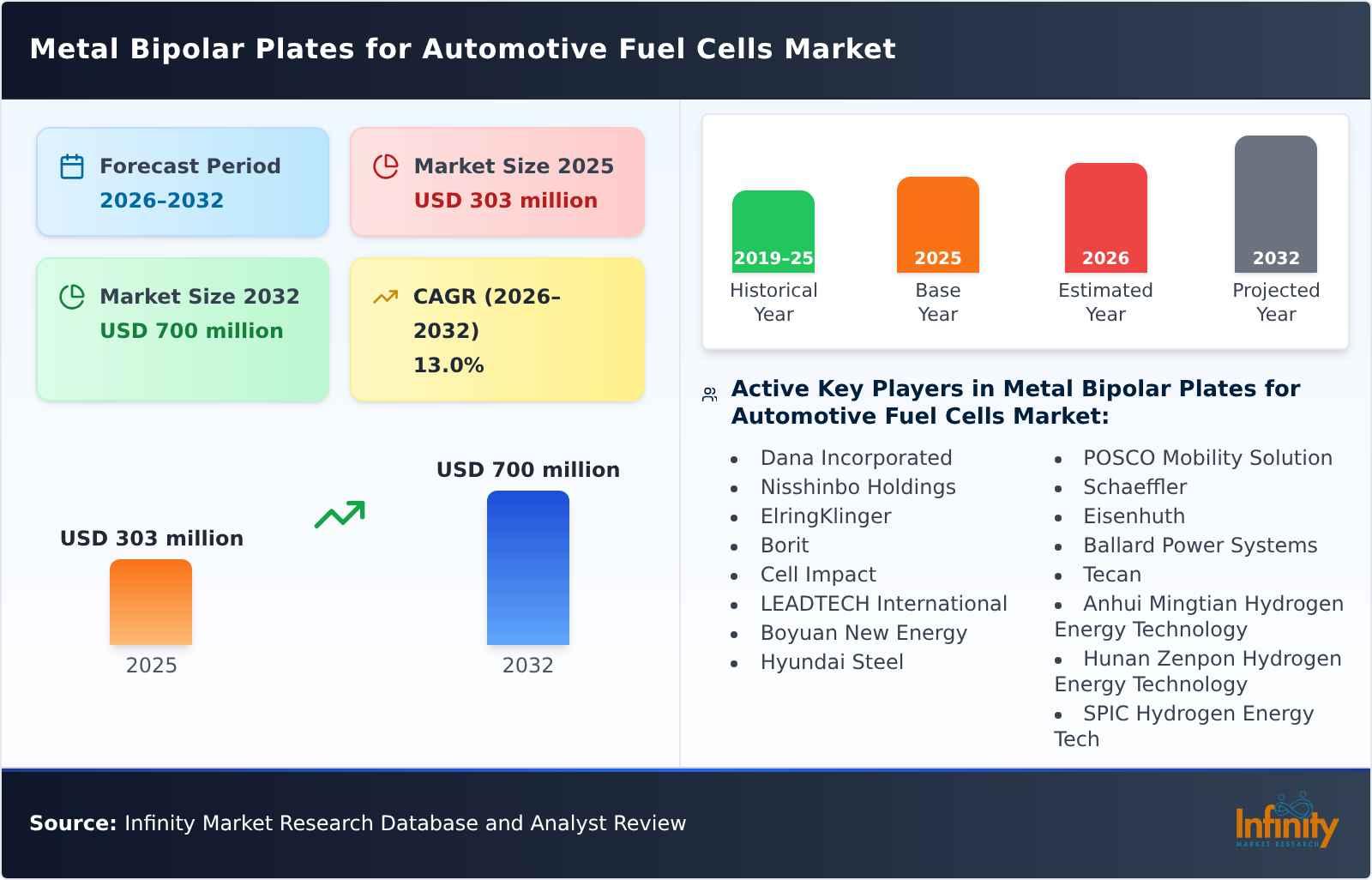
The global Metal Bipolar Plates for Automotive Fuel Cells market size is predicted to grow from US$ 303 million in 2025 to US$ 700 million in 2032; it is expected to grow at a CAGR of 13.0% from 2026 to 2032.
Explore this report in detail? Download a free sample copy
Download Free Sample Report
In 2024, global Metal Bipolar Plates for Automotive Fuel Cells production reached approximately 11,276.9 K Pcs, with an average global market price of around US$ 24.2 per Pcs.
Metal Bipolar Plates for Automotive Fuel Cells are core components of fuel cell stacks, made of lightweight, high-strength metal materials (such as aluminum, stainless steel, or titanium) through precision stamping and surface coating processes. They serve key functions including uniformly distributing hydrogen and oxygen, conducting electricity and heat, separating reaction gases to prevent leakage, and supporting the stack structure. Characterized by thin thickness, excellent conductivity, high mechanical strength, and mass-producibility, they address the limitations of traditional graphite plates (such as poor toughness and high processing costs) and are critical for enhancing the power density and reducing the overall cost of automotive fuel cell systems.
The single-line production capacity of Metal Bipolar Plates for Automotive Fuel Cells is 405 to 409 K Pcs per year, the average gross profit margin was 35.8%.
The cost structure of Metal Bipolar Plates for Automotive Fuel Cells is dominated by four core components with distinct weights: surface coating costs account for the largest share at 40%-50%, primarily covering materials (such as carbon-based composites or precious metal films) and advanced coating processes (e.g., vacuum coating), with coating costs once exceeding 70% of the total before technological optimization. Raw material costs make up 25%-30%, including high-purity metals (aluminum, stainless steel) and corrosion-resistant additives, where the selection of base metals directly impacts structural strength and durability. Production and processing costs represent 15%-20%, covering precision stamping, forming, and automated assembly, as well as energy consumption for intelligent production lines. R&D costs constitute the remaining 8%-12%, dedicated to optimizing coating durability (targeting 30,000+ hours of service life) and developing low-cost, high-efficiency manufacturing technologies to drive large-scale production.
The industry chain of Metal Bipolar Plates for Automotive Fuel Cells features three interconnected tiers: upstream includes suppliers of core raw materials (high-purity metals, coating materials like carbon-based composites or precious metals) and specialized production equipment (precision stamping machines, vacuum coating equipment, intelligent assembly lines), as well as providers of material performance testing services. Midstream involves enterprises engaged in metal plate stamping, surface coating, structural forming, and quality inspection, focusing on process control to meet strict requirements for conductivity, corrosion resistance, and gas tightness. Downstream covers fuel cell stack manufacturers, automotive OEMs (hydrogen fuel cell vehicles), hydrogen energy logistics enterprises, and after-sales service providers, with demand driven by the development of the global hydrogen energy industry and policy support for new energy vehicles.
Demand for Metal Bipolar Plates for Automotive Fuel Cells is growing rapidly driven by the global promotion of hydrogen fuel cell vehicles, the need for high-efficiency and low-cost fuel cell stacks, and policy incentives for green transportation. It addresses pain points such as the high cost and low power density of traditional fuel cell components, while technological breakthroughs in coating processes (e.g., carbon-based coatings replacing precious metals) further reduce production costs. Key business opportunities lie in developing long-life, low-resistance coating technologies, expanding application scenarios to commercial vehicles (trucks, buses) with high energy demands, and optimizing automated production lines to achieve large-scale manufacturing. Additionally, cooperating with fuel cell stack and vehicle manufacturers for customized development and leveraging domestic substitution trends in the hydrogen energy industry can tap into significant market potential amid the transition to clean energy.
Infinity Market Research newest research report, the Metal Bipolar Plates for Automotive Fuel Cells Industry Forecast looks at past sales and reviews total world Metal Bipolar Plates for Automotive Fuel Cells sales in 2025, providing a comprehensive analysis by region and market sector of projected Metal Bipolar Plates for Automotive Fuel Cells sales for 2026 through 2032. With Metal Bipolar Plates for Automotive Fuel Cells sales broken down by region, market sector and sub-sector, this report provides a detailed analysis in US$ millions of the world Metal Bipolar Plates for Automotive Fuel Cells industry.
This Insight Report provides a comprehensive analysis of the global Metal Bipolar Plates for Automotive Fuel Cells landscape and highlights key trends related to product segmentation, company formation, revenue, and market share, latest development, and M&A activity. This report also analyzes the strategies of leading global companies with a focus on Metal Bipolar Plates for Automotive Fuel Cells portfolios and capabilities, market entry strategies, market positions, and geographic footprints, to better understand these firms unique position in an accelerating global Metal Bipolar Plates for Automotive Fuel Cells market.
This Insight Report evaluates the key market trends, drivers, and affecting factors shaping the global outlook for Metal Bipolar Plates for Automotive Fuel Cells and breaks down the forecast by Material Type, by Application, geography, and market size to highlight emerging pockets of opportunity. With a transparent methodology based on hundreds of bottom-up qualitative and quantitative market inputs, this study forecast offers a highly nuanced view of the current state and future trajectory in the global Metal Bipolar Plates for Automotive Fuel Cells.
This report presents a comprehensive overview, market shares, and growth opportunities of Metal Bipolar Plates for Automotive Fuel Cells market by product type, application, key manufacturers and key regions and countries.
Segmentation by Material Type:
Stainless Steel Plates
Titanium Plates
Nickel-Based Alloy Plates
Others
Segmentation by Manufacturing Process:
Stamping Plates
Hydroforming Plates
Etching Plates
Laser Welding Plates
Segmentation by Surface Treatment:
Carbon Coated Plates
Gold-Coated Plates
Ceramic-Coated Plates
Conductive Polymer Coated Plates
Segmentation by Application:
Passenger Vehicle
Commercial Vehicle
This report also splits the market by region:
Americas
United States
Canada
Mexico
Brazil
APAC
China
Japan
Korea
Southeast Asia
India
Australia
Europe
Germany
France
UK
Italy
Russia
Middle East & Africa
Egypt
South Africa
Israel
Turkey
GCC Countries
The below companies that are profiled have been selected based on inputs gathered from primary experts and analysing the companys coverage, product portfolio, its market penetration.
Dana Incorporated
Nisshinbo Holdings
ElringKlinger
Borit
Cell Impact
LEADTECH International
Boyuan New Energy
Hyundai Steel
POSCO Mobility Solution
Schaeffler
Eisenhuth
Ballard Power Systems
Tecan
Anhui Mingtian Hydrogen Energy Technology
Hunan Zenpon Hydrogen Energy Technology
SPIC Hydrogen Energy Tech
CEMT
Sanjia Machinery (Shanghai)Co.,Ltd.
Boyuan Hydrogen Components
Filter Tech
Shanghai Yoogle Metal Technology
Shanghai Shenli Technology
Shanghai Zhizhen New Energy
Key Questions Addressed in this Report
What is the 10-year outlook for the global Metal Bipolar Plates for Automotive Fuel Cells market?
What factors are driving Metal Bipolar Plates for Automotive Fuel Cells market growth, globally and by region?
Which technologies are poised for the fastest growth by market and region?
How do Metal Bipolar Plates for Automotive Fuel Cells market opportunities vary by end market size?
How does Metal Bipolar Plates for Automotive Fuel Cells break out by Material Type, by Application?
Metal Bipolar Plates for Automotive Fuel Cells Market Scope
| Report Attribute | Details |
|---|---|
| Market Size (Start Year) | USD XX Million |
| Market Size (End Year) | USD XX Million |
| Compound Annual Growth Rate (CAGR) | USD XX Million |
| Forecast Period | USD XX Million |
| Base Year | USD XX Million |
| Historical Data | USD XX Million |
| Key Players | USD XX Million |
REPORT COVERAGE
Revenue forecast, Company Analysis, Industry landscape, Growth factors, and Trends
SEGMENT COVERED
By component, deployment, organization size, application, and industry.
REGIONAL SCOPE
North America, Europe, Asia Pacific, Middle East & Africa, South & Central America
COUNTRY SCOPE
Includes key countries across all major regions.
Frequently Asked Questions
1. What is the market size of Global Metal Bipolar Plates for Automotive Fuel Cells Market?
Answer: The global Metal Bipolar Plates for Automotive Fuel Cells market size is predicted to grow from US$ 303 million in 2025 to US$ 700 million in 2032; it is expected to grow at a CAGR of 13.0% from 2026 to 2032.
2. Which regions are analyzed in the Global Metal Bipolar Plates for Automotive Fuel Cells Market report?
Answer: The Global Metal Bipolar Plates for Automotive Fuel Cells Market report covers major regions such as Europe, Middle East & Africa. Each region is analyzed for trends, opportunities, and market dynamics.
3. What methodology is used for forecasting of Global Metal Bipolar Plates for Automotive Fuel Cells Market?
Answer: The Global Metal Bipolar Plates for Automotive Fuel Cells Market report uses a mix of primary research, secondary data, and expert analysis.
4. Are emerging markets analyzed separately in the Global Metal Bipolar Plates for Automotive Fuel Cells Market?
Answer: Yes, the Global Metal Bipolar Plates for Automotive Fuel Cells Market report highlights high-growth emerging regions with dedicated insights.
5. Does the report include competitive benchmarking of Global Metal Bipolar Plates for Automotive Fuel Cells Market?
Answer: Yes, Global Metal Bipolar Plates for Automotive Fuel Cells Market report compares major players based on revenue, product portfolio, and innovation.
6. Can I access country-level data within the Global Metal Bipolar Plates for Automotive Fuel Cells Market report?
Answer: Yes, Global Metal Bipolar Plates for Automotive Fuel Cells Market report includes detailed data by country for major regions.
7. Can I get customized insights or data from the Global Metal Bipolar Plates for Automotive Fuel Cells Market report?
Answer: Yes, we offer customization options to align with your specific business needs. You can request tailored sections or regional breakdowns.