


Global Military Aircraft Piston Engine Market Growth 2026-2032
Jan 2026
Machinery And Equipment
Pages: 95
ILR1137
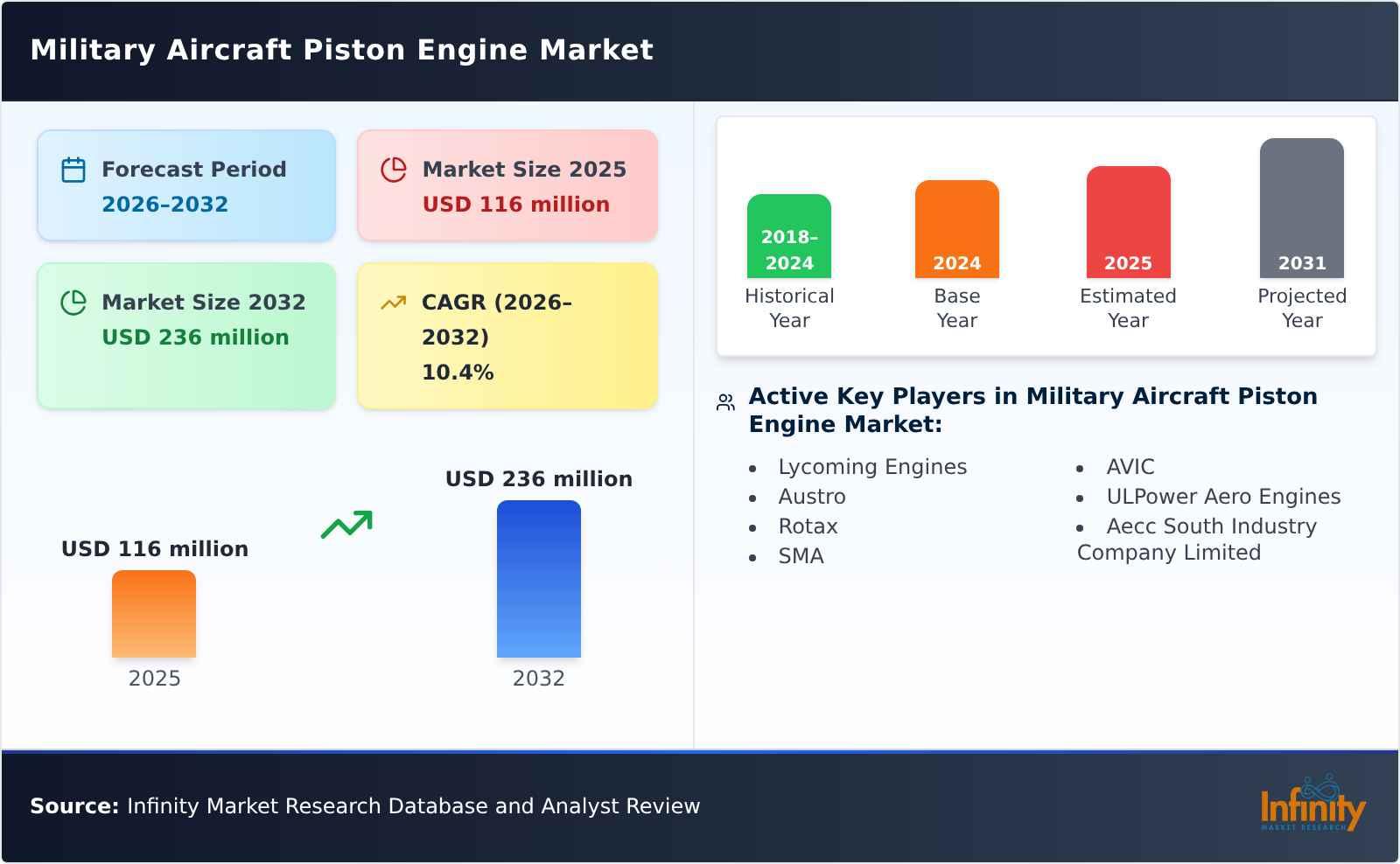
The global Military Aircraft Piston Engine market size is predicted to grow from US$ 116 million in 2025 to US$ 236 million in 2032; it is expected to grow at a CAGR of 10.4% from 2026 to 2032.
Explore this report in detail? Download a free sample copy
Download Free Sample Report
Military aircraft piston engines are, in essence, reciprocating internal-combustion engines used to drive propellers. Their technology lineage is closely aligned with general-aviation piston engines; most products are horizontally opposed, air-cooled designs fueled by gasoline or heavy fuels (Jet-A/diesel). As described in standard aerospace engineering textbooks, these engines convert the pistons reciprocating motion into crankshaft rotation to turn the propeller, and they remain one of the core powerplant types for modern low-speed aircraft operating in the low to mid altitudes. Thanks to lower cost, mature architectures, and extensive operational and maintenance know-how, they have long held a dominant position on light, low-speed aviation platforms.
From a military application perspective, piston aircraft engines are mainly found in three platform categories. First are basic/primary trainers, liaison aircraft, and border-patrol aircraftslow fixed-wing aircraft where controlling acquisition cost, fuel burn, and sustainment expense is essential to support large-scale, long-cycle flight training and routine operations. Second are various light intelligence, surveillance, and reconnaissance (ISR) / special-mission aircraft; these missions are highly sensitive to low-altitude, slow-speed loitering performance and endurance, and piston engines can deliver relatively high fuel efficiency within the relevant operating envelope. Third is the fast-growing military and quasi-military UAV/UAS segment, especially small and medium long-endurance platforms. Research notes that small UAVs widely use piston engines; their typical replacement intervals are far shorter than those of large turbine engines, but they remain highly attractive for tactical and long-endurance UAVs due to low unit cost, strong modularity, and the limited availability of turbine substitutes in the small-thrust class.
I. Overall Trend
Although military piston aircraft engines belong to a traditional propulsion family, they remain strategically relevant in training, UAV, and special-mission applications. The global market size rose from USD 54.7 million in 2020 to USD 92.5 million in 2024, and is expected to exceed USD 218 million by 2031, with future growth driven primarily by emerging markets in Asia-Pacific. As demand for small- and mid-sized military platforms expands and sensitivity to cost and maintenance increases, piston propulsion is likely to retain long-term room for deployment.
II. Regional Landscape
North America and Europe remain in the lead, supported by established technical ecosystems and supply-chain advantages, while China, India, and Southeast Asia are becoming the fastest-releasing demand regions. Chinas market shows a 20252031 CAGR of over 15%, reflecting strong momentum from domestic substitution in military UAVs and trainer aircraft. Asia-Pacific excluding China is also sustaining high growth, highlighting potential upside from regional cooperation and improving local manufacturing capabilities.
III. Technology and Product Direction
Technology evolution is concentrating on three priorities: reliability, fuel diversification, and environmental adaptability:
Promoting FADEC electronic control and heavy-fuel (Jet-A) compression-ignition powerplants
Advancing lightweight structures and high-efficiency cooling systems to improve power-to-weight performance
Exploring hybrid-electric concepts and unleaded-fuel compatibility to meet decarbonization and long-endurance mission needs
Chinese manufacturers are gradually breaking through in materials processes, control systems, and verification/testing, building a more complete capability chain from design and trials to series production.
IV. Market Structure and Competition
The global market features oligopolistic concentration, regional differentiation, and diverse sub-segments. Lycoming and Continental maintain global leadership by leveraging the general-aviation ecosystem, while AECC and several regional players in China are entering via trainer aircraft, target drones, and UAV programs, achieving civilmilitary integration breakthroughs. By 2031, international suppliers are expected to continue dominating high-end platforms, while Chinese and Indian companies are likely to form a strong competitive cohort in the mid- to low-power range.
V. Supply Chain and Policy Implications
The military piston engine value chain spans metallurgy/materials, precision machining, fuel systems, and electronic control, making supply-chain security and strategic autonomy core policy themes. Many countries are strengthening civilmilitary integration to accelerate the military adoption of civilian engine technologies. During Chinas 15th Five-Year Plan period, priorities should include:
Localization of core components: crankshafts, cylinder blocks, control systems, and other critical links
Power-system interface standards: co-developing unified interfaces with airframe OEMs
Test and certification infrastructure: building end-to-end military airworthiness verification platforms
International cooperation and export positioning: leveraging general-aviation export channels to enter developing-country markets for training and UAV applications
VI. Outlook
By 2031, global shipments of military piston engines are expected to reach over 4,300 units, with China accounting for more than 20% of the market. The industry is likely to continue evolving along a path of general-aviationmilitary convergence, light-platformunmanned expansion, and energyenvironment co-advancement. Over the next decade, piston propulsion will remain a mainstay for low-speed military aviation platforms, while also serving as an important testbed for advanced materials and intelligent control technologies.
Infinity Market Research newest research report, the Military Aircraft Piston Engine Industry Forecast looks at past sales and reviews total world Military Aircraft Piston Engine sales in 2025, providing a comprehensive analysis by region and market sector of projected Military Aircraft Piston Engine sales for 2026 through 2032. With Military Aircraft Piston Engine sales broken down by region, market sector and sub-sector, this report provides a detailed analysis in US$ millions of the world Military Aircraft Piston Engine industry.
This Insight Report provides a comprehensive analysis of the global Military Aircraft Piston Engine landscape and highlights key trends related to product segmentation, company formation, revenue, and market share, latest development, and M&A activity. This report also analyzes the strategies of leading global companies with a focus on Military Aircraft Piston Engine portfolios and capabilities, market entry strategies, market positions, and geographic footprints, to better understand these firms unique position in an accelerating global Military Aircraft Piston Engine market.
This Insight Report evaluates the key market trends, drivers, and affecting factors shaping the global outlook for Military Aircraft Piston Engine and breaks down the forecast by Type, by Application, geography, and market size to highlight emerging pockets of opportunity. With a transparent methodology based on hundreds of bottom-up qualitative and quantitative market inputs, this study forecast offers a highly nuanced view of the current state and future trajectory in the global Military Aircraft Piston Engine.
This report presents a comprehensive overview, market shares, and growth opportunities of Military Aircraft Piston Engine market by product type, application, key manufacturers and key regions and countries.
Segmentation by Type:
More than 300 Horsepower
180-300 Horsepower
Less than 180 Horsepower
Segmentation by Output Power Class:
Micro Power
Low Power
Mid Power
High Power
Segmentation by Fuel:
Gasoline
Diesel
Others
Segmentation by Application:
Training and Liaison Aircraft
Military Unmanned Aerial Vehicles (UAVs)
Light Attack/Close Range Support Aircraft
Military Helicopters and Rotary-Wing Trainer Aircraft
Experimental/Target Drones/Research and Special Platforms
This report also splits the market by region:
Americas
United States
Canada
Mexico
Brazil
APAC
China
Japan
Korea
Southeast Asia
India
Australia
Europe
Germany
France
UK
Italy
Russia
Middle East & Africa
Egypt
South Africa
Israel
Turkey
GCC Countries
The below companies that are profiled have been selected based on inputs gathered from primary experts and analysing the companys coverage, product portfolio, its market penetration.
Lycoming Engines
Austro
Rotax
SMA
AVIC
ULPower Aero Engines
Aecc South Industry Company Limited
Key Questions Addressed in this Report
What is the 10-year outlook for the global Military Aircraft Piston Engine market?
What factors are driving Military Aircraft Piston Engine market growth, globally and by region?
Which technologies are poised for the fastest growth by market and region?
How do Military Aircraft Piston Engine market opportunities vary by end market size?
How does Military Aircraft Piston Engine break out by Type, by Application?
Military Aircraft Piston Engine Market Scope
| Report Attribute | Details |
|---|---|
| Market Size (Start Year) | USD XX Million |
| Market Size (End Year) | USD XX Million |
| Compound Annual Growth Rate (CAGR) | USD XX Million |
| Forecast Period | USD XX Million |
| Base Year | USD XX Million |
| Historical Data | USD XX Million |
| Key Players | USD XX Million |
REPORT COVERAGE
Revenue forecast, Company Analysis, Industry landscape, Growth factors, and Trends
SEGMENT COVERED
By component, deployment, organization size, application, and industry.
REGIONAL SCOPE
North America, Europe, Asia Pacific, Middle East & Africa, South & Central America
COUNTRY SCOPE
Includes key countries across all major regions.
Frequently Asked Questions
1. What is the market size of Global Military Aircraft Piston Engine Market?
Answer: The global Military Aircraft Piston Engine market size is predicted to grow from US$ 116 million in 2025 to US$ 236 million in 2032; it is expected to grow at a CAGR of 10.4% from 2026 to 2032.
2. Which regions are analyzed in the Global Military Aircraft Piston Engine Market report?
Answer: The Global Military Aircraft Piston Engine Market report covers major regions such as North America, Europe, Asia-Pacific, Middle East & Africa. Each region is analyzed for trends, opportunities, and market dynamics.
3. What methodology is used for forecasting of Global Military Aircraft Piston Engine Market?
Answer: The Global Military Aircraft Piston Engine Market report uses a mix of primary research, secondary data, and expert analysis.
4. Are emerging markets analyzed separately in the Global Military Aircraft Piston Engine Market?
Answer: Yes, the Global Military Aircraft Piston Engine Market report highlights high-growth emerging regions with dedicated insights.
5. Does the report include competitive benchmarking of Global Military Aircraft Piston Engine Market?
Answer: Yes, Global Military Aircraft Piston Engine Market report compares major players based on revenue, product portfolio, and innovation.
6. Can I access country-level data within the Global Military Aircraft Piston Engine Market report?
Answer: Yes, Global Military Aircraft Piston Engine Market report includes detailed data by country for major regions.
7. Can I get customized insights or data from the Global Military Aircraft Piston Engine Market report?
Answer: Yes, we offer customization options to align with your specific business needs. You can request tailored sections or regional breakdowns.