


🔐 Secure Payment Guaranteed
Safe checkout with trusted global payment methods.
🌟 Why Choose Infinity Market Research?
At Infinity Market Research, we dont just deliver data — we deliver clarity, confidence, and competitive edge.
In a world driven by insights, we help businesses unlock the infinite potential of informed decisions.
Here why global brands, startups, and decision-makers choose us:
Industry-Centric Expertise
With deep domain knowledge across sectors — from healthcare and technology to manufacturing and consumer goods — our team delivers insights that matter.
Custom Research, Not Cookie-Cutter Reports
Every business is unique, and so are its challenges. Thats why we tailor our research to your specific goals, offering solutions that are actionable, relevant, and reliable.
Data You Can Trust
Our research methodology is rigorous, transparent, and validated at every step. We believe in delivering not just numbers, but numbers that drive real impact.
Client-Centric Approach
Your success is our priority. From first contact to final delivery, our team is responsive, collaborative, and committed to your goals — because you re more than a client; you re a partner.
Recent Reports
Diaphragm Pressure Sensor Market
Wideband Sensor Market

Global Mobile Phone Mobile Broadband Modem Market Size, Share and Analysis Report 2026-2032
Apr 2026
Semiconductor and Electronics
Pages: 88
ILR4897
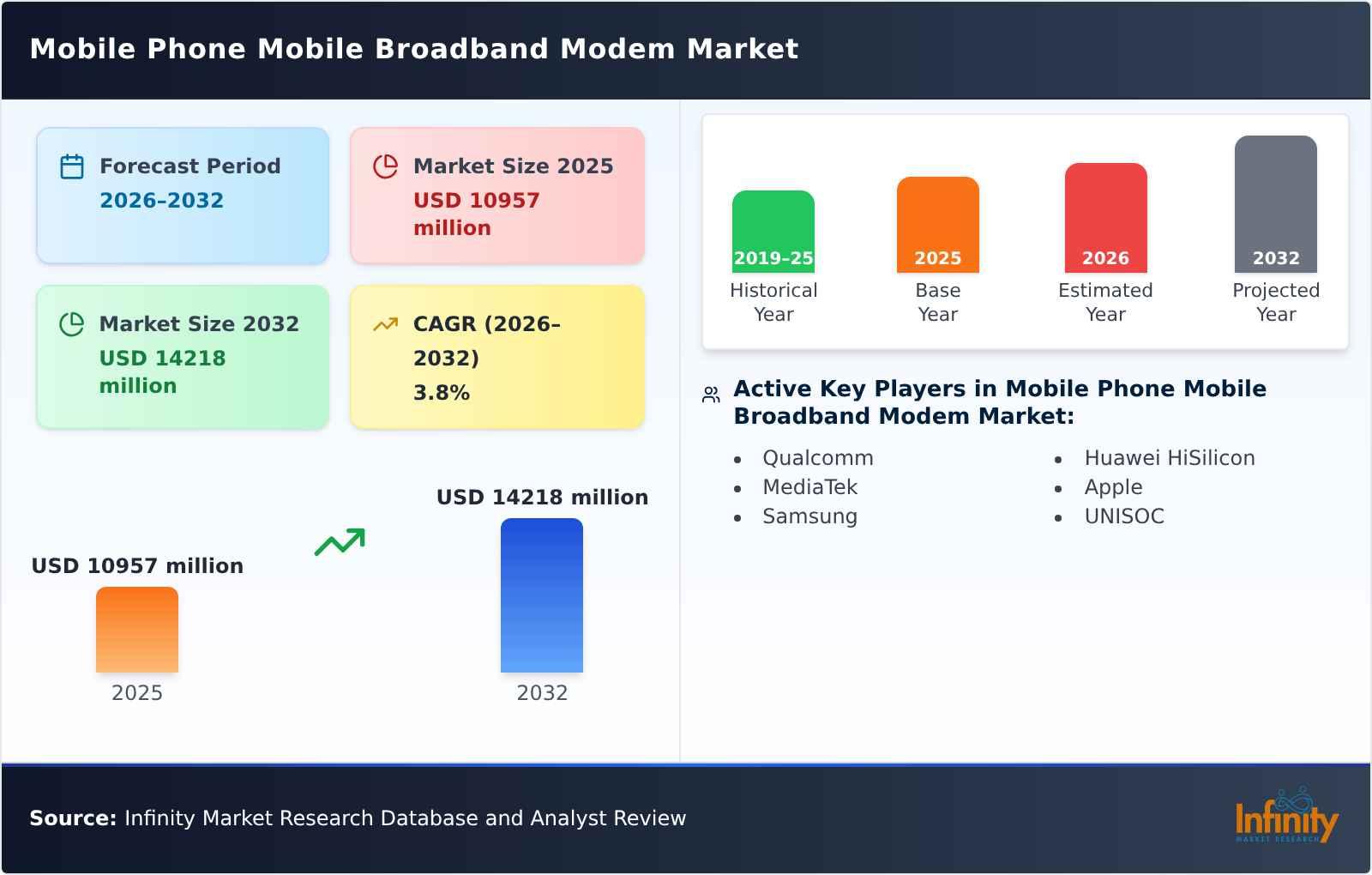
The global Mobile Phone Mobile Broadband Modem market size is predicted to grow from US$ 10957 million in 2025 to US$ 14218 million in 2032; it is expected to grow at a CAGR of 3.8% from 2026 to 2032.
Explore this report in detail? Download a free sample copy
Download Free Sample Report
A Mobile Phone Mobile Broadband Modem?commonly referred to in the handset industry as a cellular baseband/modem?is the subsystem that enables a smartphone to attach to a carrier?s cellular network and sustain data and voice services while the user moves across cells and radio conditions. It solves the fundamental problem of ?reliable wide-area connectivity on the move? by converting between digital data and radio waveforms and by implementing the cellular protocol stack end-to-end (registration, authentication, scheduling, handover, power control, and data bearers), ensuring session continuity and acceptable throughput/latency under fluctuating signal quality and network load. Historically, handset modems evolved from relatively discrete 2G/3G baseband chips paired with separate RF transceivers into higher-integration 4G designs that improved multi-band/multi-mode support and power efficiency; with 5G, modems added wider bandwidths, more complex carrier aggregation and MIMO, lower latency targets, and broader frequency coverage, leading to two dominant product architectures: standalone modems that can iterate radio generations rapidly, and tightly integrated SoCs where the modem is embedded to optimize system power, cost, and thermal behavior. Upstream supply spans both materials and electronic component ecosystems: on the materials side, it includes high-purity silicon and process consumables (photoresists, specialty gases, wet chemicals), interconnect metals, and packaging materials such as substrates, resins, solder balls, and thermal interface/heat-spreading materials; on the component side, it includes modem silicon/IP development (DSP and protocol-stack IP), advanced wafer fabrication capacity, assembly/test services, companion components like memory and power management, and RF front-end building blocks (filters, power amplifiers, LNAs, switches/tuners, and antenna matching networks) that are often combined into modules?together forming the upstream foundation required to deliver robust mobile broadband connectivity in modern smartphones.In 2025, global production capacity of mobile broadband modems for smartphones reached 1.5 billion units, while shipments totaled 1.241 billion units. The average selling price (ASP) was USD 9.02 per unit, and gross margins across manufacturers ranged between 50% and 70%.
The market today is characterized by deeper integration, clearer segmentation, and a longer end-to-end value chain. Mainstream devices increasingly rely on modem capabilities embedded tightly within application SoCs to optimize power, cost, and system coordination, while standalone modems remain concentrated in select form factors and fast-iteration tiers. Competitive differentiation has shifted beyond headline throughput toward holistic experience: coverage across fragmented bands and modes, robustness in weak and congested networks, uplink consistency, voice/data coexistence, location and emergency features, and the quality of tuning across RF front-end, antennas, OS networking stack, and carrier parameters. As RF and antenna complexity rises, the modem becomes less a discrete component and more a platform engineering program, where validation breadth, time-to-market discipline, yield and supply stability, and region/carrier readiness can be decisive. The ecosystem layer?patent licensing, regulatory compliance, and carrier acceptance?continues to shape who can compete and how quickly, making pure ?spec wins? insufficient to change the landscape.
Looking forward, the trajectory centers on smarter connectivity, more controllable energy use, and tighter system-level orchestration. Instead of only scaling bandwidth and antenna counts, more intelligence will be applied to connection policy?network and band selection, congestion handling, weak-signal scheduling, and application-aware quality-of-service balanced against power and thermal constraints?so that user-perceived stability and latency consistency improve in real mobility. Connectivity will also converge with adjacent capabilities such as positioning, satellite fallback, multi-device continuity, and coordinated operation across handset, wearables, and vehicles, encouraging unified management across cellular and short-range radios at a higher software layer. Manufacturing advances will continue, but practical advantage will increasingly come from RF/antenna co-design, thermal management, and ?industrializing? adaptation work?standardized validation frameworks, better observability and test automation, and reusable carrier-readiness tooling that compresses integration cycles and reduces surprise failures in late stages.
Drivers and constraints are tightly intertwined. Demand-side momentum comes from sustained expectations of reliable coverage and battery life, real application needs for lower latency and stronger uplink, and ongoing network evolution that creates incentives to upgrade devices and capabilities. On the supply side, device makers pursue differentiation and risk reduction through deeper vertical integration and multi-sourcing strategies, which reshapes partnerships and investment. Counterbalancing forces are significant: licensing and IP structures raise entry barriers and complicate economics; regulatory and carrier certification across regions expands engineering workload and elongates schedules; and the rising complexity of RF front-end components and antenna systems means end-device experience can lag behind silicon specs without extensive tuning and tight quality control in mass production. Geopolitical uncertainty and supply chain volatility add further risk around advanced process access, capacity, and critical materials. As a result, the market increasingly rewards players who can deliver repeatable, end-to-end engineering and ecosystem execution?not only strong silicon performance in isolation.
Infinity Market Research newest research report, the ?Mobile Phone Mobile Broadband Modem Industry Forecast? looks at past sales and reviews total world Mobile Phone Mobile Broadband Modem sales in 2025, providing a comprehensive analysis by region and market sector of projected Mobile Phone Mobile Broadband Modem sales for 2026 through 2032. With Mobile Phone Mobile Broadband Modem sales broken down by region, market sector and sub-sector, this report provides a detailed analysis in US$ millions of the world Mobile Phone Mobile Broadband Modem industry.
This Insight Report provides a comprehensive analysis of the global Mobile Phone Mobile Broadband Modem landscape and highlights key trends related to product segmentation, company formation, revenue, and market share, latest development, and M&A activity. This report also analyzes the strategies of leading global companies with a focus on Mobile Phone Mobile Broadband Modem portfolios and capabilities, market entry strategies, market positions, and geographic footprints, to better understand these firms? unique position in an accelerating global Mobile Phone Mobile Broadband Modem market.
This Insight Report evaluates the key market trends, drivers, and affecting factors shaping the global outlook for Mobile Phone Mobile Broadband Modem and breaks down the forecast by Type, by Application, geography, and market size to highlight emerging pockets of opportunity. With a transparent methodology based on hundreds of bottom-up qualitative and quantitative market inputs, this study forecast offers a highly nuanced view of the current state and future trajectory in the global Mobile Phone Mobile Broadband Modem.
This report presents a comprehensive overview, market shares, and growth opportunities of Mobile Phone Mobile Broadband Modem market by product type, application, key manufacturers and key regions and countries.
Segmentation by Type:
4G LTE Modem
5G NR Sub-6 Modem
5G NR mmWave Modem
Segmentation by Modem Architecture:
Discrete Modem
SoC-Integrated Modem
Segmentation by Performance:
Entry-Level
Mainstream
Flagship-Level
Segmentation by Application:
IOS System Mobile Phone
Android Mobile Phone
HarmonyOS Mobile Phone
Others
This report also splits the market by region:
Americas
United States
Canada
Mexico
Brazil
APAC
China
Japan
Korea
Southeast Asia
India
Australia
Europe
Germany
France
UK
Italy
Russia
Middle East & Africa
Egypt
South Africa
Israel
Turkey
GCC Countries
The below companies that are profiled have been selected based on inputs gathered from primary experts and analysing the companys coverage, product portfolio, its market penetration.
Qualcomm
MediaTek
Samsung
Huawei HiSilicon
Apple
UNISOC
Key Questions Addressed in this Report
What is the 10-year outlook for the global Mobile Phone Mobile Broadband Modem market?
What factors are driving Mobile Phone Mobile Broadband Modem market growth, globally and by region?
Which technologies are poised for the fastest growth by market and region?
How do Mobile Phone Mobile Broadband Modem market opportunities vary by end market size?
How does Mobile Phone Mobile Broadband Modem break out by Type, by Application?
Mobile Phone Mobile Broadband Modem Market Scope
| Report Attribute | Details |
|---|---|
| Market Size (Start Year) | USD XX Million |
| Market Size (End Year) | USD XX Million |
| Compound Annual Growth Rate (CAGR) | USD XX Million |
| Forecast Period | USD XX Million |
| Base Year | USD XX Million |
| Historical Data | USD XX Million |
| Key Players | USD XX Million |
REPORT COVERAGE
Revenue forecast, Company Analysis, Industry landscape, Growth factors, and Trends
SEGMENT COVERED
By component, deployment, organization size, application, and industry.
REGIONAL SCOPE
North America, Europe, Asia Pacific, Middle East & Africa, South & Central America
COUNTRY SCOPE
Includes key countries across all major regions.
📘 Frequently Asked Questions
1. What is the market size of Global Mobile Phone Mobile Broadband Modem Market?
Answer: The global Mobile Phone Mobile Broadband Modem market size is predicted to grow from US$ 10957 million in 2025 to US$ 14218 million in 2032; it is expected to grow at a CAGR of 3.8% from 2026 to 2032.
2. Which regions are analyzed in the Global Mobile Phone Mobile Broadband Modem Market report?
Answer: The Global Mobile Phone Mobile Broadband Modem Market report covers major regions such as Europe, Middle East & Africa. Each region is analyzed for trends, opportunities, and market dynamics.
3. What methodology is used for forecasting of Global Mobile Phone Mobile Broadband Modem Market?
Answer: The Global Mobile Phone Mobile Broadband Modem Market report uses a mix of primary research, secondary data, and expert analysis to build its forecasts. Models include both qualitative and quantitative approaches.
4. Are emerging markets analyzed separately in the Global Mobile Phone Mobile Broadband Modem Market?
Answer: Yes, the Global Mobile Phone Mobile Broadband Modem Market report highlights high-growth emerging regions with dedicated insights. These include untapped opportunities, risks, and potential for expansion.
5. Does the report include competitive benchmarking of Global Mobile Phone Mobile Broadband Modem Market?
Answer: Yes, Global Mobile Phone Mobile Broadband Modem Market report compares major players based on revenue, product portfolio, innovation, and regional presence. This helps assess competitive positioning.
6. Can I access country-level data within the Global Mobile Phone Mobile Broadband Modem Market report?
Answer: Yes, Global Mobile Phone Mobile Broadband Modem Market report includes detailed data by country, especially for key markets. This allows for localized insights and decision-making.
7. Can I get customized insights or data from the Global Mobile Phone Mobile Broadband Modem Market report?
Answer: Yes, we offer customization options to align with your specific business needs. You can request tailored sections or regional breakdowns.

🔐 Secure Payment Guaranteed
Safe checkout with trusted global payment methods.
🌟 Why Choose Infinity Market Research?
At Infinity Market Research, we dont just deliver data — we deliver clarity, confidence, and competitive edge.
In a world driven by insights, we help businesses unlock the infinite potential of informed decisions.
Here why global brands, startups, and decision-makers choose us:
Industry-Centric Expertise
With deep domain knowledge across sectors — from healthcare and technology to manufacturing and consumer goods — our team delivers insights that matter.
Custom Research, Not Cookie-Cutter Reports
Every business is unique, and so are its challenges. Thats why we tailor our research to your specific goals, offering solutions that are actionable, relevant, and reliable.
Data You Can Trust
Our research methodology is rigorous, transparent, and validated at every step. We believe in delivering not just numbers, but numbers that drive real impact.
Client-Centric Approach
Your success is our priority. From first contact to final delivery, our team is responsive, collaborative, and committed to your goals — because you re more than a client; you re a partner.