


Global Nerve Capping Device Market Size, Share and Analysis Report 2026-2032
Mar 2026
Healthcare
Pages: 86
ILR4693
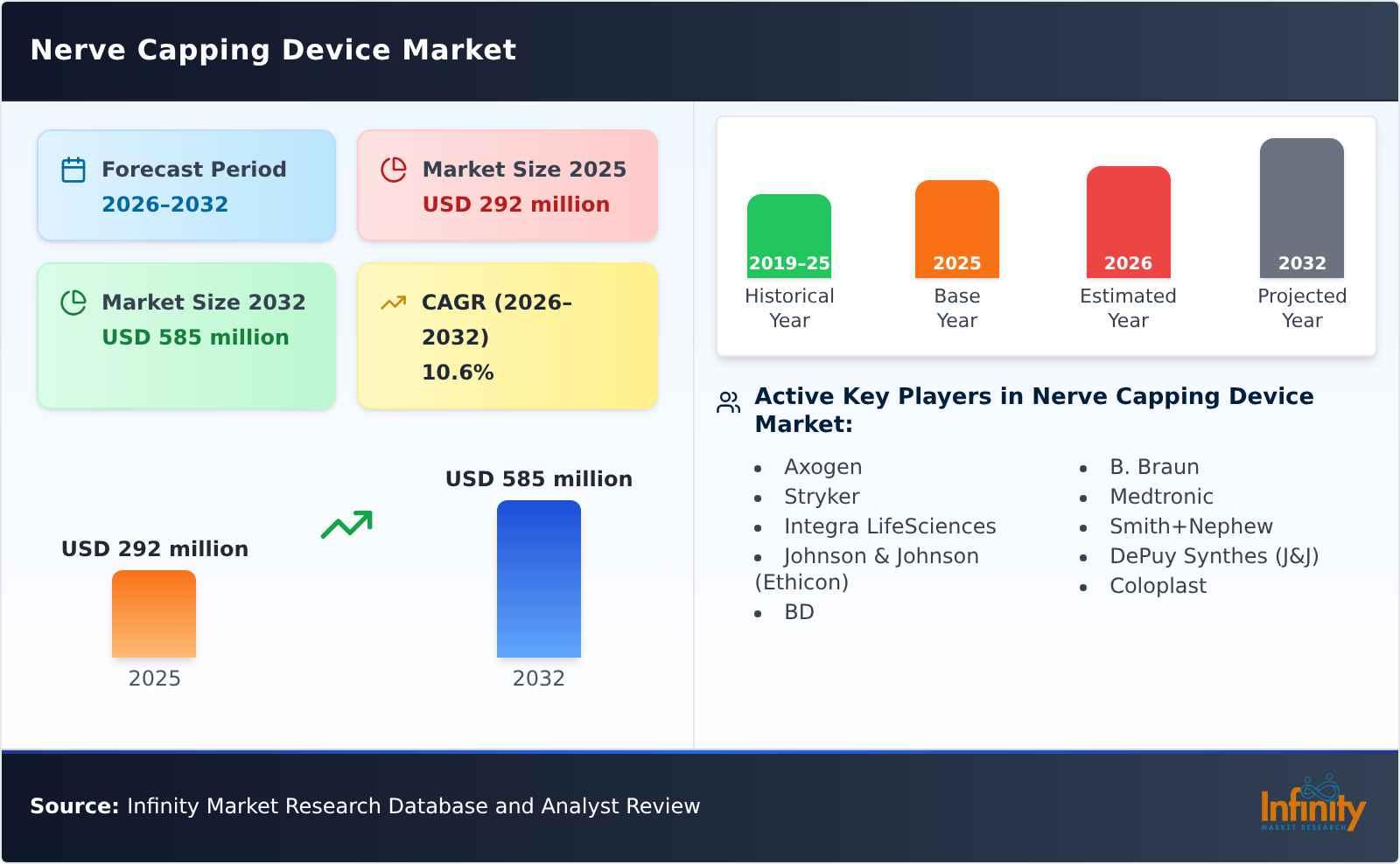
The global Nerve Capping Device market size is predicted to grow from US$ 292 million in 2025 to US$ 585 million in 2032; it is expected to grow at a CAGR of 10.6% from 2026 to 2032.
Explore this report in detail? Download a free sample copy
Download Free Sample Report
A Nerve Capping Device is an implantable device used in open or minimally invasive procedures to manage the distal end of a transected or injured peripheral nerve. Its primary purpose is to create a protective interface through physical isolation and microenvironment control, reducing the risk of painful neuroma formation and ectopic firing, while providing a controlled endpoint for nerve regeneration. Typically designed as a cap-like sleeve that covers and seals the nerve stump, the device may be made of bioresorbable materials or long-term implant polymers. The lumen geometry can be tailored to the epineurial/perineurial anatomy, and advanced designs may integrate guidance structures, anti-adhesion barriers, or drug-release functions to minimize traction and scar tethering, inhibit fibrotic ingrowth, and improve postoperative pain and sensory outcomes in amputations, trauma repair, tumor resections, and post-neurolysis settings. Its value is not merely ?blocking? but converting disorganized sprouting into a manageable healing process.In 2025, global Nerve Capping Device production reached approximately 2.99 million units and price is about 100 USD/Unit.The average gross profit margin of this product is 55%.
Chronic pain management after peripheral nerve injury and amputation is shifting from symptomatic relief and secondary interventions toward intraoperative prevention and structured nerve-end management, creating a clearer adoption pathway for nerve capping devices. Rising volumes of trauma, oncologic resections, and orthopedic/reconstructive procedures make nerve stump handling a critical determinant of long-term quality of life. As pain medicine converges with functional reconstruction, surgeons increasingly adopt standardized, first-pass solutions to lower the risk of neuroma, residual limb pain, and phantom pain. Compared with more complex nerve relocation or reinnervation approaches, nerve caps offer intuitive handling, compatibility with existing workflows, and scalability. For manufacturers, they can be positioned as part of a broader peripheral nerve repair portfolio?bundled with conduits, wraps, anti-adhesion materials, and rehabilitation pathways?evolving from a single implant into an integrated solution.The central hurdles are clinical evidence strength and indication boundaries. Variations in nerve caliber, stump tension, defect context, inflammation, and scar environment can cause outcome variability; inconsistent patient selection and surgical technique may slow adoption and erode confidence. Material and structural design must balance conformability, secure fixation, anti-adhesion performance, and controlled bioresorption or long-term stability. Complications such as migration, compression, chronic inflammation, or irritating degradation byproducts can lead to revision surgery. Regulatory and reimbursement factors also shape penetration: as implantable devices, nerve caps require stringent quality systems, sterility assurance, lot consistency, and long-term follow-up. Without clear health-economic rationale and standardized training, hospitals may default to traditional suturing, burying techniques, or pharmacologic pain pathways.
Demand is trending toward ?prevention-first, standardization-centric, and combination-therapy shaped? solutions. In amputation and high-risk trauma, teams increasingly prioritize reproducible stump management, making nerve caps an easy-to-standardize step within surgical pathways. In hand and reconstructive surgery, clinicians focus on how dysesthesia, tenderness, and scar tethering affect functional rehabilitation?driving designs that are thinner, more compliant, and more anti-adhesive. Use in combination with conduits, nerve wraps, and local anti-inflammatory/analgesic release strategies is rising, forming a closed loop around neuroma reduction, pain improvement, and rehab adherence. Teaching hospitals and trauma centers also demand visual training, procedural guidelines, and follow-up tools, pushing suppliers to deliver system-level support beyond the implant itself.Upstream materials generally follow two routes: bioresorbable and non-bioresorbable. Bioresorbables often include collagen, gelatin/chitosan, and degradable polymers such as PLGA/PCL/PLA or composites, prioritizing tunable degradation, biocompatibility, and low inflammatory response. Non-bioresorbables commonly include silicone elastomers, ePTFE, and polyurethane, emphasizing shape retention and long-term barrier function. Structurally, key differentiators include lumen geometry and surface microfeatures (to limit fibrotic ingrowth and reduce friction/adhesion), fixation strategies (suture features, rings, textured surfaces), and compliance matching to epineurial/perineurial anatomy. Manufacturing focuses on micro-molding/extrusion, surface modification, sterile packaging, and consistency testing. Supply-chain competition will center on material purity and traceability, batch stability of degradation and mechanical parameters, and scalable product families that fit a wide range of nerve sizes.
Infinity Market Research newest research report, the ?Nerve Capping Device Industry Forecast? looks at past sales and reviews total world Nerve Capping Device sales in 2025, providing a comprehensive analysis by region and market sector of projected Nerve Capping Device sales for 2026 through 2032. With Nerve Capping Device sales broken down by region, market sector and sub-sector, this report provides a detailed analysis in US$ millions of the world Nerve Capping Device industry.
This Insight Report provides a comprehensive analysis of the global Nerve Capping Device landscape and highlights key trends related to product segmentation, company formation, revenue, and market share, latest development, and M&A activity. This report also analyzes the strategies of leading global companies with a focus on Nerve Capping Device portfolios and capabilities, market entry strategies, market positions, and geographic footprints, to better understand these firms? unique position in an accelerating global Nerve Capping Device market.
This Insight Report evaluates the key market trends, drivers, and affecting factors shaping the global outlook for Nerve Capping Device and breaks down the forecast by Type, by Application, geography, and market size to highlight emerging pockets of opportunity. With a transparent methodology based on hundreds of bottom-up qualitative and quantitative market inputs, this study forecast offers a highly nuanced view of the current state and future trajectory in the global Nerve Capping Device.
This report presents a comprehensive overview, market shares, and growth opportunities of Nerve Capping Device market by product type, application, key manufacturers and key regions and countries.
Segmentation by Type:
Bioabsorbable Polymers
Biologic/Collagen-Based
Silicone/Non-absorbable
Other Materials
Segmentation by Surgical Specialty:
Orthopedics/Trauma
Plastic/Reconstructive
Vascular & Amputation Care
Other
Segmentation by Device Architecture:
Closed-End Ca
Semi-Closed / Restricted Outlet
Sleeve Cap
Other
Segmentation by Application:
Hospitals
Ambulatory Surgery Centers
Other
This report also splits the market by region:
Americas
United States
Canada
Mexico
Brazil
APAC
China
Japan
Korea
Southeast Asia
India
Australia
Europe
Germany
France
UK
Italy
Russia
Middle East & Africa
Egypt
South Africa
Israel
Turkey
GCC Countries
The below companies that are profiled have been selected based on inputs gathered from primary experts and analysing the companys coverage, product portfolio, its market penetration.
Axogen
Stryker
Integra LifeSciences
Johnson & Johnson (Ethicon)
BD
B. Braun
Medtronic
Smith+Nephew
DePuy Synthes (J&J)
Coloplast
Key Questions Addressed in this Report
What is the 10-year outlook for the global Nerve Capping Device market?
What factors are driving Nerve Capping Device market growth, globally and by region?
Which technologies are poised for the fastest growth by market and region?
How do Nerve Capping Device market opportunities vary by end market size?
How does Nerve Capping Device break out by Type, by Application?
Nerve Capping Device Market Scope
| Report Attribute | Details |
|---|---|
| Market Size (Start Year) | USD XX Million |
| Market Size (End Year) | USD XX Million |
| Compound Annual Growth Rate (CAGR) | USD XX Million |
| Forecast Period | USD XX Million |
| Base Year | USD XX Million |
| Historical Data | USD XX Million |
| Key Players | USD XX Million |
REPORT COVERAGE
Revenue forecast, Company Analysis, Industry landscape, Growth factors, and Trends
SEGMENT COVERED
By component, deployment, organization size, application, and industry.
REGIONAL SCOPE
North America, Europe, Asia Pacific, Middle East & Africa, South & Central America
COUNTRY SCOPE
Includes key countries across all major regions.
Frequently Asked Questions
1. What is the market size of Global Nerve Capping Device Market?
Answer: The global Nerve Capping Device market size is predicted to grow from US$ 292 million in 2025 to US$ 585 million in 2032; it is expected to grow at a CAGR of 10.6% from 2026 to 2032.
2. Which regions are analyzed in the Global Nerve Capping Device Market report?
Answer: The Global Nerve Capping Device Market report covers major regions such as Europe, Middle East & Africa. Each region is analyzed for trends, opportunities, and market dynamics.
3. What methodology is used for forecasting of Global Nerve Capping Device Market?
Answer: The Global Nerve Capping Device Market report uses a mix of primary research, secondary data, and expert analysis.
4. Are emerging markets analyzed separately in the Global Nerve Capping Device Market?
Answer: Yes, the Global Nerve Capping Device Market report highlights high-growth emerging regions with dedicated insights.
5. Does the report include competitive benchmarking of Global Nerve Capping Device Market?
Answer: Yes, Global Nerve Capping Device Market report compares major players based on revenue, product portfolio, and innovation.
6. Can I access country-level data within the Global Nerve Capping Device Market report?
Answer: Yes, Global Nerve Capping Device Market report includes detailed data by country for major regions.
7. Can I get customized insights or data from the Global Nerve Capping Device Market report?
Answer: Yes, we offer customization options to align with your specific business needs. You can request tailored sections or regional breakdowns.