


Global Nuclear Power Radiation Resistant Maintenance Robot Market Growth 2026-2032
Jan 2026
Machinery And Equipment
Pages: 109
ILR1489
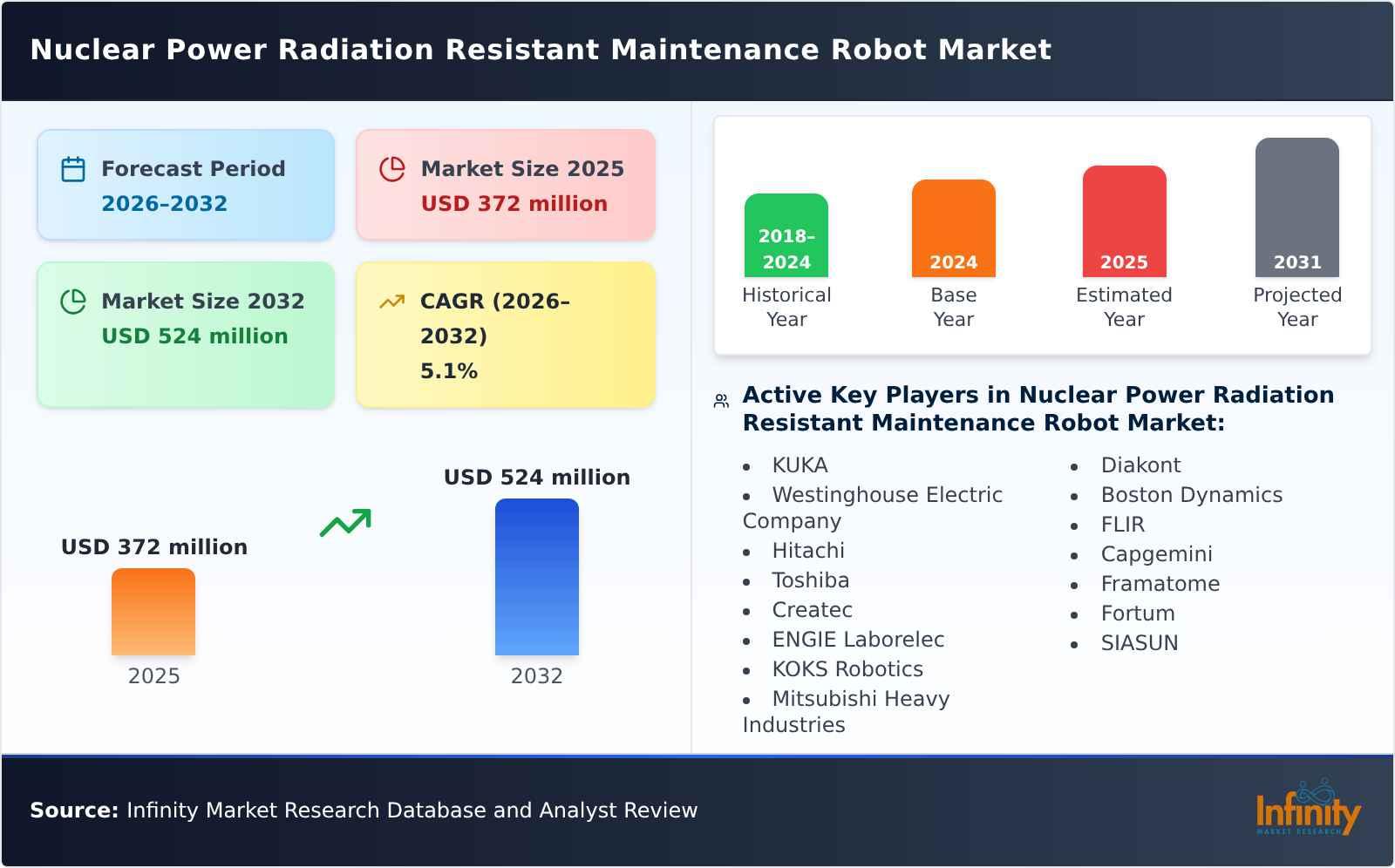
The global Nuclear Power Radiation Resistant Maintenance Robot market size is predicted to grow from US$ 372 million in 2025 to US$ 524 million in 2032; it is expected to grow at a CAGR of 5.1% from 2026 to 2032.
Explore this report in detail? Download a free sample copy
Download Free Sample Report
In 2025, global Nuclear Power Radiation Resistant Maintenance Robot production reached approximately 95 Units .The global price range for Nuclear Power Radiation Resistant Maintenance Robots varies significantly depending on the complexity of their tasks and the degree of customization. Basic inspection or standard underwater robots typically cost between $800,000 and $2 million. Complex systems equipped with heavy-duty robotic arms, high-precision sensors, and strong autonomous operation capabilities can cost between $3 million and $8 million.
The Nuclear Power Radiation Resistant Maintenance Robot is a specialized intelligent piece of equipment designed specifically for the high-radiation environment of nuclear power plants. It integrates radiation-hardened hardware, sensors, and mechanical systems, enabling it to perform remote monitoring, equipment inspection, maintenance operations, and emergency response in areas inaccessible to personnel, such as reactor buildings and spent fuel pools. Its core function is to replace or assist manual labor, significantly reducing radiation risks and improving the safety and efficiency of nuclear power plant operation and maintenance. These robots typically possess strong environmental adaptability, high reliability, and precise operational capabilities, making them a key technological means to ensure the long-term safe operation of nuclear power plants, extend their lifespan, and respond to potential accidents.
The global supply chain structure for Nuclear Power Radiation Resistant Maintenance Robots is expected to be clear by 2025. The upstream sector is dominated by highly specialized suppliers of key materials and core components, primarily including radiation-hardened semiconductors (such as FPGAs and image sensors), special shielding and structural materials (such as lead-based composites and boron polyethylene), high-precision harmonic reducers and servo motors, as well as radiation-resistant cameras and robotic arms. This field has extremely high technological barriers and is mainly monopolized by a few leading companies in the United States, Japan, and Germany. Downstream application customers are highly concentrated, primarily consisting of nuclear power operators in various countries (such as EDF, CGN, and Exelon), while also serving government nuclear decommissioning management agencies, nuclear accident emergency response departments, and major international research projects (such as ITER). The supply chain is characterized by a highly concentrated upstream sector and rigid downstream demand with a concentrated customer base.
The cost of the Nuclear Power Radiation Resistant Maintenance Robot primarily consists of specialized hardware and highly customized development. Core components such as radiation-resistant chips, sensors, shielding materials, and precision robotic arms account for over 50% of the total cost. Due to its extremely high technological barriers, specialized requirements, and small order volume, the industrys gross profit margin is significantly higher than that of ordinary robots, reaching 50%-70%. Profits mainly stem from high technology premiums, stringent nuclear-grade certifications, and full lifecycle maintenance and upgrade services.
The Nuclear Power Radiation Resistant Maintenance Robot industry is at a critical stage of rapid development, moving from specific applications to systematization and intelligentization. The global market is dominated by leading technology companies in the US, Japan, and France, which have established a monopoly in high-end areas such as reactor inspection and underwater operations. China and South Korea, through policy support and independent research and development, have rapidly caught up and achieved partial domestic production, but still rely on imports for high-end core components (such as radiation-hardened chips and precision reducers). Technological trends focus on greater autonomy, digital twin integration, and modular design to improve adaptability and reduce costs. However, the industry still faces core challenges such as huge R&D investment, long certification cycles, and limited market size. Its development is highly dependent on the upgrading, renovation, and new construction needs of the global nuclear power industry.
Infinity Market Research newest research report, the Nuclear Power Radiation Resistant Maintenance Robot Industry Forecast looks at past sales and reviews total world Nuclear Power Radiation Resistant Maintenance Robot sales in 2025, providing a comprehensive analysis by region and market sector of projected Nuclear Power Radiation Resistant Maintenance Robot sales for 2026 through 2032. With Nuclear Power Radiation Resistant Maintenance Robot sales broken down by region, market sector and sub-sector, this report provides a detailed analysis in US$ millions of the world Nuclear Power Radiation Resistant Maintenance Robot industry.
This Insight Report provides a comprehensive analysis of the global Nuclear Power Radiation Resistant Maintenance Robot landscape and highlights key trends related to product segmentation, company formation, revenue, and market share, latest development, and M&A activity. This report also analyzes the strategies of leading global companies with a focus on Nuclear Power Radiation Resistant Maintenance Robot portfolios and capabilities, market entry strategies, market positions, and geographic footprints, to better understand these firms unique position in an accelerating global Nuclear Power Radiation Resistant Maintenance Robot market.
This Insight Report evaluates the key market trends, drivers, and affecting factors shaping the global outlook for Nuclear Power Radiation Resistant Maintenance Robot and breaks down the forecast by Type, by Application, geography, and market size to highlight emerging pockets of opportunity. With a transparent methodology based on hundreds of bottom-up qualitative and quantitative market inputs, this study forecast offers a highly nuanced view of the current state and future trajectory in the global Nuclear Power Radiation Resistant Maintenance Robot.
This report presents a comprehensive overview, market shares, and growth opportunities of Nuclear Power Radiation Resistant Maintenance Robot market by product type, application, key manufacturers and key regions and countries.
Segmentation by Type:
Radiation Detection and Mapping Robot
Emergency Response and Disposal Robot
Decontamination and Waste Treatment Robot
Others
Segmentation by Workplace:
Low-Dose Area Robot
High-Dose Area Robot
Segmentation by Autonomy:
Teleoperated (Master-Slave) Robot
Semi-Autonomous Robot
Fully Autonomous Robot
Segmentation by Application:
Daily Inspections
Radiation Monitoring
Equipment Maintenance
Waste Transportation
Others
This report also splits the market by region:
Americas
United States
Canada
Mexico
Brazil
APAC
China
Japan
Korea
Southeast Asia
India
Australia
Europe
Germany
France
UK
Italy
Russia
Middle East & Africa
Egypt
South Africa
Israel
Turkey
GCC Countries
The below companies that are profiled have been selected based on inputs gathered from primary experts and analysing the companys coverage, product portfolio, its market penetration.
KUKA
Westinghouse Electric Company
Hitachi
Toshiba
Createc
ENGIE Laborelec
KOKS Robotics
Mitsubishi Heavy Industries
Diakont
Boston Dynamics
FLIR
Capgemini
Framatome
Fortum
SIASUN
Key Questions Addressed in this Report
What is the 10-year outlook for the global Nuclear Power Radiation Resistant Maintenance Robot market?
What factors are driving Nuclear Power Radiation Resistant Maintenance Robot market growth, globally and by region?
Which technologies are poised for the fastest growth by market and region?
How do Nuclear Power Radiation Resistant Maintenance Robot market opportunities vary by end market size?
How does Nuclear Power Radiation Resistant Maintenance Robot break out by Type, by Application?
Nuclear Power Radiation Resistant Maintenance Robot Market Scope
| Report Attribute | Details |
|---|---|
| Market Size (Start Year) | USD XX Million |
| Market Size (End Year) | USD XX Million |
| Compound Annual Growth Rate (CAGR) | USD XX Million |
| Forecast Period | USD XX Million |
| Base Year | USD XX Million |
| Historical Data | USD XX Million |
| Key Players | USD XX Million |
REPORT COVERAGE
Revenue forecast, Company Analysis, Industry landscape, Growth factors, and Trends
SEGMENT COVERED
By component, deployment, organization size, application, and industry.
REGIONAL SCOPE
North America, Europe, Asia Pacific, Middle East & Africa, South & Central America
COUNTRY SCOPE
Includes key countries across all major regions.
Frequently Asked Questions
1. What is the market size of Global Nuclear Power Radiation Resistant Maintenance Robot Market?
Answer: The global Nuclear Power Radiation Resistant Maintenance Robot market size is predicted to grow from US$ 372 million in 2025 to US$ 524 million in 2032; it is expected to grow at a CAGR of 5.1% from 2026 to 2032.
2. Which regions are analyzed in the Global Nuclear Power Radiation Resistant Maintenance Robot Market report?
Answer: The Global Nuclear Power Radiation Resistant Maintenance Robot Market report covers major regions such as Europe, Middle East & Africa. Each region is analyzed for trends, opportunities, and market dynamics.
3. What methodology is used for forecasting of Global Nuclear Power Radiation Resistant Maintenance Robot Market?
Answer: The Global Nuclear Power Radiation Resistant Maintenance Robot Market report uses a mix of primary research, secondary data, and expert analysis.
4. Are emerging markets analyzed separately in the Global Nuclear Power Radiation Resistant Maintenance Robot Market?
Answer: Yes, the Global Nuclear Power Radiation Resistant Maintenance Robot Market report highlights high-growth emerging regions with dedicated insights.
5. Does the report include competitive benchmarking of Global Nuclear Power Radiation Resistant Maintenance Robot Market?
Answer: Yes, Global Nuclear Power Radiation Resistant Maintenance Robot Market report compares major players based on revenue, product portfolio, and innovation.
6. Can I access country-level data within the Global Nuclear Power Radiation Resistant Maintenance Robot Market report?
Answer: Yes, Global Nuclear Power Radiation Resistant Maintenance Robot Market report includes detailed data by country for major regions.
7. Can I get customized insights or data from the Global Nuclear Power Radiation Resistant Maintenance Robot Market report?
Answer: Yes, we offer customization options to align with your specific business needs. You can request tailored sections or regional breakdowns.