


Global Oral Retinoids Market Growth 2026-2032
Jan 2026
Healthcare
Pages: 148
ILR1611
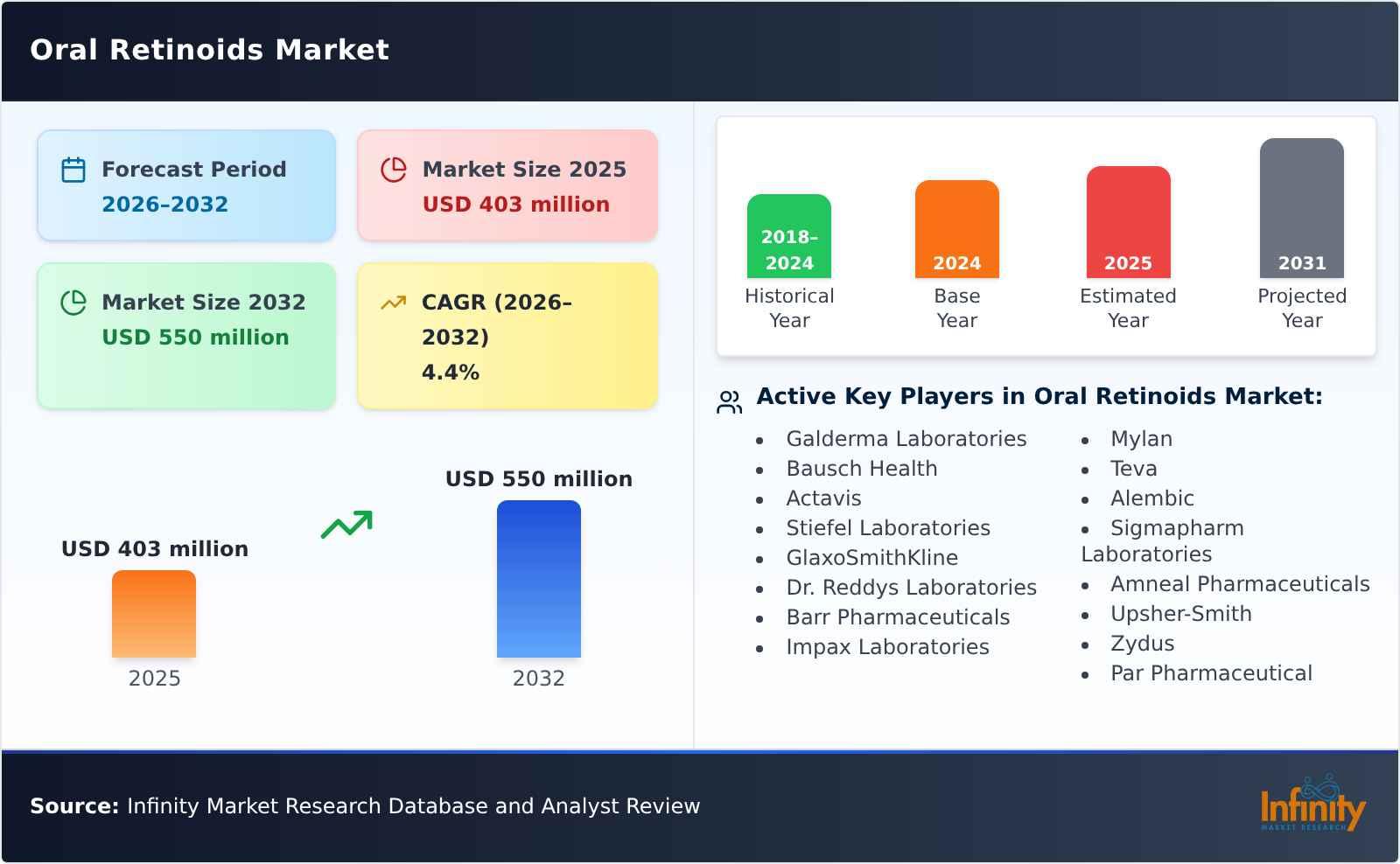
The global Oral Retinoids market size is predicted to grow from US$ 403 million in 2025 to US$ 550 million in 2032; it is expected to grow at a CAGR of 4.4% from 2026 to 2032.
Explore this report in detail? Download a free sample copy
Download Free Sample Report
Oral retinoids are used to address conditions driven by disordered keratinization, excess sebaceous activity, and inflammatory pathwaysmost notably severe or treatment-refractory acne, where systemic modulation of sebaceous gland function, follicular differentiation, and inflammation can reduce relapse and scarring risk, but also selected severe psoriasis and other keratinization disorders, and certain niche indications in oncology and immune-related diseases where control of cellular differentiation and proliferation is clinically valuable. Historically, their development grew out of foundational research linking vitamin A biology to epithelial differentiation and keratinization; early retinoid therapies were constrained by toxicity and narrow therapeutic windows, which motivated successive generations of synthetic analogs and more refined clinical positioning, and as receptor biology (RAR/RXR signaling) and dose-dependent risk became better understood, oral retinoids matured into well-defined treatment paradigms supported by risk-management systemsespecially stringent pregnancy prevention and monitoring programsto ensure benefits outweigh risks. Upstream, the supply chain spans API manufacture and key intermediates supported by chemical synthesis inputs (solvents, catalysts, reagents), purification materials and controls needed for polymorph and impurity management, and oral solid-dosage excipients (diluents, binders, disintegrants, lubricants, coating polymers, antioxidants), alongside packaging and production components and consumables such as capsule shells or tablet-coating systems, blister packs and cold-form foils, bottles with moisture-barrier liners, child-resistant and tamper-evident parts, desiccants, labeling and serialization/traceability materials, and GMP-critical single-use assemblies, filtration elements, and cleanroom consumables that collectively enable stability, content uniformity, and safe shelf-life performance.In 2025, global production capacity for oral retinoids is estimated at 30 million boxes, with total sales reaching 23.01 million boxes. The average selling price is approximately USD 17.9 per box, and corporate gross margins generally range between 40% and 60%.
The market today is shaped by a distinctive combination of strong clinical pull, stringent governance, and parallel brandgeneric competition. On the demand side, clinicians rely heavily on systemic options for severe or refractory patients and have clear expectations for outcomes, while many patients accept more structured follow-up because the potential benefits are tangible. On the access side, however, risk-management requirements place usage firmly within a high-touch medical workflow: prescribing controls, pregnancy prevention safeguards, laboratory monitoring, and pharmacist-led counseling collectively determine real-world availability, creating significant variation across countries and care settings (specialist clinics, hospitals, and telemedicine pathways). Competitive dynamics differ by marketsome segments sustain premium positioning through differentiated dosage forms or specific use characteristics, while many rely primarily on generic supply with higher price sensitivity. Operationally, channels and institutional buyers prioritize compliance maturity and supply reliability; any disruption tied to safety signals, recalls, or shortages can quickly erode prescriber confidence and patient persistence. As a result, performance depends not only on the molecule but also on the surrounding care infrastructure and the quality of patient education.
Looking forward, the direction of travel is toward experience optimization under controlled risk and tighter integration between therapy and service delivery. On the product side, differentiation will increasingly come from formulation and pharmacokinetic refinements that improve consistency and tolerability, along with clearer, evidence-backed personalization of dosing and monitoring in real-world settings. On the delivery side, digital health and standardized medication-management pathways are poised to expandremote follow-up, monitoring reminders, structured risk communication, and side-effect triage can make complex workflows more scalable and reproducible, improving initiation and completion of intended treatment courses. More systematic segmentation and support for priority populationssuch as people of childbearing potential, adolescents, and patients with comorbid metabolic or mental-health considerationswill also grow in importance, alongside patient support programs and pharmacist interventions that strengthen adherence. Over time, growth is likely to be driven less by simple volume expansion and more by the ability of health systems and manufacturers to operationalize risk management in a user-friendly, efficient way.
The tailwinds are anchored in durable demand for reliable clinical outcomes, patient preference for meaningful and sustained improvement, and system-level pressure to manage difficult cases efficiently; competition can further encourage investment in quality systems and supply resilience, reinforcing a healthier baseline of reliability. The headwinds are equally pronounced: pregnancy prevention and monitoring requirements inherently raise barriers and add friction, leading some patients to delay initiation or discontinue early; clinician risk aversion can increase when monitoring burdens are high; the online information environment can amplify fear of adverse effects or encourage nonstandard use; regulatory fragmentation and compliance costs complicate cross-market scaling; and upstream volatility in raw materials, packaging components, and specialized testing capacity can introduce supply uncertainty. Ultimately, the categorys central tension is that clinical value is strong, but converting that value into consistent, scalable utilization depends on smooth, rigorous risk-management operations, continuous patient education, and sustainable care and supply-chain capability.
Infinity Market Research newest research report, the Oral Retinoids Industry Forecast looks at past sales and reviews total world Oral Retinoids sales in 2025, providing a comprehensive analysis by region and market sector of projected Oral Retinoids sales for 2026 through 2032. With Oral Retinoids sales broken down by region, market sector and sub-sector, this report provides a detailed analysis in US$ millions of the world Oral Retinoids industry.
This Insight Report provides a comprehensive analysis of the global Oral Retinoids landscape and highlights key trends related to product segmentation, company formation, revenue, and market share, latest development, and M&A activity. This report also analyzes the strategies of leading global companies with a focus on Oral Retinoids portfolios and capabilities, market entry strategies, market positions, and geographic footprints, to better understand these firms unique position in an accelerating global Oral Retinoids market.
This Insight Report evaluates the key market trends, drivers, and affecting factors shaping the global outlook for Oral Retinoids and breaks down the forecast by Type, by Application, geography, and market size to highlight emerging pockets of opportunity. With a transparent methodology based on hundreds of bottom-up qualitative and quantitative market inputs, this study forecast offers a highly nuanced view of the current state and future trajectory in the global Oral Retinoids.
This report presents a comprehensive overview, market shares, and growth opportunities of Oral Retinoids market by product type, application, key manufacturers and key regions and countries.
Segmentation by Type:
Tretinoin
Isotretinoin
Acitretin
Bexarotene
Alitretinoin
Segmentation by Strength:
Low Strength
Medium Strength
High Strength
Segmentation by Packaging:
Bottle Pack
Blister Pack
Segmentation by Application:
Hospital and Clinic
Pharmacy
Other
This report also splits the market by region:
Americas
United States
Canada
Mexico
Brazil
APAC
China
Japan
Korea
Southeast Asia
India
Australia
Europe
Germany
France
UK
Italy
Russia
Middle East & Africa
Egypt
South Africa
Israel
Turkey
GCC Countries
The below companies that are profiled have been selected based on inputs gathered from primary experts and analysing the companys coverage, product portfolio, its market penetration.
Galderma Laboratories
Bausch Health
Actavis
Stiefel Laboratories
GlaxoSmithKline
Dr. Reddys Laboratories
Barr Pharmaceuticals
Impax Laboratories
Mylan
Teva
Alembic
Sigmapharm Laboratories
Amneal Pharmaceuticals
Upsher-Smith
Zydus
Par Pharmaceutical
Fuji Pharma
Shandong Liangfu Pharmaceutical
Chongqing Huapont Pharmaceutical
Harbin Dazhong Pharmaceutical
Sichuan Med-Shine Pharmaceutical
Heilongjiang Fuhe Pharmaceutical
HEC Pharm
Key Questions Addressed in this Report
What is the 10-year outlook for the global Oral Retinoids market?
What factors are driving Oral Retinoids market growth, globally and by region?
Which technologies are poised for the fastest growth by market and region?
How do Oral Retinoids market opportunities vary by end market size?
How does Oral Retinoids break out by Type, by Application?
Oral Retinoids Market Scope
| Report Attribute | Details |
|---|---|
| Market Size (Start Year) | USD XX Million |
| Market Size (End Year) | USD XX Million |
| Compound Annual Growth Rate (CAGR) | USD XX Million |
| Forecast Period | USD XX Million |
| Base Year | USD XX Million |
| Historical Data | USD XX Million |
| Key Players | USD XX Million |
REPORT COVERAGE
Revenue forecast, Company Analysis, Industry landscape, Growth factors, and Trends
SEGMENT COVERED
By component, deployment, organization size, application, and industry.
REGIONAL SCOPE
North America, Europe, Asia Pacific, Middle East & Africa, South & Central America
COUNTRY SCOPE
Includes key countries across all major regions.
Frequently Asked Questions
1. What is the market size of Global Oral Retinoids Market?
Answer: The global Oral Retinoids market size is predicted to grow from US$ 403 million in 2025 to US$ 550 million in 2032; it is expected to grow at a CAGR of 4.4% from 2026 to 2032.
2. Which regions are analyzed in the Global Oral Retinoids Market report?
Answer: The Global Oral Retinoids Market report covers major regions such as Europe, Middle East & Africa. Each region is analyzed for trends, opportunities, and market dynamics.
3. What methodology is used for forecasting of Global Oral Retinoids Market?
Answer: The Global Oral Retinoids Market report uses a mix of primary research, secondary data, and expert analysis.
4. Are emerging markets analyzed separately in the Global Oral Retinoids Market?
Answer: Yes, the Global Oral Retinoids Market report highlights high-growth emerging regions with dedicated insights.
5. Does the report include competitive benchmarking of Global Oral Retinoids Market?
Answer: Yes, Global Oral Retinoids Market report compares major players based on revenue, product portfolio, and innovation.
6. Can I access country-level data within the Global Oral Retinoids Market report?
Answer: Yes, Global Oral Retinoids Market report includes detailed data by country for major regions.
7. Can I get customized insights or data from the Global Oral Retinoids Market report?
Answer: Yes, we offer customization options to align with your specific business needs. You can request tailored sections or regional breakdowns.