


🔐 Secure Payment Guaranteed
Safe checkout with trusted global payment methods.
🌟 Why Choose Infinity Market Research?
At Infinity Market Research, we dont just deliver data — we deliver clarity, confidence, and competitive edge.
In a world driven by insights, we help businesses unlock the infinite potential of informed decisions.
Here why global brands, startups, and decision-makers choose us:
Industry-Centric Expertise
With deep domain knowledge across sectors — from healthcare and technology to manufacturing and consumer goods — our team delivers insights that matter.
Custom Research, Not Cookie-Cutter Reports
Every business is unique, and so are its challenges. Thats why we tailor our research to your specific goals, offering solutions that are actionable, relevant, and reliable.
Data You Can Trust
Our research methodology is rigorous, transparent, and validated at every step. We believe in delivering not just numbers, but numbers that drive real impact.
Client-Centric Approach
Your success is our priority. From first contact to final delivery, our team is responsive, collaborative, and committed to your goals — because you re more than a client; you re a partner.
Recent Reports
IoT-based Smart Aquaculture System Market
Subsea Life of Field Services Market
Global Osteoporosis Screening Software Market Size, Share and Analysis Report 2026-2032
Mar 2026
Healthcare
Pages: 84
ILR4732
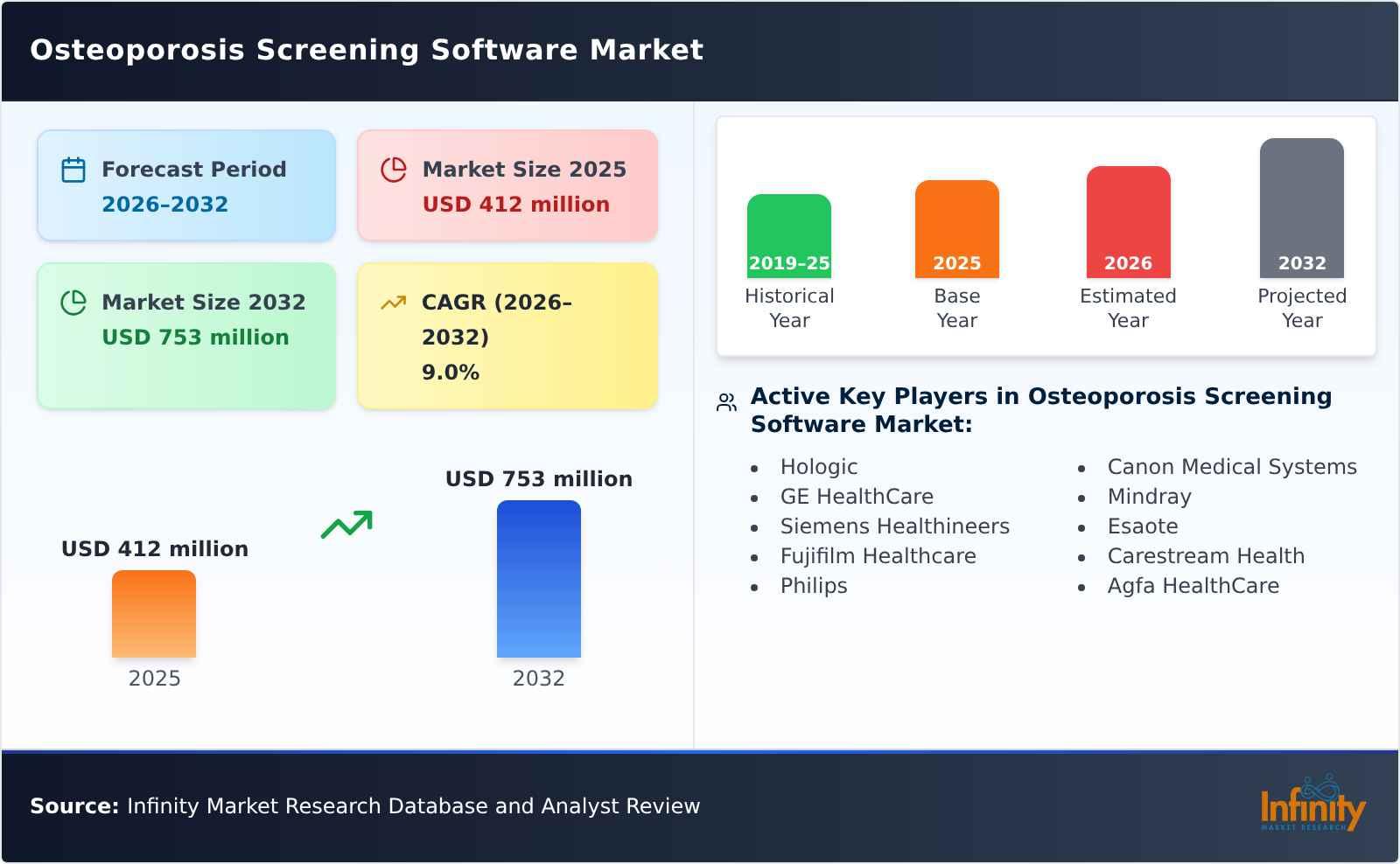
The global Osteoporosis Screening Software market size is predicted to grow from US$ 412 million in 2025 to US$ 753 million in 2032; it is expected to grow at a CAGR of 9.0% from 2026 to 2032.
Explore this report in detail? Download a free sample copy
Download Free Sample Report
Osteoporosis Screening Software is a digital solution designed for hospitals and health-check settings to identify individuals with low bone mass and elevated fracture risk at an early stage, enabling risk stratification, follow-up, and clinical decision support. It typically integrates data from DXA, quantitative ultrasound, and opportunistic CT or routine imaging, applying standardized metrics and validated risk models to automate quality control, calculation, and structured reporting. Beyond reporting, it provides risk alerts, re-test recommendations, and patient education, translating fragmented test results into an actionable screening workflow. Its core value lies in improving screening reach and consistency, reducing missed diagnoses, and supporting an end-to-end pathway from population screening to specialty care and chronic disease management.The average gross profit margin of this product is 35%.
With population aging and expanded chronic disease management, osteoporosis is increasingly shifting from a ?silent progression? condition to one that benefits from proactive screening. Screening software converts scattered imaging and test outputs into a standardized, repeatable workflow?risk stratification, consistent reporting, and follow-up?improving execution efficiency in primary care and health-check settings. In parallel, the adoption of digital health and AI enables image-based analytics and opportunistic screening using existing CT or routine imaging, creating a compelling ?bone health signal without additional exam burden.? For device vendors, imaging platforms, and integrated care networks, tight integration with installed equipment and PACS/RIS/HIS ecosystems also opens room for recurring service revenue through upgrades, maintenance, and pathway expansion.
Key risks concentrate on clinical credibility, regulatory compliance, and implementation costs. Data variability across devices, populations, and acquisition conditions can materially affect outputs; insufficient validation may lead to bias, low clinician trust, and medico-legal concerns. As regulated medical software/AI, products must meet registration requirements, cybersecurity, and data compliance, increasing ongoing investment during iterative releases and multi-site deployment. Hospital IT environments are heterogeneous; integration often requires multi-system interfacing, workflow redesign, and staff training. If the software adds workload rather than reducing friction, utilization may fall short. Commercially, shifting from one-time licensing to subscription or usage-based models must align with local procurement and budgeting mechanisms, often resulting in longer sales cycles and slower cash collection.
Demand is moving from ?single-result reporting? toward a closed loop of screening, referral, treatment, and follow-up. Health-check centers prioritize fast, structured conclusions and population stratification; primary care needs standardized screening with clear referral pathways; specialties such as orthopedics, endocrinology, and geriatrics require risk assessment embedded into long-term therapy and adherence monitoring. Meanwhile, opportunistic screening is gaining traction in radiology and imaging centers?automated bone-risk flags from existing studies can improve post-exam management and specialty conversion. On the patient side, expectations are rising for understandable risk explanations and actionable guidance, pushing products from reporting tools toward patient engagement and longitudinal management solutions.
Upstream ?inputs? are less about physical materials and more about data, computing, software engineering, and compliance infrastructure. Critical components include multi-source data connectivity (DICOM imaging, densitometry outputs, structured lab results), validated algorithms/models and annotation knowledge bases, clinical rule engines and reporting template libraries, and a secure architecture with access control, auditing, encryption, and backup. Engineering factors such as cross-vendor device adaptation, integration middleware for HIS/PACS/RIS and health-check systems, and deployable operations models (on-prem, private cloud, or hybrid) determine delivery efficiency and scalability. Compliance enablers?quality management systems, clinical evaluation, and a sustainable update mechanism?form enduring competitive moats as ?invisible but decisive? investments.
LPI (LP Information) newest research report, the ?Osteoporosis Screening Software Industry Forecast? looks at past sales and reviews total world Osteoporosis Screening Software sales in 2025, providing a comprehensive analysis by region and market sector of projected Osteoporosis Screening Software sales for 2026 through 2032. With Osteoporosis Screening Software sales broken down by region, market sector and sub-sector, this report provides a detailed analysis in US$ millions of the world Osteoporosis Screening Software industry.
This Insight Report provides a comprehensive analysis of the global Osteoporosis Screening Software landscape and highlights key trends related to product segmentation, company formation, revenue, and market share, latest development, and M&A activity. This report also analyses the strategies of leading global companies with a focus on Osteoporosis Screening Software portfolios and capabilities, market entry strategies, market positions, and geographic footprints, to better understand these firms? unique position in an accelerating global Osteoporosis Screening Software market.
This Insight Report evaluates the key market trends, drivers, and affecting factors shaping the global outlook for Osteoporosis Screening Software and breaks down the forecast by Type, by Application, geography, and market size to highlight emerging pockets of opportunity. With a transparent methodology based on hundreds of bottom-up qualitative and quantitative market inputs, this study forecast offers a highly nuanced view of the current state and future trajectory in the global Osteoporosis Screening Software.
This report presents a comprehensive overview, market shares, and growth opportunities of Osteoporosis Screening Software market by product type, application, key players and key regions and countries.
Segmentation by Type:
DXA Analysis & Reporting
Opportunistic CT Bone Density
Risk Assessment / FRAX Integration
Other Workflows
Segmentation by Deployment:
On-Premise
Cloud / SaaS
Hybrid
Segmentation by Integration Depth:
Standalone Workstation Type
Semi-integrated Type
Deeply embedded Type
Other
Segmentation by Application:
Hospitals
Imaging Centers
Other
This report also splits the market by region:
Americas
United States
Canada
Mexico
Brazil
APAC
China
Japan
Korea
Southeast Asia
India
Australia
Europe
Germany
France
UK
Italy
Russia
Middle East & Africa
Egypt
South Africa
Israel
Turkey
GCC Countries
The below companies that are profiled have been selected based on inputs gathered from primary experts and analyzing the companys coverage, product portfolio, its market penetration.
Hologic
GE HealthCare
Siemens Healthineers
Fujifilm Healthcare
Philips
Canon Medical Systems
Mindray
Esaote
Carestream Health
Agfa HealthCare
Osteoporosis Screening Software Market Scope
| Report Attribute | Details |
|---|---|
| Market Size (Start Year) | USD XX Million |
| Market Size (End Year) | USD XX Million |
| Compound Annual Growth Rate (CAGR) | USD XX Million |
| Forecast Period | USD XX Million |
| Base Year | USD XX Million |
| Historical Data | USD XX Million |
| Key Players | USD XX Million |
REPORT COVERAGE
Revenue forecast, Company Analysis, Industry landscape, Growth factors, and Trends
SEGMENT COVERED
By component, deployment, organization size, application, and industry.
REGIONAL SCOPE
North America, Europe, Asia Pacific, Middle East & Africa, South & Central America
COUNTRY SCOPE
Includes key countries across all major regions.
📘 Frequently Asked Questions
1. What is the market size of Global Osteoporosis Screening Software Market?
Answer: The global Osteoporosis Screening Software market size is predicted to grow from US$ 412 million in 2025 to US$ 753 million in 2032; it is expected to grow at a CAGR of 9.0% from 2026 to 2032.
2. Which regions are analyzed in the Global Osteoporosis Screening Software Market report?
Answer: The Global Osteoporosis Screening Software Market report covers major regions such as Europe, Middle East & Africa. Each region is analyzed for trends, opportunities, and market dynamics.
3. What methodology is used for forecasting of Global Osteoporosis Screening Software Market?
Answer: The Global Osteoporosis Screening Software Market report uses a mix of primary research, secondary data, and expert analysis to build its forecasts. Models include both qualitative and quantitative approaches.
4. Are emerging markets analyzed separately in the Global Osteoporosis Screening Software Market?
Answer: Yes, the Global Osteoporosis Screening Software Market report highlights high-growth emerging regions with dedicated insights. These include untapped opportunities, risks, and potential for expansion.
5. Does the report include competitive benchmarking of Global Osteoporosis Screening Software Market?
Answer: Yes, Global Osteoporosis Screening Software Market report compares major players based on revenue, product portfolio, innovation, and regional presence. This helps assess competitive positioning.
6. Can I access country-level data within the Global Osteoporosis Screening Software Market report?
Answer: Yes, Global Osteoporosis Screening Software Market report includes detailed data by country, especially for key markets. This allows for localized insights and decision-making.
7. Can I get customized insights or data from the Global Osteoporosis Screening Software Market report?
Answer: Yes, we offer customization options to align with your specific business needs. You can request tailored sections or regional breakdowns.

🔐 Secure Payment Guaranteed
Safe checkout with trusted global payment methods.
🌟 Why Choose Infinity Market Research?
At Infinity Market Research, we dont just deliver data — we deliver clarity, confidence, and competitive edge.
In a world driven by insights, we help businesses unlock the infinite potential of informed decisions.
Here why global brands, startups, and decision-makers choose us:
Industry-Centric Expertise
With deep domain knowledge across sectors — from healthcare and technology to manufacturing and consumer goods — our team delivers insights that matter.
Custom Research, Not Cookie-Cutter Reports
Every business is unique, and so are its challenges. Thats why we tailor our research to your specific goals, offering solutions that are actionable, relevant, and reliable.
Data You Can Trust
Our research methodology is rigorous, transparent, and validated at every step. We believe in delivering not just numbers, but numbers that drive real impact.
Client-Centric Approach
Your success is our priority. From first contact to final delivery, our team is responsive, collaborative, and committed to your goals — because you re more than a client; you re a partner.