


Global Passive Daytime Radiative Cooling Materials Market Growth 2026-2032
Jan 2026
Chemicals and Materials
Pages: 121
ILR1768
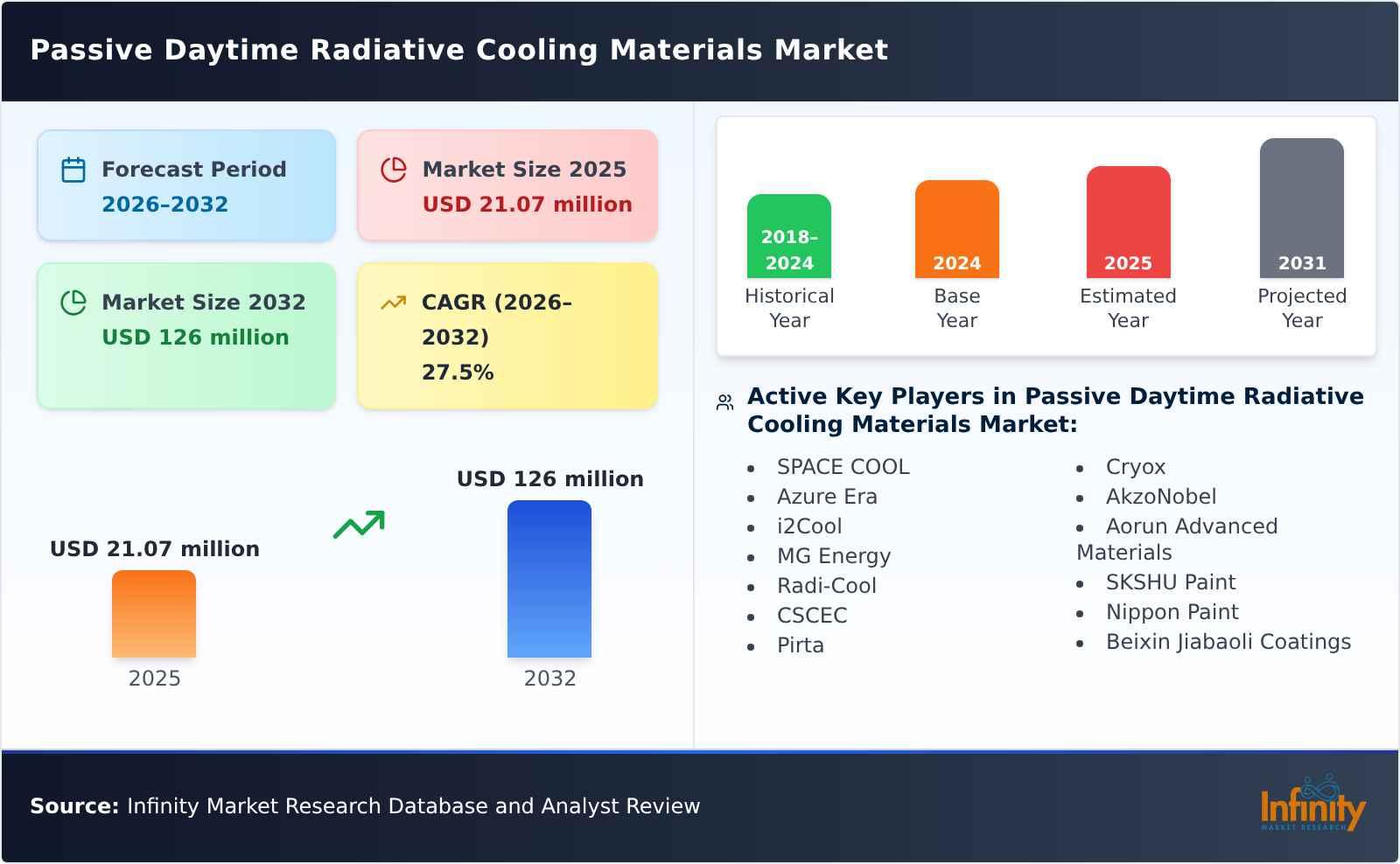
The global Passive Daytime Radiative Cooling Materials market size is predicted to grow from US$ 21.07 million in 2025 to US$ 126 million in 2032; it is expected to grow at a CAGR of 27.5% from 2026 to 2032.
Explore this report in detail? Download a free sample copy
Download Free Sample Report
Passive daytime radiative cooling (PDRC) materials are engineered surfacesoften films, paints, or coatingsthat can lower their temperature under direct sunlight without consuming energy by balancing two optical properties: they reflect most incoming solar radiation (so they absorb very little heat from the sun) and they strongly emit thermal infrared radiation in the atmospheric transparent window (roughly 813 m), allowing heat to radiate from the surface to the cold sky/outer space. When designed well and used on sky-facing surfaces, this combination can keep the material cooler than conventional surfaces and, under favorable weather (clear skies, low humidity, low wind), can even cool to below ambient air temperature. The average price of coating products is approximately US$6.29 per square meter, while the average price of film products is US$30 per square meter. Upstream sectors therefore span (1) materials: high-bandgap white pigments/fillers (e.g., BaSO?, CaCO?, TiO?), polymer binders/resins, solvents (for liquid systems), and additives for dispersion, rheology, UV stability, and anti-soiling; (2) substrates & converting: roof membranes, metal panels, plastics, fabrics, primers, adhesives, and packaging; and (3) manufacturing & QA: paint-making/dispersing, film extrusion/lamination or scalable coating processes (e.g., spray/roll/dip/phase-inversion approaches) plus optical/thermal metrology to verify reflectance/emittance consistency. Downstream, PDRC materials flow into construction and roofing (new build + retrofit roofs/facades), industrial assets (tanks, warehouses, cold-chain surfaces), and outdoor infrastructure/equipment (enclosures, transport surfaces), typically sold through coating/roofing distributors, contractors, and OEM partnerships; adoption is often gated by standard test metrics (solar reflectance, thermal emittance, and SRI) used in cool-surface procurement and specifications.
The market opportunity for PDRC materials is strongest where customers value a passive, no-electricity way to cut surface temperatures and reduce cooling loads/peak demand, and where procurement can be pulled through existing cool-roof/cool-surface specification habitsbut PDRC must prove incremental value beyond conventional high-reflectance coatings. Competition is therefore less about the basic physics (widely understood) and more about bankable field performance: maintaining high reflectance/emittance over time despite UV exposure, soiling, moisture, and real-world installation variability, with climate effects (humidity/cloud cover) and maintenance practices shaping realized benefits. Commercial winners tend to be those who can industrialize durable, standards-aligned products (including versions compatible with common roof systems and application methods), document performance with credible testing, and partner with established coatings/roofing channelswhile R&D focus areas like anti-soiling, long-life binders, and scalable film/coating manufacturing determine how quickly PDRC moves from specialty to mainstream building and infrastructure specifications.
Infinity Market Research newest research report, the Passive Daytime Radiative Cooling Materials Industry Forecast looks at past sales and reviews total world Passive Daytime Radiative Cooling Materials sales in 2025, providing a comprehensive analysis by region and market sector of projected Passive Daytime Radiative Cooling Materials sales for 2026 through 2032. With Passive Daytime Radiative Cooling Materials sales broken down by region, market sector and sub-sector, this report provides a detailed analysis in US$ millions of the world Passive Daytime Radiative Cooling Materials industry.
This Insight Report provides a comprehensive analysis of the global Passive Daytime Radiative Cooling Materials landscape and highlights key trends related to product segmentation, company formation, revenue, and market share, latest development, and M&A activity. This report also analyzes the strategies of leading global companies with a focus on Passive Daytime Radiative Cooling Materials portfolios and capabilities, market entry strategies, market positions, and geographic footprints, to better understand these firms unique position in an accelerating global Passive Daytime Radiative Cooling Materials market.
This Insight Report evaluates the key market trends, drivers, and affecting factors shaping the global outlook for Passive Daytime Radiative Cooling Materials and breaks down the forecast by Type, by Application, geography, and market size to highlight emerging pockets of opportunity. With a transparent methodology based on hundreds of bottom-up qualitative and quantitative market inputs, this study forecast offers a highly nuanced view of the current state and future trajectory in the global Passive Daytime Radiative Cooling Materials.
This report presents a comprehensive overview, market shares, and growth opportunities of Passive Daytime Radiative Cooling Materials market by product type, application, key manufacturers and key regions and countries.
Segmentation by Type:
Paints
Films
Others
Segmentation by Reflectivity:
Reflectivity Greater Than 96%
Reflectivity Less Than 96%
Segmentation by Color:
White
Colored
Transparent
Segmentation by Application:
Construction Industry
Warehousing
Transportation Equipment
Energy and Power Facilities
Others
This report also splits the market by region:
Americas
United States
Canada
Mexico
Brazil
APAC
China
Japan
Korea
Southeast Asia
India
Australia
Europe
Germany
France
UK
Italy
Russia
Middle East & Africa
Egypt
South Africa
Israel
Turkey
GCC Countries
The below companies that are profiled have been selected based on inputs gathered from primary experts and analysing the companys coverage, product portfolio, its market penetration.
SPACE COOL
Azure Era
i2Cool
MG Energy
Radi-Cool
CSCEC
Pirta
Cryox
3M
AkzoNobel
Aorun Advanced Materials
SKSHU Paint
Nippon Paint
Beixin Jiabaoli Coatings
Key Questions Addressed in this Report
What is the 10-year outlook for the global Passive Daytime Radiative Cooling Materials market?
What factors are driving Passive Daytime Radiative Cooling Materials market growth, globally and by region?
Which technologies are poised for the fastest growth by market and region?
How do Passive Daytime Radiative Cooling Materials market opportunities vary by end market size?
How does Passive Daytime Radiative Cooling Materials break out by Type, by Application?
Passive Daytime Radiative Cooling Materials Market Scope
| Report Attribute | Details |
|---|---|
| Market Size (Start Year) | USD XX Million |
| Market Size (End Year) | USD XX Million |
| Compound Annual Growth Rate (CAGR) | USD XX Million |
| Forecast Period | USD XX Million |
| Base Year | USD XX Million |
| Historical Data | USD XX Million |
| Key Players | USD XX Million |
REPORT COVERAGE
Revenue forecast, Company Analysis, Industry landscape, Growth factors, and Trends
SEGMENT COVERED
By component, deployment, organization size, application, and industry.
REGIONAL SCOPE
North America, Europe, Asia Pacific, Middle East & Africa, South & Central America
COUNTRY SCOPE
Includes key countries across all major regions.
Frequently Asked Questions
1. What is the market size of Global Passive Daytime Radiative Cooling Materials Market?
Answer: The global Passive Daytime Radiative Cooling Materials market size is predicted to grow from US$ 21.07 million in 2025 to US$ 126 million in 2032; it is expected to grow at a CAGR of 27.5% from 2026 to 2032.
2. Which regions are analyzed in the Global Passive Daytime Radiative Cooling Materials Market report?
Answer: The Global Passive Daytime Radiative Cooling Materials Market report covers major regions such as Europe, Middle East & Africa. Each region is analyzed for trends, opportunities, and market dynamics.
3. What methodology is used for forecasting of Global Passive Daytime Radiative Cooling Materials Market?
Answer: The Global Passive Daytime Radiative Cooling Materials Market report uses a mix of primary research, secondary data, and expert analysis.
4. Are emerging markets analyzed separately in the Global Passive Daytime Radiative Cooling Materials Market?
Answer: Yes, the Global Passive Daytime Radiative Cooling Materials Market report highlights high-growth emerging regions with dedicated insights.
5. Does the report include competitive benchmarking of Global Passive Daytime Radiative Cooling Materials Market?
Answer: Yes, Global Passive Daytime Radiative Cooling Materials Market report compares major players based on revenue, product portfolio, and innovation.
6. Can I access country-level data within the Global Passive Daytime Radiative Cooling Materials Market report?
Answer: Yes, Global Passive Daytime Radiative Cooling Materials Market report includes detailed data by country for major regions.
7. Can I get customized insights or data from the Global Passive Daytime Radiative Cooling Materials Market report?
Answer: Yes, we offer customization options to align with your specific business needs. You can request tailored sections or regional breakdowns.