


Global Peritoneal Dialysis Drainage Bag Market Growth 2026-2032
Jan 2026
Healthcare
Pages: 106
ILR1572
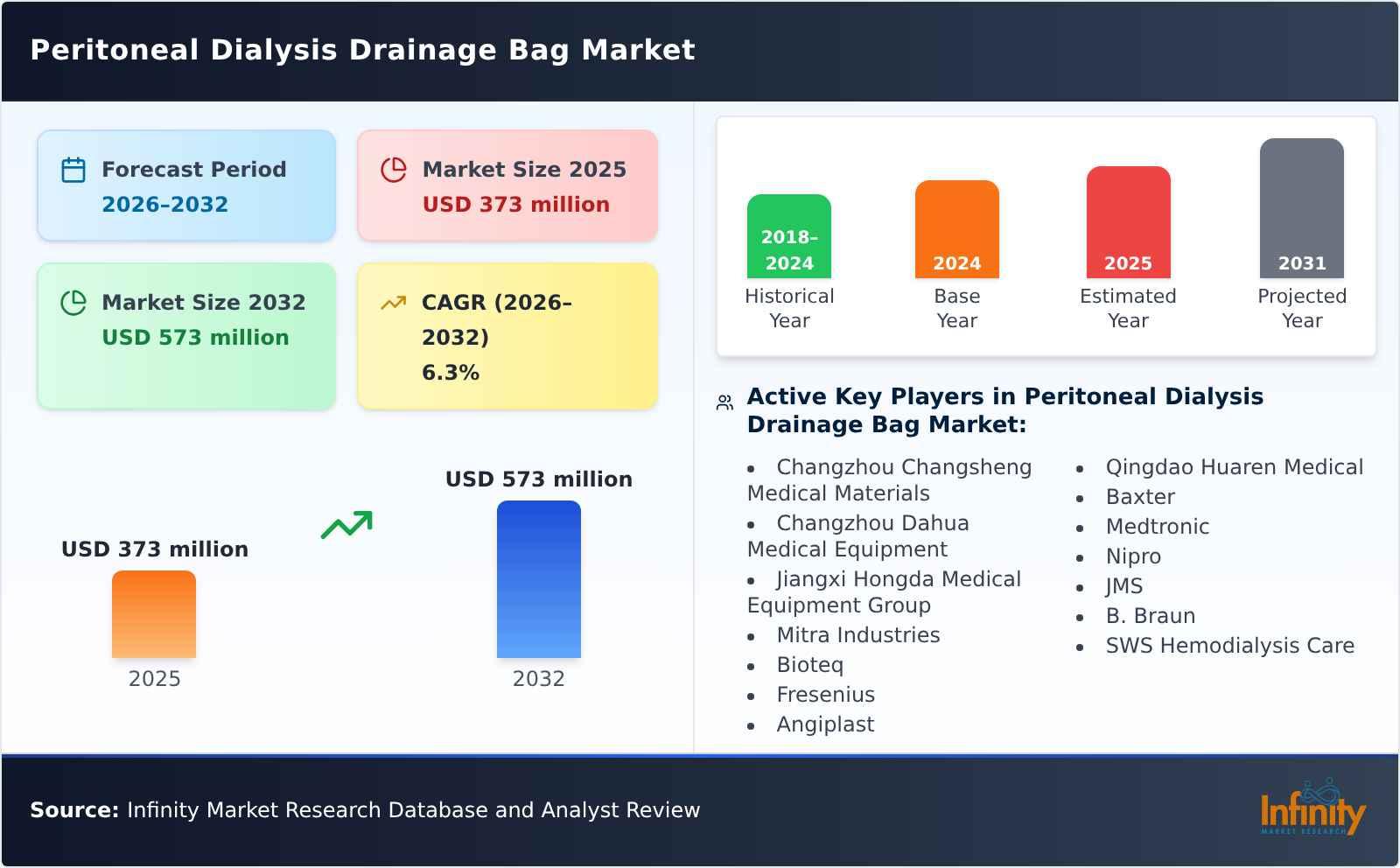
The global Peritoneal Dialysis Drainage Bag market size is predicted to grow from US$ 373 million in 2025 to US$ 573 million in 2032; it is expected to grow at a CAGR of 6.3% from 2026 to 2032.
Explore this report in detail? Download a free sample copy
Download Free Sample Report
Peritoneal Dialysis Drainage Bags are single-use medical consumables designed to sterilely collect and temporarily contain spent dialysate drained from the peritoneal cavity during peritoneal dialysis therapy. The core problem they solve is safe and controlled effluent management: they help maintain a closed or semi-closed drainage pathway to minimize touch points and environmental exposurethereby reducing contamination and infection risks such as peritonitiswhile enabling predictable drainage, visual inspection of effluent characteristics, and compliant disposal of medical waste in both home and clinical settings. Historically, drainage solutions evolved from relatively rudimentary, more open collection approaches into standardized disposable drainage bags aligned with CAPD workflows, and later co-developed with twin-bag systems, Y-set connection systems, and more advanced closed-connection designs that prioritize aseptic technique, compatibility, and user-friendly handling. Key improvements have focused on connector integrity and protection, barrier and seal reliability of bag films, anti-backflow and flow-control features, clearer graduations and ergonomic structures, and higher integration into pre-assembled therapy sets. Upstream supply chains typically involve medical-grade polymers and packaging systems: bag films and tubing commonly use medical-grade PVC, PE, PP, or multilayer co-extruded/laminated structures tailored for flexibility, clarity, low extractables, and sterilization tolerance; precision components such as connectors, clamps, and check valves are supplied by specialized injection-molding and assembly vendors using medical-grade resins (e.g., PP/PC/ABS/TPU), with seals often made from silicone or thermoplastic elastomers. Sterile barrier packaging materials (medical paper-plastic, multilayer films, indicators) and sterilization/validation service providers (e.g., ethylene oxide or irradiation) also form critical upstream inputs. Final manufacturers assemble and test these components in controlled environments, perform leak/strength and functional checks, validate sterilization and packaging integrity, and deliver product under strict regulatory compliance and batch-to-batch consistency requirements.In 2025, the global production capacity of peritoneal dialysis drainage bags reached 250 million units, with total sales volume amounting to 211 million units. The average selling price was approximately USD 1.8 per unit, and corporate gross margins generally ranged between 30% and 45%.
The current market is characterized by high-frequency, non-discretionary demand and fragmented competition, while the effective entry bar is rising. On the demand side, buyers prioritize reliability, batch consistency, connector compatibility, sterility assurance, and sealing integrityattributes where failures carry outsized clinical and reputational consequences. Procurement is often executed through standardized lists and bundled therapy sets, which compresses standalone pricing power and shifts competition toward fulfillment capability, service responsiveness, channel reach, and seamless fit with dominant PD workflows. On the supply side, tightening regulations, stricter quality-system expectations, and more rigorous sterilization and packaging validation are driving stratification: simple low-cost manufacturing becomes less sustainable, and suppliers with robust clean manufacturing, stable and compliant raw-material systems, consistent processes, and end-to-end traceability tend to earn stronger institutional trust. Upstream stability in films, resins, molded components, clamps, and valves increasingly matters, making supply-chain governance part of competitive differentiation rather than a back-office function.
Looking forward, the direction is toward deeper system integration, usability refinement, and earlier risk management. Bundling, pre-assembly, and lower-touch workflows are expected to expand, reducing steps, exposure time, and contamination opportunities so that the product is designed as a component of a more closed therapy pathway rather than a standalone item. Both clinical and home settings are pushing for clearer user guidance and smoother disposal routinesthrough easier-to-read graduations and visibility, more stable drainage and anti-backflow features, more ergonomic clamping and connector protection, and more patient-friendly waste packaging and handling. As follow-up models become more digitally enabled, integrated solutions that support adherence, education, and infection-risk mitigation may become more common, with suppliers creating value through optimized consumable combinations, kit design, and service offerings instead of relying solely on unit price. In parallel, sustainability and compliance pressures will encourage lighter packaging and material optimization, but changes must be balanced carefully against sterility and validation requirements, raising new technical and regulatory hurdles.
Growth drivers and constraints are tightly intertwined. The main tailwinds include the steady consumable pull from home-based PD pathways, ongoing clinical goals to reduce infection and complication burden, and health-system preference for consistent quality and uninterrupted supply; continued advances in barrier films, low-extractables materials, precision connectors, and validated sterilization/packaging processes further expand what is feasible in safety and usability. The key headwinds center on value capture under bundled procurement, pathway lock-in and compatibility costs, and supply-chain vulnerability: individual items are often priced inside broader bundles, making it hard to monetize incremental improvements; differences across dominant connection standards increase switching friction; and raw-material volatility, sterilization capacity constraints, logistics disruptions, and evolving regulatory expectations can all amplify delivery and compliance risk. In practice, the next phase of competition is less about making a bag and more about building a repeatable system of stable delivery, compliant quality, high compatibility with therapy workflows, and a user experience that supports both clinicians and patients.
Infinity Market Research newest research report, the Peritoneal Dialysis Drainage Bag Industry Forecast looks at past sales and reviews total world Peritoneal Dialysis Drainage Bag sales in 2025, providing a comprehensive analysis by region and market sector of projected Peritoneal Dialysis Drainage Bag sales for 2026 through 2032. With Peritoneal Dialysis Drainage Bag sales broken down by region, market sector and sub-sector, this report provides a detailed analysis in US$ millions of the world Peritoneal Dialysis Drainage Bag industry.
This Insight Report provides a comprehensive analysis of the global Peritoneal Dialysis Drainage Bag landscape and highlights key trends related to product segmentation, company formation, revenue, and market share, latest development, and M&A activity. This report also analyzes the strategies of leading global companies with a focus on Peritoneal Dialysis Drainage Bag portfolios and capabilities, market entry strategies, market positions, and geographic footprints, to better understand these firms unique position in an accelerating global Peritoneal Dialysis Drainage Bag market.
This Insight Report evaluates the key market trends, drivers, and affecting factors shaping the global outlook for Peritoneal Dialysis Drainage Bag and breaks down the forecast by Type, by Application, geography, and market size to highlight emerging pockets of opportunity. With a transparent methodology based on hundreds of bottom-up qualitative and quantitative market inputs, this study forecast offers a highly nuanced view of the current state and future trajectory in the global Peritoneal Dialysis Drainage Bag.
This report presents a comprehensive overview, market shares, and growth opportunities of Peritoneal Dialysis Drainage Bag market by product type, application, key manufacturers and key regions and countries.
Segmentation by Type:
Conventional Type
High Capacity Type
Segmentation by Packaging:
Sterile Single-Pack Products
Sterile Multi-Pack Products
Segmentation by Connector:
Universal Connector Products
Brand-Specific Connector Products
Segmentation by Application:
Hospital
Clinic
Other
This report also splits the market by region:
Americas
United States
Canada
Mexico
Brazil
APAC
China
Japan
Korea
Southeast Asia
India
Australia
Europe
Germany
France
UK
Italy
Russia
Middle East & Africa
Egypt
South Africa
Israel
Turkey
GCC Countries
The below companies that are profiled have been selected based on inputs gathered from primary experts and analysing the companys coverage, product portfolio, its market penetration.
Changzhou Changsheng Medical Materials
Changzhou Dahua Medical Equipment
Jiangxi Hongda Medical Equipment Group
Mitra Industries
Bioteq
Fresenius
Angiplast
Qingdao Huaren Medical
Baxter
Medtronic
Nipro
JMS
B. Braun
SWS Hemodialysis Care
Key Questions Addressed in this Report
What is the 10-year outlook for the global Peritoneal Dialysis Drainage Bag market?
What factors are driving Peritoneal Dialysis Drainage Bag market growth, globally and by region?
Which technologies are poised for the fastest growth by market and region?
How do Peritoneal Dialysis Drainage Bag market opportunities vary by end market size?
How does Peritoneal Dialysis Drainage Bag break out by Type, by Application?
Peritoneal Dialysis Drainage Bag Market Scope
| Report Attribute | Details |
|---|---|
| Market Size (Start Year) | USD XX Million |
| Market Size (End Year) | USD XX Million |
| Compound Annual Growth Rate (CAGR) | USD XX Million |
| Forecast Period | USD XX Million |
| Base Year | USD XX Million |
| Historical Data | USD XX Million |
| Key Players | USD XX Million |
REPORT COVERAGE
Revenue forecast, Company Analysis, Industry landscape, Growth factors, and Trends
SEGMENT COVERED
By component, deployment, organization size, application, and industry.
REGIONAL SCOPE
North America, Europe, Asia Pacific, Middle East & Africa, South & Central America
COUNTRY SCOPE
Includes key countries across all major regions.
Frequently Asked Questions
1. What is the market size of Global Peritoneal Dialysis Drainage Bag Market?
Answer: The global Peritoneal Dialysis Drainage Bag market size is predicted to grow from US$ 373 million in 2025 to US$ 573 million in 2032; it is expected to grow at a CAGR of 6.3% from 2026 to 2032.
2. Which regions are analyzed in the Global Peritoneal Dialysis Drainage Bag Market report?
Answer: The Global Peritoneal Dialysis Drainage Bag Market report covers major regions such as Europe, Middle East & Africa. Each region is analyzed for trends, opportunities, and market dynamics.
3. What methodology is used for forecasting of Global Peritoneal Dialysis Drainage Bag Market?
Answer: The Global Peritoneal Dialysis Drainage Bag Market report uses a mix of primary research, secondary data, and expert analysis.
4. Are emerging markets analyzed separately in the Global Peritoneal Dialysis Drainage Bag Market?
Answer: Yes, the Global Peritoneal Dialysis Drainage Bag Market report highlights high-growth emerging regions with dedicated insights.
5. Does the report include competitive benchmarking of Global Peritoneal Dialysis Drainage Bag Market?
Answer: Yes, Global Peritoneal Dialysis Drainage Bag Market report compares major players based on revenue, product portfolio, and innovation.
6. Can I access country-level data within the Global Peritoneal Dialysis Drainage Bag Market report?
Answer: Yes, Global Peritoneal Dialysis Drainage Bag Market report includes detailed data by country for major regions.
7. Can I get customized insights or data from the Global Peritoneal Dialysis Drainage Bag Market report?
Answer: Yes, we offer customization options to align with your specific business needs. You can request tailored sections or regional breakdowns.