


Global Peritoneal Dialysis (PD) Supplies Market Growth 2026-2032
Jan 2026
Healthcare
Pages: 129
ILR1571
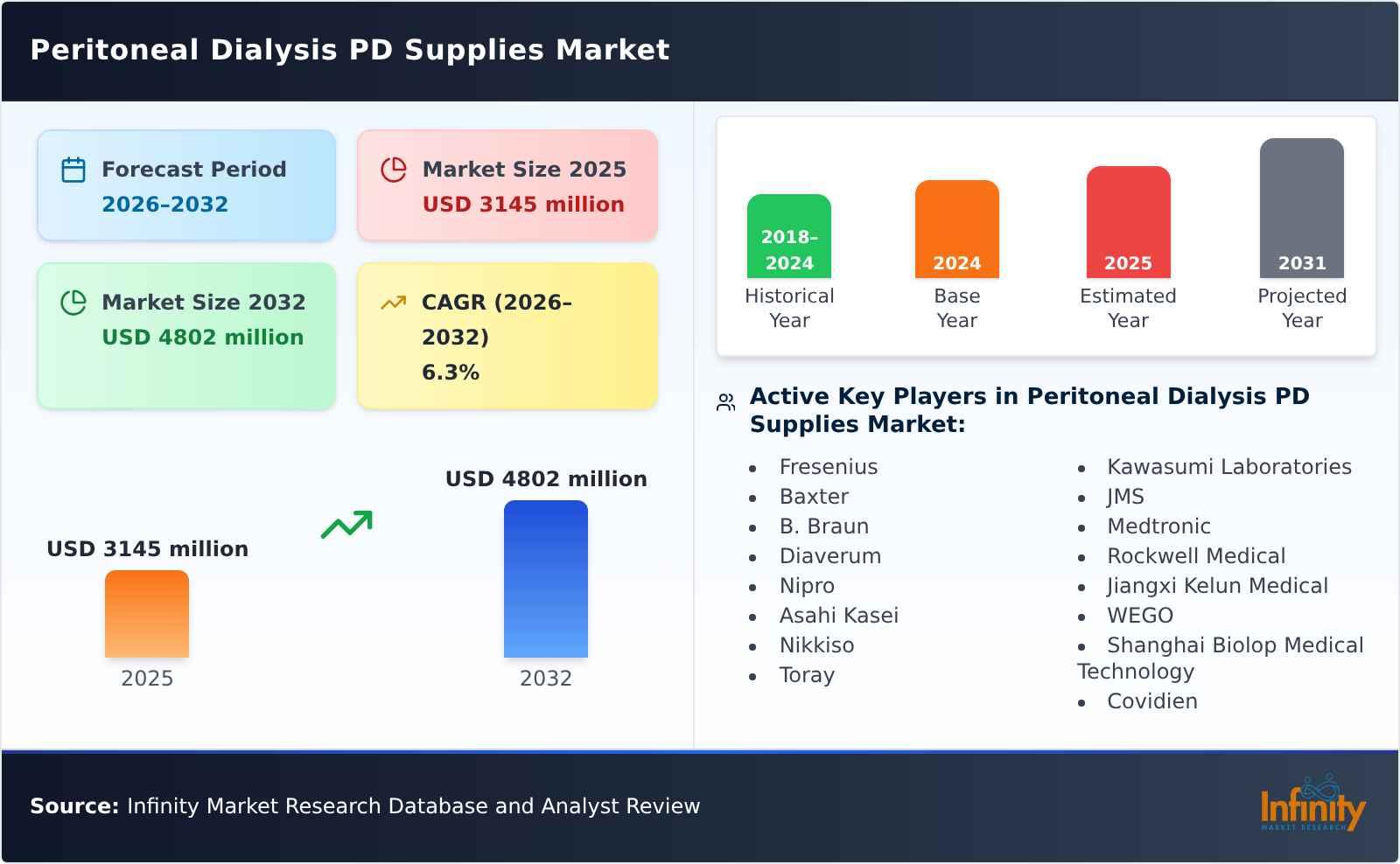
The global Peritoneal Dialysis (PD) Supplies market size is predicted to grow from US$ 3145 million in 2025 to US$ 4802 million in 2032; it is expected to grow at a CAGR of 6.3% from 2026 to 2032.
Explore this report in detail? Download a free sample copy
Download Free Sample Report
Peritoneal Dialysis (PD) supplies refer to the set of disposable and periodically replaced medical consumables used to deliver peritoneal dialysis therapy, in which a patients peritoneal membrane acts as a semi-permeable barrier to remove uremic toxins, correct electrolyte imbalance, and control fluid overload when the kidneys fail. The central problem these products address is the life-threatening accumulation of metabolic waste and excess water in chronic kidney disease/end-stage kidney disease, while enabling a home-based, patient-managed alternative to in-center hemodialysis. Typical PD supplies include sterile dialysate solutions (with varying osmotic agent concentrations/formulations), solution bags and overwraps, tubing sets and transfer sets, PD catheters with accessories, connectors/clamps/valves, disinfecting caps and sterile connection protection devices, drain bags, dressings and catheter care kits, andwhen used with automated peritoneal dialysis (APD)single-use cassettes and dedicated disposable tubing assemblies that interface with the cycler. Historically, PD evolved from early clinical exploration of the peritoneum as a natural dialysis membrane into more standardized regimens, and later into widely adopted modalities such as CAPD and APD as sterile connection technology, infection control (especially peritonitis reduction), dialysate stability, biocompatibility, and user workflow improvedshifting PD from a hospital procedure toward scalable home therapy. The upstream supply chain typically includes medical-grade polymers (e.g., PVC/PP/PE/TPU and silicone elastomers for bags, tubing, connectors, and seals), pharmaceutical-grade chemicals for dialysate (osmotic agents, electrolytes, buffers, and water-for-injection systems), barrier packaging materials (multilayer films, medical paper-plastic, indicators), nonwovens and medical adhesives for dressings, and precision components such as injection-molded parts, extruded tubing, sterile connectors, check valves, and flow-control clamps. For APD-related disposables, additional component suppliers provide interface parts and tight-tolerance valve/cassette elementsgenerally produced under medical quality systems with clean manufacturing, validated sterilization, and regulatory compliance, before final assembly, testing, and sterile release by the PD consumables manufacturer.In 2025, the global production capacity of peritoneal dialysis (PD) supplies reached 600 million units, with total sales volume amounting to 527 million units. The average selling price was approximately USD 6.1 per unit, and corporate gross margins generally ranged between 35% and 50%.
The current market for PD-related supplies shows a pattern of steady underlying demand with noticeable structural divergence: health systems increasingly value home-based care pathways and the operational flexibility PD can provide, while clinicians and providers have become far more sensitive to infection prevention, ease of use, and consistent long-term outcomesshifting competition from basic availability to safety, workflow simplicity, and lifecycle support. Adoption, however, remains uneven because it depends heavily on local reimbursement design, the maturity of training and nursing infrastructure, institutional inertia tied to established in-center dialysis pathways, and differences in patient education and support. On the supply side, tighter regulation and higher quality-system expectations are accelerating consolidation; leading manufacturers emphasize end-to-end traceability and dependable fulfillment, while smaller players differentiate through curated kits, connection-safety accessories, optimized consumable bundles, and service integration. Clinically, heightened focus on reducing peritonitis, catheter-related complications, and membrane deterioration is directly influencing procurement preferences toward more reliable connection components, protective devices, and care materials, as well as more biocompatible solution-and-packaging choicesraising the bar for brand trust, delivery stability, and training capability.
Looking ahead, the direction is toward patient-centered, system-level upgrades anchored in biocompatibility and end-to-end infection control. Product innovation is likely to emphasize more closed, low-touch sterile connection workflows that reduce contamination exposure and user error, alongside packaging and usability refinements that make daily routines more intuitive and less burdensome. Integration with devices, follow-up programs, and digital support will deepen, with consumables increasingly designed as part of a broader therapy ecosystemlinking education, reminders, adherence support, and complication-risk mitigation into one coherent pathway. This encourages manufacturers to target reductions in patient workload and downstream complications rather than treating supplies as standalone items. Supply-chain capability becomes a strategic differentiator as well: compliant material sourcing, validated sterilization choices, clean manufacturing competence, and resilience against disruptions will matter more, while environmental and compliance pressures will push exploration of more sustainable materials, packaging, and waste-management approachesforcing careful trade-offs among performance, cost, regulatory acceptance, and responsible disposal.
The markets momentum and friction points are tightly intertwined. Key growth drivers include policy and provider interest in home-care models and resource efficiency, patient demand for better quality of life and schedule flexibility, continuous clinical goals around lowering infection and complication burdens, and innovation in usability plus service models that support long-term adherence. Upstream advances in medical polymers, sterile connector components, barrier packaging, and sterilization validation also expand what is technically feasible for safer, simpler consumable systems. The main constraints fall into three buckets: people and process (PD depends on training quality, caregiver capacity, and sustained adherence; weak follow-up amplifies infection risk and undermines confidence), system and incentives (misaligned reimbursement or entrenched provider pathways can slow adoption), and industrial/regulatory realities (sterility assurance, batch consistency, and uninterrupted supply are critical; volatility in raw materials, sterilization capacity constraints, or evolving requirements can raise compliance and operating burdens). Ultimately, manufacturers and providers that can reliably deliver a repeatable bundle of safety performance, patient experience, service support, supply continuity, and regulatory robustness are better positioned to build durable adoption and trust over the next phase.
Infinity Market Research newest research report, the Peritoneal Dialysis (PD) Supplies Industry Forecast looks at past sales and reviews total world Peritoneal Dialysis (PD) Supplies sales in 2025, providing a comprehensive analysis by region and market sector of projected Peritoneal Dialysis (PD) Supplies sales for 2026 through 2032. With Peritoneal Dialysis (PD) Supplies sales broken down by region, market sector and sub-sector, this report provides a detailed analysis in US$ millions of the world Peritoneal Dialysis (PD) Supplies industry.
This Insight Report provides a comprehensive analysis of the global Peritoneal Dialysis (PD) Supplies landscape and highlights key trends related to product segmentation, company formation, revenue, and market share, latest development, and M&A activity. This report also analyzes the strategies of leading global companies with a focus on Peritoneal Dialysis (PD) Supplies portfolios and capabilities, market entry strategies, market positions, and geographic footprints, to better understand these firms unique position in an accelerating global Peritoneal Dialysis (PD) Supplies market.
This Insight Report evaluates the key market trends, drivers, and affecting factors shaping the global outlook for Peritoneal Dialysis (PD) Supplies and breaks down the forecast by Type, by Application, geography, and market size to highlight emerging pockets of opportunity. With a transparent methodology based on hundreds of bottom-up qualitative and quantitative market inputs, this study forecast offers a highly nuanced view of the current state and future trajectory in the global Peritoneal Dialysis (PD) Supplies.
This report presents a comprehensive overview, market shares, and growth opportunities of Peritoneal Dialysis (PD) Supplies market by product type, application, key manufacturers and key regions and countries.
Segmentation by Type:
Dialysis Fluid
Catheter
Drainage Bag
Other
Segmentation by Use Attributes:
Single-Use Products
Reusable Components
Segmentation by Packaging:
Sterile Packaged Products
Non-Sterile Packaged Products
Segmentation by Application:
Hospital
Clinic
Other
This report also splits the market by region:
Americas
United States
Canada
Mexico
Brazil
APAC
China
Japan
Korea
Southeast Asia
India
Australia
Europe
Germany
France
UK
Italy
Russia
Middle East & Africa
Egypt
South Africa
Israel
Turkey
GCC Countries
The below companies that are profiled have been selected based on inputs gathered from primary experts and analysing the companys coverage, product portfolio, its market penetration.
Fresenius
Baxter
B. Braun
Diaverum
Nipro
Asahi Kasei
Nikkiso
Toray
Kawasumi Laboratories
JMS
Medtronic
Rockwell Medical
Jiangxi Kelun Medical
WEGO
Shanghai Biolop Medical Technology
Covidien
Copper
Terumo
SWS Hemodialysis Care
Key Questions Addressed in this Report
What is the 10-year outlook for the global Peritoneal Dialysis (PD) Supplies market?
What factors are driving Peritoneal Dialysis (PD) Supplies market growth, globally and by region?
Which technologies are poised for the fastest growth by market and region?
How do Peritoneal Dialysis (PD) Supplies market opportunities vary by end market size?
How does Peritoneal Dialysis (PD) Supplies break out by Type, by Application?
Peritoneal Dialysis PD Supplies Market Scope
| Report Attribute | Details |
|---|---|
| Market Size (Start Year) | USD XX Million |
| Market Size (End Year) | USD XX Million |
| Compound Annual Growth Rate (CAGR) | USD XX Million |
| Forecast Period | USD XX Million |
| Base Year | USD XX Million |
| Historical Data | USD XX Million |
| Key Players | USD XX Million |
REPORT COVERAGE
Revenue forecast, Company Analysis, Industry landscape, Growth factors, and Trends
SEGMENT COVERED
By component, deployment, organization size, application, and industry.
REGIONAL SCOPE
North America, Europe, Asia Pacific, Middle East & Africa, South & Central America
COUNTRY SCOPE
Includes key countries across all major regions.
Frequently Asked Questions
1. What is the market size of Global Peritoneal Dialysis PD Supplies Market?
Answer: The global Peritoneal Dialysis (PD) Supplies market size is predicted to grow from US$ 3145 million in 2025 to US$ 4802 million in 2032; it is expected to grow at a CAGR of 6.3% from 2026 to 2032.
2. Which regions are analyzed in the Global Peritoneal Dialysis PD Supplies Market report?
Answer: The Global Peritoneal Dialysis PD Supplies Market report covers major regions such as Europe, Middle East & Africa. Each region is analyzed for trends, opportunities, and market dynamics.
3. What methodology is used for forecasting of Global Peritoneal Dialysis PD Supplies Market?
Answer: The Global Peritoneal Dialysis PD Supplies Market report uses a mix of primary research, secondary data, and expert analysis.
4. Are emerging markets analyzed separately in the Global Peritoneal Dialysis PD Supplies Market?
Answer: Yes, the Global Peritoneal Dialysis PD Supplies Market report highlights high-growth emerging regions with dedicated insights.
5. Does the report include competitive benchmarking of Global Peritoneal Dialysis PD Supplies Market?
Answer: Yes, Global Peritoneal Dialysis PD Supplies Market report compares major players based on revenue, product portfolio, and innovation.
6. Can I access country-level data within the Global Peritoneal Dialysis PD Supplies Market report?
Answer: Yes, Global Peritoneal Dialysis PD Supplies Market report includes detailed data by country for major regions.
7. Can I get customized insights or data from the Global Peritoneal Dialysis PD Supplies Market report?
Answer: Yes, we offer customization options to align with your specific business needs. You can request tailored sections or regional breakdowns.