


🔐 Secure Payment Guaranteed
Safe checkout with trusted global payment methods.
🌟 Why Choose Infinity Market Research?
At Infinity Market Research, we dont just deliver data — we deliver clarity, confidence, and competitive edge.
In a world driven by insights, we help businesses unlock the infinite potential of informed decisions.
Here why global brands, startups, and decision-makers choose us:
Industry-Centric Expertise
With deep domain knowledge across sectors — from healthcare and technology to manufacturing and consumer goods — our team delivers insights that matter.
Custom Research, Not Cookie-Cutter Reports
Every business is unique, and so are its challenges. Thats why we tailor our research to your specific goals, offering solutions that are actionable, relevant, and reliable.
Data You Can Trust
Our research methodology is rigorous, transparent, and validated at every step. We believe in delivering not just numbers, but numbers that drive real impact.
Client-Centric Approach
Your success is our priority. From first contact to final delivery, our team is responsive, collaborative, and committed to your goals — because you re more than a client; you re a partner.
Recent Reports
AI Motion Capture Software Market
Chlorinated Methoxy Fatty Acid Methyl Ester Market

Global Radiosurgery Planning System Market Size, Share and Analysis Report 2026-2032
Mar 2026
Healthcare
Pages: 97
ILR4753
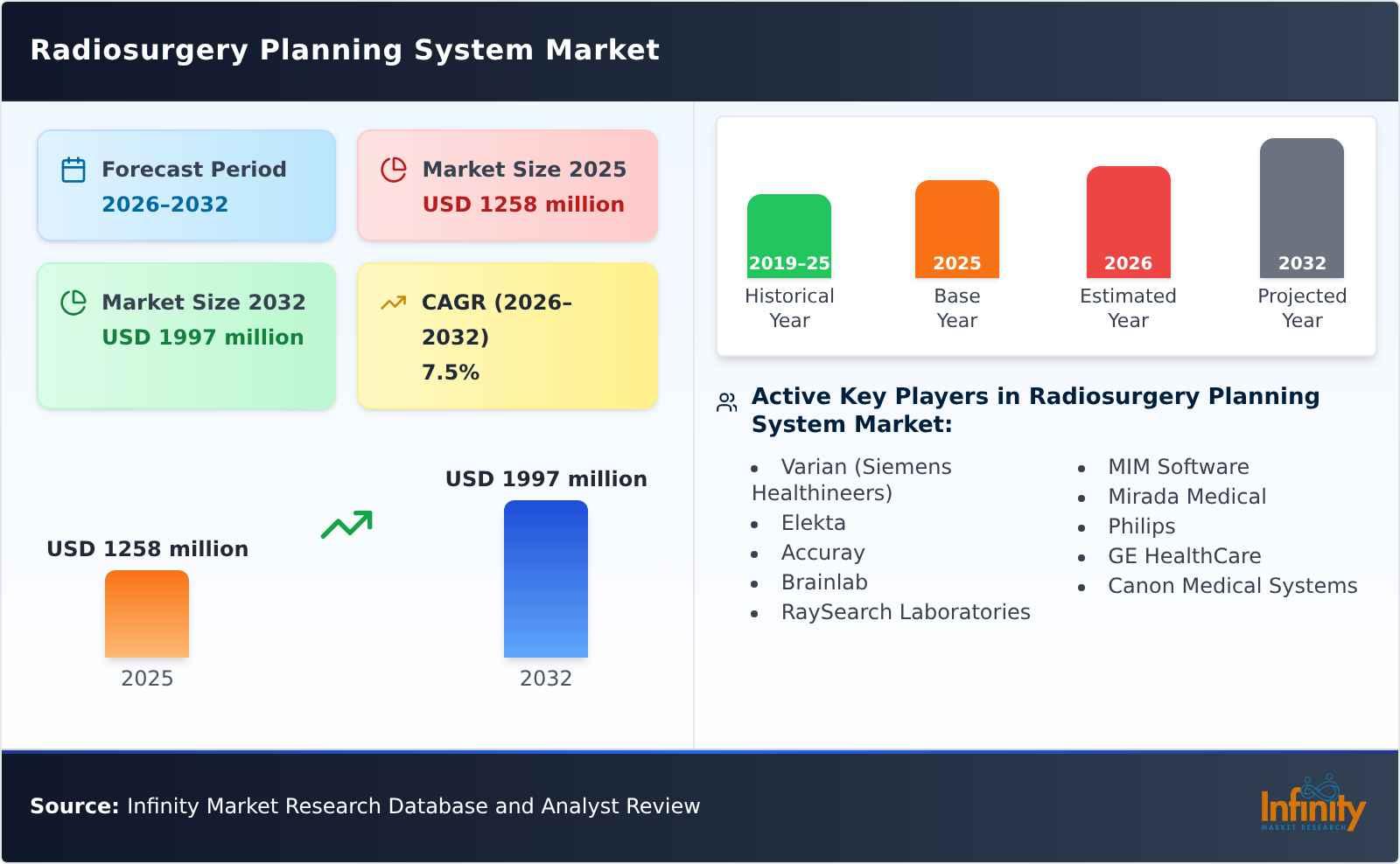
The global Radiosurgery Planning System market size is predicted to grow from US$ 1258 million in 2025 to US$ 1997 million in 2032; it is expected to grow at a CAGR of 7.5% from 2026 to 2032.
Explore this report in detail? Download a free sample copy
Download Free Sample Report
Radiosurgery Planning System is the core software platform for stereotactic radiosurgery (SRS) and related high-precision radiotherapy workflows. It converts multi-modal imaging and localization data (CT/MRI/PET, etc.) into a deliverable treatment plan through contouring, image registration (including deformable methods when needed), dose calculation, inverse planning optimization, and plan verification. The system ultimately bridges clinical intent?tumor control, organ-at-risk constraints, delivery efficiency, and safety margins?into quantifiable, reviewable, and traceable plan outputs, seamlessly integrating with delivery ecosystems such as LINAC-based SRS, Gamma Knife, or CyberKnife. Its strategic value lies in enabling standardized, consistent, and scalable radiosurgery capability as a digital foundation for advanced oncology services.The average gross profit margin of this product is 45%.
The expansion of precision oncology and functional radiosurgery applications is driving demand for planning software that is accurate, repeatable, and quality-controllable. A radiosurgery planning system is no longer just a dose calculator; it is an integrated hub connecting multi-modal imaging, optimization, QA review, and delivery workflows. It helps centralized teams shorten planning cycles, improve consistency in target coverage and organ protection, and support more complex cases and broader indications. In parallel, the rise of regional cancer centers, specialty branding competition, and patient preference for minimally invasive, efficient treatments are pushing providers to treat planning systems as strategic ?productivity assets,? accelerating the shift from standalone workstations to platform-based, networked, and multi-site collaborative deployments.
Barriers are defined by safety-critical accountability, algorithmic trust, and integration complexity. Because the planning system directly determines treatment output, any dose-calculation bias, registration error, or configuration mistake can be consequential?requiring rigorous validation, audit trails, version control, and access governance. Differences in vendor delivery chains, beam models, imaging ecosystems, and QA protocols increase cross-platform compatibility challenges and implementation costs. Hospital IT heterogeneity adds interface, network, and cybersecurity compliance burdens, often extending deployment timelines. Finally, outcomes depend on clinical team proficiency; without robust training and standardized workflows, software advantages may not translate into sustained improvements in safety and efficiency, limiting adoption and expansion.
Demand is shifting from ?plan generation? to ?quality governance and scalable replication.? Radiosurgery?s steep dose gradients and strict organ-at-risk constraints require structured peer review, automated rule checks, visual decision support, and comparable metrics across cases to reduce variability and risk. Meanwhile, stronger multi-modal fusion, on-board/intraoperative imaging, and adaptive radiotherapy trends are pushing systems to enhance registration, deformable propagation, dose accumulation, and fast re-optimization. As centralized planning and remote collaboration become more common, users increasingly prioritize network deployment, task orchestration, role-based access with auditability, and closed-loop integration with QA devices, imaging platforms, and oncology information systems?favoring comprehensive solutions that combine planning, workflow governance, and QA frameworks.
Upstream inputs are less physical ?materials? and more a combination of algorithms and compute, data connectivity, and engineering-grade quality systems. Key investments include dose engines and optimization solvers (with robust modeling across beams and delivery platforms), high-reliability imaging and registration modules, standardized data interoperability and interfaces (to CT/MRI/PET, PACS/RIS, and delivery devices), and scalable compute architectures (on-prem clusters, private cloud, or hybrid). Equally critical are medical software quality management and verification frameworks, cybersecurity and permission auditing, and a sustainable iteration loop driven by clinical feedback. The depth of these upstream capabilities ultimately manifests in planning accuracy, delivery stability, deployment scalability, and long-term compliance resilience.
LPI (LP Information) newest research report, the ?Radiosurgery Planning System Industry Forecast? looks at past sales and reviews total world Radiosurgery Planning System sales in 2025, providing a comprehensive analysis by region and market sector of projected Radiosurgery Planning System sales for 2026 through 2032. With Radiosurgery Planning System sales broken down by region, market sector and sub-sector, this report provides a detailed analysis in US$ millions of the world Radiosurgery Planning System industry.
This Insight Report provides a comprehensive analysis of the global Radiosurgery Planning System landscape and highlights key trends related to product segmentation, company formation, revenue, and market share, latest development, and M&A activity. This report also analyses the strategies of leading global companies with a focus on Radiosurgery Planning System portfolios and capabilities, market entry strategies, market positions, and geographic footprints, to better understand these firms? unique position in an accelerating global Radiosurgery Planning System market.
This Insight Report evaluates the key market trends, drivers, and affecting factors shaping the global outlook for Radiosurgery Planning System and breaks down the forecast by Type, by Application, geography, and market size to highlight emerging pockets of opportunity. With a transparent methodology based on hundreds of bottom-up qualitative and quantitative market inputs, this study forecast offers a highly nuanced view of the current state and future trajectory in the global Radiosurgery Planning System.
This report presents a comprehensive overview, market shares, and growth opportunities of Radiosurgery Planning System market by product type, application, key players and key regions and countries.
Segmentation by Type:
Linac-Based Radiosurgery Planning
Gamma Knife Planning
CyberKnife Planning
Other
Segmentation by Indication:
CNS
Spine
Lung
Liver
Other
Segmentation by Deployment:
Onprem
Private
Hybrid
Segmentation by Application:
Cancer Hospitals
General Hospitals
Research/Academic Centers
Other Users
This report also splits the market by region:
Americas
United States
Canada
Mexico
Brazil
APAC
China
Japan
Korea
Southeast Asia
India
Australia
Europe
Germany
France
UK
Italy
Russia
Middle East & Africa
Egypt
South Africa
Israel
Turkey
GCC Countries
The below companies that are profiled have been selected based on inputs gathered from primary experts and analyzing the companys coverage, product portfolio, its market penetration.
Varian (Siemens Healthineers)
Elekta
Accuray
Brainlab
RaySearch Laboratories
MIM Software
Mirada Medical
Philips
GE HealthCare
Canon Medical Systems
Radiosurgery Planning System Market Scope
| Report Attribute | Details |
|---|---|
| Market Size (Start Year) | USD XX Million |
| Market Size (End Year) | USD XX Million |
| Compound Annual Growth Rate (CAGR) | USD XX Million |
| Forecast Period | USD XX Million |
| Base Year | USD XX Million |
| Historical Data | USD XX Million |
| Key Players | USD XX Million |
REPORT COVERAGE
Revenue forecast, Company Analysis, Industry landscape, Growth factors, and Trends
SEGMENT COVERED
By component, deployment, organization size, application, and industry.
REGIONAL SCOPE
North America, Europe, Asia Pacific, Middle East & Africa, South & Central America
COUNTRY SCOPE
Includes key countries across all major regions.
📘 Frequently Asked Questions
1. What is the market size of Global Radiosurgery Planning System Market?
Answer: The global Radiosurgery Planning System market size is predicted to grow from US$ 1258 million in 2025 to US$ 1997 million in 2032; it is expected to grow at a CAGR of 7.5% from 2026 to 2032.
2. Which regions are analyzed in the Global Radiosurgery Planning System Market report?
Answer: The Global Radiosurgery Planning System Market report covers major regions such as Europe, Middle East & Africa. Each region is analyzed for trends, opportunities, and market dynamics.
3. What methodology is used for forecasting of Global Radiosurgery Planning System Market?
Answer: The Global Radiosurgery Planning System Market report uses a mix of primary research, secondary data, and expert analysis to build its forecasts. Models include both qualitative and quantitative approaches.
4. Are emerging markets analyzed separately in the Global Radiosurgery Planning System Market?
Answer: Yes, the Global Radiosurgery Planning System Market report highlights high-growth emerging regions with dedicated insights. These include untapped opportunities, risks, and potential for expansion.
5. Does the report include competitive benchmarking of Global Radiosurgery Planning System Market?
Answer: Yes, Global Radiosurgery Planning System Market report compares major players based on revenue, product portfolio, innovation, and regional presence. This helps assess competitive positioning.
6. Can I access country-level data within the Global Radiosurgery Planning System Market report?
Answer: Yes, Global Radiosurgery Planning System Market report includes detailed data by country, especially for key markets. This allows for localized insights and decision-making.
7. Can I get customized insights or data from the Global Radiosurgery Planning System Market report?
Answer: Yes, we offer customization options to align with your specific business needs. You can request tailored sections or regional breakdowns.

🔐 Secure Payment Guaranteed
Safe checkout with trusted global payment methods.
🌟 Why Choose Infinity Market Research?
At Infinity Market Research, we dont just deliver data — we deliver clarity, confidence, and competitive edge.
In a world driven by insights, we help businesses unlock the infinite potential of informed decisions.
Here why global brands, startups, and decision-makers choose us:
Industry-Centric Expertise
With deep domain knowledge across sectors — from healthcare and technology to manufacturing and consumer goods — our team delivers insights that matter.
Custom Research, Not Cookie-Cutter Reports
Every business is unique, and so are its challenges. Thats why we tailor our research to your specific goals, offering solutions that are actionable, relevant, and reliable.
Data You Can Trust
Our research methodology is rigorous, transparent, and validated at every step. We believe in delivering not just numbers, but numbers that drive real impact.
Client-Centric Approach
Your success is our priority. From first contact to final delivery, our team is responsive, collaborative, and committed to your goals — because you re more than a client; you re a partner.