


Global Rebar Welding Robot Market Size, Share and Analysis Report 2026-2032
Feb 2026
Machinery And Equipment
Pages: 82
ILR4239
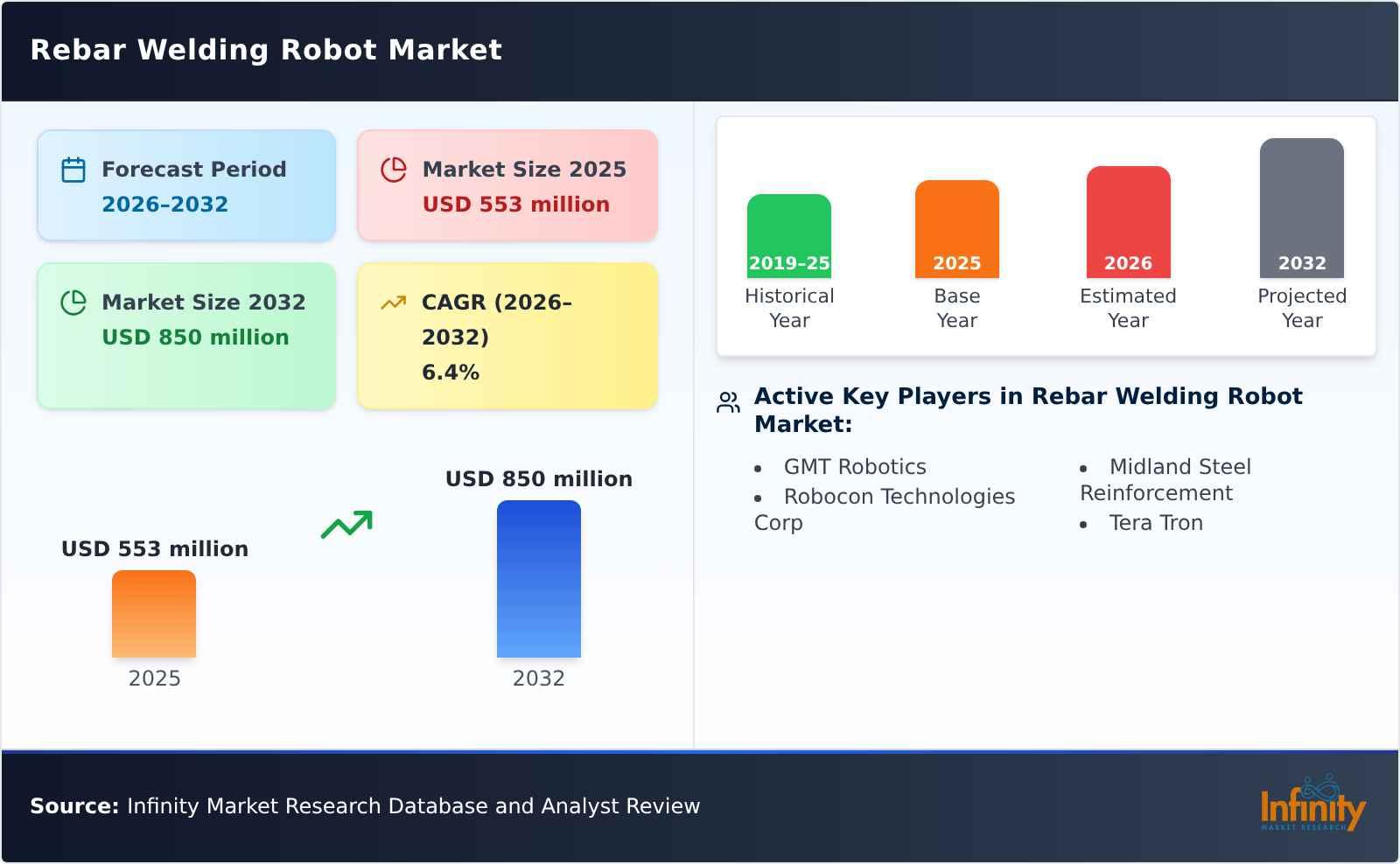
The global Rebar Welding Robot market size is predicted to grow from US$ 553 million in 2025 to US$ 850 million in 2032; it is expected to grow at a CAGR of 6.4% from 2026 to 2032.
Explore this report in detail? Download a free sample copy
Download Free Sample Report
In 2025, global Rebar Welding Robot production reached approximately 50,000 units, with an average global market price of around US$12,000 per unit. In 2025, the global s total production capacity of Rebar Welding Robot reached 66,000 units units. The industry average gross profit margin of this product reached 39%.Rebar welding robots are specialized industrial robot systems designed for automated rebar connection operations in the construction and engineering fields. They are not standalone devices but integrated intelligent solutions, typically consisting of a high-degree-of-freedom robotic arm, a dedicated welding power source, a high-precision end effector, and a core perception and control system. Their core function is to accurately identify the spatial location of rebar laps or intersections through offline programming or autonomous sensing technology, autonomously plan paths, and adjust parameters to stably complete high-quality, highly repetitive welding tasks in prefabrication plants or construction sites. This aims to replace traditional manual labor, fundamentally solving efficiency bottlenecks, quality fluctuations, and labor shortages in rebar engineering.
The rebar welding robot industry chain is a technology-intensive chain from precision components to end-user integrated applications. Upstream are core component and software suppliers, providing the three key components that determine robot performance: servo systems, reducers, and controllers, as well as indispensable welding power sources, laser vision sensors, and dedicated algorithm software. Midstream is the robot manufacturing and system integration stage, where the robot body, welding torch, sensors, fixtures, and process packages are integrated into a complete system adapted to construction site or factory scenarios. The downstream market comprises end-user markets, primarily large general contractors, specialized steel structure/precast component manufacturers, and major infrastructure projects. Their large-scale procurement and process requirements directly drive technological iteration and customized development across the industry chain.
The future of rebar welding robots is deeply intertwined with the global construction industrys trend towards industrialization and intelligent transformation. The market potential is enormous, but the penetration path is clear. Short-term drivers mainly stem from a global shortage of skilled welders due to an aging population, and increasingly stringent construction quality, safety, and environmental regulations, forcing large projects to prioritize the introduction of robots in prefabrication plants and standardized processes to improve efficiency and consistency. Medium- to long-term development will depend on technological maturity and cost reduction, particularly breakthroughs in visual AI and adaptive control technologies. These breakthroughs will enable robots to better cope with the chaotic environment of construction sites and rebar positioning errors, achieving a breakthrough from prefabricated to cast-in-place scenarios.
United States market for Rebar Welding Robot is estimated to increase from US$ million in 2025 to US$ million by 2032, at a CAGR of % from 2026 through 2032.
China market for Rebar Welding Robot is estimated to increase from US$ million in 2025 to US$ million by 2032, at a CAGR of % from 2026 through 2032.
Europe market for Rebar Welding Robot is estimated to increase from US$ million in 2025 to US$ million by 2032, at a CAGR of % from 2026 through 2032.
Global key Rebar Welding Robot players cover GMT Robotics, Robocon Technologies Corp, Midland Steel Reinforcement, Tera Tron, etc. In terms of revenue, the global two largest companies occupied for a share nearly % in 2025.
Infinity Market Research newest research report, the ?Rebar Welding Robot Industry Forecast? looks at past sales and reviews total world Rebar Welding Robot sales in 2025, providing a comprehensive analysis by region and market sector of projected Rebar Welding Robot sales for 2026 through 2032. With Rebar Welding Robot sales broken down by region, market sector and sub-sector, this report provides a detailed analysis in US$ millions of the world Rebar Welding Robot industry.
This Insight Report provides a comprehensive analysis of the global Rebar Welding Robot landscape and highlights key trends related to product segmentation, company formation, revenue, and market share, latest development, and M&A activity. This report also analyzes the strategies of leading global companies with a focus on Rebar Welding Robot portfolios and capabilities, market entry strategies, market positions, and geographic footprints, to better understand these firms? unique position in an accelerating global Rebar Welding Robot market.
This Insight Report evaluates the key market trends, drivers, and affecting factors shaping the global outlook for Rebar Welding Robot and breaks down the forecast by Technology Forms, by Application, geography, and market size to highlight emerging pockets of opportunity. With a transparent methodology based on hundreds of bottom-up qualitative and quantitative market inputs, this study forecast offers a highly nuanced view of the current state and future trajectory in the global Rebar Welding Robot.
This report presents a comprehensive overview, market shares, and growth opportunities of Rebar Welding Robot market by product type, application, key manufacturers and key regions and countries.
Segmentation by Technology Forms:
Joint Robots
Cartesian Robots
Segmentation Welding Processes:
Arc Welding Robots
Laser Welding Robots
Resistance Spot Welding Robots
Hybrid Welding Robots
Segmentation by Application:
Precast Factory Automation
On-site Construction Automation
This report also splits the market by region:
Americas
United States
Canada
Mexico
Brazil
APAC
China
Japan
Korea
Southeast Asia
India
Australia
Europe
Germany
France
UK
Italy
Russia
Middle East & Africa
Egypt
South Africa
Israel
Turkey
GCC Countries
The below companies that are profiled have been selected based on inputs gathered from primary experts and analysing the companys coverage, product portfolio, its market penetration.
GMT Robotics
Robocon Technologies Corp
Midland Steel Reinforcement
Tera Tron
Key Questions Addressed in this Report
What is the 10-year outlook for the global Rebar Welding Robot market?
What factors are driving Rebar Welding Robot market growth, globally and by region?
Which technologies are poised for the fastest growth by market and region?
How do Rebar Welding Robot market opportunities vary by end market size?
How does Rebar Welding Robot break out by Technology Forms, by Application?
Rebar Welding Robot Market Scope
| Report Attribute | Details |
|---|---|
| Market Size (Start Year) | USD XX Million |
| Market Size (End Year) | USD XX Million |
| Compound Annual Growth Rate (CAGR) | USD XX Million |
| Forecast Period | USD XX Million |
| Base Year | USD XX Million |
| Historical Data | USD XX Million |
| Key Players | USD XX Million |
REPORT COVERAGE
Revenue forecast, Company Analysis, Industry landscape, Growth factors, and Trends
SEGMENT COVERED
By component, deployment, organization size, application, and industry.
REGIONAL SCOPE
North America, Europe, Asia Pacific, Middle East & Africa, South & Central America
COUNTRY SCOPE
Includes key countries across all major regions.
Frequently Asked Questions
1. What is the market size of Global Rebar Welding Robot Market?
Answer: The global Rebar Welding Robot market size is predicted to grow from US$ 553 million in 2025 to US$ 850 million in 2032; it is expected to grow at a CAGR of 6.4% from 2026 to 2032.
2. Which regions are analyzed in the Global Rebar Welding Robot Market report?
Answer: The Global Rebar Welding Robot Market report covers major regions such as Europe, Middle East & Africa. Each region is analyzed for trends, opportunities, and market dynamics.
3. What methodology is used for forecasting of Global Rebar Welding Robot Market?
Answer: The Global Rebar Welding Robot Market report uses a mix of primary research, secondary data, and expert analysis.
4. Are emerging markets analyzed separately in the Global Rebar Welding Robot Market?
Answer: Yes, the Global Rebar Welding Robot Market report highlights high-growth emerging regions with dedicated insights.
5. Does the report include competitive benchmarking of Global Rebar Welding Robot Market?
Answer: Yes, Global Rebar Welding Robot Market report compares major players based on revenue, product portfolio, and innovation.
6. Can I access country-level data within the Global Rebar Welding Robot Market report?
Answer: Yes, Global Rebar Welding Robot Market report includes detailed data by country for major regions.
7. Can I get customized insights or data from the Global Rebar Welding Robot Market report?
Answer: Yes, we offer customization options to align with your specific business needs. You can request tailored sections or regional breakdowns.