


Global Resistive Tactile Sensors Market Size, Share and Analysis Report 2026-2032
Feb 2026
Semiconductor and Electronics
Pages: 165
ILR4358
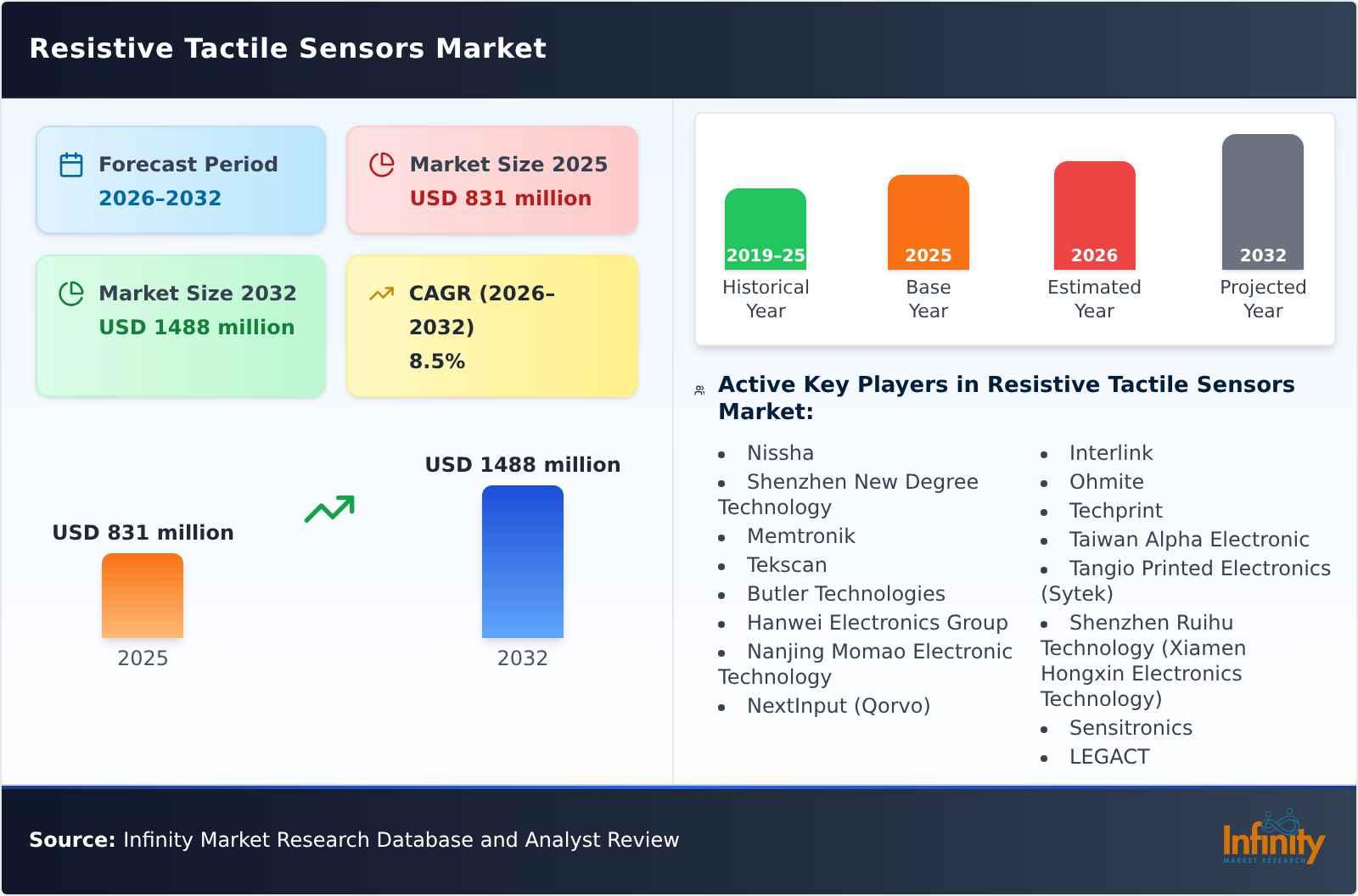
The global Resistive Tactile Sensors market size is predicted to grow from US$ 831 million in 2025 to US$ 1488 million in 2032; it is expected to grow at a CAGR of 8.5% from 2026 to 2032.
Explore this report in detail? Download a free sample copy
Download Free Sample Report
Resistive Tactile Sensors are sensing devices based on the principle that resistance changes with external pressure. Their core components consist of a force-sensitive resistor element, a substrate material, and signal processing circuitry. They are key devices for converting mechanical pressure signals into measurable electrical signals.
Their working principle stems from the piezoresistive effect or contact resistance variation of the material: when an external force acts on the sensor surface, the lattice structure of the internal force-sensitive resistor deforms, or the contact state between conductive particles changes, directly causing a regular increase or decrease in its resistance value. The accompanying signal processing circuitry captures this resistance change and converts it into standard electrical signals such as voltage and current, ultimately achieving accurate detection of pressure magnitude.
Force-sensitive resistor sensors are characterized by their small size, fast response speed, and low cost. They can adapt to different pressure ranges and are widely used in consumer electronics, automotive electronics, medical, robotics, and other scenarios. They are fundamental components for force signal sensing in industrial automation and smart hardware.
Resistive Tactile Sensors, with their precise sensing and flexible adaptability, directly address core pain points in both industrial and consumer electronics sectors. In industrial settings, they solve the problems of lagging pressure monitoring and inaccurate force feedback in traditional production lines, becoming the tactile nerves of smart manufacturing, ensuring stable equipment operation and precision. In consumer electronics, they overcome the pain points of insufficient touch sensitivity in smart terminals and poor pressure detection adaptability in wearable devices, supporting upgrades to product experience. With the deepening of industrial automation and the iterative innovation of consumer electronics, Resistive Tactile Sensors will advance towards miniaturization, intelligence, and flexibility, meeting the stringent requirements of high-end industrial scenarios while adapting to diverse consumer applications, releasing greater value in the wave of the smart industry, and promising a broad market prospect.
In 2025, global Resistive Tactile Sensors reached approximately 269.74 M Units, with an average global market price of around 3148USD per K Units.
Resistive Tactile Sensors upstream raw materials mainly include substrate materials such as polyester film (PET) and polyimide (PI), and conductive functional materials such as high-purity zinc oxide and tin dioxide. Typical suppliers include Toray, SKC Films, DuPont, Mitsubishi, and Polyplex. Downstream applications mainly include consumer electronics, automotive electronics, medical devices, and robotics. Typical customers include Fujifilm, Huawei, Foxconn, Samsung, LG, and Goertek.
The single-line production capacity of Resistive Tactile Sensors varies considerably depending on the complexity of the production process and the level of automation, generally ranging from tens of thousands to hundreds of thousands of units, with a gross profit margin between 30% and 40%.
United States market for Resistive Tactile Sensors is estimated to increase from US$ million in 2025 to US$ million by 2032, at a CAGR of % from 2026 through 2032.
China market for Resistive Tactile Sensors is estimated to increase from US$ million in 2025 to US$ million by 2032, at a CAGR of % from 2026 through 2032.
Europe market for Resistive Tactile Sensors is estimated to increase from US$ million in 2025 to US$ million by 2032, at a CAGR of % from 2026 through 2032.
Global key Resistive Tactile Sensors players cover Nissha, Shenzhen New Degree Technology, Memtronik, Tekscan, Butler Technologies, etc. In terms of revenue, the global two largest companies occupied for a share nearly % in 2025.
Infinity Market Research newest research report, the ?Resistive Tactile Sensors Industry Forecast? looks at past sales and reviews total world Resistive Tactile Sensors sales in 2025, providing a comprehensive analysis by region and market sector of projected Resistive Tactile Sensors sales for 2026 through 2032. With Resistive Tactile Sensors sales broken down by region, market sector and sub-sector, this report provides a detailed analysis in US$ millions of the world Resistive Tactile Sensors industry.
This Insight Report provides a comprehensive analysis of the global Resistive Tactile Sensors landscape and highlights key trends related to product segmentation, company formation, revenue, and market share, latest development, and M&A activity. This report also analyzes the strategies of leading global companies with a focus on Resistive Tactile Sensors portfolios and capabilities, market entry strategies, market positions, and geographic footprints, to better understand these firms? unique position in an accelerating global Resistive Tactile Sensors market.
This Insight Report evaluates the key market trends, drivers, and affecting factors shaping the global outlook for Resistive Tactile Sensors and breaks down the forecast by Type, by Application, geography, and market size to highlight emerging pockets of opportunity. With a transparent methodology based on hundreds of bottom-up qualitative and quantitative market inputs, this study forecast offers a highly nuanced view of the current state and future trajectory in the global Resistive Tactile Sensors.
This report presents a comprehensive overview, market shares, and growth opportunities of Resistive Tactile Sensors market by product type, application, key manufacturers and key regions and countries.
Segmentation by Type:
Shunt Mode
Thru Mode
Segmentation by Shape:
Shunt Mode
Thru Mode
Segmentation by Sensitivity Range:
50N Below
50-100N
100N Above
Segmentation by Application:
Consumer Electronics
Automotive Electronics
Medical
Robotics
Others
This report also splits the market by region:
Americas
United States
Canada
Mexico
Brazil
APAC
China
Japan
Korea
Southeast Asia
India
Australia
Europe
Germany
France
UK
Italy
Russia
Middle East & Africa
Egypt
South Africa
Israel
Turkey
GCC Countries
The below companies that are profiled have been selected based on inputs gathered from primary experts and analysing the companys coverage, product portfolio, its market penetration.
Nissha
Shenzhen New Degree Technology
Memtronik
Tekscan
Butler Technologies
Hanwei Electronics Group
Nanjing Momao Electronic Technology
NextInput (Qorvo)
Interlink
Ohmite
Techprint
Taiwan Alpha Electronic
Tangio Printed Electronics (Sytek)
Shenzhen Ruihu Technology (Xiamen Hongxin Electronics Technology)
Sensitronics
LEGACT
Cubbison
Ceradex Corporation
Reid Industrial Graphic Products
Shanghai Smith Adhesive New Material
Moxian Technology
Zhejiang Fulai New Materials
Key Questions Addressed in this Report
What is the 10-year outlook for the global Resistive Tactile Sensors market?
What factors are driving Resistive Tactile Sensors market growth, globally and by region?
Which technologies are poised for the fastest growth by market and region?
How do Resistive Tactile Sensors market opportunities vary by end market size?
How does Resistive Tactile Sensors break out by Type, by Application?
Resistive Tactile Sensors Market Scope
| Report Attribute | Details |
|---|---|
| Market Size (Start Year) | USD XX Million |
| Market Size (End Year) | USD XX Million |
| Compound Annual Growth Rate (CAGR) | USD XX Million |
| Forecast Period | USD XX Million |
| Base Year | USD XX Million |
| Historical Data | USD XX Million |
| Key Players | USD XX Million |
REPORT COVERAGE
Revenue forecast, Company Analysis, Industry landscape, Growth factors, and Trends
SEGMENT COVERED
By component, deployment, organization size, application, and industry.
REGIONAL SCOPE
North America, Europe, Asia Pacific, Middle East & Africa, South & Central America
COUNTRY SCOPE
Includes key countries across all major regions.
📘 Frequently Asked Questions
1. What is the market size of Global Resistive Tactile Sensors Market?
Answer: The global Resistive Tactile Sensors market size is predicted to grow from US$ 831 million in 2025 to US$ 1488 million in 2032; it is expected to grow at a CAGR of 8.5% from 2026 to 2032.
2. Which regions are analyzed in the Global Resistive Tactile Sensors Market report?
Answer: The Global Resistive Tactile Sensors Market report covers major regions such as Europe, Middle East & Africa. Each region is analyzed for trends, opportunities, and market dynamics.
3. What methodology is used for forecasting of Global Resistive Tactile Sensors Market?
Answer: The Global Resistive Tactile Sensors Market report uses a mix of primary research, secondary data, and expert analysis.
4. Are emerging markets analyzed separately in the Global Resistive Tactile Sensors Market?
Answer: Yes, the Global Resistive Tactile Sensors Market report highlights high-growth emerging regions with dedicated insights.
5. Does the report include competitive benchmarking of Global Resistive Tactile Sensors Market?
Answer: Yes, Global Resistive Tactile Sensors Market report compares major players based on revenue, product portfolio, and innovation.
6. Can I access country-level data within the Global Resistive Tactile Sensors Market report?
Answer: Yes, Global Resistive Tactile Sensors Market report includes detailed data by country for major regions.
7. Can I get customized insights or data from the Global Resistive Tactile Sensors Market report?
Answer: Yes, we offer customization options to align with your specific business needs. You can request tailored sections or regional breakdowns.