


Global Robot Electronic Skin Market Growth 2026-2032
Jan 2026
Semiconductor and Electronics
Pages: 180
ILR1484
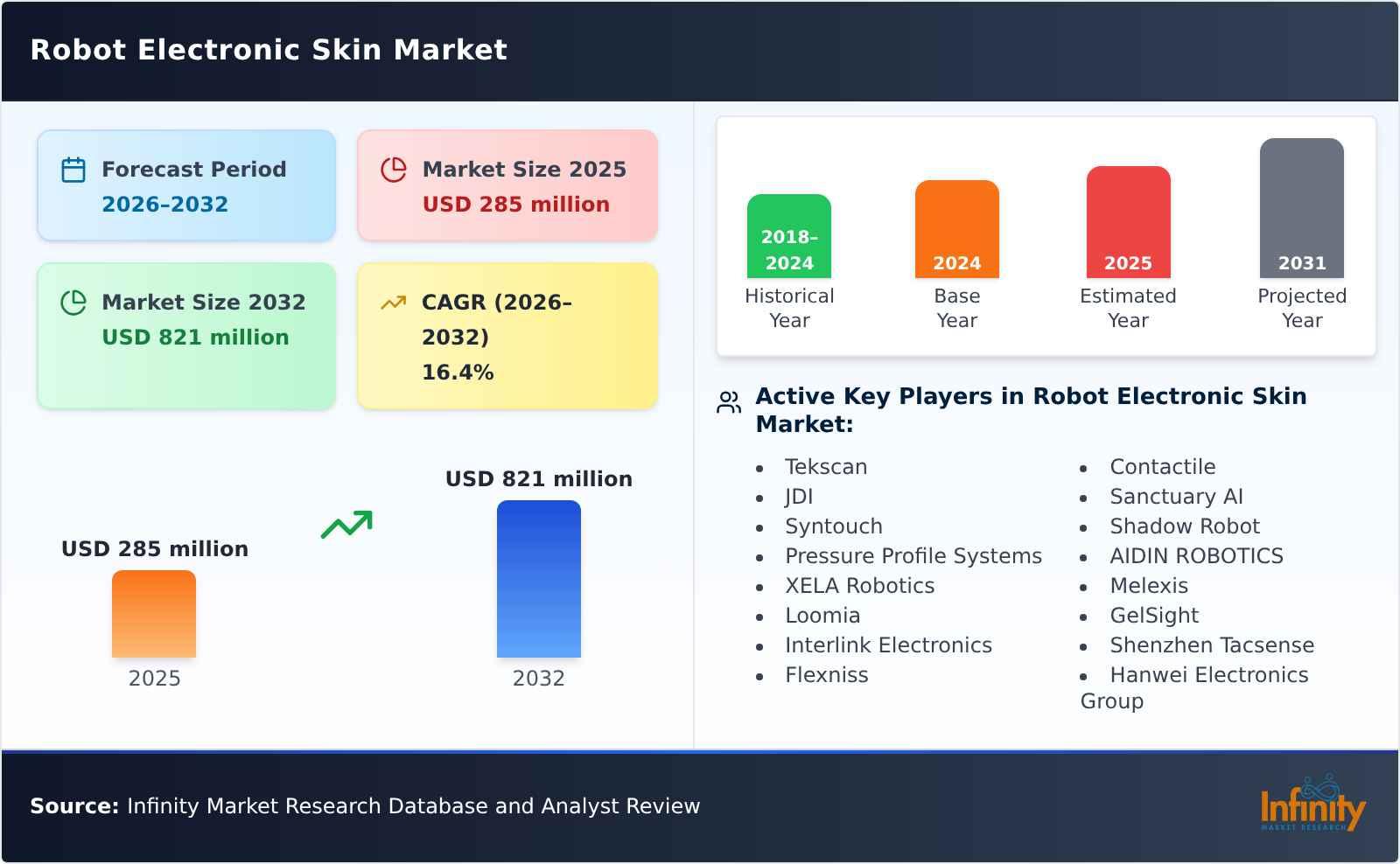
The global Robot Electronic Skin market size is predicted to grow from US$ 285 million in 2025 to US$ 821 million in 2032; it is expected to grow at a CAGR of 16.4% from 2026 to 2032.
Explore this report in detail? Download a free sample copy
Download Free Sample Report
Electronic skin, also known as a flexible tactile sensor, is an intelligent sensing system that mimics the tactile perception mechanism of biological skin, aiming to endow robots with human-like tactile functions. This system integrates advanced flexible electronic materials, nanosensors, and microfabrication technology to achieve highly sensitive detection and real-time feedback of environmental variables such as contact force, temperature, and humidity. The design of electronic skin not only enhances the robots environmental interaction capabilities and operational precision but also strengthens its adaptability and safety in complex working environments, with applications covering multiple fields such as medical monitoring, smart wearables, robotics, and virtual reality. With the rapid development of the robotics industry, electronic skin, which gives robots tactile senses, has become one of the most watched areas in the industry chain. Electronic skin is crucial for robots. When a robot comes into contact with an external object, the skin transmits electrical signals to the robots brain, allowing the brain to perceive information such as the texture, pattern, temperature, and shape of the object, making the robots movements more flexible and effective. The core of electronic skin is the flexible tactile sensor, currently employing various technical approaches such as piezoresistive, capacitive, and piezoelectric sensors. Electronic skin generally consists of a flexible substrate, an active functional layer, dielectric materials, and electrodes. Existing substrate materials include polyimide (PI), polydimethylsiloxane (PDMS), and polyethylene terephthalate (PET). Main application scenarios are as follows: Dexterous hands and bionic fingertips: used for precision grasping, force feedback control, temperature sensing, etc., to achieve functions such as recognizing object shape, hardness, and sliding. Case applications: ABB YuMi collaborative robot, ShadowRobot dexterous hand, UBTECH Walker X home robot. Downstream customers: Xiaomi, Leadshine Intelligent, Zhiyuan Robotics, Huawei humanoid robots, etc. In 2025, global Robot Electronic Skin production reached 3.7501 million square meters, with an average selling price of US$77.68 per square meter. Monthly production for companies was 5,000-6,000 square meters, with a gross profit margin of approximately 29.35%-30.47%.
In the field of intelligent robots and bionic systems, electronic skin is becoming a key infrastructure driving machine intelligence towards human-like perception. By endowing robots with tactile, pressure, temperature, and even pain perception similar to human skin, electronic skin makes human-machine collaboration safer, more natural, and more intelligent. From a technological perspective, electronic skin for robots often employs distributed flexible sensor networks, including flexible piezoresistive/capacitive arrays, temperature/humidity sensing units, stretchable conductors, and artificial neural interface circuits, supplemented by embedded AI chips and edge computing modules to achieve multimodal perception and rapid local response.
Currently, the downstream applications of electronic skin are in their early stages, with the robotics industry primarily focused on trial production and small-batch manufacturing. Hanwei Technology: Its subsidiary, Suzhou Nengsida, has developed eight series of flexible sensor products and currently operates four mature production lines, including two printing lines, one assembly line, and one testing line. The companys flexible sensor division boasts ultra-clean printing and assembly lines with an annual production capacity exceeding ten million units. Current capacity utilization is high, and the company is planning to add more production lines to increase capacity based on demand growth, with plans to complete the construction and trial operation of new production lines in the first half of 2025. Tashan Technology: In 2024, the companys electronic skin began mass production and shipment, demonstrating its large-scale production capabilities. Shenhao Technology: Its independently developed non-contact electronic skin sensors are currently being used in small batches in its own intelligent robot products, such as switch room operation robots, to achieve obstacle avoidance and ensure safety. Moxian Technology: In January 2025, Moxian Technology partnered with Pudu Robotics to apply its flexible pressure sensor technology to the robotic arm of Pudus latest humanoid robot, the PUDU D9. Fulei New Materials: On November 27, 2025, the companys independently developed electronic skin product completed multiple iterations and achieved mass production. Currently, it has dozens of domestic and international clients, some of whom have explicitly requested bulk orders. The main applications are: in high-end intelligent manufacturing, enabling humanoid robots and dexterous hands to perform precision assembly tasks previously only achievable by human hands; and in intelligent companions, providing tactile coverage from fingertips to the entire body. In September 2025, the company established a wholly-owned subsidiary, Apex Sensing LLC, in California, USA, and set up a business and technical team there, already achieving progress in small-batch orders in the North American market.
Infinity Market Research newest research report, the Robot Electronic Skin Industry Forecast looks at past sales and reviews total world Robot Electronic Skin sales in 2025, providing a comprehensive analysis by region and market sector of projected Robot Electronic Skin sales for 2026 through 2032. With Robot Electronic Skin sales broken down by region, market sector and sub-sector, this report provides a detailed analysis in US$ millions of the world Robot Electronic Skin industry.
This Insight Report provides a comprehensive analysis of the global Robot Electronic Skin landscape and highlights key trends related to product segmentation, company formation, revenue, and market share, latest development, and M&A activity. This report also analyzes the strategies of leading global companies with a focus on Robot Electronic Skin portfolios and capabilities, market entry strategies, market positions, and geographic footprints, to better understand these firms unique position in an accelerating global Robot Electronic Skin market.
This Insight Report evaluates the key market trends, drivers, and affecting factors shaping the global outlook for Robot Electronic Skin and breaks down the forecast by Type, by Application, geography, and market size to highlight emerging pockets of opportunity. With a transparent methodology based on hundreds of bottom-up qualitative and quantitative market inputs, this study forecast offers a highly nuanced view of the current state and future trajectory in the global Robot Electronic Skin.
This report presents a comprehensive overview, market shares, and growth opportunities of Robot Electronic Skin market by product type, application, key manufacturers and key regions and countries.
Segmentation by Type:
Piezoresistive Type
Capacitive Type
Piezoelectric Type
Ionizing Type
Electromagnetic Type
Other
Segmentation by Flexible Substrate:
Polydimethylsiloxane (PDMS)
Polyimide (PI)
Polyethylene Terephthalate (PET)
Others
Segmentation by Manufacturing Process:
Photolithography and Silicon Etching Technology
3D Printing
Inkjet Printing
Screen Printing
Segmentation by Application:
Industrial Robotics
Medical Robotics
Service Robotics
Others
This report also splits the market by region:
Americas
United States
Canada
Mexico
Brazil
APAC
China
Japan
Korea
Southeast Asia
India
Australia
Europe
Germany
France
UK
Italy
Russia
Middle East & Africa
Egypt
South Africa
Israel
Turkey
GCC Countries
The below companies that are profiled have been selected based on inputs gathered from primary experts and analysing the companys coverage, product portfolio, its market penetration.
Tekscan
JDI
Syntouch
Pressure Profile Systems
XELA Robotics
Loomia
Interlink Electronics
Flexniss
Contactile
Sanctuary AI
Shadow Robot
AIDIN ROBOTICS
Melexis
GelSight
Shenzhen Tacsense
Hanwei Electronics Group
PaXiniTech
Shenzhen Legact Technology Co., Ltd.
New Degree Technology
Hangzhou Shenhao Technology Co.,LTD.
Beijing Tashan Science And Technology Co., Ltd.
Moxian Technology (Dongguan) Co., Ltd
Sycsense Technology(Shenzhen) Co., Ltd.
ADD Industry(Zhejiang) CO., LTD.
Zhejiang Fulai New Material Co., Ltd.
Beijing Jingzhigan New Materials Co., Ltd.
Key Questions Addressed in this Report
What is the 10-year outlook for the global Robot Electronic Skin market?
What factors are driving Robot Electronic Skin market growth, globally and by region?
Which technologies are poised for the fastest growth by market and region?
How do Robot Electronic Skin market opportunities vary by end market size?
How does Robot Electronic Skin break out by Type, by Application?
Robot Electronic Skin Market Scope
| Report Attribute | Details |
|---|---|
| Market Size (Start Year) | USD XX Million |
| Market Size (End Year) | USD XX Million |
| Compound Annual Growth Rate (CAGR) | USD XX Million |
| Forecast Period | USD XX Million |
| Base Year | USD XX Million |
| Historical Data | USD XX Million |
| Key Players | USD XX Million |
REPORT COVERAGE
Revenue forecast, Company Analysis, Industry landscape, Growth factors, and Trends
SEGMENT COVERED
By component, deployment, organization size, application, and industry.
REGIONAL SCOPE
North America, Europe, Asia Pacific, Middle East & Africa, South & Central America
COUNTRY SCOPE
Includes key countries across all major regions.
📘 Frequently Asked Questions
1. What is the market size of Global Robot Electronic Skin Market?
Answer: The global Robot Electronic Skin market size is predicted to grow from US$ 285 million in 2025 to US$ 821 million in 2032; it is expected to grow at a CAGR of 16.4% from 2026 to 2032.
2. Which regions are analyzed in the Global Robot Electronic Skin Market report?
Answer: The Global Robot Electronic Skin Market report covers major regions such as North America, Europe, Middle East & Africa. Each region is analyzed for trends, opportunities, and market dynamics.
3. What methodology is used for forecasting of Global Robot Electronic Skin Market?
Answer: The Global Robot Electronic Skin Market report uses a mix of primary research, secondary data, and expert analysis.
4. Are emerging markets analyzed separately in the Global Robot Electronic Skin Market?
Answer: Yes, the Global Robot Electronic Skin Market report highlights high-growth emerging regions with dedicated insights.
5. Does the report include competitive benchmarking of Global Robot Electronic Skin Market?
Answer: Yes, Global Robot Electronic Skin Market report compares major players based on revenue, product portfolio, and innovation.
6. Can I access country-level data within the Global Robot Electronic Skin Market report?
Answer: Yes, Global Robot Electronic Skin Market report includes detailed data by country for major regions.
7. Can I get customized insights or data from the Global Robot Electronic Skin Market report?
Answer: Yes, we offer customization options to align with your specific business needs. You can request tailored sections or regional breakdowns.