


Global Rotary Actuators for Humanoid Robots Market Size, Share and Analysis Report 2026-2032
Mar 2026
Machinery And Equipment
Pages: 75
ILR4813
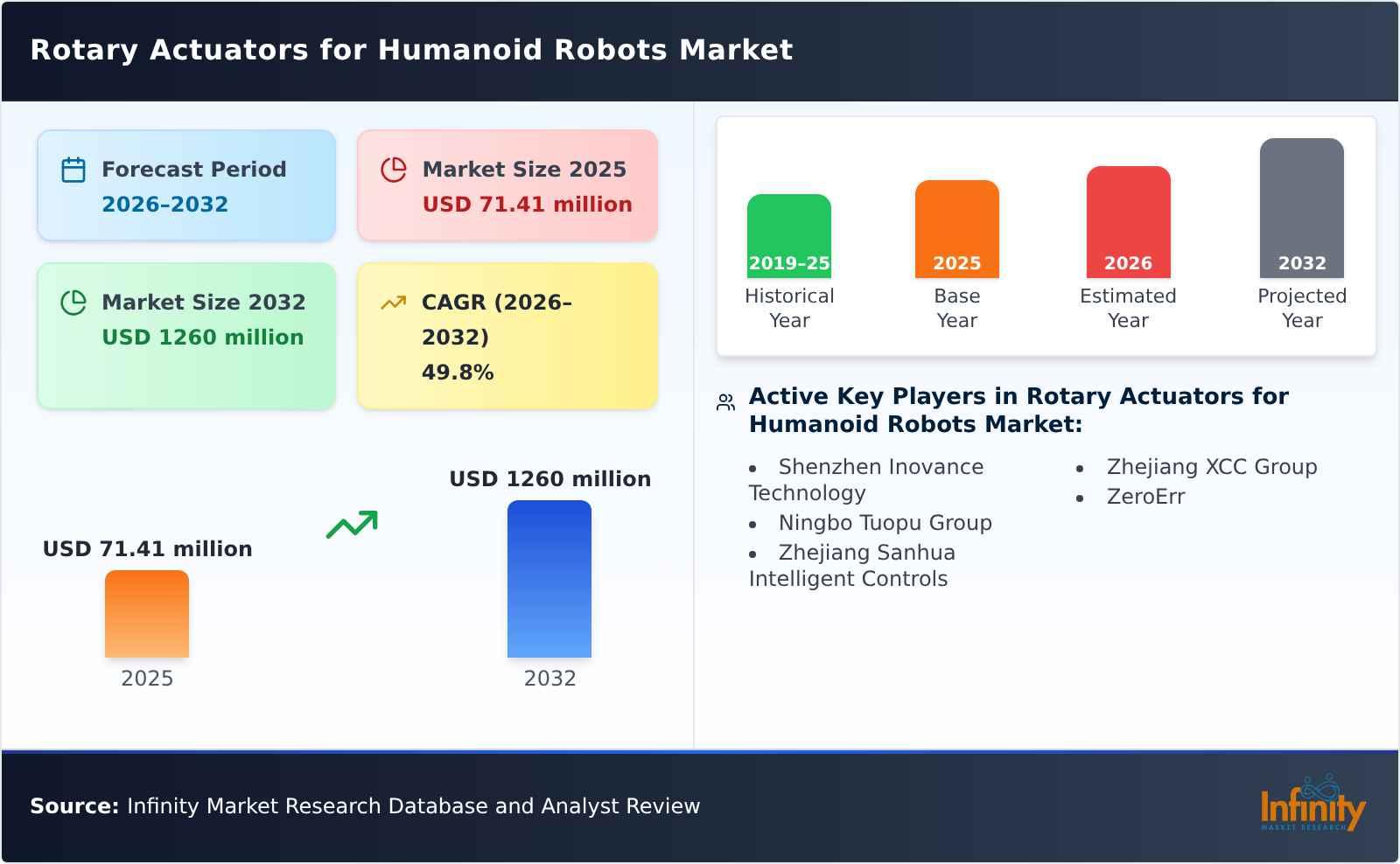
The global Rotary Actuators for Humanoid Robots market size is predicted to grow from US$ 71.41 million in 2025 to US$ 1260 million in 2032; it is expected to grow at a CAGR of 49.8% from 2026 to 2032.
Explore this report in detail? Download a free sample copy
Download Free Sample Report
In 2025, global Rotary Actuators for Humanoid Robots capacity 240 k Units, sales reached approximately 231 k Units, with an average market price of around 317 USD/Unit, industrial gross margin 41%.
Rotary Actuators for Humanoid Robots are no longer ?just joints.? They are the performance-and-cost anchor that determines whether a humanoid can move with authority, survive real duty cycles, and ship repeatedly with predictable quality. As programs transition from prototypes to replicable builds, the actuator becomes the shared bottleneck: arms demand bandwidth and backdrivability for safe interaction; legs demand stiffness, shock tolerance, and fatigue life; torso and neck prioritize stability and low acoustic signature. In practice, Rotary Actuators for Humanoid Robots are judged by system delivery?power density plus thermal headroom plus consistency?rather than by a single peak metric.
The key evaluation set for Rotary Actuators for Humanoid Robots tends to converge on six engineering ?truths?: (1) peak vs. continuous torque and torque density, (2) joint speed/acceleration and usable control bandwidth, (3) backlash and torsional stiffness under load, (4) force/impedance control capability and sensor stack quality, (5) thermal rise and heat-flow architecture, and (6) sealing/robustness for industrial handling. The dominant architecture is the integrated joint module: a frameless torque motor or flat BLDC + precision reduction (harmonic/cycloidal RV/planetary) + cross-roller bearing + absolute encoder (increasingly dual-encoder, multi-turn) + embedded FOC drive with CANopen/EtherCAT. The industry direction is clear: integration pushes intelligence down into the joint?single-cable wiring, position retention behavior, built-in protection and diagnostics, and calibration routines become part of the actuator, not the robot.
Supplier dynamics reflect ?critical-component pull? and ?system-integration tiers.? Harmonic-drive-based servo actuators remain compelling when compact packaging, high positional accuracy, and near-zero backlash are the priority; cycloidal RV solutions typically win where large torque, long life, and shock tolerance dominate; frameless motor platforms compete on torque density, manufacturability, and the ability to scale from prototype to full production without redesign; bearings and encoders often set the true ceiling on lifetime and repeatability. The Rotary Actuators for Humanoid Robots value chain therefore runs from upstream magnetic materials and electrical steel, specialty steels and bearing steels, into midstream stator/rotor manufacturing, precision gearing with heat treatment and grinding, drives and power electronics, and then into joint modules and final assembly. The hard moat is rarely ?the CAD model??it is distortion control in heat treatment, contact fatigue on gear/race surfaces, dual-encoder calibration, motor-drive tuning, and statistical process control that keeps batch-to-batch behavior within tight limits.
Commercial momentum is increasingly visible through designated sourcing and framework agreements that freeze specs early. In December 2025, Zhongyuan Neipei disclosed a strategic cooperation framework with Ningbo Puzhi Future Robot. One explicit objective is that, after supplier qualification, the subsidiary aims to become a core supplier of humanoid robot joint modules, with a five-year cooperation term. The disclosure also emphasizes process and manufacturing commonality between robot joint modules and established electromechanical actuators?an important signal that automotive-grade manufacturing discipline (quality systems, supply-chain control, traceability) is moving into Rotary Actuators for Humanoid Robots as a practical route to scale.
The growth engine for Rotary Actuators for Humanoid Robots is shifting from ?peak performance? to ?platform cost-down and supply resilience.? Expect continued upward integration (embedded drives, simplified harnessing, dual absolute encoders, built-in diagnostics), clearer module standardization (high-torque/high-stiffness leg joints; high-bandwidth/backdrivable arm joints; highly integrated miniature hand joints), and thermal design becoming the mass-production separator (heat paths, grease life, drift compensation under long duty cycles). Upstream magnet supply is now a first-order design constraint: on Oct 9, 2025, China?s MOFCOM Announcement No. 61 implemented export controls covering specified rare-earth items and items containing rare-earth permanent magnet materials; in July 2025, MP Materials and Apple announced a US$500 million partnership to produce recycled rare-earth magnets in the U.S., while MP Materials also announced a public-private partnership with the U.S. defense-related side to accelerate domestic magnet independence; in Oct 2025, Lynas announced expansion of heavy rare earth separation capacity in Malaysia. For actuator makers, the practical responses are already visible: magnet recipes that reduce heavy-rare-earth dependence, recycling loops and dual-sourcing qualification, and elevating manufacturability metrics (yield, consistency, traceability) to the same status as torque density.
Infinity Market Research newest research report, the ?Rotary Actuators for Humanoid Robots Industry Forecast? looks at past sales and reviews total world Rotary Actuators for Humanoid Robots sales in 2025, providing a comprehensive analysis by region and market sector of projected Rotary Actuators for Humanoid Robots sales for 2026 through 2032. With Rotary Actuators for Humanoid Robots sales broken down by region, market sector and sub-sector, this report provides a detailed analysis in US$ millions of the world Rotary Actuators for Humanoid Robots industry.
This Insight Report provides a comprehensive analysis of the global Rotary Actuators for Humanoid Robots landscape and highlights key trends related to product segmentation, company formation, revenue, and market share, latest development, and M&A activity. This report also analyzes the strategies of leading global companies with a focus on Rotary Actuators for Humanoid Robots portfolios and capabilities, market entry strategies, market positions, and geographic footprints, to better understand these firms? unique position in an accelerating global Rotary Actuators for Humanoid Robots market.
This Insight Report evaluates the key market trends, drivers, and affecting factors shaping the global outlook for Rotary Actuators for Humanoid Robots and breaks down the forecast by Power, by Application, geography, and market size to highlight emerging pockets of opportunity. With a transparent methodology based on hundreds of bottom-up qualitative and quantitative market inputs, this study forecast offers a highly nuanced view of the current state and future trajectory in the global Rotary Actuators for Humanoid Robots.
This report presents a comprehensive overview, market shares, and growth opportunities of Rotary Actuators for Humanoid Robots market by product type, application, key manufacturers and key regions and countries.
Segmentation by Power:
Hydraulic Type
Pneumatic Type
Electric Type
Segmentation by Type:
Rigid Type
Elastic Type
Collimation Type
Segmentation by Application:
Biped Humanoid Robot
Wheeled Humanoid Robot
This report also splits the market by region:
Americas
United States
Canada
Mexico
Brazil
APAC
China
Japan
Korea
Southeast Asia
India
Australia
Europe
Germany
France
UK
Italy
Russia
Middle East & Africa
Egypt
South Africa
Israel
Turkey
GCC Countries
The below companies that are profiled have been selected based on inputs gathered from primary experts and analysing the companys coverage, product portfolio, its market penetration.
Shenzhen Inovance Technology
Ningbo Tuopu Group
Zhejiang Sanhua Intelligent Controls
Zhejiang XCC Group
ZeroErr
Key Questions Addressed in this Report
What is the 10-year outlook for the global Rotary Actuators for Humanoid Robots market?
What factors are driving Rotary Actuators for Humanoid Robots market growth, globally and by region?
Which technologies are poised for the fastest growth by market and region?
How do Rotary Actuators for Humanoid Robots market opportunities vary by end market size?
How does Rotary Actuators for Humanoid Robots break out by Power, by Application?
Rotary Actuators for Humanoid Robots Market Scope
| Report Attribute | Details |
|---|---|
| Market Size (Start Year) | USD XX Million |
| Market Size (End Year) | USD XX Million |
| Compound Annual Growth Rate (CAGR) | USD XX Million |
| Forecast Period | USD XX Million |
| Base Year | USD XX Million |
| Historical Data | USD XX Million |
| Key Players | USD XX Million |
REPORT COVERAGE
Revenue forecast, Company Analysis, Industry landscape, Growth factors, and Trends
SEGMENT COVERED
By component, deployment, organization size, application, and industry.
REGIONAL SCOPE
North America, Europe, Asia Pacific, Middle East & Africa, South & Central America
COUNTRY SCOPE
Includes key countries across all major regions.
Frequently Asked Questions
1. What is the market size of Global Rotary Actuators for Humanoid Robots Market?
Answer: The global Rotary Actuators for Humanoid Robots market size is predicted to grow from US$ 71.41 million in 2025 to US$ 1260 million in 2032; it is expected to grow at a CAGR of 49.8% from 2026 to 2032.
2. Which regions are analyzed in the Global Rotary Actuators for Humanoid Robots Market report?
Answer: The Global Rotary Actuators for Humanoid Robots Market report covers major regions such as Europe, Middle East & Africa. Each region is analyzed for trends, opportunities, and market dynamics.
3. What methodology is used for forecasting of Global Rotary Actuators for Humanoid Robots Market?
Answer: The Global Rotary Actuators for Humanoid Robots Market report uses a mix of primary research, secondary data, and expert analysis.
4. Are emerging markets analyzed separately in the Global Rotary Actuators for Humanoid Robots Market?
Answer: Yes, the Global Rotary Actuators for Humanoid Robots Market report highlights high-growth emerging regions with dedicated insights.
5. Does the report include competitive benchmarking of Global Rotary Actuators for Humanoid Robots Market?
Answer: Yes, Global Rotary Actuators for Humanoid Robots Market report compares major players based on revenue, product portfolio, and innovation.
6. Can I access country-level data within the Global Rotary Actuators for Humanoid Robots Market report?
Answer: Yes, Global Rotary Actuators for Humanoid Robots Market report includes detailed data by country for major regions.
7. Can I get customized insights or data from the Global Rotary Actuators for Humanoid Robots Market report?
Answer: Yes, we offer customization options to align with your specific business needs. You can request tailored sections or regional breakdowns.