


Global Seismic Accelerometer Market Growth 2026-2032
Jan 2026
Machinery And Equipment
Pages: 162
ILR1704
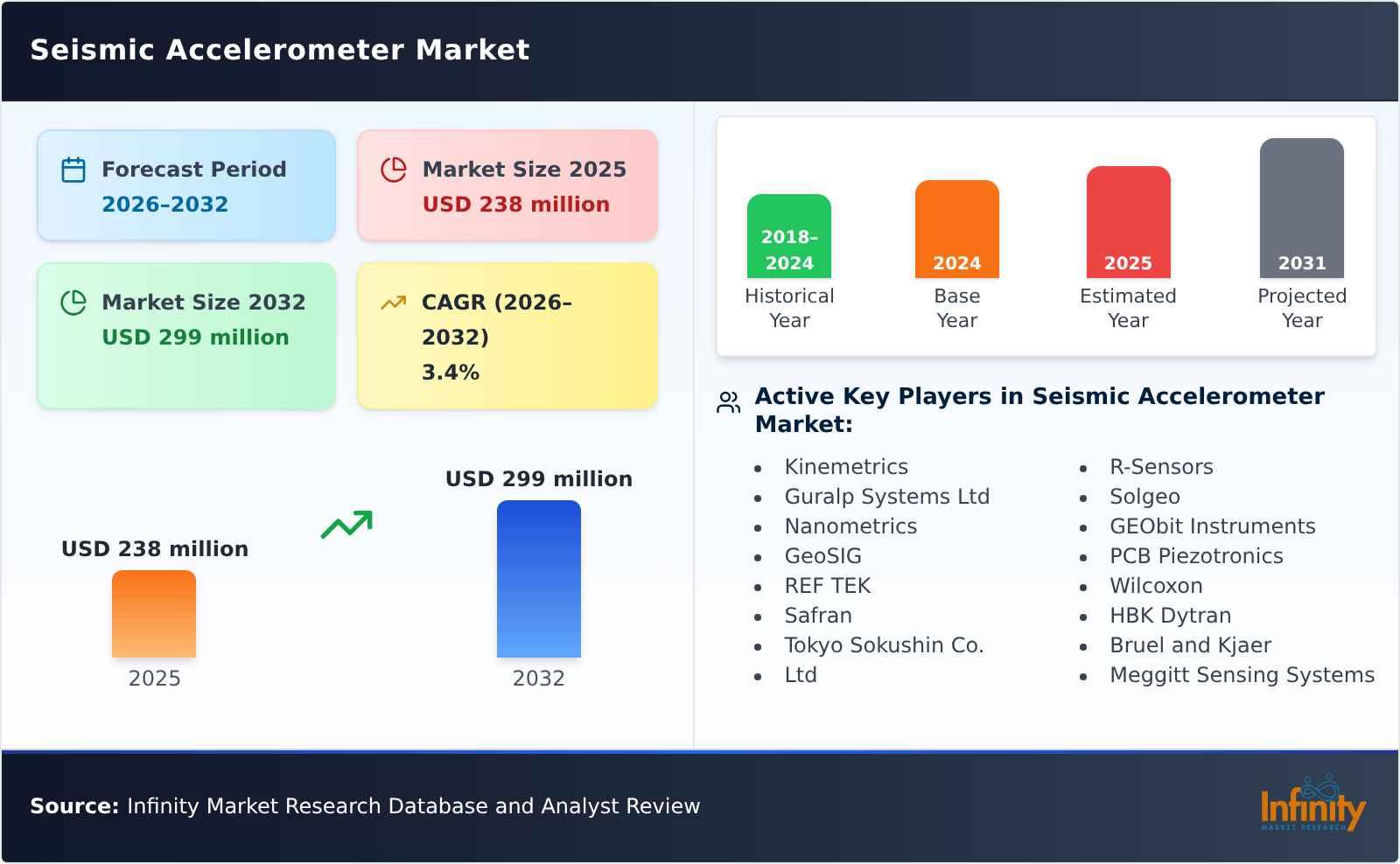
The global Seismic Accelerometer market size is predicted to grow from US$ 238 million in 2025 to US$ 299 million in 2032; it is expected to grow at a CAGR of 3.4% from 2026 to 2032.
Explore this report in detail? Download a free sample copy
Download Free Sample Report
A seismic accelerometer is a vital instrument used to measure the acceleration of ground motion during seismic events. It operates based on different principles such as the piezoelectric effect, capacitance change, or electromagnetic induction. These accelerometers come in various designs. Single - axis ones measure acceleration in a single direction, which is useful when the direction of interest is known. Multi - axis accelerometers can measure in two or three directions simultaneously, providing a more comprehensive view of the seismic motion. Miniaturized accelerometers are compact and lightweight, suitable for applications with space constraints. In terms of applications, they play a crucial role in structural monitoring. Installed in buildings, bridges, and other structures, they help in assessing the response to earthquakes and detecting any signs of damage. They are also integral to earthquake early - warning systems, where they quickly detect the arrival of the P - wave to provide valuable warning time. In geophysical exploration, they work with other instruments to measure the propagation of seismic waves through the earths subsurface, helping to identify geological features and potential resources such as oil and gas. Overall, the seismic accelerometer is an indispensable tool for earthquake - related studies and safety - related applications. In 2025, global production of seismic accelerometers reached 105,704 units, with an average selling price of USD 2,300 per unit.
Seismic accelerometers are high-sensitivity sensors used to accurately record earthquake ground motion and engineering vibration acceleration responses. Market demand is characterized by high reliability requirements, strong dependence on calibration, fragmented SKUs, and project-driven purchasing cycles. End users typically prioritize life-cycle data quality, long-term zero stability, low noise density, and system compatibility, rather than competing purely on form factor or channel pricing. As infrastructure monitoring becomes increasingly digital and sensor networks become denser, adoption continues to expand across multiple vibration-measurement use cases, and competition is evolving from single-point hardware delivery toward high-reliability sensing plus maintainable delivery systems.
From a technology-route perspective, mainstream products can be grouped into two mutually exclusive categories: Force-Balance Accelerometers (FBA) and MEMS accelerometers, which are clearly reflected in most suppliers product portfolios. FBA products rely on closed-loop force-rebalance architectures, offering advantages in dynamic range, noise floor, linearity, and long-term stability, and are commonly selected for high-precision, specification-driven deployments. MEMS solutions, enabled by silicon microfabrication platforms, provide lower cost, smaller size, and lower power consumption; in recent years, improvements in packaging stress control, temperature-drift compensation algorithms, and calibration consistency have significantly strengthened reliability and maintainability for dense deployments and volume deliveries, narrowing the performance gap versus high-end routes in many engineering scenarios.
Key parameters remain the primary basis for product differentiation across suppliers catalogs, including low-frequency response capability, noise density, dynamic range, selectable full-scale ranges, temperature-drift compensation performance, linearity, and packaging stress control. Within this framework, capacitive designs are the most common transduction mechanism in MEMS portfolios, piezoresistive designs are more frequently used in high-range and harsh-environment scenarios, while piezoelectric designs retain advantages in mid-frequency vibration measurement; however, for true near-DC/ultra-low-frequency high-accuracy measurements, piezoelectric approaches are typically less competitive than the other routes. As a result, catalog competition increasingly centers on parameter consistency and verifiable long-term stability rather than pure low-price positioning.
On the manufacturing side, capacity is constrained primarily by assembly throughput, temperature-compensation calibration, the availability of parallel calibration fixtures, and the cycle time of reliability screening/aging testsrather than by front-end sensing-element fabrication alone. Typical single-line annual capacity, measured on a finished-goods delivery basis, is 3,00012,000 units for MEMS products and 3001,500 units for precision FBA lines. Most suppliers capable of scaled deliveries meet project and tender requirements by replicating multiple parallel finished-goods lines and calibration fixtures, rather than by relying on a single line expansion. Overall line takt time and supply capabilities are relatively stable, while capacity replication for higher-grade models tends to be more conservative.
In terms of profitability, the industrys average ex-factory gross margin is 30%45% (midpoint 37%). Closed-loop FBA products typically command structural premiums under higher reliability grades and stricter parameter consistency requirements, though their capacity expansion cadence is generally cautious. MEMS routes benefit from faster line replication and lower changeover costs, supporting more competitive delivery performance while maintaining stable margins. Looking ahead, development trends will continue to focus on lower noise, wider selectable full-scale ranges, stronger temperature-drift compensation, triaxial integration, and improved maintainability for field deployment. Suppliers with advantages in core sensing elements, closed-loop magnetic circuits, low-stress packaging, and robust calibration systems are expected to be best positioned as high-reliability sensing networks deepen and volume delivery becomes more prevalent.
Infinity Market Research newest research report, the Seismic Accelerometer Industry Forecast looks at past sales and reviews total world Seismic Accelerometer sales in 2025, providing a comprehensive analysis by region and market sector of projected Seismic Accelerometer sales for 2026 through 2032. With Seismic Accelerometer sales broken down by region, market sector and sub-sector, this report provides a detailed analysis in US$ millions of the world Seismic Accelerometer industry.
This Insight Report provides a comprehensive analysis of the global Seismic Accelerometer landscape and highlights key trends related to product segmentation, company formation, revenue, and market share, latest development, and M&A activity. This report also analyzes the strategies of leading global companies with a focus on Seismic Accelerometer portfolios and capabilities, market entry strategies, market positions, and geographic footprints, to better understand these firms unique position in an accelerating global Seismic Accelerometer market.
This Insight Report evaluates the key market trends, drivers, and affecting factors shaping the global outlook for Seismic Accelerometer and breaks down the forecast by Type, by Application, geography, and market size to highlight emerging pockets of opportunity. With a transparent methodology based on hundreds of bottom-up qualitative and quantitative market inputs, this study forecast offers a highly nuanced view of the current state and future trajectory in the global Seismic Accelerometer.
This report presents a comprehensive overview, market shares, and growth opportunities of Seismic Accelerometer market by product type, application, key manufacturers and key regions and countries.
Segmentation by Type:
Piezoelectric Accelerometer Sensors
Piezoresistive Accelerometer Sensors
Capacitive Sensors
Segmentation by Technology:
Force-Balance Accelerometer
MEMS Accelerometer
Segmentation by Sales Channel:
Direct Sales
Distribution
Segmentation by Application:
Industrial Monitoring
Structural Health Monitoring
Seismic Early Warning
Others
This report also splits the market by region:
Americas
United States
Canada
Mexico
Brazil
APAC
China
Japan
Korea
Southeast Asia
India
Australia
Europe
Germany
France
UK
Italy
Russia
Middle East & Africa
Egypt
South Africa
Israel
Turkey
GCC Countries
The below companies that are profiled have been selected based on inputs gathered from primary experts and analysing the companys coverage, product portfolio, its market penetration.
Kinemetrics
Guralp Systems Ltd
Nanometrics
GeoSIG
REF TEK
Safran
Tokyo Sokushin Co., Ltd
R-Sensors
Solgeo
GEObit Instruments
PCB Piezotronics
Wilcoxon
HBK Dytran
Bruel and Kjaer
Meggitt Sensing Systems
Metrix Instrument
DJB Instruments
Columbia Research Laboratories?Inc.
IMV Corporation
Honeywell
Gangzhen Instrument & Equipment
Key Questions Addressed in this Report
What is the 10-year outlook for the global Seismic Accelerometer market?
What factors are driving Seismic Accelerometer market growth, globally and by region?
Which technologies are poised for the fastest growth by market and region?
How do Seismic Accelerometer market opportunities vary by end market size?
How does Seismic Accelerometer break out by Type, by Application?
Seismic Accelerometer Market Scope
| Report Attribute | Details |
|---|---|
| Market Size (Start Year) | USD XX Million |
| Market Size (End Year) | USD XX Million |
| Compound Annual Growth Rate (CAGR) | USD XX Million |
| Forecast Period | USD XX Million |
| Base Year | USD XX Million |
| Historical Data | USD XX Million |
| Key Players | USD XX Million |
REPORT COVERAGE
Revenue forecast, Company Analysis, Industry landscape, Growth factors, and Trends
SEGMENT COVERED
By component, deployment, organization size, application, and industry.
REGIONAL SCOPE
North America, Europe, Asia Pacific, Middle East & Africa, South & Central America
COUNTRY SCOPE
Includes key countries across all major regions.
Frequently Asked Questions
1. What is the market size of Global Seismic Accelerometer Market?
Answer: The global Seismic Accelerometer market size is predicted to grow from US$ 238 million in 2025 to US$ 299 million in 2032; it is expected to grow at a CAGR of 3.4% from 2026 to 2032.
2. Which regions are analyzed in the Global Seismic Accelerometer Market report?
Answer: The Global Seismic Accelerometer Market report covers major regions such as Europe, Middle East & Africa. Each region is analyzed for trends, opportunities, and market dynamics.
3. What methodology is used for forecasting of Global Seismic Accelerometer Market?
Answer: The Global Seismic Accelerometer Market report uses a mix of primary research, secondary data, and expert analysis.
4. Are emerging markets analyzed separately in the Global Seismic Accelerometer Market?
Answer: Yes, the Global Seismic Accelerometer Market report highlights high-growth emerging regions with dedicated insights.
5. Does the report include competitive benchmarking of Global Seismic Accelerometer Market?
Answer: Yes, Global Seismic Accelerometer Market report compares major players based on revenue, product portfolio, and innovation.
6. Can I access country-level data within the Global Seismic Accelerometer Market report?
Answer: Yes, Global Seismic Accelerometer Market report includes detailed data by country for major regions.
7. Can I get customized insights or data from the Global Seismic Accelerometer Market report?
Answer: Yes, we offer customization options to align with your specific business needs. You can request tailored sections or regional breakdowns.