


Global Self-healing Microcapsule System Market Size, Share and Analysis Report 2026-2032
Mar 2026
Chemicals and Materials
Pages: 81
ILR4677
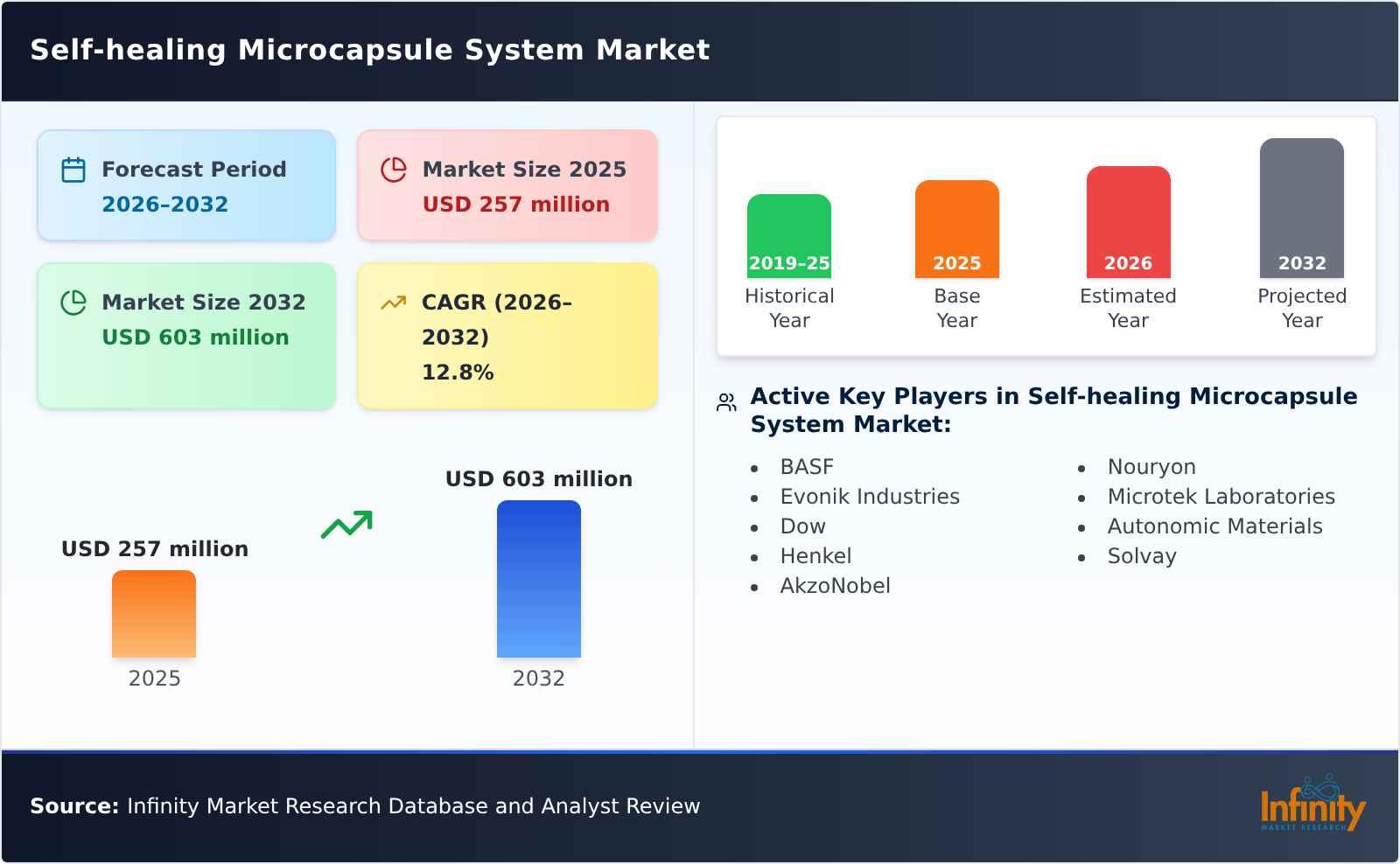
The global Self-healing Microcapsule System market size is predicted to grow from US$ 257 million in 2025 to US$ 603 million in 2032; it is expected to grow at a CAGR of 12.8% from 2026 to 2032.
Explore this report in detail? Download a free sample copy
Download Free Sample Report
A Self-Healing Microcapsule System is a materials-engineering platform that encapsulates functional agents?such as healing monomers, curing agents, catalysts, corrosion inhibitors, or lubricants?within micron-scale shells, enabling on-demand release and in-situ reaction triggered by stress, crack propagation, or environmental stimuli. When microcracks form in coatings, composites, adhesives, or cementitious matrices, microcapsules rupture near crack tips or allow controlled diffusion, releasing healing agents that polymerize, crosslink, or precipitate to bridge and seal cracks, restoring barrier properties and mechanical integrity. The system can be extended to multifunctional designs (anti-corrosion, lubrication, flame retardancy), delivering engineering value through life extension, reduced maintenance, and improved reliability. Key success factors include shell strength and trigger-threshold tuning, matched reaction kinetics of core components, dispersion/compatibility with the matrix, and long-term storage stability.The average gross profit margin of this product is 25%.
Commercial momentum is driven by a shift toward reliability and total life-cycle cost optimization. Industries and infrastructure owners increasingly prioritize long-term operation with minimal downtime, pushing materials from passive protection to active self-repair. Microcracks are often the starting point of failure; microcapsules embed scalable healing mechanisms that restore anti-corrosion, sealing, and wear-resistance performance at early damage stages?extending service life and reducing maintenance frequency. Higher requirements for consistency, lightweighting, and extreme-condition robustness, together with ?life extension over replacement? under low-carbon agendas, support adoption across automotive, wind energy, marine engineering, rail transit, and electronic encapsulation. Modular microcapsule platforms also provide material suppliers with a clear path to differentiated product upgrades and system-level solutions.Key hurdles lie in balancing controllable triggering, reaction kinetics, and long-term stability. Overly brittle shells may rupture during processing or logistics, while overly tough shells may fail to release at crack initiation. Core reactions that are too fast can cause localized brittleness or exotherm risks; reactions that are too slow may not deliver timely repair. Adding microcapsules can alter viscosity, film formation, and mechanical properties, narrowing the process window and increasing formulation iteration costs. Application requirements vary widely (temperature, humidity, chemicals, UV), and insufficient durability validation can lead to ?early effectiveness, later decay.? Supply-chain concerns include lot consistency, residual solvent/odor control, environmental compliance, and safety management for reactive chemicals. Commercially, customers often demand quantified life extension and maintenance ROI, which lengthens sales cycles and raises validation costs.Demand is shifting from single-function self-healing toward multifunctional integration?e.g., corrosion-inhibitor release in protective coatings, lubricant micro-release in wear-resistant layers, and moisture-barrier strategies in electronic packaging?to address complex reliability challenges. End users favor engineering-ready solutions: compatibility with mainstream matrices (epoxy, PU, acrylic, silicone, cementitious), ?plug-and-play? adoption as additive masterbatches, and stable performance across spraying, dipping, roll coating, injection molding, and composite processes (RTM/prepreg). Procurement increasingly rewards suppliers that provide integrated support covering materials, processing guidance, and validation packages. In downtime-sensitive scenarios such as wind blades, offshore structures, bridges/tunnels, energy storage, and rail, the value proposition is evolving from ?material innovation? to ?maintenance insurance,? emphasizing predictability and repeatability.Upstream materials fall into shell materials, core payloads, and trigger/reaction components. Shell options include UF/MF resins, polyurethane/polyurea, epoxy-modified shells, siloxane-based shells, and inorganic?organic hybrids, with priorities on tunable strength, chemical resistance, and dispersibility. Core payloads range from epoxy/isocyanate healing agents to acrylic/olefin monomers, drying oils/modified resins, solvent or solvent-free healing liquids, plus functional loads such as corrosion inhibitors and lubricants. Trigger/reaction components?curing agents, catalysts, initiators, and controlled-release media?define healing speed and final network quality. Competition centers on wall thickness and particle-size distribution control, encapsulation efficiency and leakage rate, payload purity and storage stability, and compatibility solutions tailored to different matrices. As environmental and safety requirements tighten, low-VOC, low-free-formaldehyde, sustainable shell routes and waterborne dispersions will become key upgrade directions, widening the technical gap between leading suppliers and commodity producers.
LPI (LP Information) newest research report, the ?Self-healing Microcapsule System Industry Forecast? looks at past sales and reviews total world Self-healing Microcapsule System sales in 2025, providing a comprehensive analysis by region and market sector of projected Self-healing Microcapsule System sales for 2026 through 2032. With Self-healing Microcapsule System sales broken down by region, market sector and sub-sector, this report provides a detailed analysis in US$ millions of the world Self-healing Microcapsule System industry.
This Insight Report provides a comprehensive analysis of the global Self-healing Microcapsule System landscape and highlights key trends related to product segmentation, company formation, revenue, and market share, latest development, and M&A activity. This report also analyses the strategies of leading global companies with a focus on Self-healing Microcapsule System portfolios and capabilities, market entry strategies, market positions, and geographic footprints, to better understand these firms? unique position in an accelerating global Self-healing Microcapsule System market.
This Insight Report evaluates the key market trends, drivers, and affecting factors shaping the global outlook for Self-healing Microcapsule System and breaks down the forecast by Type, by Application, geography, and market size to highlight emerging pockets of opportunity. With a transparent methodology based on hundreds of bottom-up qualitative and quantitative market inputs, this study forecast offers a highly nuanced view of the current state and future trajectory in the global Self-healing Microcapsule System.
This report presents a comprehensive overview, market shares, and growth opportunities of Self-healing Microcapsule System market by product type, application, key players and key regions and countries.
Segmentation by Type:
Polymerization-Based Microcapsules
Corrosion-Inhibitor Release Capsules
Solvent/Plasticizer Release Capsules
Multi-Capsule Hybrid Systems
Segmentation by Healing Chemistry:
One-Component Polymerization
Two-Part Curing
Other
Segmentation by Shell Material:
UF/MF Resin Shells
Polyurea/PU Shells
Gelatin/Biopolymer Shells
Silica/Inorganic Shells
Others
Segmentation by Application:
Aerospace & Defense
Automotive
Marine/Offshore
Construction
Electronics
This report also splits the market by region:
Americas
United States
Canada
Mexico
Brazil
APAC
China
Japan
Korea
Southeast Asia
India
Australia
Europe
Germany
France
UK
Italy
Russia
Middle East & Africa
Egypt
South Africa
Israel
Turkey
GCC Countries
The below companies that are profiled have been selected based on inputs gathered from primary experts and analyzing the companys coverage, product portfolio, its market penetration.
BASF
Evonik Industries
3M
Dow
Henkel
AkzoNobel
Nouryon
Microtek Laboratories
Autonomic Materials
Solvay
Self-healing Microcapsule System Market Scope
| Report Attribute | Details |
|---|---|
| Market Size (Start Year) | USD XX Million |
| Market Size (End Year) | USD XX Million |
| Compound Annual Growth Rate (CAGR) | USD XX Million |
| Forecast Period | USD XX Million |
| Base Year | USD XX Million |
| Historical Data | USD XX Million |
| Key Players | USD XX Million |
REPORT COVERAGE
Revenue forecast, Company Analysis, Industry landscape, Growth factors, and Trends
SEGMENT COVERED
By component, deployment, organization size, application, and industry.
REGIONAL SCOPE
North America, Europe, Asia Pacific, Middle East & Africa, South & Central America
COUNTRY SCOPE
Includes key countries across all major regions.
Frequently Asked Questions
1. What is the market size of Global Self-healing Microcapsule System Market?
Answer: The global Self-healing Microcapsule System market size is predicted to grow from US$ 257 million in 2025 to US$ 603 million in 2032; it is expected to grow at a CAGR of 12.8% from 2026 to 2032.
2. Which regions are analyzed in the Global Self-healing Microcapsule System Market report?
Answer: The Global Self-healing Microcapsule System Market report covers major regions such as Europe, Middle East & Africa. Each region is analyzed for trends, opportunities, and market dynamics.
3. What methodology is used for forecasting of Global Self-healing Microcapsule System Market?
Answer: The Global Self-healing Microcapsule System Market report uses a mix of primary research, secondary data, and expert analysis.
4. Are emerging markets analyzed separately in the Global Self-healing Microcapsule System Market?
Answer: Yes, the Global Self-healing Microcapsule System Market report highlights high-growth emerging regions with dedicated insights.
5. Does the report include competitive benchmarking of Global Self-healing Microcapsule System Market?
Answer: Yes, Global Self-healing Microcapsule System Market report compares major players based on revenue, product portfolio, and innovation.
6. Can I access country-level data within the Global Self-healing Microcapsule System Market report?
Answer: Yes, Global Self-healing Microcapsule System Market report includes detailed data by country for major regions.
7. Can I get customized insights or data from the Global Self-healing Microcapsule System Market report?
Answer: Yes, we offer customization options to align with your specific business needs. You can request tailored sections or regional breakdowns.